Chuan Wang Can't Build a Doctor
Spending money on public welfare — that's greatness.
"Spending money on public welfare? Noble."
"AI products drop daily, foundation models update monthly. Benchmarks and slide decks everywhere, invite codes and agents flying in formation. Yet nobody cares except AI content creators.
And does anyone even remember, before Hangzhou's Six Little Dragons, the previous generation's gods were the AI Six Little Tigers? 😭
Therefore, I hereby declare this week as the Savage Roast Week. Taking down each of the AI Six Little Tigers one by one. Keeping it real.
One piece per day. Today: Baichuan. Tomorrow: 01.AI."
Since falling behind in the foundation model race, Baichuan has been fixated on one grand mission: using large AI models to create expert-level doctors.
Chuan Wang's story goes that by increasing the supply of AI doctors, we can solve the fundamental problem of scarce quality medical resources.
As a former healthcare reporter, I'll say this outright: impossible.
First, we need to understand that a doctor's core function is diagnosis. This is first and foremost a question of authority and accountability, only secondarily a question of capability.
ChatGPT can absolutely handle minor ailments like colds and fevers. But ChatGPT is definitely not a doctor, because it lacks prescription authority and bears no medical liability.
If a so-called AI doctor triggers a medical dispute, who's responsible? Can Baichuan's legal representative take responsibility?
Only when a company is willing to assume full liability for an AI's decisions can that AI be considered a doctor with independent diagnostic qualifications.
Clearly, within the foreseeable future, no company dares to assume such liability.
This is exactly like autonomous driving. Since autonomous driving companies won't take responsibility, their products can only be called "intelligent assisted driving." By the same logic, AI healthcare can only be "AI-assisted diagnosis" — it can never become an independent doctor.
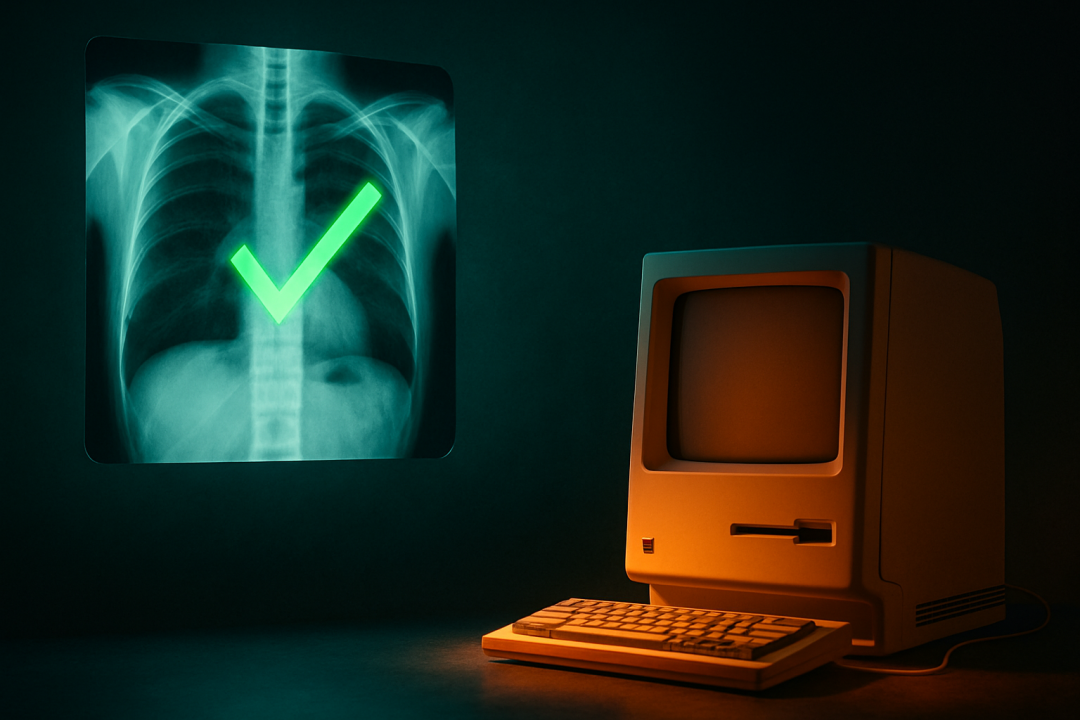
In fact, during the previous AI healthcare boom, AI models built on computer vision had already surpassed the average radiologist in screening tasks like pulmonary nodules and lung cancer.
Yet AI still didn't replace radiologists. Partly because AI still struggles with complex cases. But the more practical reason is that AI companies cannot independently assume liability — only doctors can sign off on diagnoses.
So Chuan Wang can't build a doctor. What he's building is still AI-assisted diagnosis.
Since AI can only assist in diagnosis, Chuan Wang's entire narrative — building doctors, changing pathways, advancing medicine — fundamentally collapses.
And "assisted diagnosis" isn't a new story. During the previous AI healthcare wave, plenty of people tried it. Most died horrible deaths.
The core reason: China doesn't lack assisted diagnosis; it lacks quality medical resources — medical students, residents, and trainees are abundant and cheap. Chief physicians don't need help writing case notes, and hospitals certainly won't purchase assisted diagnosis tools they don't need.
Chuan Wang's story also dodges a central question: whose money are you actually trying to earn?
Baichuan's plan is to charge hospitals in the near term.
This too is nearly impossible. In China, charging hospitals essentially means billing the healthcare insurance administration. But with strict cost controls on medical insurance, earning money from the insurance bureau is extraordinarily difficult.
In 2024, the National Healthcare Security Administration included "AI-assisted diagnosis" in its medical service pricing guidelines for the first time — but only as an "extension item" to primary services, with no separate billing allowed.
Therefore, for at least the next two to three years, Baichuan's probability of making money from hospitals or the insurance bureau through AI-assisted diagnosis is essentially zero.
There are actually precedents here. WeDoctor, the elder statesman of internet healthcare, offers a useful reference.
WeDoctor has filed for IPO on the Hong Kong Stock Exchange multiple times without success. Its prospectus shows cumulative losses of 8.26 billion yuan from 2021 through the first half of 2024.
WeDoctor's main business is AI healthcare, but in reality it's building cost-control systems for insurance bureaus and doing IT upgrades for hospitals. In the first half of 2024, a single client — Tianjin's Healthcare Security Bureau — contributed 56.8% of WeDoctor's total revenue.
The AI healthcare segment accounts for 79% of WeDoctor's revenue but delivers only 4.9% gross margin.
AI healthcare is a terrible business. Sounds high-tech, but it's really just building information systems for insurance bureaus. Heavy operations, low margins, no path to profitability — none of the internet's scale effects whatsoever.
As for charging patients? Even less likely. Haodf.com, which has abundant specialist resources, couldn't make online consultations profitable and had to sell itself to Alipay.
My first job was at a healthcare media outlet. I seriously studied the industry.
To write this piece, I watched most of Chuan Wang's interviews from the past year. After all that, I still don't understand how he's going to do healthcare.
Of course, using AI to improve medical diagnosis is something with genuine social value.
Baichuan's "Futang·Baichuan" AI model, developed in partnership with Beijing Children's Hospital and deployed in Hebei and Xinjiang for AI preliminary screening plus remote review, clearly can improve diagnostic capabilities in remote areas.
But the pioneer of this internet-enabled hierarchical diagnosis and treatment system was Haodf.com. And Haodf's experience proved that creating social value and commercial success are two different things — extremely difficult to achieve simultaneously.
If Chuan Wang is willing to spend money on public welfare, that's certainly praiseworthy.
But Baichuan is a commercial company funded by VC money. It clearly needs to create commercial value. This is an unavoidable contradiction.
There's probably only one solution — Chuan Wang really does pull off a miracle and achieves AGI in medicine, fundamentally transforming the healthcare system.
That would truly be great. Baichuan would deserve a temple of its own.
(Article images generated by ChatGPT o3, writing assisted by Gemini 2.5 Pro.)