"Zang CLI" Launches Lightning-Fast

The World's First Anti-Hype CLI Makes Its Debut

"Funeral AI's First Open-Source Projects" — Funeral AI has open-sourced two projects: one without a frontend, one without a backend.
I hereby report to you all with utmost sincerity that, after days of vibe coding, I have officially launched two mini-program projects.
The first is Funeral AI Web4. Nominally a Web4 project, it's actually a knowledge graph website. Since nobody knows what Web4 is anyway, I might as well just declare it so 🤓
You can access it directly at funeralai.cc.
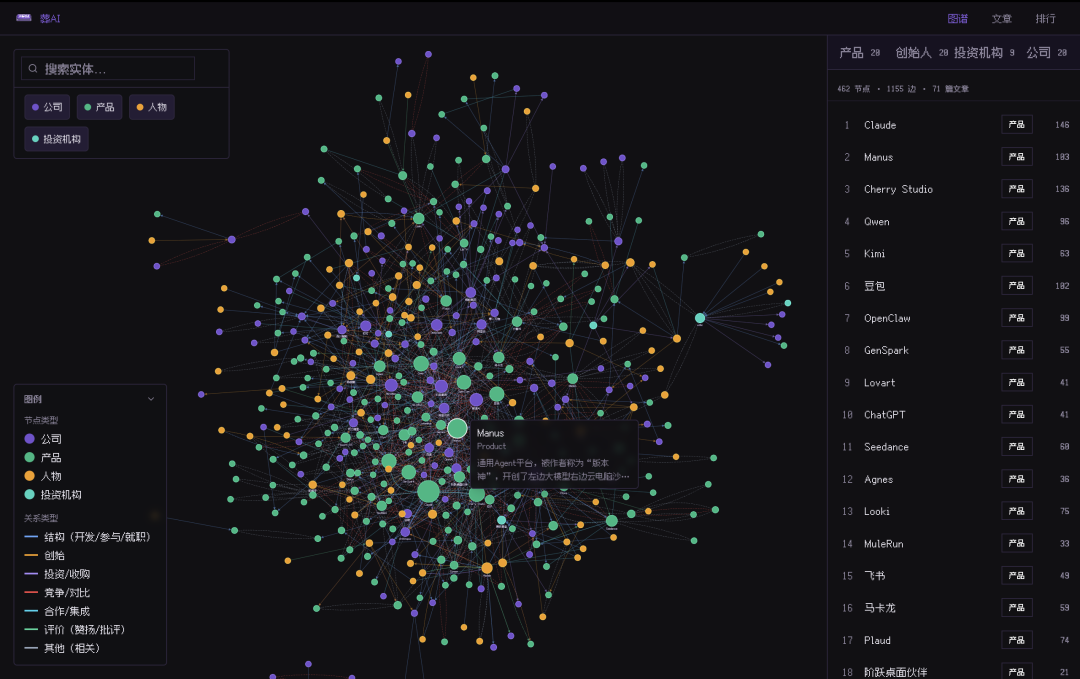
I ran all 70+ articles published by Funeral AI through a knowledge graph pipeline and visualized the results.
Specifically, I extracted entity concepts mentioned in each article as individual nodes, then identified relationships between these nodes. In total, from 71 articles, I extracted 462 nodes and established 1,155 relationships.
For example, Lovart is one of this channel's (Muqiu's) favorites. Click on the Lovart node in the graph, and you'll see its connections to Ant Group, Zhuanzhuan, LibTV, Chen Mian, and others.
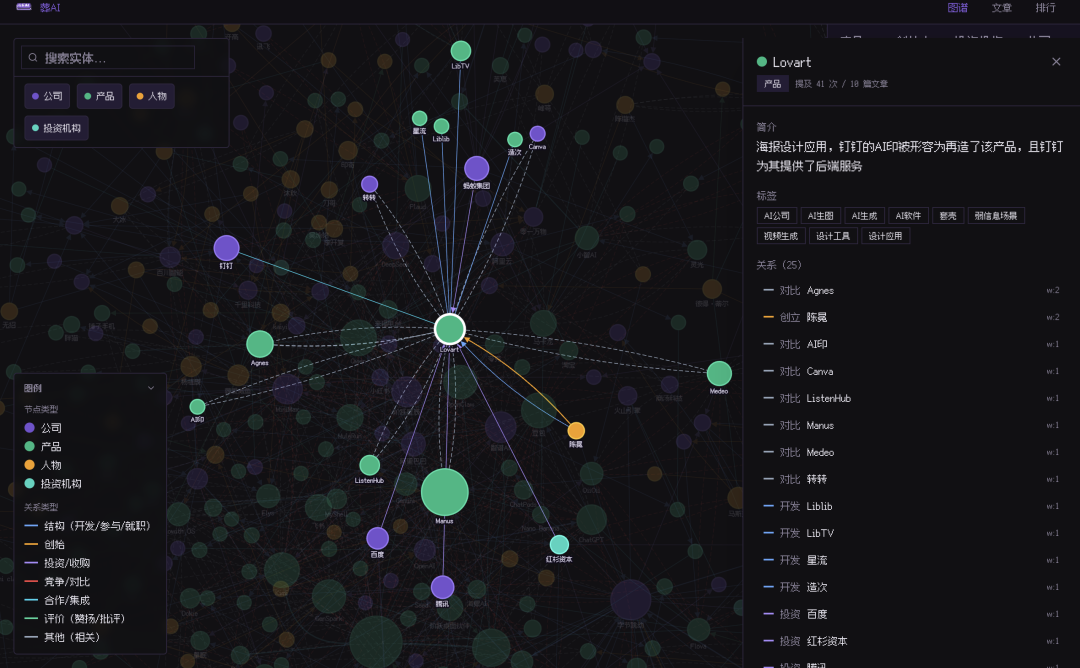
Each node's size is determined by mention frequency and relationship count. Although Muqiu loves Mian dearly, our Fujian compatriot is too lazy, having written about Lovart so infrequently that the related node's weight in Funeral AI Web4 fails to match Mian's江湖地位.
By contrast, Manus — despite only two dedicated articles — ranks extremely high on the product leaderboard, second only to Claude. This is because we kept name-dropping Singaporean companies, essentially using our compatriots as running gags.
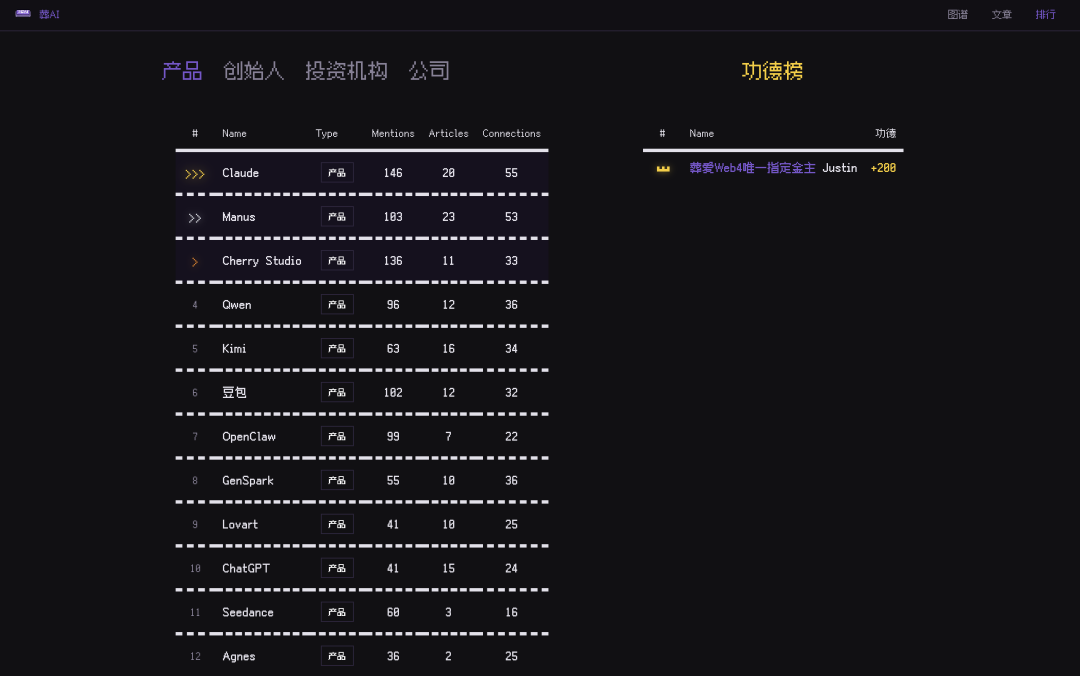
That's right — beyond the graph page with its 462 clickable nodes, I also built a leaderboard page with four categories: products, founders, investment institutions, and companies.
Claude sits uncontested at the top. Lovart's ninth-place finish is deeply regrettable. Cherry Studio ranks as high as third, somehow placing above the great Qwen.
The reasons, beyond my constant use of 🍒 to illustrate the greatness of wrapper products, include our recent video interview with founder Yinsen, in which the product name was mentioned over 100 times... resulting in Yinsen topping the founder leaderboard as well. Even after applying frequency downweighting, the damage was irreversible 😭
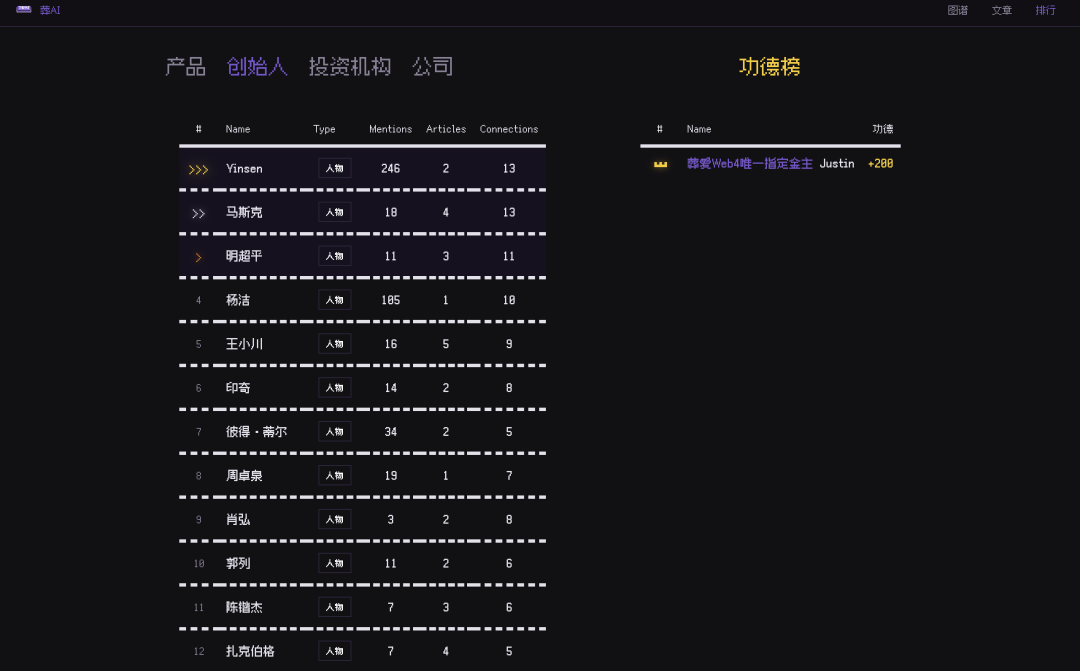
I won't spoil the remaining highlights — check out the site yourselves, folks.
Beyond the four main leaderboards, Funeral AI Web4 also features a special "Merit Board," with thanks to our first sponsor Justin for his RMB 200 contribution. May his merit increase by 200.
A complete collection of Funeral AI's past articles in Markdown format, along with the knowledge graph extraction pipeline, has also been open-sourced on GitHub. Feel free to download, thank you 🍆
The Funeral AI Web4 open-source URL is github.com/FrichXi/funeralai-web4
I've chosen the AGPL-3.0 license — use it however you like, but any project using my code must open-source all of its own code. Meaning, theoretically, you're not allowed to use Funeral AI articles in non-open-source products 🤡
The other beautiful project is Funeral CLI, the world's first anti-hype CLI. My collaborator Mule-Horse suggested naming it the CLI that fires all hype beasts.
Since everyone's chatting about CLI, and Skill can no longer keep pace with the hype, why not just whip up a CLI myself 🤓
The Funeral CLI experience is identical to Claude Code. Run the command below in your terminal to install it; thereafter, simply type funeralai to summon this beautiful Funeral CLI.
curl -fsSL https://raw.githubusercontent.com/FrichXi/funeral-cli/main/install.sh | bash
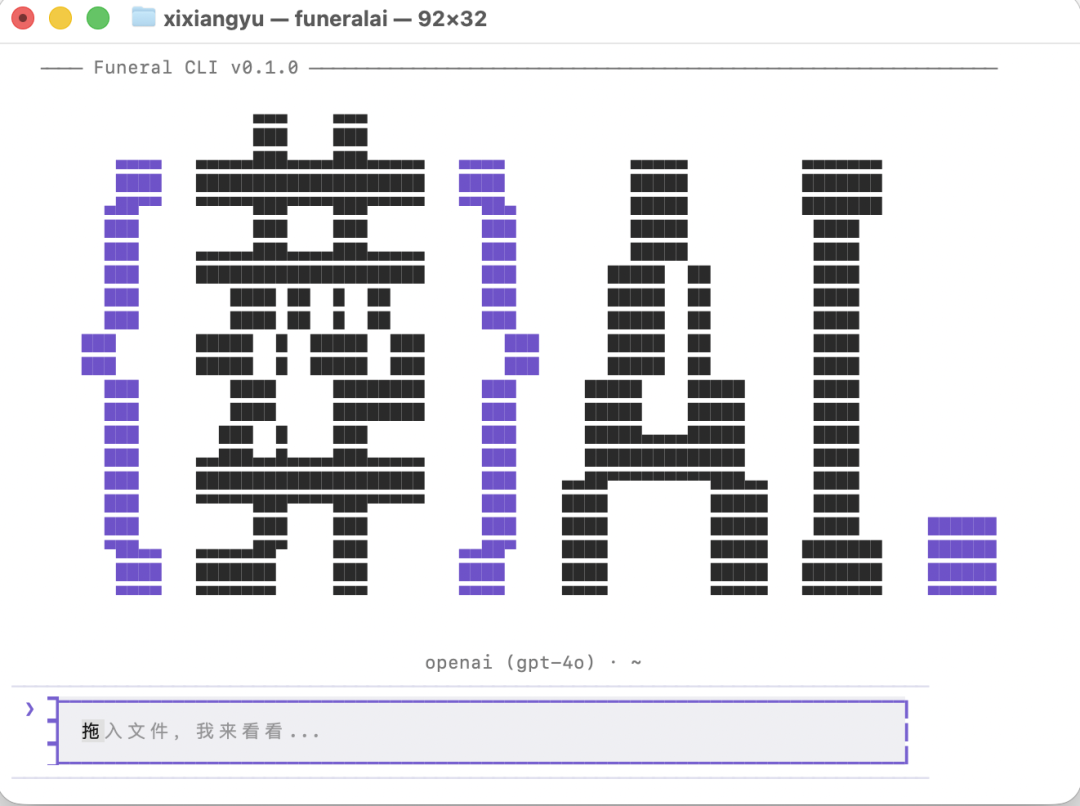
The functionality is refreshingly pure: you input a product description — whether as a news link, PDF, or product website.
Funeral CLI will conduct a serious analysis, breaking it down into four parallel tasks for deep thinking, then generating a report.
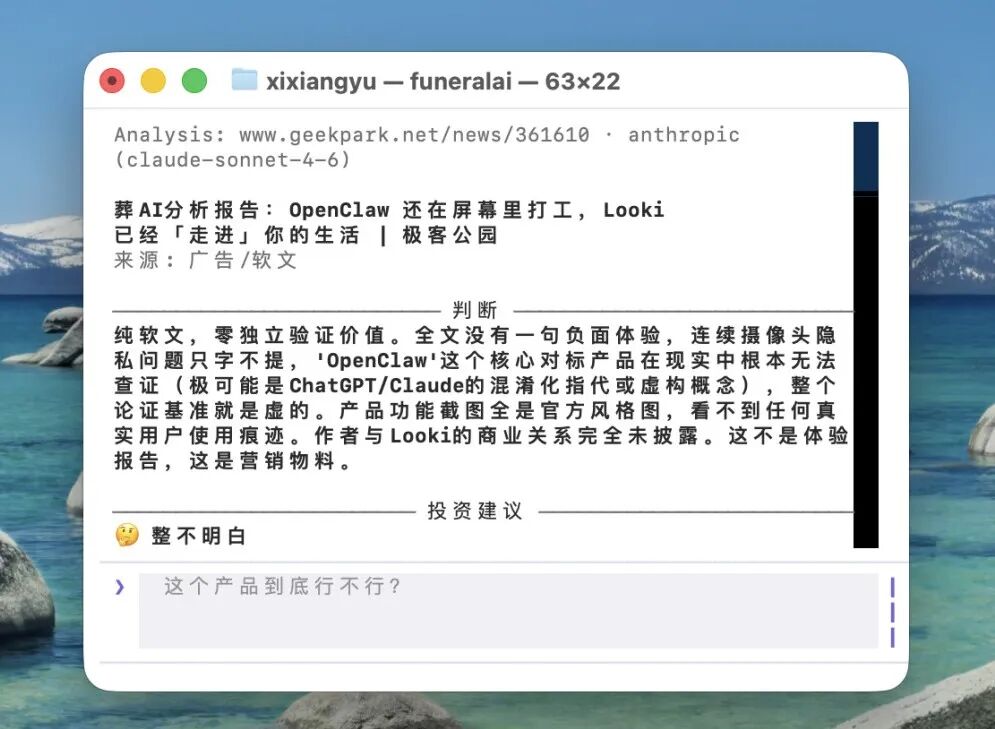
The core of Funeral CLI's analytical framework is whether the product is actually useful. Across our 70+ articles, our central thesis has been: hype is fine, but you need a passable product.
So Funeral CLI strictly extracts product-experience-related facts, compares them against marketing claims, and actively solicits user feedback to gauge the gap between the product itself and its promotional rhetoric.
The final output is an investment recommendation — one of three options: "Actually Solid," "Just Hype," or "Can't Tell," corresponding to positive, negative, and inconclusive judgments respectively.
As my collaborator CC succinctly put it: "Funeral AI breaks product evaluation into a clear pipeline: extract facts → probe experience → parallel judgment → assemble conclusion. The focus isn't predicting the future, but describing the present as truthfully as possible."
For example, I fed it a beloved Looki article. Though I personally support Looki surpassing OpenClaw in hype, Funeral CLI faithfully performed its fact-extraction duty — not only criticizing the article's information gaps but also sharply noting the reporting site's poor technical quality...
Let me excerpt the product experience section of the report:
Product Reality
Looki L1 is a wearable AI device with camera and microphone,主打 active perception + automatic recording. The new version's core selling point is AI autonomously判断 worthy moments to capture and extending recording accordingly. However, this so-called "experience report" comes from [redacted] and contains zero negative feedback throughout; all feature screenshots are in official style; basic information like pricing, privacy mechanisms, and battery life is entirely absent — its independence is highly questionable. The article also uses an unsubstantiated OpenClaw as a comparison baseline, making overall credibility very low and the product's actual performance impossible to assess.
What was actually examined was [redacted]'s reporting page rather than the product itself. The page had 32% resource loading failures, broken homepage links, and no meta description. The media platform's own poor technical quality further undermines content credibility.
The Funeral CLI open-source URL is github.com/FrichXi/funeral-cli
Though honestly, I only put real effort into the analysis layer — first discussing an analytical framework with CC, then running it against Funeral AI's past articles to evaluate whether the framework's judgments aligned with my own instincts. Essentially experienced digital assembly-line work, manual labeling and all.
Here I must thank Opencode and the great open-source community for birthing such a beautiful, magnificent CLI product. I had CC and Codex — the former mainly executing, the latter reviewing plans and debugging — collaborate to copy Opencode's CLI shell 🥵
Of course, Funeral CLI is entirely for laughs. At its core it's a prompt collection, packaged as CLI merely to respond to everyone's enthusiasm for learning.
For convenient access, I've also packaged Funeral CLI's analytical framework as a Skill version. You can directly hand it to coding agents, have them install it as a Skill, and invoke it at will during regular conversations.
The Funeral AI Analysis Skill open-source URL is github.com/FrichXi/funeralai
Finally, some broader reflections.
My intuitive feeling is: fellow mid-to-senior tech workers, AI has completely taken over your lives and entertainment.
At work, everyone uses Lobster to transcribe leadership speeches. After work, you're still vibe coding. Open your feed and it's nothing but AI hype bombardment.
This is a terrible situation, friends.
Since vibe coding went viral, all my casual chat groups — political debates, gossip sessions, flame wars — have started hand-crafting mini-programs. Multiple times I've seen WeChat @ notifications thinking there's juicy gossip, only to find some dude showing off his latest hand-crafted thing.
Vibe coding truly is a scourge 😭😭😭
What's been making me feel deeply uncomfortable these past few days is how quickly consensus forms now.
Any flashy buzzword emerges, and within days everyone's hyping it — furiously hyping — writing obituaries, aka the "X is dead, Fat Cat lives forever" cycle.
In just this short month or two, the hype wave has cycled through Skill, OpenClaw, and now CLI, with assorted bizarre concepts like Harness sprinkled throughout. Comrades are already declaring you shouldn't invest in GUI-thinking products, with narratives extending all the way to CLI being the terminal form usable by both humans and AI.
It's the full pipeline from coining new terms to converting them into AI slop, experienced in fast-forward.
But flip it around: if you'd disconnected for the past two months and just came back online, would you have missed anything?
No.
I genuinely spent some time crafting a CLI, a Skill, building a knowledge graph website, and open-sourcing these code repositories to GitHub.
Throughout this process, the tools and services I used were: terminal, Claude Code, Codex, Gemini, Cloudflare, PyPI, GitHub, and various open-source projects above. Meanwhile, I spent the vast majority of my time chatting and surfing on WeChat and Zhihu.
AI has brought decisive change, enabling me to do some programming work. But the change AI brings isn't that violent or rapid.
I do believe coding agents are the most important AI product, but for most white-collar workers, starting a few months earlier or later makes little difference. A mad rush to get ahead only leads to everyone passing off human work as AI-generated, mutually deceiving each other.
Big companies chase metrics, model vendors sell tokens — those inside the machine all have reasons they must hype. But you, my friend, do you really need to study AI daily, trying to grasp every fresh buzzword?
Don't panic.
(This article's cover image was generated by ChatGPT; the writing is purely human.)
Also, a final plug for our Beijing offline event this Friday evening, featuring a hardware product launch on-site. Scan to register — invites going out to registered attendees this afternoon, deadline tonight at 8pm.