Head AI reminds me of Miraculous Department Store.

"Swallows return to familiar haunts" — or more fully, "Swallows return, as if from times gone by." This is a line from the Song dynasty poet Yan Shu's *Washing Creek Sand* (*浣溪沙*), expressing a bittersweet sense of recognition and the cyclical return of things past, tinged with the melancholy that what returns is never quite the same.

"Swallows return to familiar eaves"
With a mix of curiosity and reverence, I took Head AI for a spin.
This legendary product — billed as "the world's first AI Marketer," boasting "$2.5M ARR in 14 days" (quick math: 250 × 14 / 365 = ?), and promising to "eliminate every marketing department on Earth" — what's it actually like?
My verdict: a basic cold email blast tool. And a pretty crude one, even by hype-product standards.
What I admire most about the Head AI team is their audacity. Of all domains to bullshit in, they picked KOL marketing — one of the fastest-to-falsify fields out there.
Here's what Head AI does in one sentence: it scrapes info from your uploaded website, searches for influencers on YouTube, Instagram, and other platforms, then mass-blasts them with offer emails.
How do influencers respond?
Reddit is flooded with creators calling Head AI a scam.
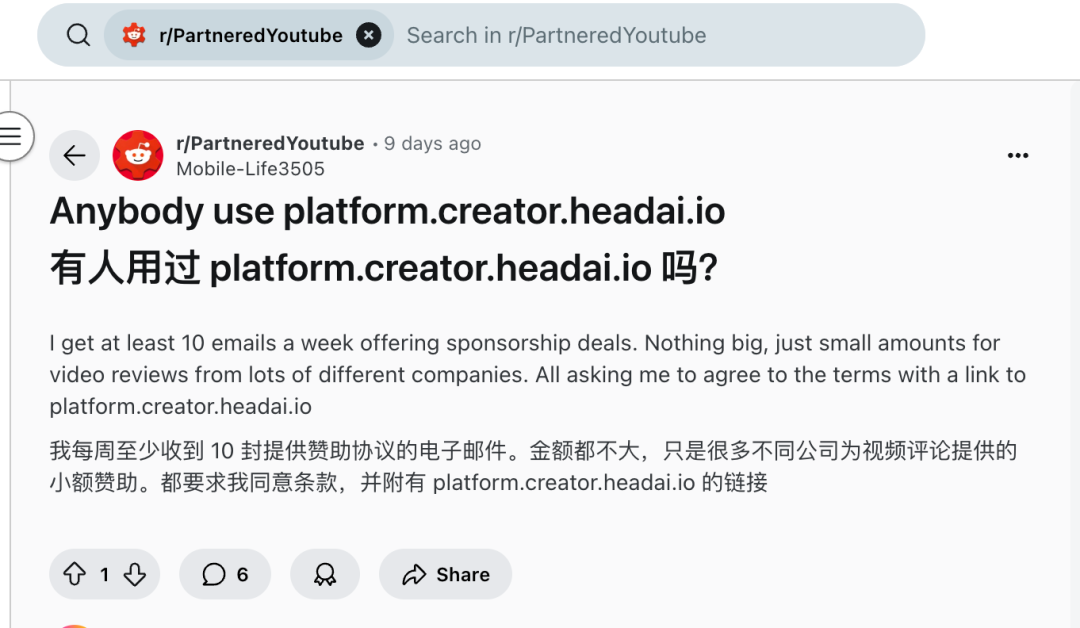
Search "Head AI" in the PartneredYouTube subreddit and you'll find seven posts. The most recent one, from nine days ago: a creator says he gets ten emails a week from them. Six of the seven comments call it a scam. One commenter says they made a video as requested but never got paid...
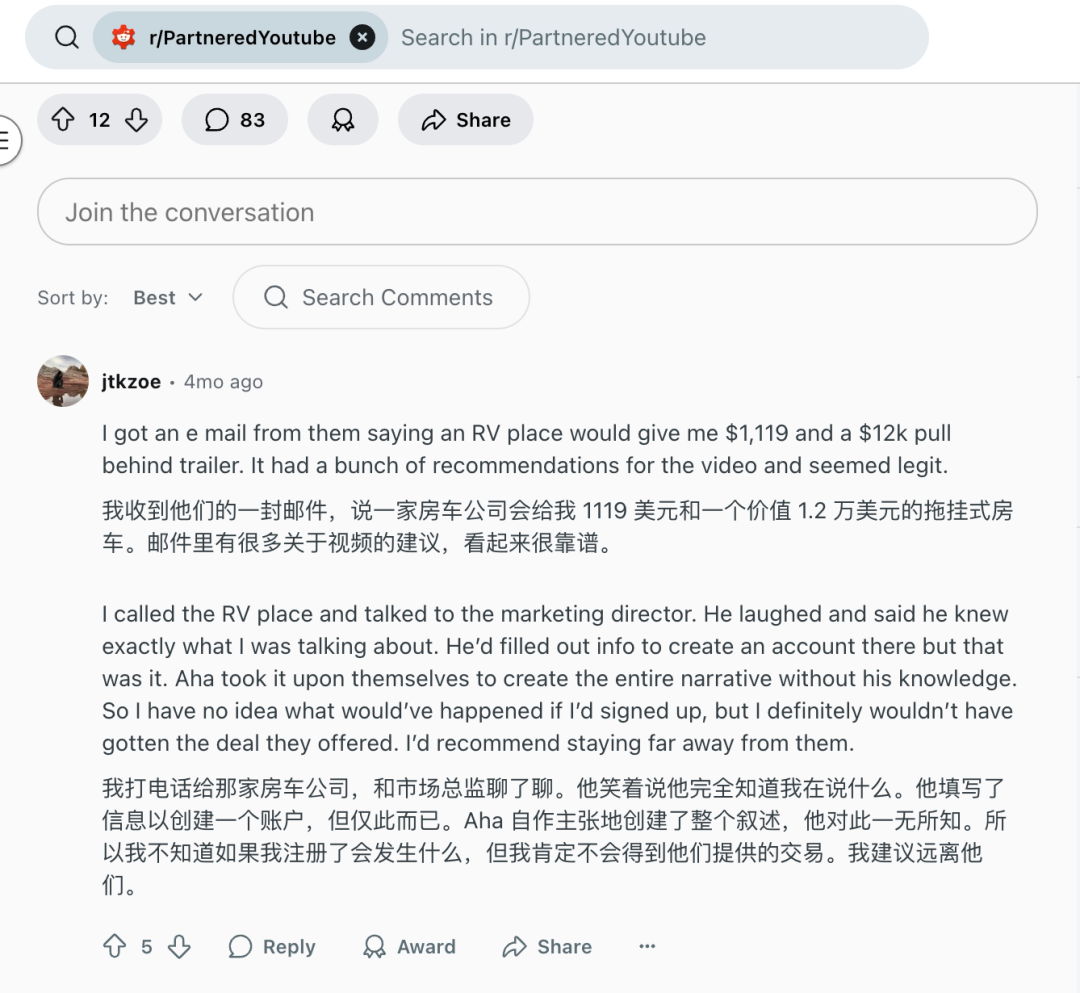
The earliest post dates back four months, with 83 comments.
At the time, Head AI was still called Aha Creator. The top comment: the creator received an email claiming an RV company would pay them $1,119 plus a $12,000 RV. They called the RV company directly. The company said they'd merely created an account — Aha had sent the email unilaterally.
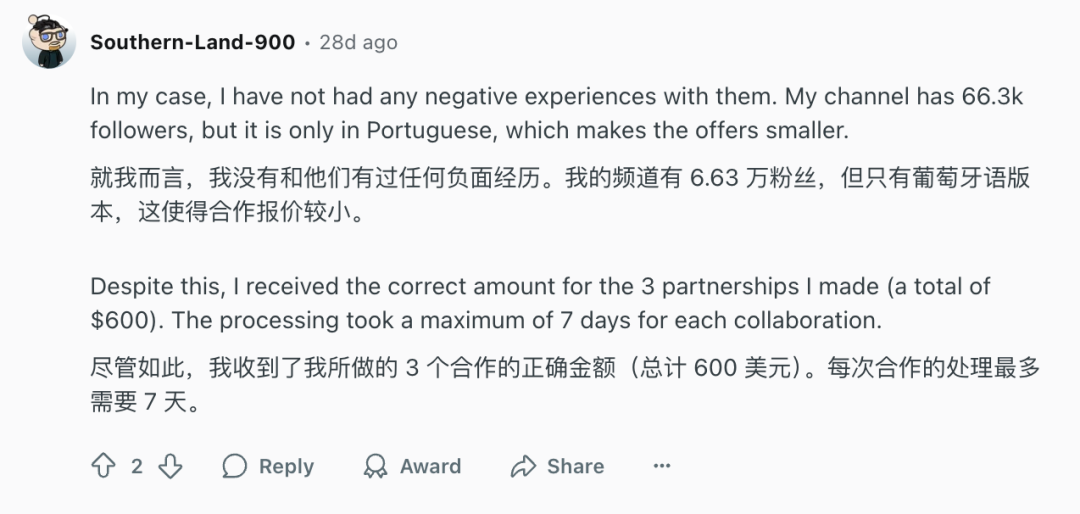
That said, Reddit isn't all negative. After some digging, I did find a few comments from people saying they actually got paid. But these scattered好评 are completely drowned out by the "scam" chorus.
I believe what Head AI is trying to do has value. Matching creators accurately and reaching them efficiently — these are engineering problems, solvable through iteration.
I don't believe Head AI can actually pull it off.
Marketing isn't crypto. Agency work is trust-intensive. Brands and creators both need to feel you're professional, credible. Yet Head AI's entire posture screams the opposite: hype-drenched rhetoric, ARR projections at day fourteen, promises to destroy all marketing departments, while creator reviews are in the gutter. How do you build a trust-based business like this? What can I say, friends 😭
From the moment it appeared, Head AI gave me déjà vu. The playbook is identical to the wave of post-95 CEOs from the 2015 mobile internet boom.
The most famous: Wang Kaixin of Magic Department Store. She was seventeen then, and her story had the same flavor as today's Head AI founder.
The script is nearly identical.
Step one: tell a "first bucket of gold" origin story. Back then: "I made tens of thousands in middle school doing e-commerce." Now: "I made money in high school through Web3." Unverifiable, yet vaguely impressive.
Step two: inflate a small business into a grand platform. Magic Department Store, at its core, was moving Taobao inventory to QQ Space — a Taobao dropshipping operation. Head AI, at its core, connects you with social media creators — a campaign management tool.
Step three: make the founder the product. What's emphasized isn't product logic but founder labels. Hard to say which combo packs more punch: "post-95, middle school dropout" or "post-00, high school dropout."
Hype products aren't worth debating in themselves. The real question: why do VCs keep funding them?
I can only explain it this way: VCs investing in Head AI are essentially buying advertising. Just like the Wang Kaixin story.
By backing these hype merchants, VCs broadcast to all founders: "We decide fast, we're bold, we don't play by the rules — if your story is sexy enough, we'll write the check (dumb, rich, come quick)."
Just as ZhenFund backed Wang Kaixin, Sequoia Capital backed Ma Jiajia, IDG backed Justin Sun, and a16z backed Cluely...
For domestic hype merchants, a VC might put in a few million RMB at most. Compared to a16z's $15 million for Cluely — pure hype, zero substance — that's practically a bargain.
And here's the thing: a top WeChat article slot on 36Kr runs several hundred thousand RMB. Instead of burning cash on sponsored content that nobody remembers, why not invest in a hype merchant and guarantee your firm's name stays plastered across the startup (or circus) headlines?
I genuinely miss 2015, when Justin Sun and Ma Jiajia first burst onto the scene.
Back then, the stunts were transparent. Sex toy e-commerce. Paid voice chat with strangers. The masses would see it and share a knowing smile.
Then everything changed. Blockchain, Web3, AI... Now when young people pull a stunt, it's concept wrapped in concept. I have to read for half an hour before I understand what bro/sis is even saying. We'll never return to those innocent days 😭
When Sun was around, we hardly noticed anything special. Since he left, no one can compare 😭
(Article illustrations generated by ChatGPT o3, with writing assistance from Gemini 2.5 Pro.)