I Declare the United States Chip Act a Worthless Piece of Paper

Abandon your illusions

"Abandon all illusions." The Jensen Huang crotch controversy became the trigger for a new round of American AI sanctions, and the Southeast Asian compute leasing that everyone had long known about in private is now being dragged into the open.
With the new US chip control rules issued on November 16, these overseas compute leasing arrangements have been completely shut down. It's easy to imagine that Southeast Asian countries will comply with US long-arm jurisdiction, effectively making these compute centers unusable.
In light of this, Funeral AI invited a lawyer friend who specializes in US export controls to write an article interpreting the new rules — from what I can see, there isn't much to interpret; it's sanctions on everything, restrictions on everything — and the lawyer friend also offered concrete advice:
Sanctioning everything means sanctioning nothing; restricting everything means restricting nothing. I recommend immediately shipping this batch of compute chips back into the country.
Because: "There is no longer any necessity to comply with US export controls. Since BIS (the Bureau of Industry and Security at the US Department of Commerce) has torn off all pretense, we must enter a state of confrontation — and complying with Chinese regulations is the most sufficient form of compliance."
Below, please enjoy this pragmatic interpretation from our lawyer friend:
I am an international lawyer who cannot disclose my identity. Having read the new US chip control rules, I want to say something today that goes against American interests and against my own colleagues — at the risk of offending them. At the same time, I want to give domestic large-model companies a heads-up:
Abandon your illusions early and give up on complying with US rules — that's the only right path.
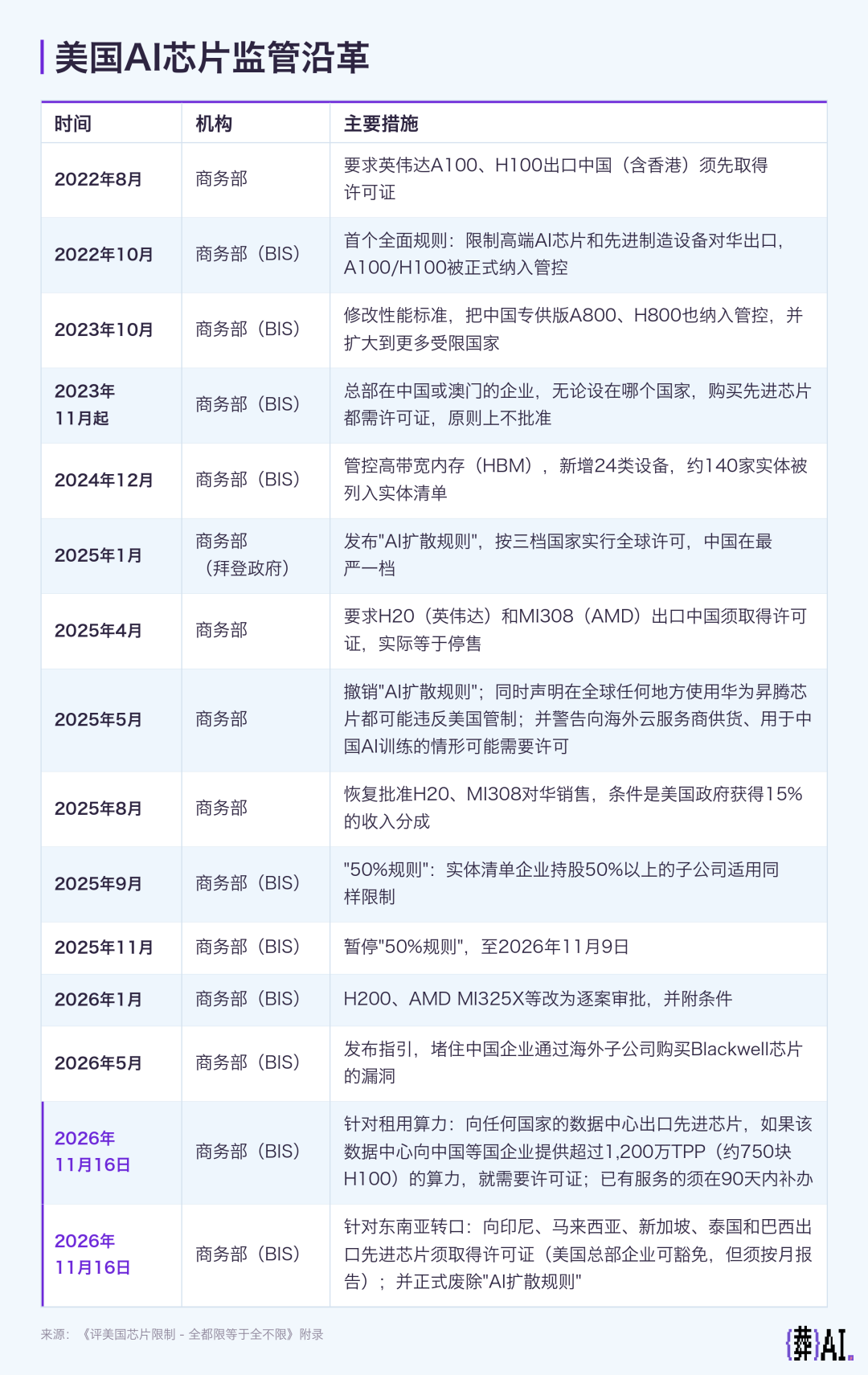
Having worked in this field for nearly a decade, and because I frequently write research articles on US regulations for my firm, I've noticed that US export control policy has become increasingly fond of hissing (I'll include a table at the end of this article so you can see just how aggressive it's gotten), creating a cat-and-mouse dynamic with the Chinese who love to take exams.
First, let me offer some introductory content that really ought to come with a legal fee, as background on this chip legislation:
No buying. US restrictions on China's access to advanced chips are mainly enforced by the Bureau of Industry and Security (BIS) under the Department of Commerce.
In October 2022, the US required export licenses for AI chips exceeding a certain performance threshold sold to China — and these licenses are basically never approved. China also doesn't allow folks at home to buy them, so since then, NVIDIA's A100 and H100 have essentially been off the market.
The great Leather Jacket Guy then rolled out the performance-reduced A800 and H800, but the US changed the standard again in 2023 and brought those two under control as well. The H20, designed specifically for China, was also required to apply for a license in April 2025, and NVIDIA took a $4.5 billion writedown over it (Old Huang is too great +1).
No making. Beyond the chips themselves, the US also restricts chipmaking equipment and high-bandwidth memory, and frequently adds Chinese companies to the "Entity List."
No skirting the edges. Since virtually all advanced chips globally depend on American technology — even a trace is enough (including the Final Product Rule) — overseas manufacturers like TSMC must also follow these rules when supplying mainland customers.
This is also why the mainland can't go to South Korea or TSMC for tape-outs or to buy GPUs or HBM.
No reselling. Everyone knows Chinese companies have tried plenty of workarounds: setting up subsidiaries in Malaysia and Singapore to buy chips, transshipping them back to China via Southeast Asia, or remotely renting compute from overseas data centers.
But the US has started plugging these loopholes one by one — companies headquartered in China need licenses to buy advanced chips no matter which country they're set up in. There have been moments of loosening: in August 2025, the H20 resumed sales to China on the condition that the US government takes 15% of revenue;
in January 2026, the more advanced H200 shifted to case-by-case review. But Mom won't let anyone buy them, so almost no compliant H200s have actually been delivered to date.
Now let's get to the main topic.
01
What is the new chip legislation?
Compared to before, this November 16 new rule is! Just! Different!
After reading the main text of the rules, I had a slight breakdown — what's the point of compliance anymore? What room is left for us lawyers who work on US export controls?
First, we can declare that places like Johor, Malaysia will become the next ghost towns; and the compute resources that mainland companies (large-model companies and several top players) previously had will also be severely cut:
As everyone knows, thanks to the romantic entanglements of a certain A12 big shot, the Southeast Asian compute center issue was dragged into the open, and as a result, five countries got banned by the US in this round. From now on, Malaysia, Singapore, Thailand, Indonesia, and Brazil also get to enjoy China-grade treatment — exporting high-end chips to these places requires a BIS license first.
That's not all — the ban doesn't stop at exports. This round, 'Murica is directly banning Chinese companies from renting compute! Even their own overseas compute clusters, in theory, can't be used by the Chinese themselves.
Spelling it out is a bit of a mouthful, but the gist is: if a supplier knows that a data center is providing more than 12 million TPP (roughly 750 H100s) of compute to a company headquartered in or whose ultimate parent is in China, supplying chips to that data center requires a license, and BIS will review case by case.
For the big companies that built their own overseas compute clusters, they theoretically can't let domestic employees remotely access or use these cards anymore either. US-based clusters are temporarily exempt, but that's coming soon too — the "Remote Access Security Act" has already passed the House 369 to 22 and is being pushed as an附加 amendment to the National Defense Authorization Act.
Training models and running models, including inference, all count!
More insidiously, 'Murica has also learned to lure the snake out of its hole: data centers that were already providing compute at this scale to Chinese companies before the November 16 new rules were published and want to keep doing so must obtain a license within 90 days of the rules taking effect, or they have to stop.
But this round is just BIS being purely malicious — if these data centers actually apply, the BIS director will most likely reject them anyway, unless he doesn't want to keep his job.
Finally, there's a closing-the-door-and-beating-the-dog move — even advanced chips (both B-series and H-series) or servers that have already been sold once secondhand, if shipped to the five countries above and China, or resold locally, in principle require a US license first.
This is utterly shameless — not letting you do business is one thing, but not even letting you sell off your assets after going bankrupt?
With this combo of moves, the US compliance lawyers who used to be able to offer clients mysterious little suggestions will be completely out of tricks — what can you do? How are we supposed to write memos when everything's banned?
02
How to deal with 'Murica
One good thing about Funeral AI as a platform is that I can speak openly.
Unlike other law firms that hem and haw about analyzing the impact, offer advice that sounds like something but amounts to nothing, and even plan to actually comply with all this, I think it's necessary to state my views clearly:
-
There is no longer any necessity to comply with US export controls. Since BIS has torn off all pretense, we must enter a state of confrontation — complying with Chinese regulations is the most sufficient form of compliance.
-
Quickly take stock of overseas risk exposure and shrink the scale of assets and personnel the US side can reach before sanctions hit. If being penalized is fate, then let fate not be able to freeze your bank accounts.
-
Promptly deploy cash reserves — buy fast and buy big, and empty out those Southeast Asian server rooms as quickly as possible. Ideally the government would also cooperate by opening up a round of current-account foreign exchange controls.
Here are three reasons.
First, domestic chip supply is limited.
While I strongly agree with Funeral AI's long-standing emphasis on the importance of domestic chips, the reality is that production of chips like Ascend 950 is still too low — even with SMIC's production lines running at full blast, they can't meet the training chip demand of various institutions, let alone the broader inference demand following the Personal agent wave.
And of course, China is also constrained by the HBM yield problem — the relevant manufacturers are working on it, so I won't elaborate here.
In short, the bottleneck holding back domestic model development right now is simply not enough high-performance chips and not enough HBM. So what about the market demand that Huawei, T-Head, and others can't supply? How do we fill the leasing resources that have been cut off?
Sitting around waiting for death is absolutely not an option — buying up existing chips is a clear path.
Second, 'Murica has already cut off the lifeline of overseas server rooms — they'll have to liquidate eventually. Better to grab them ourselves than let outsiders have them.
The server rooms the Chinese have built one by one across Southeast Asia will probably not survive under pressure from the US Department of Commerce.
Not that the US can directly enforce there, but that these small countries ultimately can't resist US long-arm jurisdiction. They will definitely roll out detailed regulations to cooperate with US supervision (Malaysia has already announced it will follow, and I bet Singapore is next).
So the longer things drag on, the more the US regulatory claws will, through local governments, sink firmly into these data centers — and by then, buying up the chips will be harder than reaching the sky. It's even possible that American peers will swoop in and buy at lowball prices.
For companies operating their own data centers, they have even less choice — are they supposed to "compliantly" rent out hard-won chips to Anthropic or OpenAI and leave their own researchers staring blankly? Clearly unrealistic.
So, domestic model companies, hurry up and find a way to buy some cards.
For the top and listed domestic model companies, I've put together a list based on public reporting.
Looking at historical investment amounts, MiniMax, Zhipu, and Moonshot AI have book cash somewhere between $3.3 billion and $10 billion, and the richest, DeepSeek, should have total funding exceeding $20 billion.
Looking at it this way, everyone's ammunition is sufficient? Going bargain-hunting in Southeast Asia seems totally doable?
Unfortunately, before going shopping there's a substantive obstacle: these companies all have purely domestic structures, so to go bargain-hunting, they'd either need to go through ODI approval for overseas investment, or go through large-sum current-account foreign exchange approval.
The former takes at least six months; the latter requires upper-level support, otherwise the quota won't be enough.
But then again, in this critical window, shouldn't we support model companies in going out to sweep up a batch of goods? After all, the huge gap in domestic chip supply needs to be filled, external regulation is tightening imminently, and we should stockpile more cards to help 10T large models be born as soon as possible.
Otherwise, if this R&D milestone gets delayed, the gap may widen once again.
Last but not least, fortunately BIS only has so many people — let them take their time investigating.
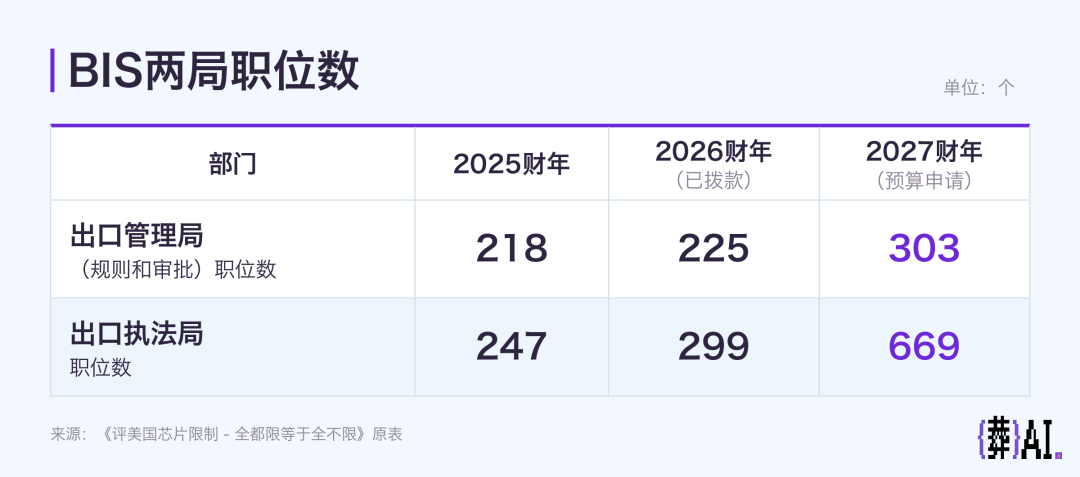
As the most effective tool for containing China, how many tool-people does BIS currently have? As of May this year, headcount on duty was 417, of which the frontline staff actually approving chip export licenses is estimated at only about 80 positions, allocated to Export Administration; and Export Enforcement, which handles enforcement, currently has only a limited headcount of 136.
The good news is they still don't have many people, and turnover is high — but the bad news is that headcount will increase considerably going forward:
Considering the contradiction between BIS's limited manpower and the Chinese people's boundless creativity, my hint here is self-evident — I suggest everyone overcome the difficulties and compliantly ship the chips into the mainland, leaving no loose ends.
Otherwise, once the headcount ramps up, the suffering will be even greater.
⬇️
Welcome to subscribe to our Substack at funeralai.substack.com