Iran Builds AI Behind Closed Doors

Divine Craft AI
"Divine AI"
In early October, Qiu Mu and I spent over ten days in Iran. Beyond cruising the Strait of Hormuz — and discovering that the region was unexpectedly peaceful, with nothing but beaches, islands, and big ships to watch — we also met several Iranian AI founders.
Two things mainly shattered our expectations:
Iran's internet is actually quite developed.
Even around the Strait of Hormuz, we could use the ride-hailing app Snapp to summon a car within minutes. It's a cashless society too — nearly all shops accept bank cards or SnappPay. Tehran's streets are full of SnappFood delivery riders.
Iran even has its own cloud provider, Arvan Cloud, offering locally deployed GLM APIs.
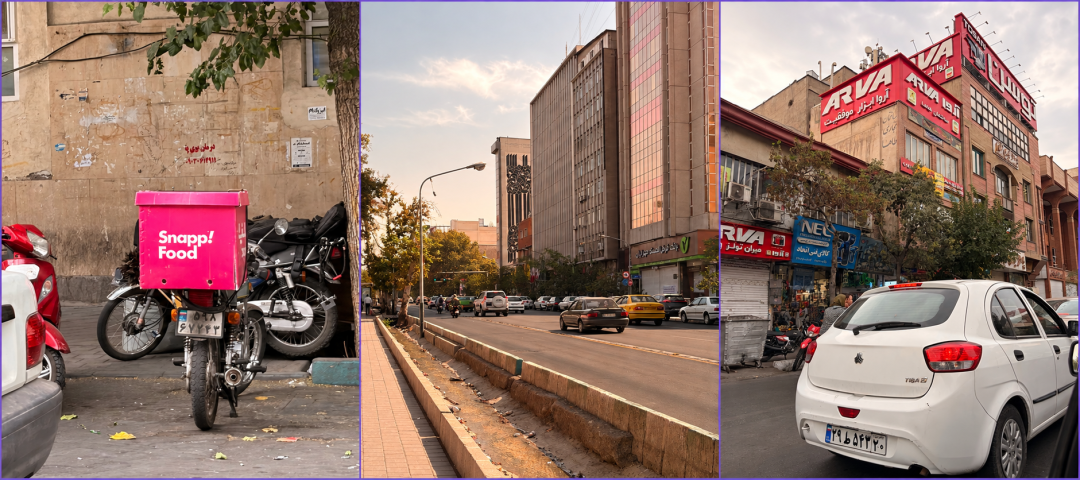
Tehran has terrible traffic
From Tehran to Bandar Abbas, every hotel and shop we saw had its own Instagram account, and they were remarkably skilled at short video content. Ordinary people chat on WhatsApp and navigate with Google Maps.
ChatGPT is the most widely used AI product in Iran — locals even use "GPT" as shorthand for translation software. When we couldn't communicate clearly, they'd say "GPT, GPT," urging me to open GPT so we could talk.
However, Iran's internet environment is complicated.
Iran is currently in a state of war and has been under US sanctions for years. Many internet services aren't available there — using an Iranian connection, you can't access WeChat Official Accounts, WeChat Channels, Douyin, Alipay, or even claim WeChat red packets.
Humorously, ChatGPT and the full Google suite work just fine.
Earlier this year, Iran experienced a nationwide internet blackout lasting roughly three months. During this period, the government hard-cut international internet access, leaving users with only domestic Iranian network services.
Even now, when I encounter connectivity issues, I can't tell whether the problem lies with these tech companies or with Iran itself. When we used Google Maps for navigation in Tehran, the positioning was consistently inaccurate — whether this was GPS interference, I couldn't say.
Yet, remarkably, Iran still has AI founders.
Just without dollar-denominated VC, there are no big startup opportunities. AI founders take what they can get — no wunderkinds, no world models, no RSI or personal agents.
In Tehran we met Hadi Farnoud. The guy said he had about a dozen employees, all remote, providing large model APIs. Most of these employees came from Iran's top university, the University of Tehran. At $500 a month, salaries were considered high — four to five times what ordinary Iranians earn.
His company does a bit of everything, from e-commerce sites to internal enterprise systems. I said it's basically Lovable plus FDE, and he agreed.
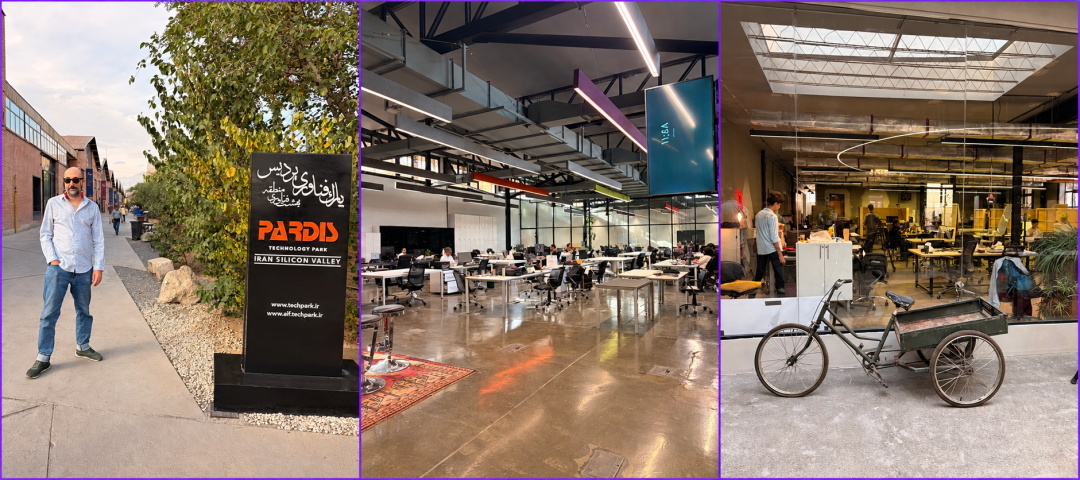
Tehran incubator Azadi Innovation Factory
We met Hadi at a Tehran innovation incubator.
The place calls itself Iran's Silicon Valley. To me, it looked no different from Beijing's 798 Art Zone — a bunch of startups sitting in row after row of open-plan offices converted from old factory buildings, with podcast studios and coffee shops galore.
Hadi went on about how Chinese open-source models code well but can't output Persian, far worse than Gemini and ChatGPT. He then mentioned that his friends have Persian training data that could help improve models' Persian proficiency. And these friends are all overseas, able to provide it in full compliance.
All in all, Iran is a complex and remarkable place.
On our last day in Iran, we also met tech journalist Mehrin Nazari at an upscale mall in north Tehran. She's been covering tech for seven years.
So we invited her to write an article about Iran's internet.
This is Mehrin's first article, starting from Iran's internet blackout earlier this year. She wrote it in Persian; I used AI to translate it, preserving her distinctive voice as much as possible.
Silent Iran
The first missile fell on Iranian soil on Esfand 9 of the Iranian calendar (February 28, 2026). After that, the entire country lost all trace of year-end festivities and Nowruz.
Nowruz is the most important holiday for Iranians, and the war had begun a month before.
It was a day off. I was still asleep in the morning. A friend had called me many times. The final call's vibration finally woke me — that's when I learned war had broken out. My first reaction was to check the internet.
Sure enough, I guessed right: international internet was down!
After Iran's Twelve-Day War (the June 2025 conflict between Iran and Israel), nearly everyone had prepared for the next war. Internet companies' infrastructure was ready, but the employees weren't...
I saw a video: in an e-commerce company's order processing center, the sound of missiles from overhead terrified the employees.
The internet was cut without any warning. Mass media didn't even mention it; nothing was announced on television. Only some tech media outlets explained the blackout situation and the damage it caused. The industry's unions, associations, and groups also used these channels to voice their demands.
Internet company industry associations had been continuously negotiating with the government for these businesses to regain internet access. I'd witnessed their efforts firsthand in my media work, and tried to pass their voices to the government and relevant officials through interviews.
But the government usually remained silent and was reluctant to be interviewed. Given the chaotic state of the country at the time, this was somewhat understandable.
You must be wondering: what happened to those internet companies afterward?
We still had domestic networks. Snapp, Digikala, and banking and fintech apps kept running.
Snapp is a ride-hailing app, essentially a localized Uber. Today, it has become a super app offering food delivery, online healthcare, credit services, and more.
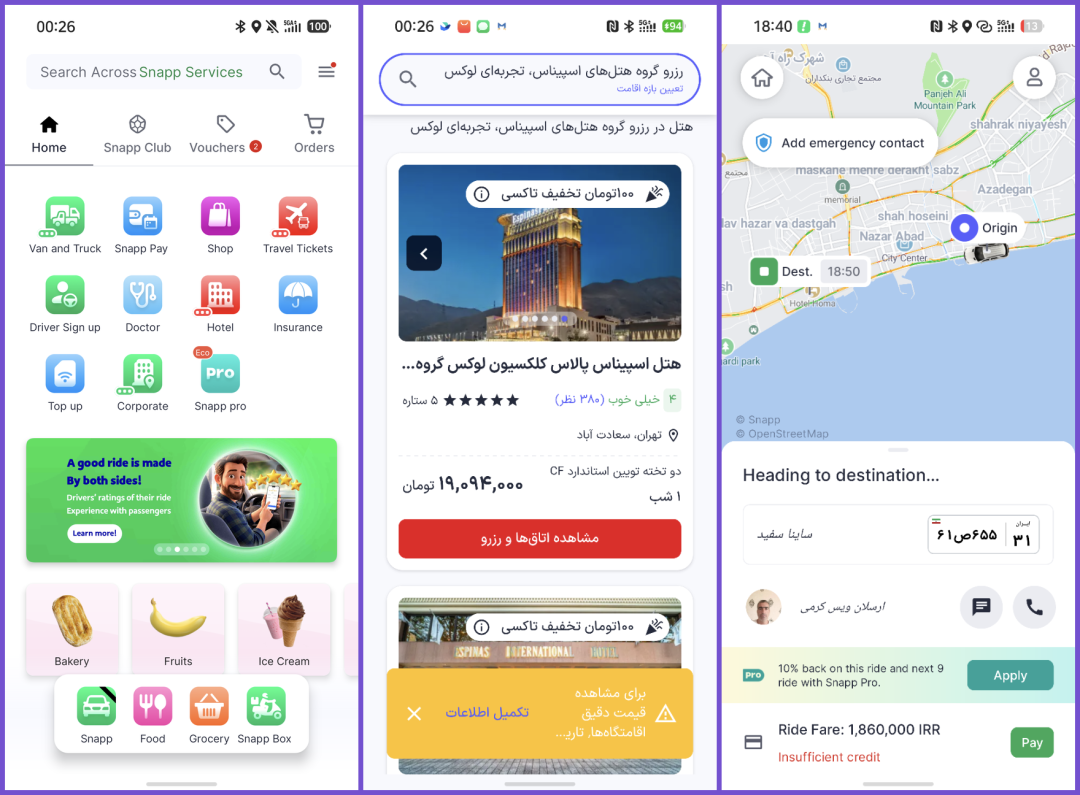
Snapp app interface
Digikala is Iran's version of Amazon. Starting as a startup, it has grown into Iran's largest e-commerce and online trading platform, expanding into innovation and other fields.
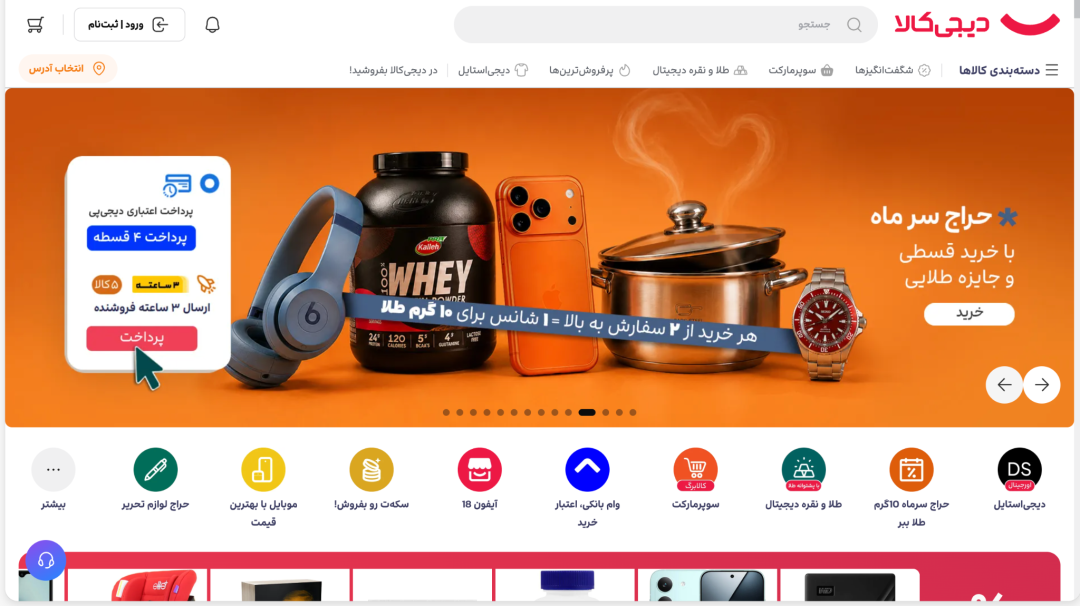
Digikala official website
Iran's modern startup ecosystem truly began taking shape in the late 2000s to early 2010s. Several factors converged during this period: rapidly expanding internet access, surging smartphone adoption, and large numbers of young people with technical education.
At the same time, international internet companies like Uber never entered the Iranian market. This created space for domestic companies to build local alternatives in e-commerce, app distribution, transportation, online trading platforms, and digital services.
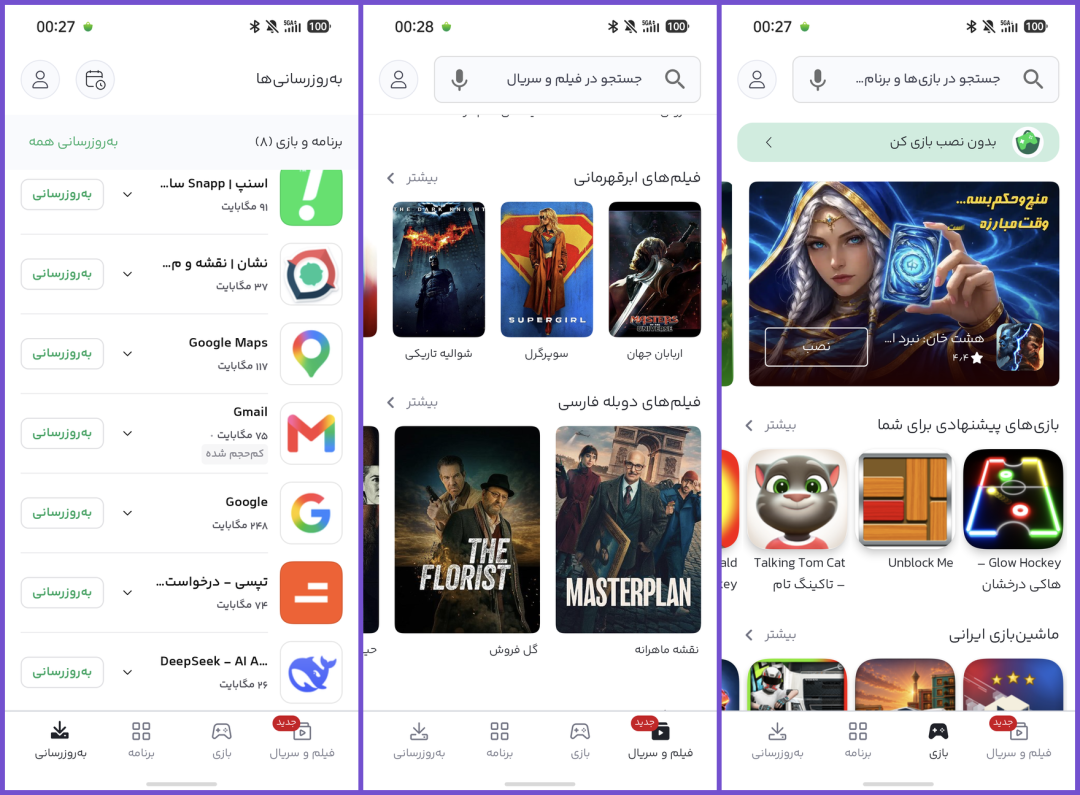
Bazaar, Iran's app store
Today's Iranian startup environment is vastly different from the optimistic period of roughly 2014 to 2017.
The top companies have grown much larger, with some developing into major internet industry holding groups like Snapp and Digikala.
But starting a new startup and scaling it has become far more difficult.
Recent reports repeatedly point to the same structural obstacles: limited financing channels, international sanctions, difficulty accessing global markets, brain drain of technical talent, economic uncertainty, regulatory uncertainty, and internet restrictions.
Snapp has about 9,000 directly employed full-time staff. Digikala has roughly 16,000 full-time employees and project-based freelancers. These figures count the companies' own operational personnel, not merchants or drivers on their platforms.
Since I have my own car, I rarely use Snapp for cars; when in a hurry, I use its motorcycle service, SnappBike.
But I frequently order food through SnappFood. During the war, however, many merchants suspended operations, people traveled less, and many went to smaller cities or rural areas.
After placing an order on Digikala, customers can choose their own delivery window, from three days to a week. This process wasn't disrupted during the war.
During the war, on the surface everything kept running: Snapp still received ride orders, Digikala still took shopping orders. With domestic networks still connected, users felt these services remained normal. But the backend told a different story.
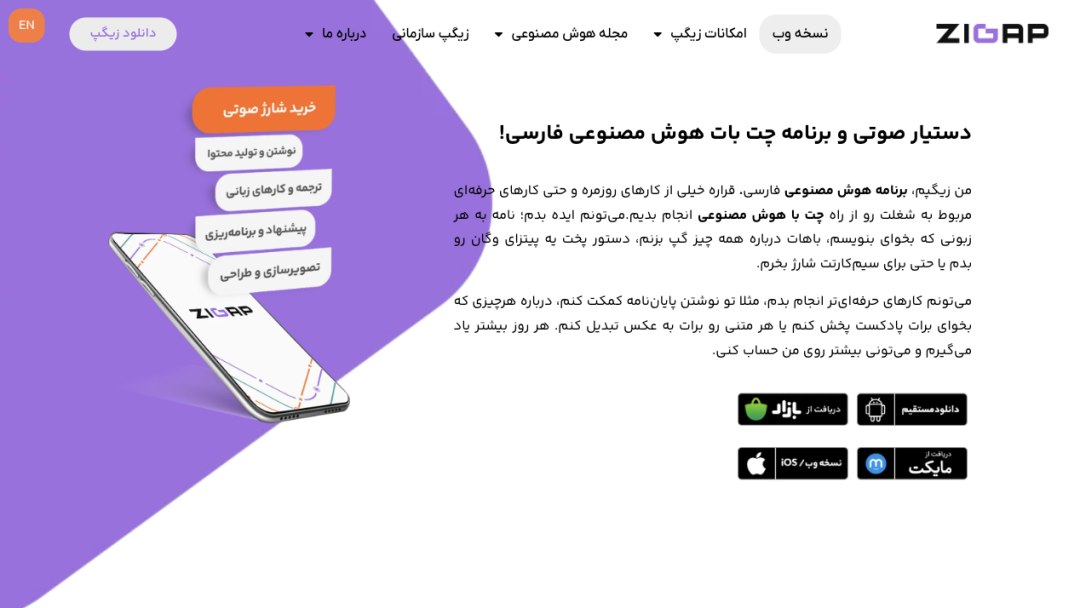
Zigap official website, Persian chatbot
With international internet cut off, technical teams couldn't normally access the tools they relied on for daily development — from GitHub and Docker to technical documentation, monitoring services, and collaboration tools.
Meanwhile, GPS and SMS services were also disrupted. Under such conditions, developing new features was no longer the priority. Teams had effectively shifted from development and business growth to maintaining existing services, disaster recovery, finding alternatives, and handling crises as they emerged.
In those days, the question was no longer "what should we develop" but "how do we keep existing services running."
Iran has its own domestic instant messaging apps, such as Bale, Eitaa, and Rubika. However, these apps aren't popular; people generally don't want to use them.
One reason is technical problems — for example, Bale can't push notifications, so you have to open the app to see messages. Another reason is that people worry these government-backed apps will hand their private information to authorities.
Still, during the blackout, media continued publishing content through domestically hosted websites, mostly using the domestic app Bale. Bale is similar to WeChat; compared to other similar apps, it's more popular, simpler to use, and less prone to freezing. Online shops that originally sold goods on Instagram, WhatsApp, or Telegram immediately migrated their sales channels to Bale, though only temporarily.
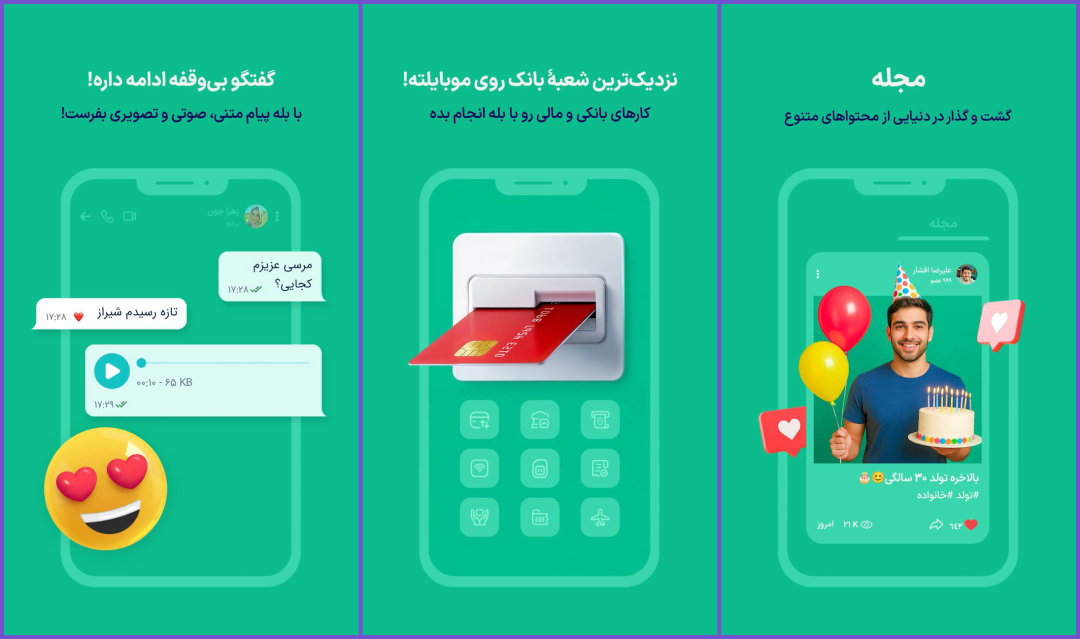
Bale interface
My first thought was of family and friends living outside Iran. How agonizing it must be to have loved ones in a country being bombed daily, yet receive no word from them.
But tech people always find a way. I heard that someone managed to connect to international internet through some method and began helping people inside Iran contact their relatives abroad.
He would first reach people outside Iran through WhatsApp or Google Meet, then call their family members or friends inside Iran on his phone, put both devices on speaker, and let the two sides talk and exchange reassurance.
I also heard that a group of volunteers took turns doing this for families. Legally, this was a crime that could bring serious consequences. But hearing separated families choke up as they spoke, they were deeply moved and turned that empathy into action.
In those days, using Starlink and international internet in Iran was illegal, with heavy penalties. Yet some still risked danger to smuggle Starlink equipment into the country, then with IT professionals' help set up Starlink servers to share international internet connections with others.
Of course, they sold it to quite a few people too!
At that time in Iran, a month's internet access cost about 15 million tomans (roughly $80). In dollar terms this might not seem expensive, but considering the toman's exchange rate against the dollar, this amount equaled half an ordinary person's monthly salary.
Many were arrested for this. I knew someone in the digital economy sector who kept servers in his office. He suddenly went silent, and we later learned he'd been arrested.
After friends and colleagues made various efforts, he was eventually released after providing bail guarantees, paying heavy fines, and making promises. Others escaped by hiding servers carefully.
Imagine those days: Iranians bearing the pressure of war and missile attacks, their homes potentially destroyed at any moment, yet still having to take risks to use the internet in such anxiety.
But it was only temporary.
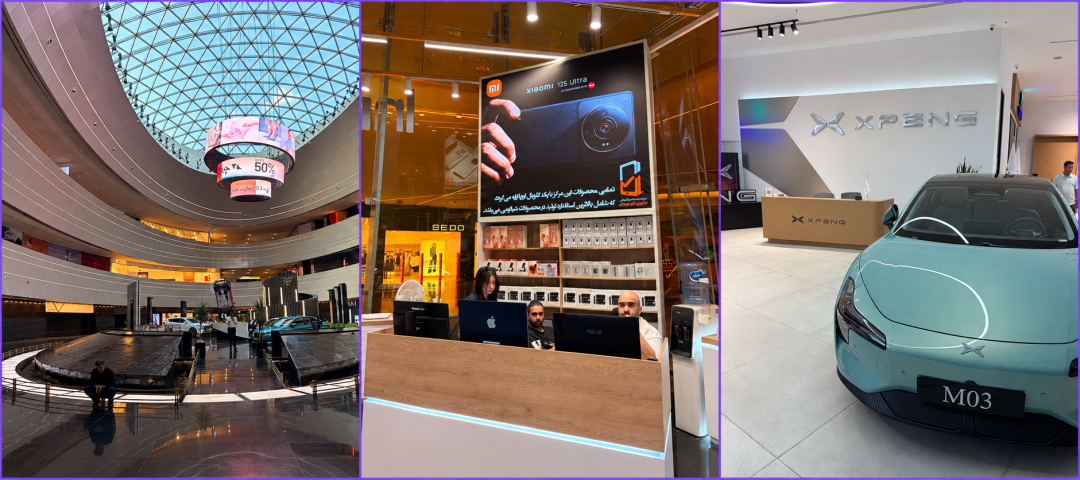
Iran's largest mall, Iran Mall
Meanwhile, the entire country plunged into darkness and desolation after 7 p.m.
Restaurants, shopping centers, and similar venues closed one after another. Though no regulation required it, streets gradually emptied. Yet pre-war Tehran had been lively even at midnight; other cities like Shiraz were equally vibrant at night.
Many joked that this was like the American TV series From — after dark, monsters come out to hunt humans, and people must hide in homes or shelters before nightfall.
Gradually, internet access became stratified. Some people with government connections and journalists could access certain international websites and social media like Google and Instagram through "white SIM cards."
Some businesses and industry practitioners were permitted to use "Pro Internet," with daily data quotas but access limited to instant messaging apps like Telegram and WhatsApp.
Journalists could obtain white SIM cards through recommendation by accredited media with official operating licenses, whether private or state-run.
Cardholders could access Google and its services, Instagram, Telegram, and several other apps. Besides journalists, some people with close government ties also obtained these cards through non-public channels.
More interestingly, some startup PR personnel leveraged their media influence to get these SIM cards too. After the war, lists of these people were published on X, sparking criticism. Users on X were dissatisfied that these people had obtained cards purely through connections.
I saw quite a few white SIM card holders who would even resell portions of their data to others...
In those days, another painful experience was watching internet companies lay off employees one after another. Many also believed the blackout was the cause of these layoffs.
Many of my friends and people around me were laid off. Many of my own work projects were canceled too, and we fell into severe financial difficulty.
Iran's largest private economic media group, Donya-e-Eqtesad, which owns multiple institutions including EcoIran, laid off two-thirds of its journalists. Another media outlet, Eghtesad Online, laid off all but two editorial staff. These journalists had previously earned monthly salaries of $100 to $400; now their income dropped to zero, forcing them to dip into savings.
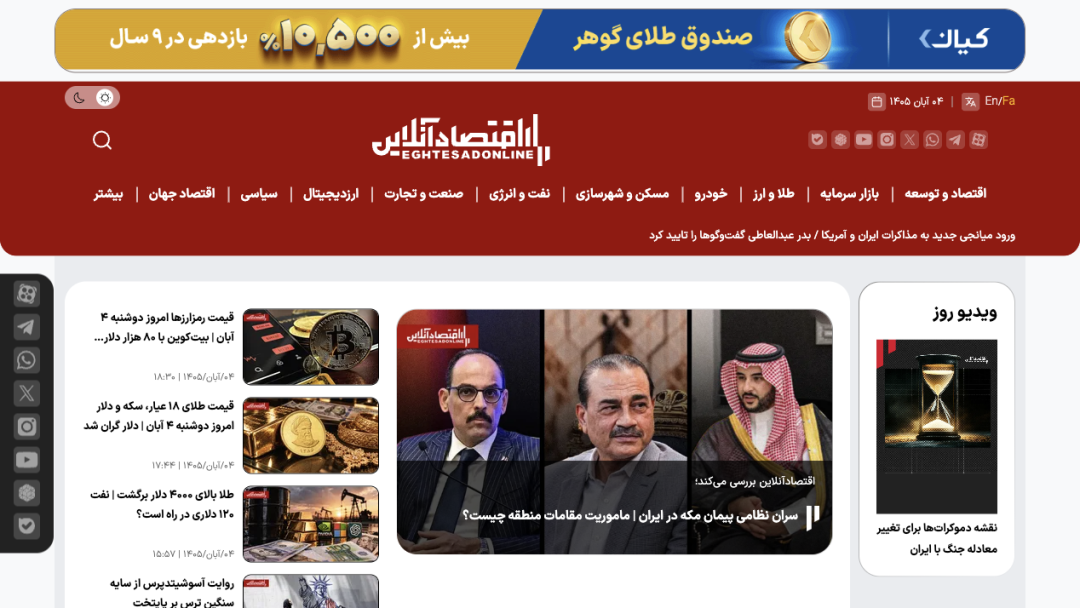
Eghtesad Online official website
Social media operators were mostly laid off, as were digital marketers. PR personnel had no news to distribute; social media and digital marketing campaigns were effectively canceled.
The job market was terrible. LinkedIn and Iranian job sites — Jobinja, Jobvision, IranTalent — received massive numbers of job applications, while companies were laying off staff or keeping only minimal employees.
Only a small number found new jobs through personal connections.
Speaking of artificial intelligence, Iranian users could already clearly feel in daily life that AI quickly became part of routine work.
According to Cloudflare data, ChatGPT is Iran's most popular AI service, followed by DeepSeek; Perplexity and Gemini also see considerable usage.
A common misconception is that AI entrepreneurship in Iran began with ChatGPT's emergence. This is not the case.
Iran's first batch of AI enterprises to reach meaningful scale appeared in the latter half of the 2010s. They mainly focused on domain-specific applications such as Persian natural language processing, computer vision, identity verification, voice processing, and data analysis.
For example, Pardazeshgaran Zaban-e Vira began working on Persian NLP around 2017, developing products like Viravirast (Persian proofreading) and Viratype (Persian speech-to-text).
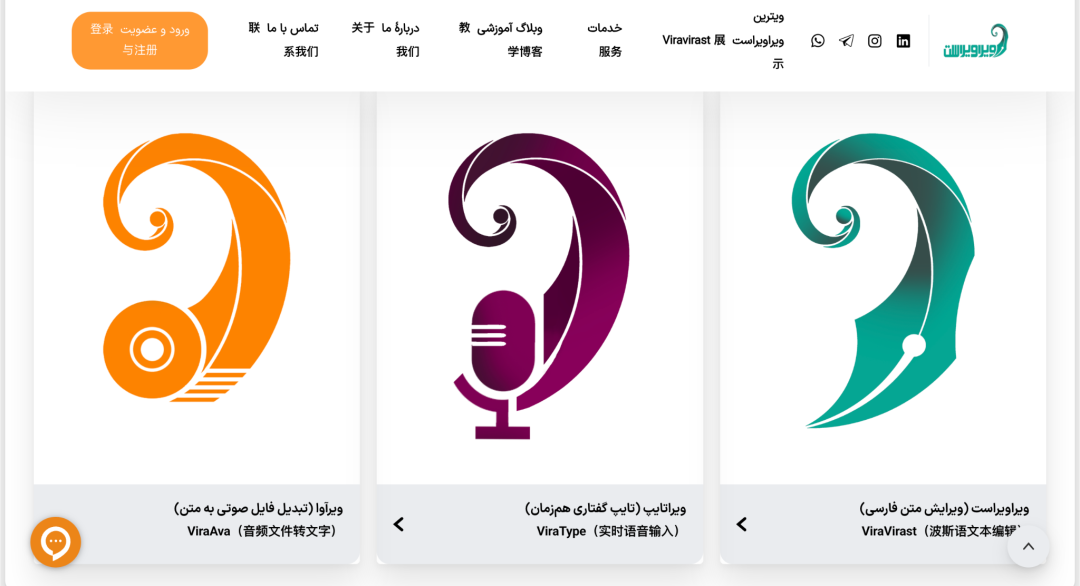
Viravirast official website
Companies like Dataak entered AI data analysis and social media sentiment monitoring.
Around 2022 to 2023, the rapid rise of generative AI changed business models. Increasingly, Iranian startups stopped merely developing algorithms for specific application scenarios and began building products around Persian AI assistants and large language model API calls.
Vira, developed by Part AI Research Center, is a consumer-facing AI super app supporting Persian chat, text-to-image, and voice functions, while also offering enterprise APIs.
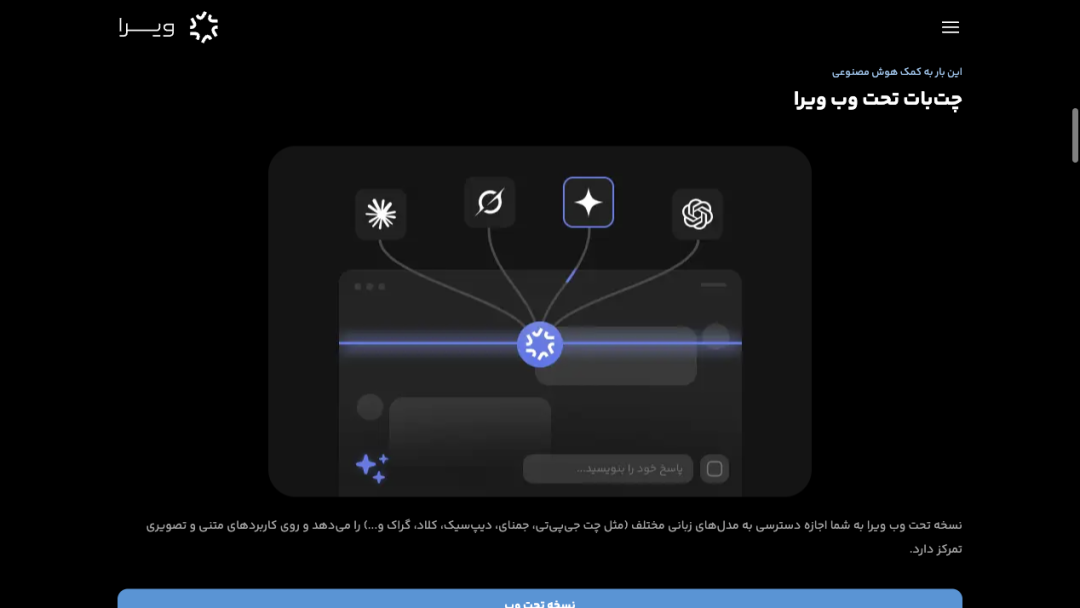
Vira official website
But only when international internet was cut did people realize how dependent these usage habits were on foreign services: ChatGPT, Gemini, and many other tools were effectively inaccessible.
Users had to turn to domestic services already available on Iranian networks, such as Vira, MetisAI (large model API relay), Zigap (Persian chatbot), Robo (Persian chatbot), and GapGPT (Persian chatbot).
These services could be used for chatting, answering questions, and generating text, but still had noticeable gaps compared to international counterparts in image generation and multimedia functions.
Of course, those who could still connect to international internet continued using ChatGPT and Gemini.
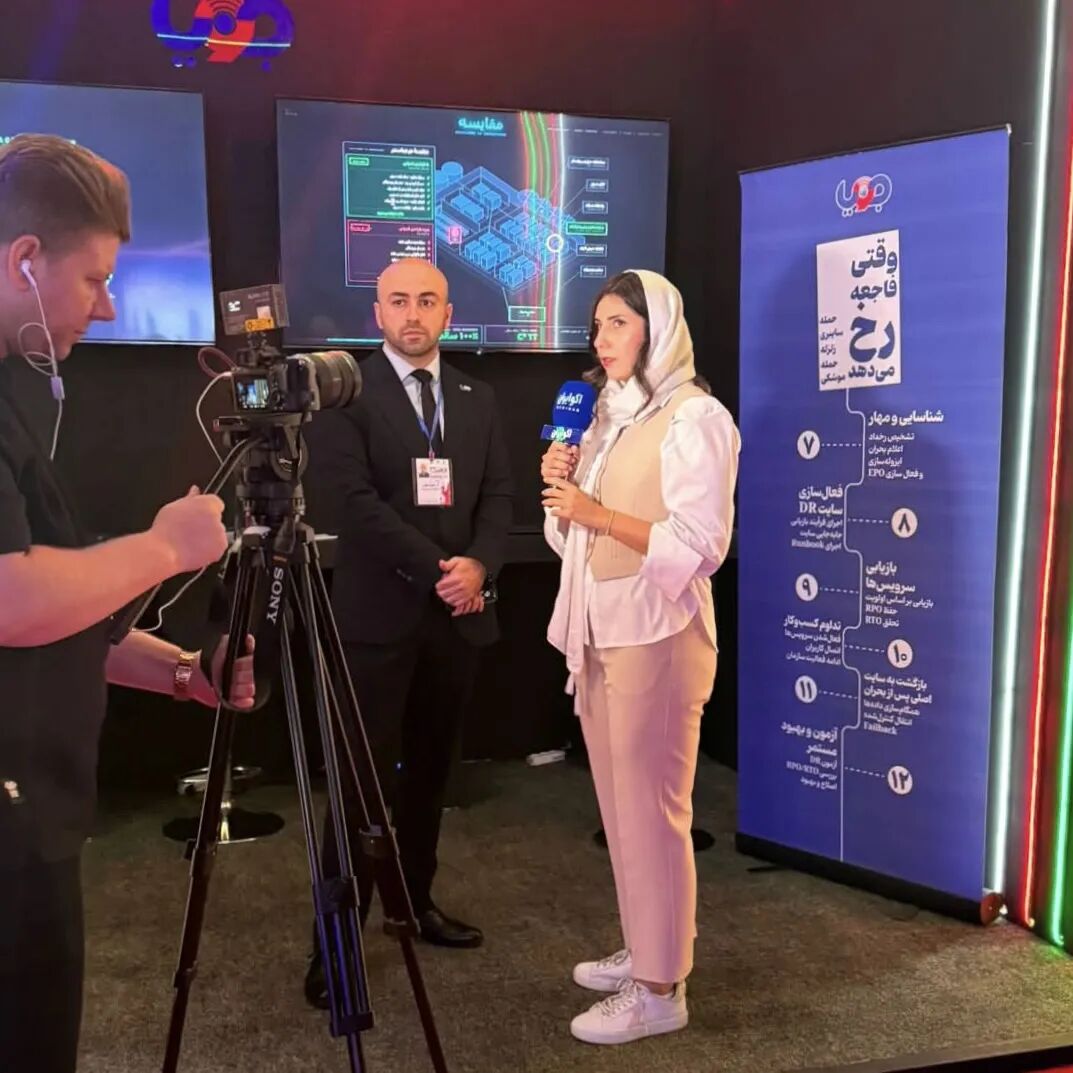
Photo of the author, Mehrin
A week or two after "Pro Internet" launched, one day the internet was restored without any notice. This was some time after the ceasefire. But for businesses that had already fallen, the restoration came too late.
For example, Kamva, a website-building and e-commerce trading platform that began operations in 2017, announced its closure in April 2026.
Founder Hadi Farnoud explicitly stated that after "two wars and months of total blackout," the company could no longer continue operating. Many small home-based businesses and Instagram shops also closed. This blackout has caused damage to the digital economy and many practitioners' lives.
Perhaps we can never return this ecosystem to its pre-war state.
Those days were hard, but they passed. This shock was like a wave, setting Iran's digital market back several steps. But ultimately, Iran's internet lit up again...
(Cover image generated by ChatGPT; purely human-written, GPT-translated, Xianyu-proofread)
Welcome to subscribe to our Substack funeralai.substack.com