Just Doing Its Job: LongCat

"Love sending some tokens" or "Like to drop some tokens" — depending on context, this could be a casual phrase about giving away cryptocurrency tokens or in-app credits.
My take on Meituan's LongCat has always been consistent, summed up in one sentence: "Just quietly training models."
LongCat never brags about its AA benchmark scores, never calls itself the pride of Chinese models. What's there to brag about? If you're not using domestic GPUs to train models, what are you using them for?
If you ask me, the real pride of Chinese models is whoever's actually optimizing for domestic GPUs.
This time with LongCat-2.5, it's the same story: "Given the constraint that domestic compute single-card VRAM falls short of 80 GB, the training system prioritizes memory optimization and designs parallel strategies around supernode architecture."
Still looking out for the domestic GPUs 😭
LongCat-2.5 is refreshingly honest too. Their technical report doesn't hide anything — they benchmark against GPT-5.5 and GPT-5.6 directly.
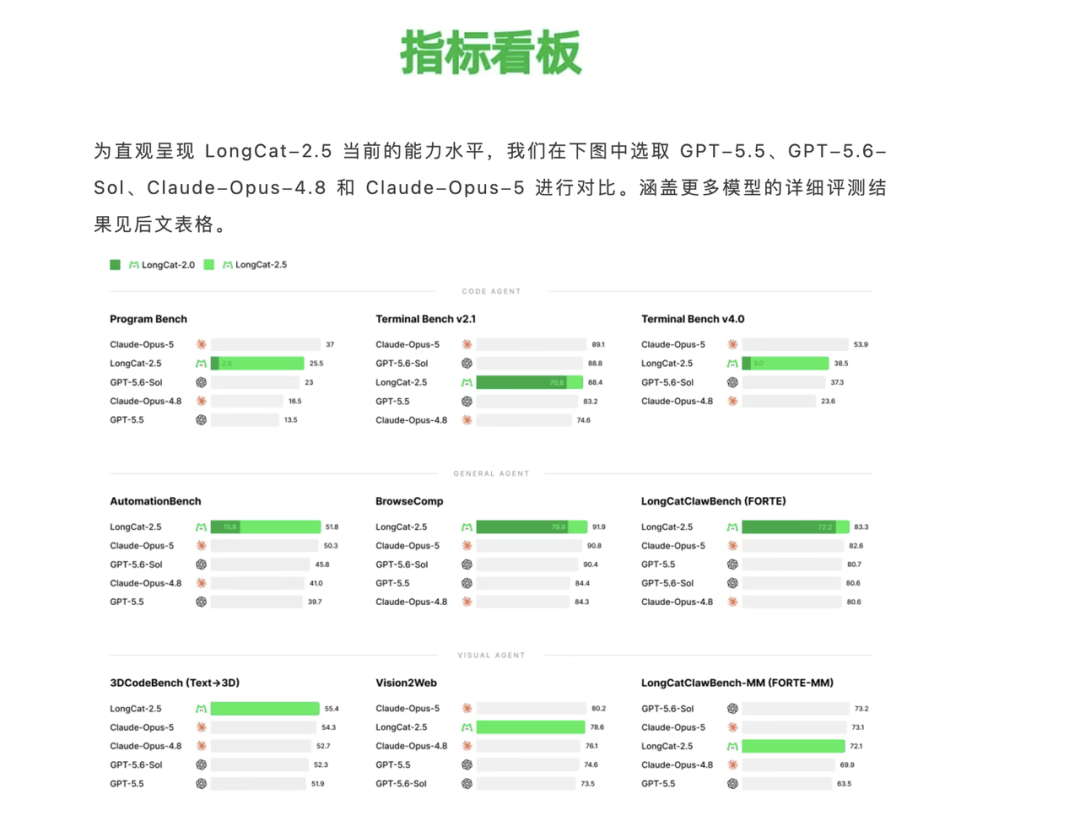
At least that shows they have no delusions about where they stand.
Which makes me feel a little bad roasting them now. But if we don't actually use LongCat-2.5, didn't Meituan train it for nothing?
So to honor the least hype-driven, most grounded LongCat-2.5, my friend @Xiaolan and I put it through some serious testing.
Their overall assessment: roughly in the same ballpark as Opus 4.8, capable of handling 70% of ordinary office work, no major issues with frontend and localized development.
But capability ceilings in real-world tasks, compounded by long-horizon drift, mean multi-step outcomes work better with iterative user feedback than set-it-and-forget-it execution.
Similarly, LongCat-2.5 also has an overthinking problem that bloats context windows, causing some prompts to fail to produce output.
Here's our more detailed testing below, using Claude Code as the harness:
01
Frontend Tasks
Started with some complex frontend tasks.
First we had LongCat summon a Meituan delivery bike to deliver food, requiring the rider to pedal, signal turns, and open the delivery box.
The prompts are too long to copy, so let's jump straight to results:
The e-bike's pretty lifelike — moves forward, runs without draining battery. Professors doing field research won't need to make deliveries themselves anymore, just send a virtual bike racing online.
You can even make the bike disassemble mid-ride, which is wild.
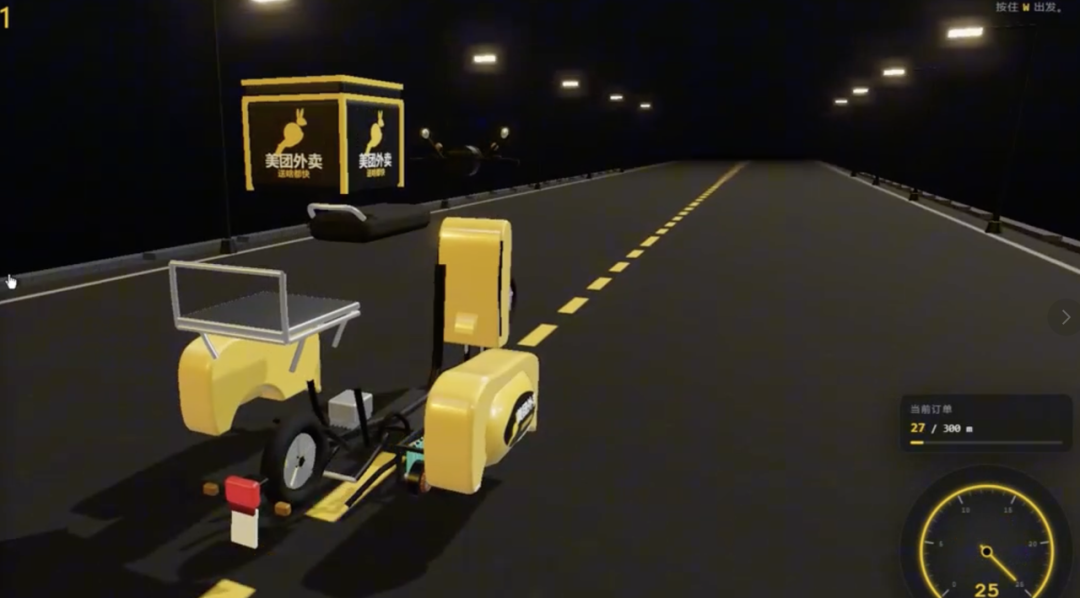
LongCat's got some serious guts — the Chinese delivery e-bike it built can literally fly.
Next, had LongCat take me to outer space with an interactive planet:
Spun up a Rasengan-looking thing, straight out of Sky: Children of the Light. Jenova Chen would lose his mind — catch a couple floating kids and you've got an instant photoshoot.
Gotta admit LongCat's got decent taste for alien celestial bodies, maybe because LongCat isn't from Earth itself either.
Final case: had LongCat-2.5 build a Japanese-style miniature shrine island diorama. The model sits in a 10×10 transparent water block with rounded edges. Base is a thin sandy-colored plate against a warm washi-paper-style background. Soft ground shadows that fade with distance.
The reproduction's pretty solid — the torii gate even has seasonal variants, and the water particle effects are decent.
Pretty much, frontend tasks are no problem as long as your prompt is precise enough.
02
Long-Horizon Coding Tasks
For a relatively complete coding task, I chose building a full web app.
Input prompt:
Build a complete web-based music player, using mock audio for testing. Overall style should toggle dark/light mode. Simulate vinyl record rotation effect. Display audio waveforms artistically in the center. Lyrics scroll with music progress bar. Beyond the player, include a free composition section supporting hand-drawn composition — draw waveform curves directly on the webpage, code generates corresponding audio.
Dark/light toggle, vinyl rotation, artistic waveform display, synced lyric scrolling, hand-drawn curve-to-audio generation — every feature requested, completed in one shot.
For the free composition feature, it actually wrote a curve-based music synthesizer. Lyrics and timeline actually correspond.
Minor quibble: the layout could be tighter — player controls bleed into the hand-drawing area, affecting aesthetics.
Also, LongCat-2.5 heavily promotes its long-horizon execution capabilities.
So I also tested reverse-engineering a readable, maintainable TypeScript project from compiled files of a homemade mini-game, plus some images.
This task has genuine difficulty and requires sustained execution — the model ran for about 5 hours.
LongCat-2.5 reverse-engineered the early levels well — scenes, elements, enemy movement, hit detection, death animations all reproduced.
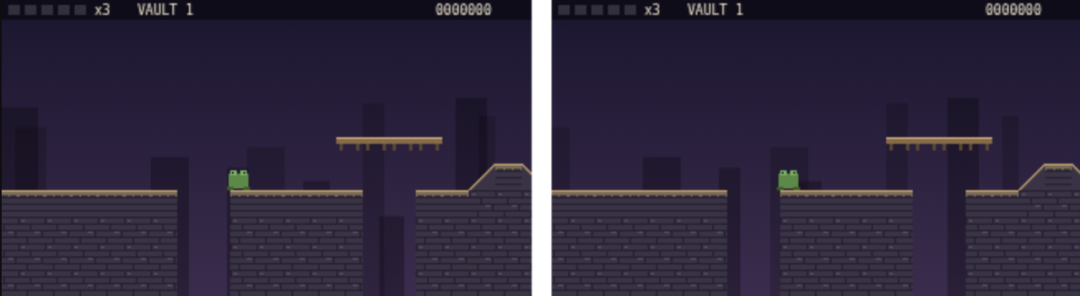
Main point loss: later levels have more complex scenes, and the model's testing coverage was limited, leaving one scene never triggered and creating a significant gap in reproduction.
From an execution standpoint, LongCat-2.5 can indeed sustain 5, 6, even 10+ hours of operation, showing end-to-end project completion potential. However, in late-stage long-horizon tasks, the model also has some probability of getting stuck in thought loops and failing to progress.
03
Cowork Tasks
Cowork tasks mainly test retrieval, plus Office file generation and processing.
This time I focused on Excel-related financial DCF valuation problems.
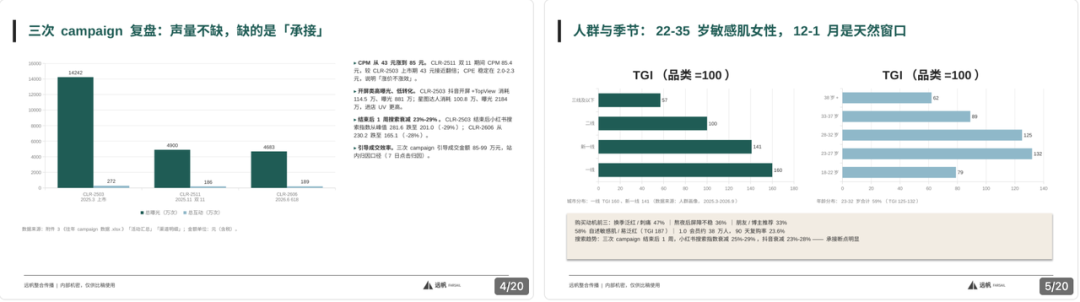
LongCat-2.5 already meets 80% of ordinary office worker needs. It found all the bank annual reports I asked for. On complex Excel modeling like DCF, only minor flaws. Template-based PPTs had no major structural or chart issues — ordinary workers can adjust and submit.
Overall, with clean inputs and clear instructions, LongCat-2.5 handles the vast majority of office worker tasks well, though it's not yet enough for real-world complexity.
Finally, I want to say — I still deeply respect LongCat and Meituan.
If every model lab had Anthropic-level data and compute, failing to train a SOTA model would be inexcusable.
For instance, there's a domestic team with the most abundant resources, yet their model capabilities don't match their company's resources — that's worth talking about repeatedly.
This year's model releases have repeatedly proven that large models are brutal manufacturing. It's primarily an engineering problem. The key factors are compute and data.
Since it's manufacturing, large models aren't a one-or-two-year game — they're about continuous progress over a decade. So-called long-term patience matters far more than temporary benchmark leapfrogging.
Meituan's LongCat: one, no benchmark-gaming circus, no antagonizing peers; two, actually training on domestic GPUs, accumulating experience for the ecosystem; three, loves giving away tokens, benefiting developers everywhere.
I'm not joking — if you're short on tokens, email LongCat. They'll probably hook you up. Chinese models supporting Chinese developers, pure public good.
(Cover image generated by ChatGPT, purely human-written)
Subscribe to our Substack at funeralai.substack.com