Looking Back at China's "AI Four Dragons": How Did the Hype Collapse?

All glory that cannot form a closed loop is fleeting.
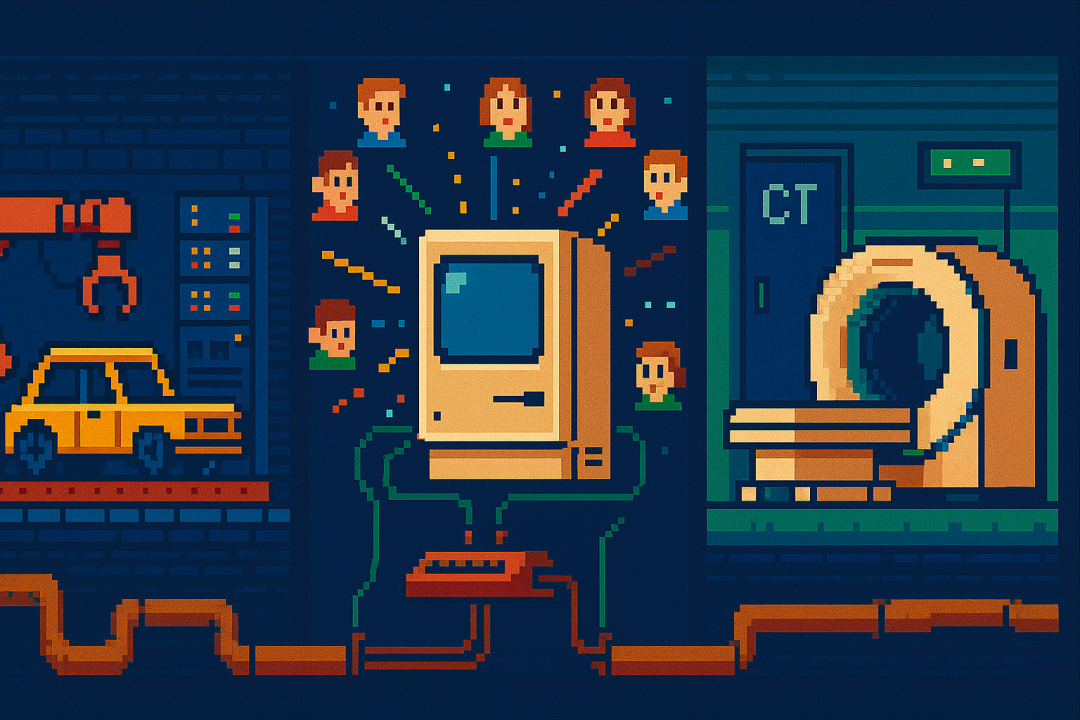
"All glory that can't be closed-looped is temporary."
The core reason the last AI wave — represented by computer vision algorithms — failed can be summed up in one sentence: The technology couldn't be productized. They could only sell algorithms, and that capability was easily replaced by hardware companies.
From 2016 to 2021, AI companies like SenseTime, Megvii, YITU, and CloudWalk raised over 10 billion yuan combined. Their technical strength was real. But today, SenseTime has accumulated losses exceeding 50 billion yuan, and hardly anyone pays attention to the others anymore. It wasn't that their technology was bad — it's that algorithms, standing alone, cannot become products. These companies would say: our facial recognition accuracy exceeds 99%, our pulmonary nodule detection outperforms attending physicians. All true.
The problem: high accuracy doesn't mean you can sell it. Hospitals don't want software — they want CT machines with built-in AI capabilities. Enterprises don't want algorithm licenses — they want cameras they can install and use immediately.
So what happened in the end?
Siemens, United Imaging, and other medical equipment makers integrated algorithms into CT and X-ray machines. Hikvision and Dahua, the security giants, embedded facial recognition directly into their cameras. Customers received complete products; the algorithm was just one functional module inside. The algorithm companies' technical value existed, but the commercial value was captured by others.
The logic is simple. Take medical AI as an example: legally, AI can only serve as "auxiliary diagnosis" and cannot replace a doctor's final decision. This means no matter how accurate the algorithm, doctors still have to review the scans themselves, and if the AI is wrong, the doctor bears responsibility. So it's not a hard necessity.
More troublesome is the workflow issue. Many AI tools require doctors to open new software and change their existing reading habits. That's extra burden.
And hospital procurement logic doesn't support buying standalone software. Hospitals prefer complete solutions — AI features should come built into equipment, not as separately purchased third-party software that needs integration.
Precisely because of these constraints, hospitals choose to buy complete systems from equipment vendors rather than procuring algorithms separately. Of course, this doesn't mean medical AI is destined to fail. Alibaba's DAMO Academy recently produced a closed-loop product — but this is an improvement born from the industry learning its lessons.
And the problems medical AI faced then — inability to stand alone as a product, necessity to attach to hardware or integrated solutions — existed across other AI application scenarios as well.
Security was the most typical case. Hikvision and Dahua supply roughly one-third of the world's security cameras. Backed by supply chains and government projects, they could directly integrate deep learning algorithms into their cameras.
Medical imaging was the same. Siemens Healthineers, United Imaging, and other equipment makers obtained dozens of FDA clearances for AI algorithms around 2020, all integrated into their own CT, MRI, and X-ray systems.
The logic here is clear. Traditional giants acquired teams, integrated algorithms, and rapidly gained AI capabilities. Meanwhile, algorithm companies had no hardware, no channels, no terminal control — they couldn't form independent products.
They could only be integrated into others' product systems, becoming replaceable modules. Their technical value did raise industry standards, but the commercial value was captured by others.
This isn't a China-specific problem.
Those once-dazzling AI unicorns in the United States didn't fare much better either. Magic Leap was a star in augmented reality, valued at over $6 billion at its peak, but the consumer market simply wouldn't open up. In 2020, it laid off half its workforce and pivoted to enterprise markets. Then in 2024 came another round of contraction, as it began doing technology licensing and optical solutions — essentially becoming a supplier to others.
Element AI was even more typical. Strong research team, valued at $600–700 million after its 2019 Series B, but productization and sales never got off the ground. Acquired by ServiceNow in 2020 — reports vary on the price, some say $230 million, others around $500 million — but either way, it was a discounted acquisition. Eventually absorbed into ServiceNow's large workflow platform, becoming just one functional module.
The core problem for these companies: they neither built a super app nor had the capability to become integrators. They could only be integrated. Technical leadership doesn't equal commercial success — this is the shared dilemma of AI companies globally.
So how can algorithms become products? There are actually three paths.
One path is B2B: become the integrator yourself. Note — not being integrated by hardware makers, but integrating others yourself, controlling the channel. But this is no small undertaking. You need government or large enterprise relationships, channel capabilities, heavy delivery capacity, or deep partnerships with traditional giants who have channels.
Palantir took this path. It builds heavy, platform-type products deeply bound to government clients. This path burns cash — its S-1 filing showed losses of nearly $600 million in both 2018 and 2019, never achieving annual profitability before IPO.
It wasn't until 2023, three years after going public, that it achieved annual profitability under GAAP standards. The upside: riding the MAGA tailwind these past couple years, its stock has soared, becoming a stock market emblem of American renewal dreams 😆
In China, the most typical example is Megvii founder Yin Qi. In an interview with LatePost, Yin said something that stuck: "All glory that can't be closed-looped is temporary." This was the lesson he drew from Megvii's experience.
So Yin Qi, having learned his lesson, chose the path of going bigger, becoming an integrator. His new company, Qianli Technology, formed a joint venture with Geely Auto called "Qianli Intelligent Driving." This is the classic model of deep partnership with a traditional giant that has channels — going heavier, bigger, more integrated, providing traditional giants with packaged AI solutions.
This is how the B2B integrator path works: Palantir through deep binding with government and large enterprises, Yin Qi through joint ventures with traditional auto giants — both require AI companies to have integrator capabilities. Those previous-generation CV algorithm companies lacked strong enough channel capabilities and had no DNA for heavy delivery. So this path was closed to them.
Another path is B2C: build a super app. ChatGPT is the archetype. It depends on no hardware maker — it's an independent product. You open ChatGPT, you can voice chat, have it write code, ask questions, generate images. Now it's even partnering with Amazon to add shopping functionality.
This is an independent product closed loop. Products like Quark and Doubao are on similar paths.
Programming is another good example. Anthropic's Claude Code achieves product closed loop in programming. I'm writing this article right now in Claude Code. It can read files, search content, edit documents — completing the entire flow from understanding requirements to outputting content.
And Anthropic has built an SDK. Applications like Cherry Studio, after integrating the Claude Code SDK, can offer programming capabilities within their own interfaces. Claude Code is becoming the core engine for many applications.
There's also a third path: fully closed-loop products for vertical scenarios. Take the medical AI product from the First Affiliated Hospital of Zhejiang University and DAMO Academy — iAorta, an acute aortic syndrome screening system. It analyzes standard CT scans that patients already need, requiring no additional tests ordered by doctors. The system runs automatically in the background, needing no new software or changed workflows — it only pops up alerts when high-risk cases are detected.
The result: missed diagnosis rates dropped from 48.8% to 4.8%, and confirmation time shortened from 4.3 hours to 1.7 hours. The key design principle: it doesn't interfere with existing workflow at all. No new hardware purchases needed, no workflow changes for doctors, no additional human resources required. It's itself a complete, independently running product.
Such attempts can indeed work in vertical scenarios, but they're also confined to vertical scenarios.
Three paths, corresponding to three capabilities: B2B integrator, B2C super app, or fully closed-loop product in a vertical scenario.
And this is exactly where the current AI wave most fundamentally differs from the last one: throughout their entire lifecycle, the previous generation never found any of these three paths. In the middle-early stages of development, this generation already has products running successfully on all three.
On the B2C super app front, ChatGPT, Quark, and others have already formed independent user ecosystems. On the B2B integrator front, Yin Qi chose deep partnership with Geely through a joint venture — a lesson learned from the previous round: glory that can't be closed-looped is temporary. On the vertical scenario front, fully workflow-non-disrupting closed-loop products like iAorta are validating this path's feasibility.
Those previous-generation CV algorithm companies never formed independent products, even to their dying day. Their algorithms had to attach to others' products to be used, had to be integrated by hardware makers and integrators to reach users. They lacked the capability to be integrators, failed to build super apps, and never produced closed-loop products for vertical scenarios.
The products in this current wave don't depend on traditional hardware giants, don't depend on traditional integrators — they themselves form closed-loop product experiences.
This is the most fundamental difference between this AI wave and the last.
Of course, achieving product closed loop doesn't equal achieving commercial closed loop. OpenAI and Anthropic still posted massive losses in 2024. The Information reported that OpenAI had $4.3 billion in revenue in the first half of 2025, with $13.5 billion in net losses.
But at least at the product level, they've proven users are willing to use them, willing to pay, and don't need to go through traditional giants' channels. This is what the previous generation of AI companies never achieved, even at the end.
Technical value and commercial value have never been the same thing. But if you can't even form an independent product, commercial value has nowhere to begin. This is the biggest lesson left by the last AI wave.
So, Yin Qi's interview — I suggest you read it closely.
(Images in this article generated by ChatGPT, writing assisted by Claude Code)