Falling in Love with MiniMax All Over Again

"Fat Cat" is here.
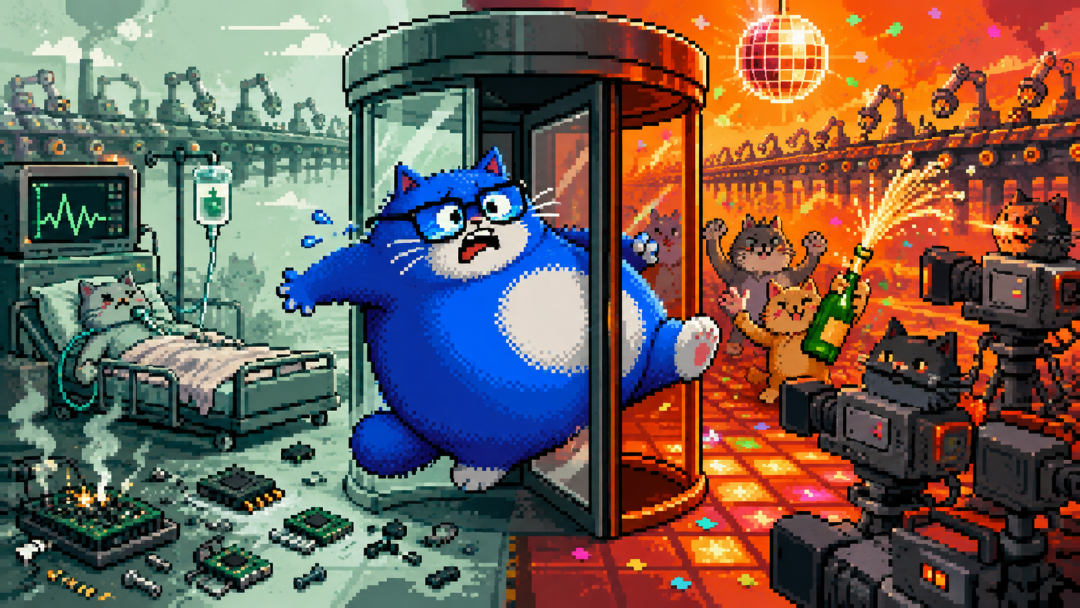 "Fat Cat's Bull Run"
MiniMax is a fascinating company — so fascinating that its financials barely matter. When it comes to revenue, there's only one number that counts: $800 million ARR in August.
Because everyone already knows the basic situation with MiniMax. Its performance swings wildly between divine inspiration and ghostly disappearance.
First, its text model M3 fell behind — no updates for three months, right when domestic Chinese models underwent a Great Leap Forward, leaving MiniMax a full generation behind its peers. The company hit its most critical moment, with the entire organization fighting with its back to the wall to train the next 3T-parameter model.
Then, out of nowhere, its video model H3 delivered — becoming the only viable model besides Seedance, surpassing Keling AI, which hadn't updated in six months, and pulling the company back from the brink of crisis.
So forget the financial reports — everyone knows where MiniMax stands. H3 launched in August, so its revenue doesn't appear in the first-half numbers; you only need to look at the latest ARR. Meanwhile, the "lobster" craze earlier this year, combined with MiniMax's knack for capturing viral traffic and its text model not yet falling behind at that point, means its revenue won't look bad.
The figure of "~$120 million revenue in H1 2026, with 80% B2B revenue share in August" meets expectations but is essentially meaningless.
Everything you think about MiniMax comes down to one question: Do you believe there's any fundamental difference between model labs, and is MiniMax several times worse than Zhipu AI or Moonshot AI?
I don't think there's any fundamental difference between model labs. Large models are high-end manufacturing — what matters is building data pipelines and infrastructure. There are no core technological moats, only differences in who ships updates sooner or later.
However, investors are always stupid, and public market investors are stupider than private market ones. Because public market investors have zero access to real information. They have no genuine feel for technology or products. They just rely on a bunch of finance bros swapping rumors, recursively circulating garbage information.
You have to admit, it makes sense for private market investors to make money trading stocks — because they can't actually approve deals themselves, but they can trade with their own money. More importantly, they're closer to company operations, so the rumors they hear are closer to first-hand information.
But I digress. Back to our beloved MiniMax.
What have I seen in MiniMax these past couple days? I've seen all the efforts teacher Junjie Yan has made for AGI 😭
Let me quote a few of Junjie's rallying cries:
"The large language model industry is not simple zero-sum competition. The intelligence gains from large language models are almost limitless."
"We are one of the first two independent large model companies in China to build scalable, long-term stable infrastructure."
"Over the past two-plus months, our text model's throughput per unit of compute has tripled. With M3.1, our goal is to reduce inference costs to roughly one-third of what they were at M3's launch."
"The core of the next phase of model competition is not compute scale or user scale, but whether you can define the right problems. Choose effective technical paths, and continuously improve the efficiency of converting compute into intelligence."
He's basically screaming at stupid investors: I'm on the same level as Zhipu AI, just temporarily behind. Don't obsess over who wins each version update.
So let's summarize the current meta.
GLM 5.2 marked the end of the old season; K3 marked the beginning of the new one. After this round of domestic model Great Leap Forward, the current competitive landscape for Chinese model teams is:
The new season has just begun, divided into two tracks. One is reaching for height, with the milestone being large-parameter models that can replace Fable 5 — Moonshot AI and Qwen have already submitted their answers. The other track is democratizing intelligence, using smaller-parameter models to accelerate AI adoption, with the milestone being a replacement for Opus 4.8. Current submissions include DeepSeek V4 Flash, Qwen 3.8 Flash, and GLM 5.3 Flash.
The two tracks complement each other and merge into one season.
Because reaching for height has clearly hit a bottleneck — mainly in coding capability optimization. All large-parameter models are coding models, and model coding abilities surpassed human levels back around late last year or early this year. Further gains yield diminishing returns.
Improving non-coding capabilities — office work, law, medicine, writing, document processing — isn't what model labs excel at. It requires AI applications to pioneer these scenarios, build corresponding data pipelines, and then model labs can follow up.
Right now is a great time for AI applications. To accelerate model capability improvements, we need more and richer applications. And application adoption can't primarily rely on large-parameter models — too expensive, too slow. We need fast, affordable, relatively small-parameter models.
That's why we're seeing all the model labs releasing Flash models.
This is what the sharp-browed, bright-eyed Junjie Yan wants to tell the family — MiniMax has its own compute infrastructure, is training large-parameter models to reach for height, and has cut inference costs to one-third of before. I can do big, I can do cheap. I'm competing in the new season. Just listen for the 🐉 roar.
However, if we're going to love MiniMax one more time, merely arguing that all model labs are roughly equivalent isn't enough — that's pure "wanwan leiqing" [substitute longing]. Just like the Fat Emperor loved Zhen Huan not because she resembled Empress Chunyuan, but because Zhen Huan had her own way of manipulating the stupid emperor.
Our dear MiniMax's biggest distinguishing feature is still H3, which contributed the most revenue in August. Video models occupy a unique position among the Four Little Dragons — able to go toe-to-toe with Seedance, and open-source.
This benefits all video Agent companies by breaking the closed-source monopoly. Anyone can post-train on H3. I'm waiting for Melvin Chen to announce that LibTV has achieved self-developed models.
As described above, the season of competing on coding capability has run its course. Multimodality is exactly the most important capability beyond programming, and H3's value should logically permeate the entire model stack. All the Flash models being released are multimodal, because building applications requires comprehensive model capabilities, and comprehensive capabilities bring data from more domains.
The season of unified model-and-application is arriving!
That said, MiniMax's biggest problem is that it hasn't yet proven itself in the new season. The video model H3 can drive revenue numbers, but stupid investors always get hacked by Saint Liang's offhand remarks about not doing multimodal, and look down on video models.
The question still comes down to whether you believe MiniMax is several times worse than its peers.
I don't believe it. The logic is simple: there's no intelligence gap between MiniMax and Zhipu AI's people, no massive compute disadvantage, and model labs swap rumors all day — there are no real technical secrets. As long as Fat Cat doesn't abandon itself, there's no reason MiniMax should underperform long-term (six months).
Of course, if it really does underperform long-term, I'll attribute it to intellectual deficiencies among team members.
Anyway, after two years of version updates, you family members surely understand one truth by now: in this game, everyone falls behind sometimes.
K3 may have opened the new season, but whether Moonshot AI can keep reaching for height isn't divinely ordained. Zhipu AI may be an old god, but if it can't ship a 3T-parameter model for too long, it might get the MiniMax treatment too.
I've even prepared the announcement script: "Upon organizational review, Zhipu AI will no longer enjoy its previous treatment status, and is downgraded to MiniMax (quasi-Zhipu) standard; MiniMax is correspondingly upgraded to quasi-Zhipu treatment."
Times change, roles reverse — it's only natural. All I can say is, family members, each must strive on their own. On Protracted War is the real deal. Everyone should study it.
(Cover image generated by ChatGPT; purely human-written)
⬇️
Subscribe to our Substack: funeralai.substack.com