Mulerun's "Borrowing the Fake to Cultivate the Real": The Agent Market Enters Open Competition

A Mule of a Leader in AI 🐎
"Mule Horse Leads AI 🐎"
Six months ago, my conclusion on MuleRun was that the Alibaba veteran had brought out his e-commerce playbook, aiming to build an AI Taobao — supply-side reform, classic through and through. The last line of that article was: just wait for the big moment — drink two bottles of fake liquor, sleep till next year, and you won't have missed a thing.
And indeed, nothing happened in the past six months. AI entrepreneurs have been forcing content where there is none.
Openclaw was the only thing that exceeded expectations. It's a major interaction innovation, the first to deploy agent capabilities at scale inside chat software, letting ordinary people finally understand how agents are actually supposed to work.
The lobster mainly solved the problem of people staring at web chat boxes not knowing what to do. Before this, the dominant agent form factor was the web chat box. Chat boxes everywhere — too many of them. How is a new app's chat box supposed to compete with Doubao?
But once the lobster plugged into chat software, you could send a voice message anytime to get an agent to do something. Zero barrier to entry. Instantly hit the sweet spot for all the middle-aged dudes.
Right now I have MuleRun tracking the Russia-Ukraine and Iran situations, monitoring several Telegram groups for first-hand updates, and summarizing the latest developments for me on schedule. Way better than skimming news briefs, no?
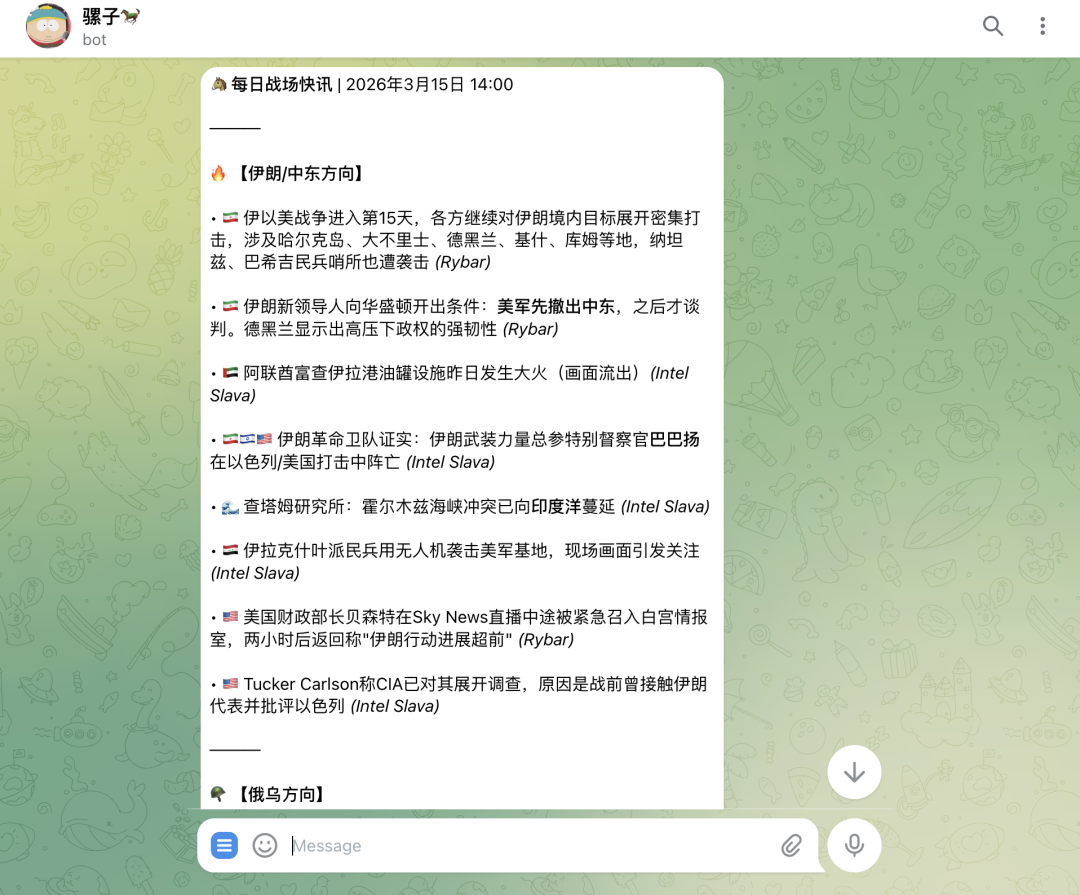
The sharp-eyed among you may have noticed: after hooking MuleRun into chat software, I deliberately named it Mule 🐎. The Mule Horse family, whose actual body is off in America hyping GDC, nominally became my slave. Calling AI by your name, basically.
Back to business.
Looking at the past year's experience, agent is the first derivative; the second derivative story is Agent Marketplace.
After Manus came out, everyone realized the next big phase is the agent market — mobilizing the masses to turn expert knowledge and experience from every industry into customized agents. But nobody knew how.
This was also what MuleRun and Coze were exploring from the start.
Once the lobster dropped, everyone instantly got it: Agent can't access your Google account? Add a skill. Can't summarize YouTube videos? Add a skill...
Skill went from abstract concept to concrete experience. Experience and knowledge become work tasks, pushed to you via email, documents, or chat software.
However, the lobster framework itself doesn't hold up to scrutiny — technically and engineering-wise it's overly complex and bloated, completely unmaintainable by humans, relying entirely on AI to merge developer-submitted code. Anyone seriously building agent products should obviously use the Claude Code SDK.
But the fake thing cultivated real understanding — the agent marketplace story was too convoluted before. Find industry experts, help them deploy their expertise to the platform for distribution. Sounded like a Web 1.0 tale.
This is cultivating truth through the false. The lobster framework is unmaintainable, but it was the first to push Agent-plus-Skill to the forefront, turning the agent marketplace from a vague consensus into an obvious move everyone can see.
Now MuleRun has iterated considerably: 24/7 cloud computers, integration with Telegram and other chat software, scheduled tasks, skill marketplace — everything you need, all in one place.
I've uploaded two skills I developed from my own work to the cloud, available for anyone to use on MuleRun.
One is PDF-to-Markdown, specifically optimized for long e-book PDFs, letting even 50MB+ PDFs convert into cleanly formatted Markdown documents for easier AI processing of large text volumes.
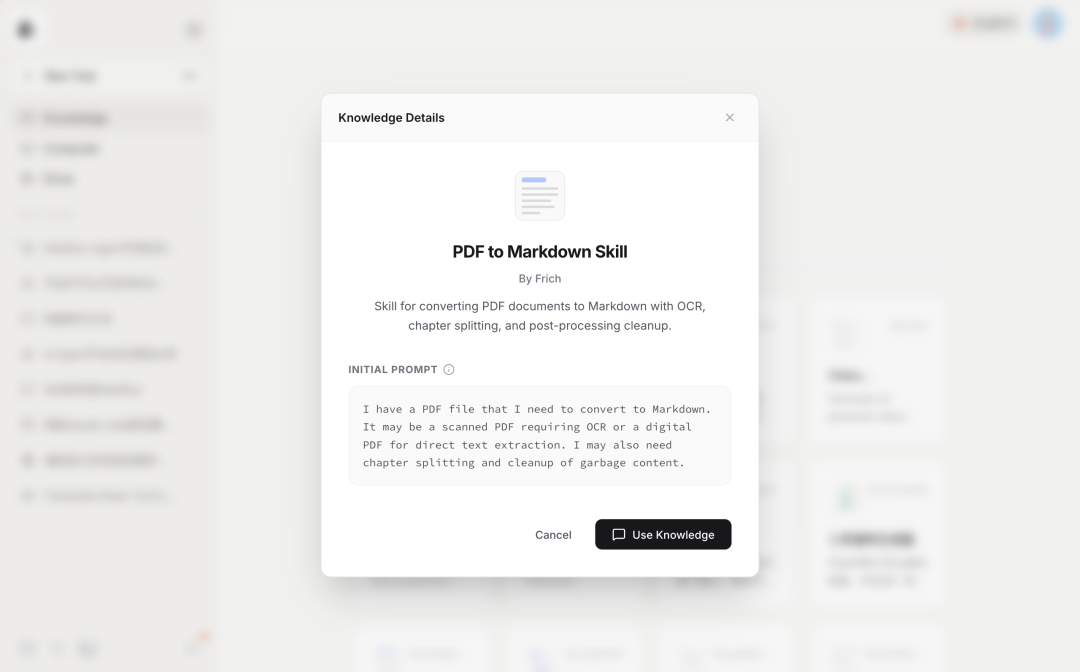
https://mulerun.com/chat?template=ff9f5ec2-13da-4d1d-841b-5475c981f6f8
The other is the AI Hype Bible, a.k.a. the Mule Horse's world-premiere AI self-media headline creation guide. You can use this thing to generate sufficiently explosive, stimulating, no-limits clickbait headlines for any article.
So I generated several banger headlines for this piece:
"Late Night Bombshell! MuleRun Integrates Chat Software + Cloud VM, Global Indie Developers Fall Into Collective Paralysis..."
"Agent War! Cloud War! Skill War! Hundred-Factory Battle! Alibaba, Tencent, Google, AWS All Breaking Out, Gunpowder Everywhere!"
"MuleRun Is Going Insane! Skill Marketplace Launches, All Vertical SaaS Has Been Sentenced to Death"
Readers, judge for yourselves which one slaps harder.
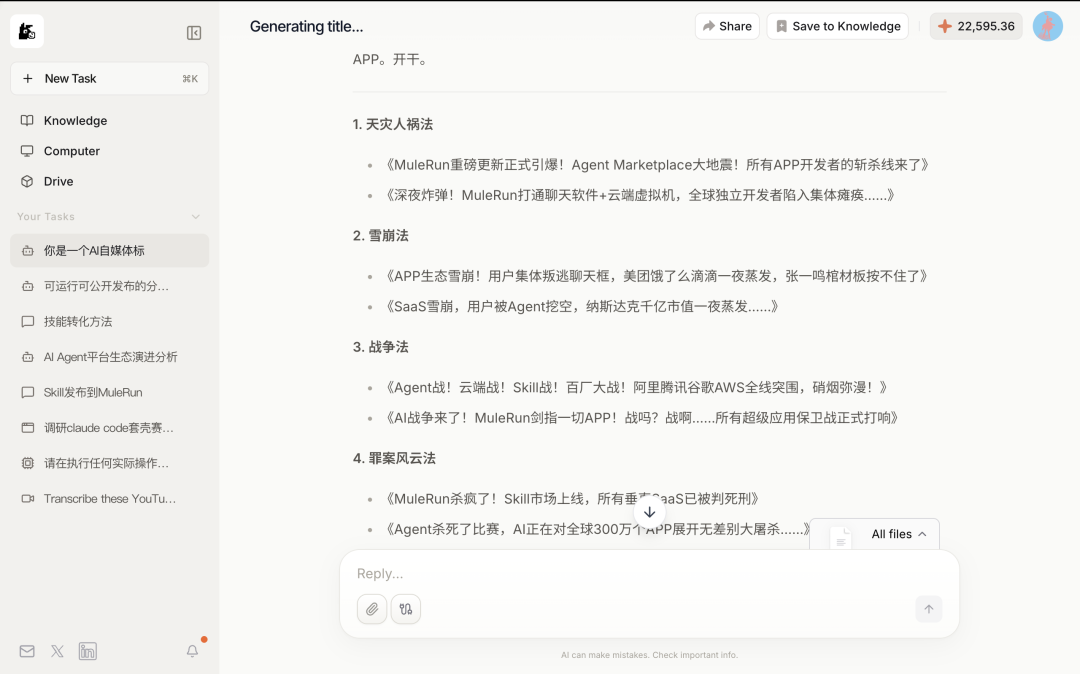
https://mulerun.com/chat?template=9cdf4bcf-fa6c-4341-aba8-fe3bd6edf277
These skills run on MuleRun's cloud, alongside many other accumulated skills you can freely use. This is what the agent marketplace means.
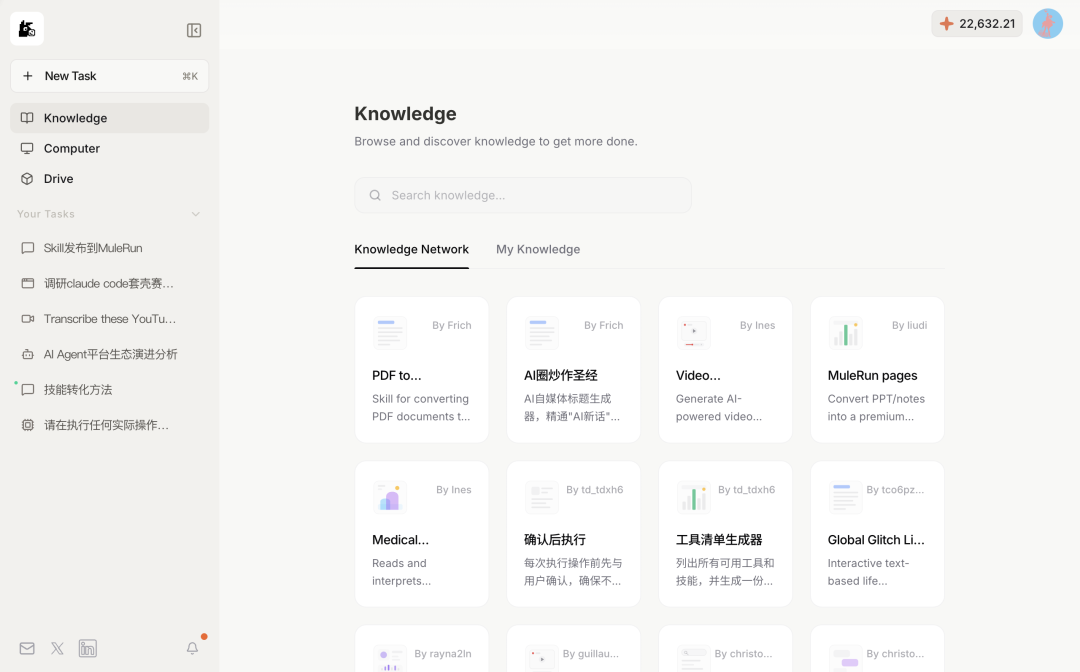
From this, I had a big thought 🤓
The agent marketplace runs on cloud, and the cloud market is winner-take-all — this is ground the major players cannot afford to lose.
This season, the big players' advantage is even more pronounced. CC SDK has flattened agent capability differences — Claude Code is the strongest, everyone's doing CC wrappers, agent capabilities are roughly equivalent. The competitive focus has shifted to environment and ecosystem.
MuleRun and Coze have been openly building toward the agent marketplace for a year, accumulating more reusable industry experience. Ecosystems need time to mature — this is first-mover advantage.
MuleRun also figured something out: the agent marketplace should be invisible to users.
Most people have no experience to share with AI. For them there are only two interaction interfaces: a web dialog box, or integration with chat software. The point is making it easy for people to use. The skill ecosystem recedes to the backend; the platform handles matching.
An agent marketplace for ordinary users needs to work out of the box, and work inside chat software.
But MuleRun still has an obvious weakness: local environment integration isn't there yet.
The command line renaissance and the lobster hype frenzy both proved that for productivity users, letting AI directly access local files is transformative. Any cloud-based AI can only tell you the solution; it can't directly solve the problem for you. Local environment is still the next priority.
To wrap up: the AI startup track has now bifurcated into two paths.
Claude Code local wrappers are the indie developer track — the local environment has room for several indie developers.
The cloud agent marketplace is the major players' battlefield — Alibaba Cloud, Tencent Cloud, Volcano Engine, Google Cloud, AWS. The last season already proved that cloud is where Matthew effects run stronger: customer acquisition, traffic, ecosystem — the big players still dominate.
At this point, the agent marketplace is no longer just about competing to become the AI Taobao.
The trend embodied by the evil, hype-crazed lobster is: front-end invisible, back-end all-in-one. Users call agents from any chat software, any interface; agents access all internet services through APIs — email, GitHub, cloud storage, documents, ride-hailing, e-commerce...
You no longer need to open different apps one by one. Just tell the agent in your chat window what you want, and it schedules all services to complete it for you. MuleRun's cloud VMs, chat software integration, and skill ecosystem are the infrastructure for this scheduling hub.
Once local environment is integrated next, the hub will be complete.
This isn't the war for AI Taobao. This is the war of agents devouring all apps (please contemplate using the AI Hype Bible skill).
(Cover image generated by ChatGPT, writing assisted by Claude Code)
⬇️
Subscribe to our Substack
funeralai.substack.com