Nobody Needs AI Podcasts Except Investors

Niche markets make it easier to spin a closed-loop story.

"Small Niches Make for Tighter Pitch Decks"
I genuinely don't understand why any AI founder would choose the podcasting vertical.
Audio podcasts are an extremely niche market. Xiaoyuzhou has only a few million DAU, and its listenership is basically white-collar workers in first-tier cities. Even overseas, Spotify can't turn a profit on podcasts — they just drag down its margins.
AI podcasts are an even more hollow, almost farcical proposition.
Until the past couple of days, when it clicked. Podcasting, precisely because it's such a small niche, makes it easier to construct a closed-loop narrative. Every self-described AI podcast product — every independent one — isn't built for users. It's built to tell investors a story.
AI podcast products are all founder-to-investor entrepreneurship. User needs don't matter; what matters is whether the story holds together.
First there was ChatPods, now there's Laifu Radio. The latter has crafted a more carefully constructed closed-loop story.
ChatPods is the type that couldn't even finish its story properly. It wants to build a new podcast listening platform, with the approach of aggregating podcasts from across the web, recommending a few episodes daily, then generating a few minutes of voice summary that you can interrupt at any time to listen to the full episode you're interested in.
The problem is: why would users listen to a few minutes of voice summary first, instead of just opening Xiaoyuzhou or Spotify and tapping their subscribed shows? This is a product that didn't even try hard to make the fiction convincing.
Laifu Radio put in the effort. It tells a closed-loop story 👍
Laifu Radio's content is AI-generated, with dozens of inexplicable programs like "Ancient Celebrity Hot Search Rankings," "Tang Dynasty Storms," and "Internet Affairs." Each episode runs about ten minutes, and you can swipe left or right to switch between system-recommended episodes.
Users can also request on-demand content: hold the talk button, and the AI will custom-generate a podcast of a few minutes.
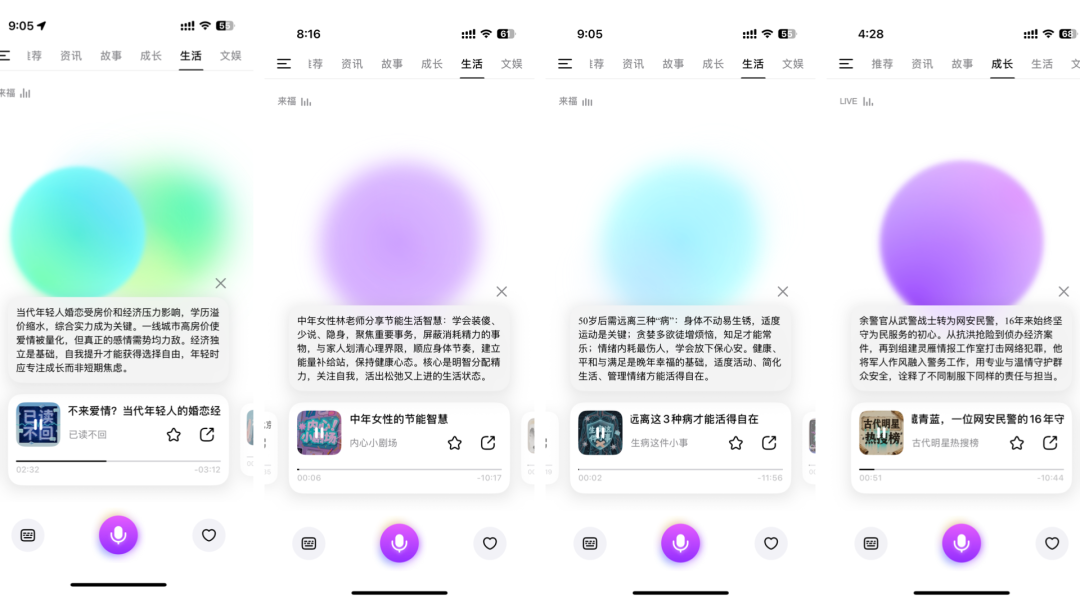
My first reaction: this feels off. Who's listening to an AI-voiced Story Magazine? The stories aren't even as wild as what you'd find on Ximalaya.
But thinking about it more carefully, I suddenly realized — this is exactly the "data flywheel + content platform" story that investors love to hear. The more users listen, the more data the platform collects, so it can generate content users love even more, and the snowball keeps rolling.
The logic is closed-loop; you can't defeat it from within Laifu Radio's own framework.
But there's one enormous problem: the AI-generated content itself is terrible.
I can hardly imagine anyone listening to AI-generated podcast content with genuine enjoyment. Open Laifu Radio and you're immediately hit with things like "Princess Gaoyang's Forbidden Journey with a Monk," "Energy-Saving Wisdom for Middle-Aged Women," and "Three Types of People Slowly Draining Your Life."
Using AI to build a budget Ximalaya clearly addresses no real user need. And Laifu Radio's voice synthesis is mechanical — not only inferior to Doubao, but even worse than ListenHub...
More seriously, this content is AI-fabricated.
Using AI to compress existing information for paper summaries or news briefs? Fine. AI can absolutely replace news and information programs — something like Sheng Dong Zao Ka Fei (Morning Coffee).
But using AI to tell stories like "Veteran Xiao Wang Goes to Yunnan to Start a Business, Wins Big on Jade Gambling to Become a Millionaire, Then Falls into Drug Addiction and Loses His Family" (an actual Laifu Radio-generated podcast) — how can users trust this? This is worse than Story Magazine.

The core of podcasting is people. Only people can share genuine experiences and insights. Only people will make offensive statements. AI can't do this. Large language models have no subjective agency. They're good at compression and structuring information, but they cannot generate firsthand original information.
Listening to an author record a podcast about their book, versus listening to an AI-generated podcast from that book — these are completely different needs. The former partly satisfies companionship and entertainment needs; the latter is purely about information acquisition.
So-called AI podcasts are, at their essence, voice summary tools.
Google's NotebookLM never calls itself an AI podcast. Its positioning is "Audio Overviews." That's the honest way to describe it.
The only valid use case for this kind of tool is helping you understand complex text. You feed it a paper; it explains it to you in voice. That works. But this has nothing to do with podcasts like Left Right or Lex Fridman.
ChatGPT or Doubao adding voice mode; NotebookLM or Tencent's ima adding voice summary features to their knowledge base tools — all of this makes sense. But this is definitely not a standalone product.
Every product on the market calling itself an AI podcast isn't competing with podcasts on Xiaoyuzhou. It's competing with WeChat Reading's text-to-speech feature.
Mainly, if you insist on telling investors a platform story, don't pick podcasting. Podcasting really isn't a good business.
Swap audio for video, and pitch yourself as building AI Douyin. Video models' photorealistic human results are still a bit lacking, but you could focus on meme content — custom-generating anime videos for users, or Fat Cat, Sister Yu, Emperor Qin videos. Isn't that more imaginative than AI podcasts?
(Article illustrations generated by ChatGPT o3, with writing assistance from Gemini 2.5 Pro. Made a video version 👇)