Only hype-chasing hacks do "one-sentence generation" AI

Noise is the enemy of information.

"Shannon: Noise Is the Enemy of Information"
Dear AI hype merchants,
Stop building "one-sentence generates an article, one-sentence generates a video, one-sentence generates a podcast" AI products. They're worthless. Pure noise pollution for the internet.
The reason is simple: "one-sentence generation" AI doesn't solve the information input problem.
The great Shannon said the key to transmitting information is reducing noise. Without original information input, AI just repeats what's already on the internet, manufacturing noise. AI-generated content from a single prompt is the classic case of high noise, low information.
My friend Ahong has a brilliant analogy for this: "The current state of AI: half the people are working hard to transcribe podcasts into text; the other half are working hard to turn text back into podcasts. Ultimately achieving the effect of doubling GDP."
To put it more bluntly: many of our dear AI hype merchants are trying to launch themselves into the sky by stepping on their own left foot with their right.
Let's break it down.
The internet industry can be divided into three core stages: information input, information processing, and information distribution. The vast majority of AI products are concentrated in the "information processing" stage.
The office suite we all know — Word, PowerPoint, and Excel, plus the Adobe family, CapCut, and most SaaS products — these are all extensions of the same thing. They're all information processing tools.
Today's AI products are the same, mainly doing information processing. If you only do information processing, the ceiling for an AI product is becoming a Word plugin.
The great Shannon also said: information is the reduction of uncertainty. Word processing information is valuable — it standardizes information and reduces noise. But the vast majority of AI products take one sentence of nonsense and expand it into a three-minute podcast or a 2,000-word article. Pure noise increase.
The internet's real value creation happens at the information input stage.
Outside of finance, information input in the internet industry has barely been industrialized. The entire internet relies on humans to solve the information input problem. Toutiao and Douyin only used the industrialization of information distribution to force content creators to produce more and higher-quality content.
Anyone with even slight expertise in any industry can generate many original ideas. Creators — living people on the internet — are the sources of high-quality information. They are essentially feeding the internet a steady stream of certainty, reducing the noise produced by marketing account matrices and AI-generated content.
That said, AI one-sentence generation isn't completely worthless.
I recently learned an analytical framework: "weak vs. weak" and "weak vs. strong."
"One-sentence content generation" describes AI products with weak information input. A weak-information product generating content for a weak-information industry — this works.
E-commerce is a classic weak-information (low signal-to-noise ratio) industry.
E-commerce users care most about price, and relatively little about other information. E-commerce merchants also care most about price, without highly specific requirements for advertising videos. As long as the visuals look decent and the product information is accurate, that's enough.
So the weak-information e-commerce industry can absolutely use weak-information AI to generate advertising videos.

Icon and Lovart clearly have more promise than Medeo and ListenHub
This is also why Jack Ma built e-commerce in the 1990s — because the information density in e-commerce was relatively low. The platform just needed to connect consumers and merchants. Before social e-commerce emerged, it didn't require complex information input.
But weak vs. strong (high signal-to-noise ratio) doesn't work. When we apply weak-information AI products to strong-information domains like podcasts and Douyin, problems emerge.
Users want substance, not fluff. These fields require massive, high-quality, original information input. You give AI one instruction, it performs human centipede on repeated internet content, and can only generate high-noise, low-information garbage.
So if you want to build truly valuable generative AI products, you first need to solve the information input problem.
In the near term, finance is the most promising. Because financial data is the most standardized. Purchase a financial data API, and you can provide high-quality information input.
Essentially, you just need to layer a "generation layer" on top of "information layers" like Wind or Bloomberg Terminal. For example, a certain AI product could call Bloomberg Terminal. I just give it one sentence: "I want to research today's soybean meal futures market," and it calls the corresponding API to quickly generate a research report.
This model works because finance has ready-made high-quality information sources. Financial AI products only need to convert information into the format users need.
But in non-finance fields, how do you achieve high-quality information input?
One possible method is progressive information input.
Current "one-sentence generation" AI products lack interaction. A better approach is feedback optimization — AI quickly generates a draft, then the user sees the draft and gives specific feedback.
I can still let AI generate an article for me with one sentence, but during generation, AI rapidly produces a draft, then the user gives feedback based on that draft. Then AI calls new information sources at each step to generate new drafts. After several rounds, the final article still contains original information input.
Users don't want to think. DeepResearch's confirmation step is useless. Ideally, you'd split one active user output into multiple passive responses.
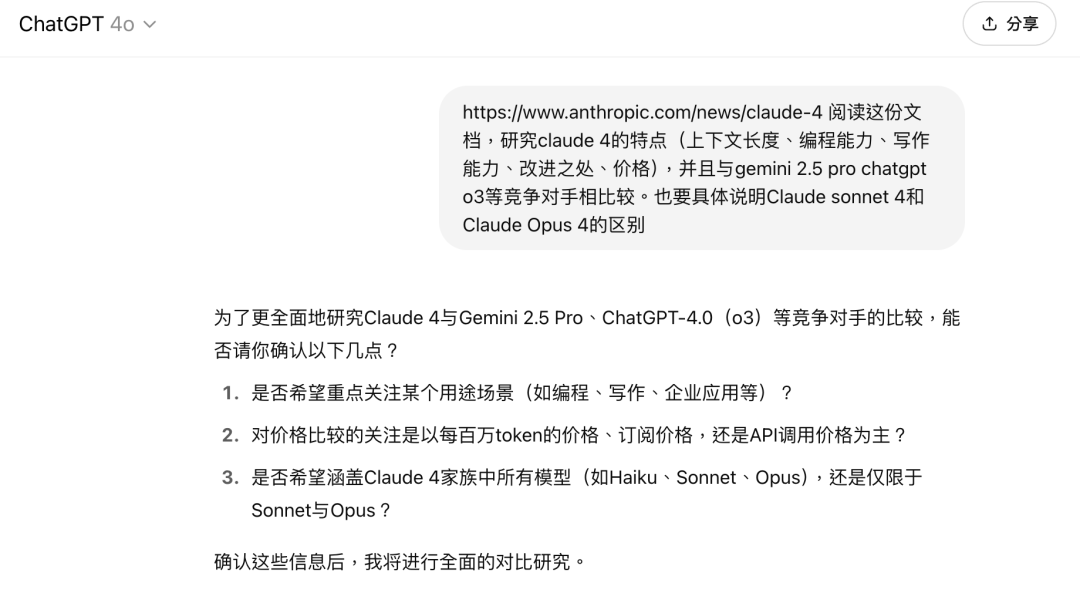
Most importantly, using large models to compress information has little value. Using generative AI to compress information is manufacturing noise, not providing more certain information.
The correct approach is to mobilize AI's creativity, letting AI assist in generating more accurate, more creative content — not just compressing information.
In short, only when AI products truly solve the information input problem can they evolve from being plugins for information processing tools into something capable of independently creating value.
As the poem goes:
Master Shannon's information theory, and you too can opine without knowing how to code.
(Images in this article generated by ChatGPT 4o, writing assisted by Claude Sonnet 4.)