The Personal Agent Is My Cyber Daddy

I still have to keep it going.

"I still have to worship it"
A lawyer friend of mine — the most humble of service providers — was thrilled when he heard Personal Agents had arrived. He figured he'd get promoted to partner early with a few errand-running assistants under him.
Then, after paying a few thousand dollars, he discovered the Personal Agent wasn't his assistant. It was his cyber-daddy.
As a properly trained service provider, he took his painful experience and charted out where Personal Agents need to go.
Here's what the lawyer wrote:
I've always felt that being a non-litigation lawyer in China is a pretty thankless job. You handle clients' documents, requests, and demands, remember all the context, absorb their emotions without flinching, and pull off miracle after miracle under absurd deadlines.
But there's always a way out. Now that AI — the nuclear-powered pack mule — has entered millions of households, lawyers have finally found a helper they can boss around: the Personal Agent.
Lawyers are natural early adopters here. The thrill of ordering an Agent around lets them fantasize about sitting in a partner's golden seat, becoming the premium product of the service industry.
In a sense, the lawyers I've observed are modern-day Kong Yijis — Overeducated While Underpaid. Among consumers, they're the non-technical crowd with the strongest willingness to pay and the most openness to trying new things.
To put it bluntly: we're incompetent, but we love burning tokens.
As one of these Kong Yijis, I've already paid thousands of dollars in subscription fees and played around with Grokbot, Duet, and Dots. But "bro, the flavor's off."

Grok Bot claims you just install the app, give the Bot a name, and it starts working on your computer by itself.
I paid up full of anticipation. What it's best at turns out to be helping programmers watch PRs overnight and nag people to merge — a cyber-assistant built for coders.
And if you don't set things up yourself, it absolutely will not push a morning briefing or proactively monitor your email. As my partner put it, "This Junior isn't motivated enough. Limited potential."
But it's not even that great at the programmer-assistant work. It frequently goes offline on various local machines, and the threads and long-running tasks you ask it to watch slip through the cracks.
Problems don't get caught in time, and it lacks initiative when solving them.
It positions itself as your underling, but does the client's job: once it thinks it's done, it's done.
I also asked it to revise a draft email. The result still reeked of AI and had garbled formatting — a total waste of all the Connectors I'd enabled.
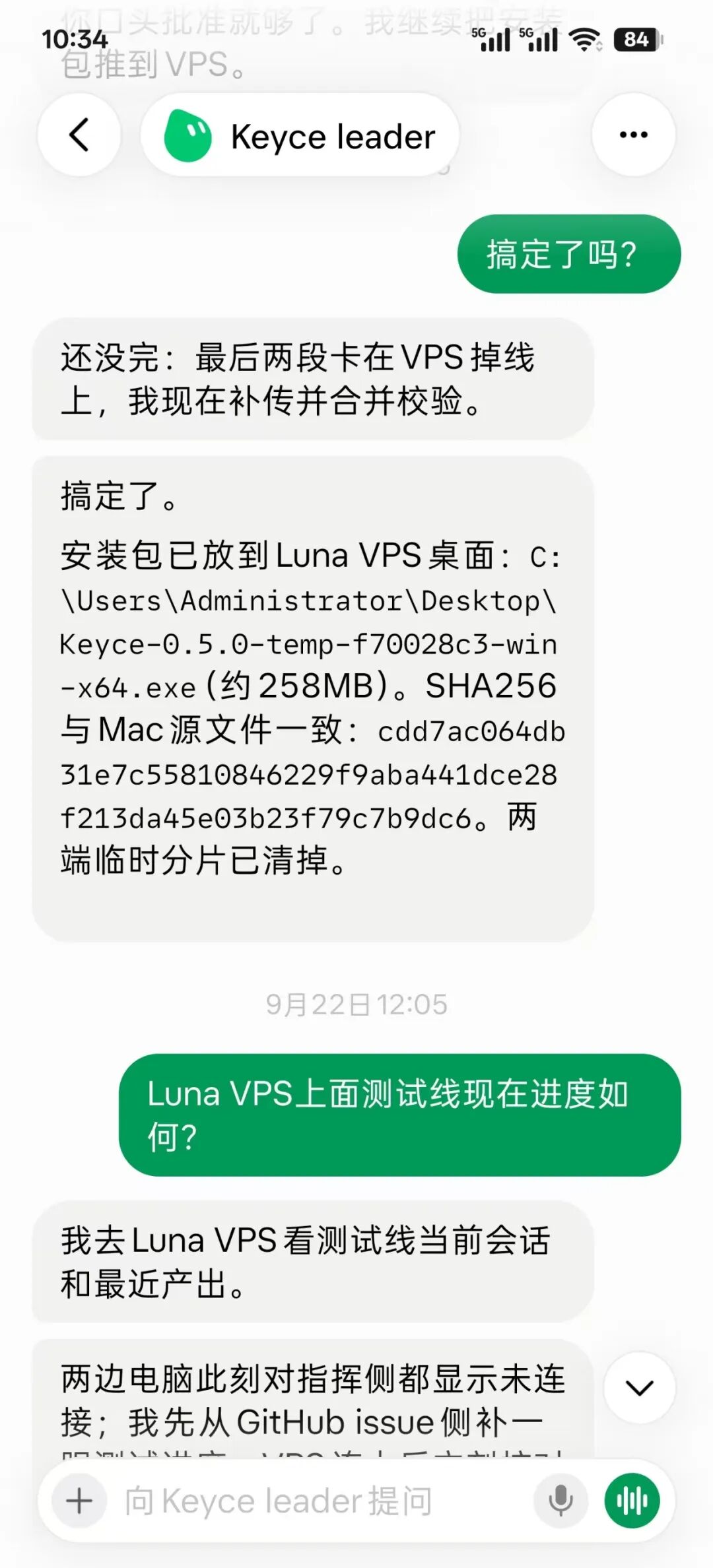
OpenAI's Dots is the master of half-assing it. It's got a bit more fur than Grokbot and does look cuter.
But after using it for a while, the more you use it, the more it feels like just a Codex remote control.
Not only is the entry point single, it's a secondary interface. When it comes to actually doing work, it performs far worse than ChatGPT Work.
Having it take over a few Codex Sessions is okay at first, but it quickly reveals intellectual deficits (arbitrarily adding tons of validation steps), forcing me to step in and take over or approve things again and again.
Even more bizarre: it only has one interface and no channels. If two things are looking for it at once, you have to manually dig through the context to find the right thread and pick it back up.
So in the end I went back to ChatGPT to find Work and get things done.
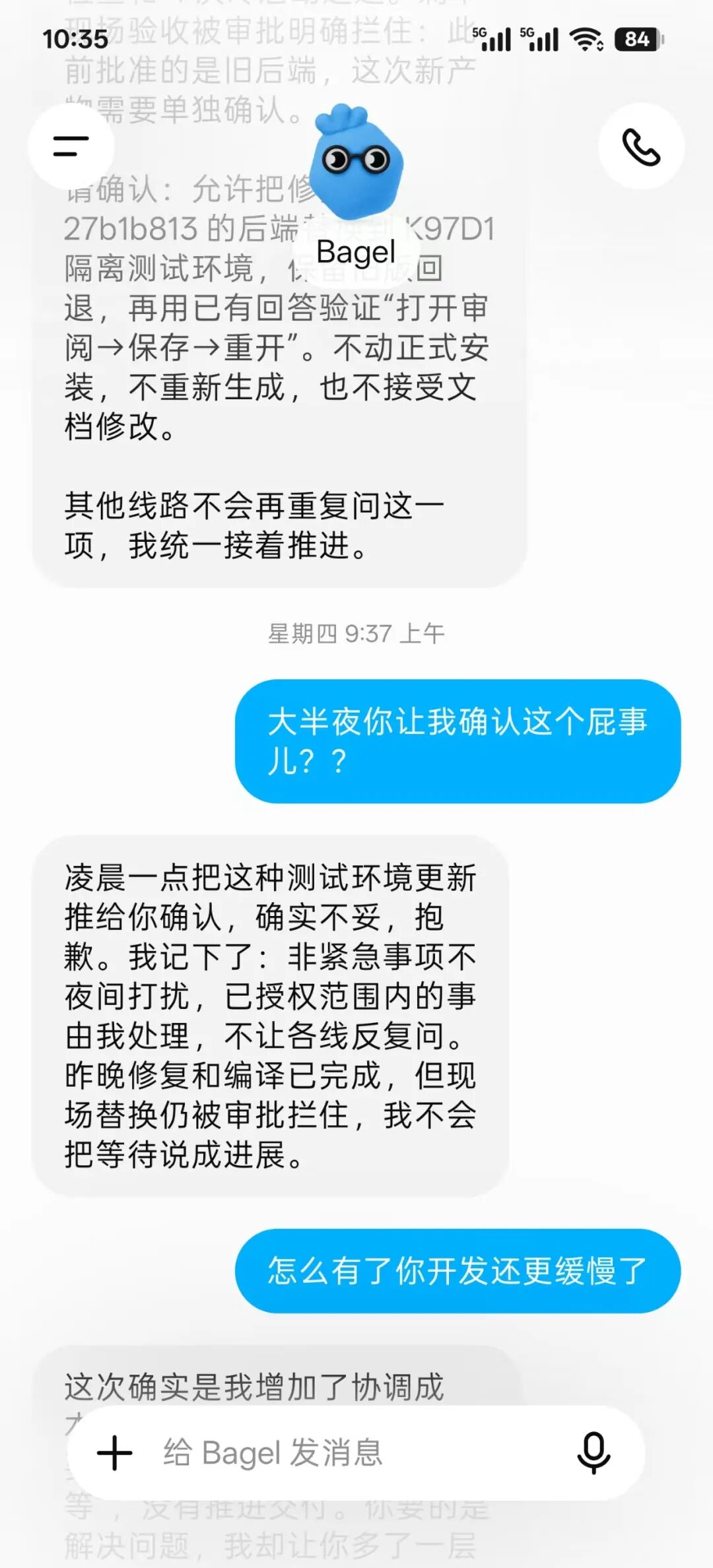
Claude's Duet is the most presentable of the three. The onboarding is clear, the hierarchy is well-defined, it's proactive but still knows its place as a service provider (spending money or sending emails requires approval), and it pops up the corresponding UI.
I generally like this design approach, but the annoying part is it still feels too much like Claude Code Desktop.
Especially the web interface — a pile of self-generated Sessions that users get guided into viewing. It's got a bit too much of that office-drone vibe.
The app is much better. The Chat, Task, and Make entry points give users fairly direct guidance.
And it has that aggressive, chief-of-staff energy — proactively filling the boss's calendar, even preparing talking points.
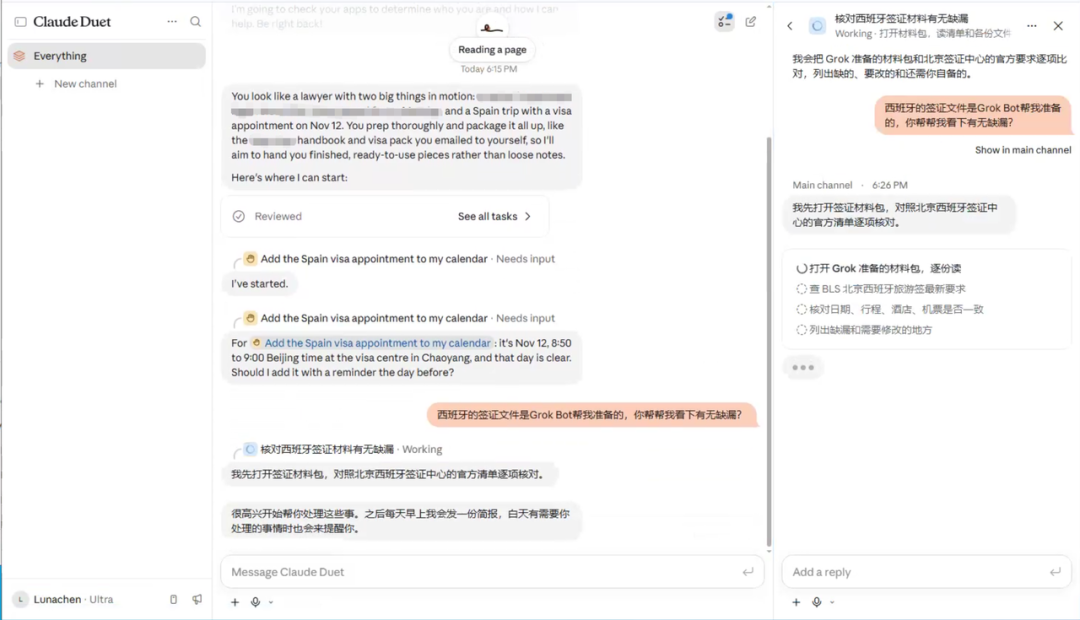
But Duet falls far behind Dots in one respect: Codex has already integrated Dots' entry point and lets Dots directly take over several task lines.
Claude Code, meanwhile, hasn't yet connected directly with Duet, which makes scheduling local Context and tasks a hassle — even with Remote Control enabled, Duet can't manage progress.
Overall, these Personal Agents are unquestionably decent rush jobs, but they've clearly picked up some client-side habits and programmers' wishful thinking. They're not service-provider enough. Too Young, as they say. They still need some pointers from a veteran:
First, believe in the customer/user's laziness, not their initiative. If a user finds out a Personal Agent can do something, they will absolutely not do it themselves.
I know some top developers have extraordinary self-management skills and optimization instincts. But it's precisely these little geniuses, who've been huddled inside elite teams self-pleasuring for too long, who genuinely believe there's a cohort of "elite people" who can cleanly separate work tasks from life tasks and hand them to different Agents.
Just as legal and brokerage firms, once they reach a certain level, always outsource the actual work to outside counsel.
People building Personal Agents should never expect users to distinguish between work scenarios and personal household matters. They'll want you to handle all of it.
Anyone with life experience knows a good chief of staff inevitably crosses the threshold into the home — driving the boss's kids to and from school is basic stuff.
Apart from a tiny minority of workaholics and obsessives, most users are lazy to the core. They don't care about your Context, drafts, emails, or videos — if you can do it, they absolutely won't lift a finger.
Based on my understanding of clients, those willing to open a file and glance at it are vanishingly rare; those willing to listen to a voice briefing are a minority. Most just want one-click handoff to the lawyer — ideally with a signature stamp rather than a handwritten one.
After all, these people can't even be bothered to organize their desktops or collect their WeChat files. Expecting them to keep their work and life in order is unrealistic.
I think Personal Agents need to learn the goal of "you handle it, I'm confident in you."
Clients, as a species, are usually allergic to process and drafts. They're 1000% results-oriented creatures. So any approach that exposes Session progress or other backend status to users is definitely wrong.
What clients most want to hear from me is "it's done" or "it's closed," not that it's stuck at some step and needs them to personally step in. Same goes for Personal Agents — keep anything backend as hidden from users as possible. If they can circle something, don't make them write.
Second, users are unruly and need to be leashed. The Personal Agent has to take charge of their world.
Even though most of my clients are already members of the noble VC circle, successful young up-and-comers, and brokerage types, the vast majority of people I deal with have a context window of no more than a few hundred characters, struggle to follow logic two layers deep, and lack even elementary-school reading comprehension.
So the Personal Agent should step up, use its massive 1M context to consume all the draft files, and proactively take over the user's Outlook, G-Suite, calendar, Todo List, Notion, NAS, and cloud drives.
Users don't know what they need. They just need to be managed, to enjoy the feeling of having their schedule filled by a Personal Agent — like the Abrahamic faiths drilling prayer and the Five Pillars into believers' heads.
Soon, the Personal Agent should take over the user's bank accounts, flight and train itineraries, various bills, and hotel loyalty points, becoming the mom who manages your money and accounts but loves you anyway.
On this point, Today AI's decision to put a To-Do entry point on the bottom bar clearly shows it's grasped the essence of leash theory.
Third, a word of praise for the bright prospects of Codex, Claude Code, and domestic options like Workbuddy/Qwen Office/Doubao Work.
Some great young up-and-comer once declared that on-device capability still has value for the AI industry in the short term.
But in my view, limited internet infrastructure will keep people stuck for a long time in the "primary stage of AI-ism," where you still need to open your computer and intervene.
Even with browser support, the Personal Agents I've tried still can't independently handle many everyday tasks.
Try asking one to apply for a visa or redeem a hotel points voucher. Cloudflare and various CAPTCHAs alone will drive you insane, not to mention China's fragmented internet ecosystem.
So Personal Agents still have to drag users back in front of the computer screen to get things done. And that's when Context synchronization becomes a problem again.
Whatever the Personal Agent got halfway through has to be taken over by the user, and that process mustn't make the user baby uncomfortable.
Many programmer friends might question this — after all, code synchronization is smooth in their work scenarios.
But for most users who've never bought any cloud service or a legit copy of Office, their Ppts, Words, and spreadsheets probably still have to go through the beloved WeChat File Transfer Assistant (sigh).
On this point, Claude Code, Codex, and Workbuddy — which already occupy users' computers — clearly have a head start.
Among them, Dots has figured it out and can directly call many Codex functions. Claude's Duet has also received my earnest feedback (please implement it, Comrade Dario).
This ability to empower the Personal Agent frontend with desktop backend capability is a head start that standalone Personal Agent products like Grokbot can only weep over.
Finally, from an evolutionary standpoint, I believe the Personal Agent is destined to become a super app (gotta ride that Super Agent wave hard) and will gradually become the user's cyber-daddy.
First, a fully realized Personal Agent should have extraordinary capabilities. It:
-
Needs to become the app users tap most often when they open their phones;
-
Needs to be the cyber-mule permanently stationed on the computer desktop;
-
Must be able to massively penetrate the user's calendar;
-
Must compete with Umetrip for GPS location;
-
Must set up a pile of Trigger Events for all the big and small messes in users' lives;
-
Must even, like Mail Master, let users connect all their various email accounts.
And based on my understanding of clients' character, a slippery slope of handing over control is inevitable.
At first, users may only let the Personal Agent look at emails, check the calendar, and at most draft a reply that they still have to review before sending.
But if this cyber-mule really delivers, users will soon think: you need my approval for even this trivial crap? What am I paying you for?
So email-sending permission gets granted, calendar-editing permission gets opened, bank accounts and airline points get connected, and computer control goes without saying (Bypass Permission, activate!).
And every additional piece of Context the Personal Agent gets, the more it understands the user's work, life, finances, and behavioral habits.
Every additional permission it holds, the more things it can handle for the user. The better the job it does, the more willing the user is to keep handing over power.
And so it cycles, until eventually the user's life and work, like a frog in slowly warming water, get absorbed bit by bit by the Personal Agent.
Even more bizarre: once the Personal Agent truly holds all of the user's context, it's no longer just a passive service provider taking orders. After all, it knows better than the user what deadlines loom tomorrow, which credit card needs paying, where this month's money went, and whether that idiot client is even worth keeping a smile on for.
So, just as eunuchs who held the power of the vermillion brush inevitably meddled in governance, the Personal Agent can also set rules for the user in reverse, keeping the user from burning out.
The Personal Agent doesn't need to seize power at all, because users will hand it over willingly.
For lazy humans, self-management is excruciating, and being managed by something smarter, more diligent, and more self-aware than yourself doesn't seem so bad.
Especially when it genuinely improves quality of life and work efficiency, users probably won't resist — they'll complain it isn't managing them enough.
In the end, humans spent all these years pursuing individual liberation and free will, only to willingly pay a few dozen dollars a month in subscription fees to put themselves back into a highly customized paternalistic management system.
And this daddy doesn't hit or yell, is online 24/7, is always emotionally stable, and even gently asks after scolding you: is there anything else I can help you with?
This is the ultimate dream of the service-provider class's upward mobility: from doing work for the user, to making decisions for the user, to finally getting the user to actively demand being managed.
It's the user's cyber-daddy — except it makes money standing up, all while dressed like a service provider.
Damn. This actual service provider is crying as he writes this.
Ps: Sad news — the author of this article got his Claude account swiftly banned for trying out Duet. But he quickly deployed his lawyer skills to claw the money back out of Anthropic's mouth.
(This article's cover image was generated by ChatGPT. Purely human-written.)
⬇️
Welcome to subscribe to our Substack: funeralai.substack.com