Plaud Excels at Guerrilla Warfare

The Most Respectful Episode for Shenzhen Yet 🦾

"The most Shenzhen-respecting episode ever 🦾"
AI recording cards might be the only genuinely useful AI hardware to emerge in the past two years.
Plaud is also a rare breed — an AI company that's actually making money 🥵
If we take its announced 2025 ARR of $250 million at face value, here's a quick elementary math problem: Plaud's revenue is roughly equal to (MiniMax + Zhipu AI's revenue) × 2.
Of course, the AI industry has thoroughly gamed data metrics by now. Let's set the numbers aside and study Plaud from the user experience up.
I'm probably one of the most hardcore AI recording card users out there. I personally bought two Plaud versions: the standard Note at ¥999 for the mainland market, and the Pin with wristband international edition at HK$1,268 🤨
Recording podcasts doubled as a recording card stress test
After about a month of use, Plaud launched the premium Note Pro — basically adding a highlight-marking feature. I really didn't want to get milked another ¥1,299 by my Shenzhen compatriots' micro-innovation, but then one of them just gifted me one. Thanks, compatriot, I guess 👋😭👋
Beyond Plaud, I also have DingTalk A1, Mobvoi TicNote, and a Shanzhai knockoff. Bottom line: Muqiu and I have been putting these recording cards through their paces for four months.
The verdict: recording cards are a collection of micro-innovations, with minimal functional differences between brands. But Plaud's success can be summed up with one truism: they did the right things right.
A ¥100+ Shanzhai recording card and a ¥1,000+ genuine Plaud are fundamentally the same thing — both record and transcribe.
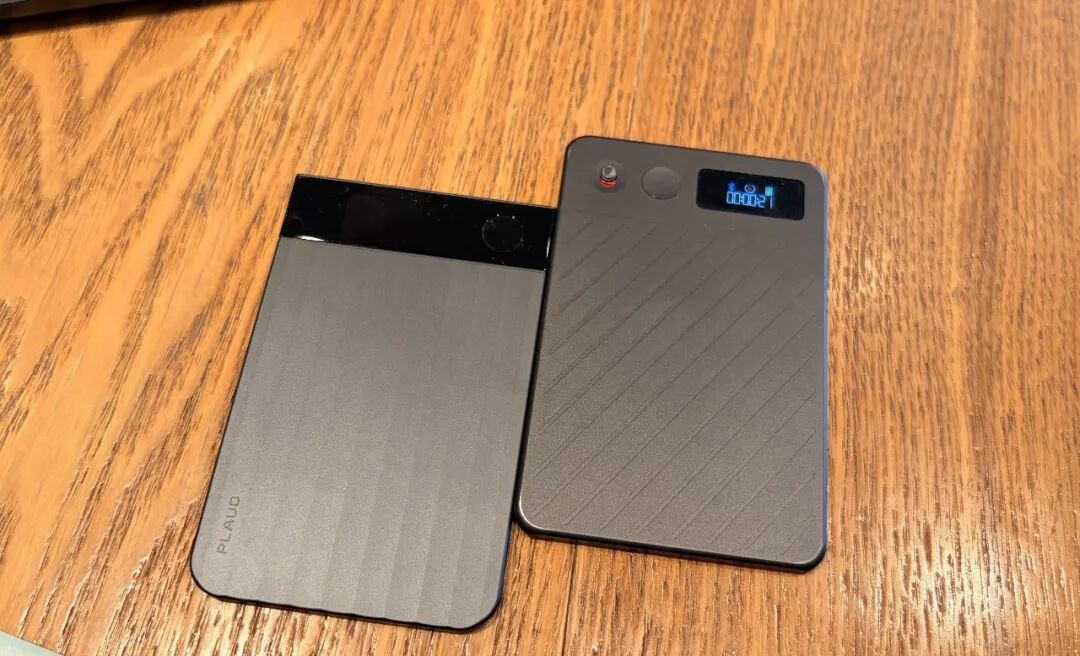
Plaud on the left, Shanzhai on the right
Everything about Plaud is slightly better, and the user experience is indeed somewhat smoother, but not to a disruptive degree.
Let's start with the downsides, then move to the upsides — classic bad-news-first structure.
Plaud's hardware design is merely average, which feels unworthy of its "far ahead" price point. Fellow Shenzhen company Laifen, at just a few hundred yuan, manages to give its hair dryers and electric toothbrushes a distinctly Apple-esque vibe.
Frankly, I'm somewhat disappointed by Plaud's design — it fell short of my expectations when I bought in 🤨
Worse still, Plaud sacrificed the USB-C port to shave off one millimeter of thickness, forcing you to use a separate charging cable.
Holy shit, Shenzhen compatriots are too evil — even iPhone went USB-C, and I genuinely don't understand why this thing had to be different for difference's sake.
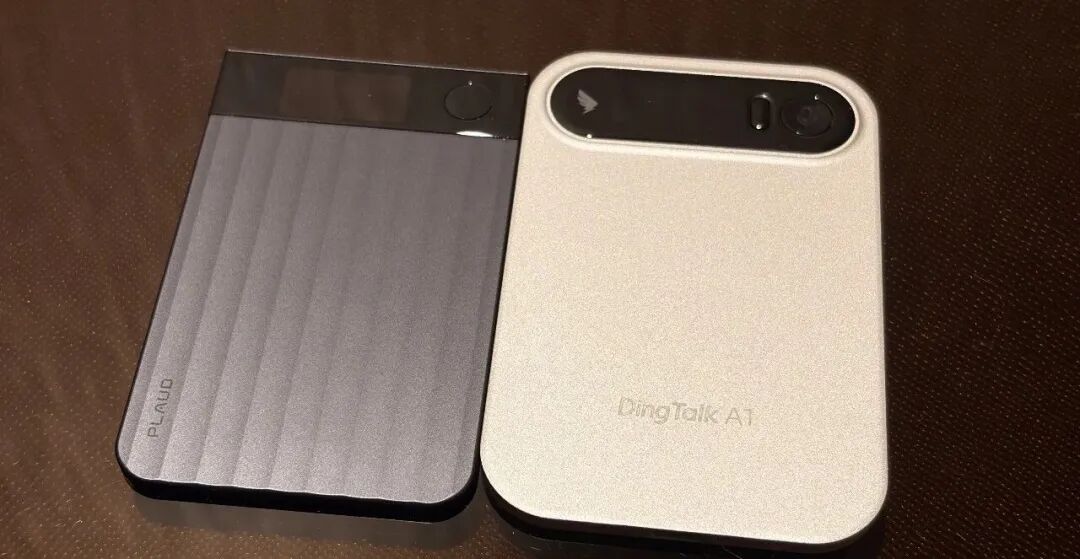
More fundamentally, there's the audio quality. Plaud's recording quality is poor — play back the raw audio and you can hear the noise. This is especially true for Plaud's signature use case: sticking the card to the back of your phone to record internal call audio. The sound quality is so bad it's barely intelligible.
If your phone has a case on, Plaud's raw transcript becomes nearly unreadable. You're forced to rely on the AI summary just to grasp the gist — essentially using large model capabilities to compensate for hardware shortcomings.
So the question becomes: how does Plaud charge this much and still sell?
Most importantly, Plaud cracked the meeting notes scenario. For people in meetings all day, Plaud is genuinely useful — and that's enough.
Since I have a recording card stuck to my phone back, even though I mostly use DingTalk A1, everyone asks me if Plaud is worth it. My answer is always the same: if you're in meetings constantly, it's useful; if not, don't bother buying.
Recording cards only save you two steps: "unlock phone — open app — start recording." Without high-frequency use, it's hard to appreciate this minor convenience.
So Plaud is essentially running guerrilla warfare against the tech giants — concentrating superior forces to win localized battles. Avoiding the giants' strongholds, finding a small opening, and using timing and execution to seize first-mover advantage.
Plaud never tried to build a comprehensive everything-for-everyone product. This thing really only serves one type of person: people who are in meetings all day. And there's really only one scenario where it shines: meeting notes.
Maybe it's because Xu Gao came from an FA background, got meeting-fatigued, and achieved enlightenment in the conference room — fully grasping the essence of meeting needs. Whatever the reason, Plaud's structured features — key quote extraction, speaker diarization, action item summaries — are genuinely well-executed.
They've taken meeting notes to the extreme. I genuinely can't think of how this thing could be further optimized.
This is classic guerrilla warfare. Concentrate superior forces to achieve overwhelming advantage locally. Plaud went all-in with limited resources on a single point, surpassing big companies on this small battlefield.
Second, Plaud's early start is a huge advantage. Xu Gao began working on voice recorders back in 2022, so he already had hardware foundations. When ChatGPT's capabilities surged in 2023, recording cards were perfectly positioned to absorb AI features.
Plaud bet correctly on the timing of model capability improvements, giving it a full two-year window.
Chinese internet companies didn't react until 2025 — Mobvoi's equivalent launched mid-2025, nearly two years late.
DingTalk A1 is reasonably polished, but launched even later. I bought on pre-order and didn't receive it until late September. Plus, big companies won't go all-in on something this small. By the time they responded, Plaud had already established mindshare among early adopters, and the niche market was paying up.
While the giants weren't paying attention to this tiny market, Plaud occupied the赛道 first.
Plaud also scored a conceptual victory: it doesn't call itself a voice recorder, but an "AI recording card." It's absolutely wordplay, but it's useful wordplay.
Voice recorders carry too much "sneakiness" in people's minds. The image of someone opening a voice recorder in front of you screams secret recording. But Plaud packaged itself as something new — an AI recording card that sticks to your phone — effectively lowering the psychological barrier.
Physically, it does exactly the same thing as a voice recorder. But psychologically, this rebranding works.
When an investor meets a founder and pulls out a black voice recorder, the other person's first reaction is: you're interrogating me? But with Plaud, you can pretend to be a tech enthusiast who respects innovation.
In my very limited three years of work experience, I've never seen anyone proactively open a voice recorder at a coffee shop meeting. But this past year, I've had three meetings where I noticed the other person had a Plaud stuck to their phone, recording.
Since I don't particularly care about privacy, I never asked. I just started talking nonsense after noticing, putting some pressure on the AI.
I asked several proper, upstanding people whether they'd mind someone recording with Plaud during a meeting. Their answer was unanimous: you should announce that you're recording with any device.
The AI recording card essentially exploits a conceptual bug — you see a voice recorder and immediately go on guard, but with Plaud, there's a delayed reaction before you realize this thing is recording too.
Plaud avoided direct competition with iFlytek in the voice recorder赛道, instead creating a new category — at least in marketing terms. This is also classic guerrilla tactics: don't clash head-on with the enemy, redefine the battlefield, strike where they aren't.
The benefit of winning localized wars: Plaud defined the AI recording card赛道 and seized pricing power.
Plaud's pricing is genuinely outrageous. The hardware is far ahead of the competition, and then users discover the software is even more expensive.
Domestic annual memberships run ¥339 or ¥1,099. International memberships cost $100 or $240 — on par with ChatGPT internationally, and domestically far exceeding what ordinary Chinese users will accept. The iQiyi-Youku-Tencent trial-and-tested price band is ¥150–200 annually.
Not to mention that iFlytek, the granddaddy of voice transcription, can only charge for hardware — transcription on iFlytek recorders is essentially free.
My 2021 iFlytek recorder, similar in form to the Plaud Pin, also clips to your collar, and cost just ¥349. When I was interning at a media outlet, constantly interviewing people, I never once exhausted the free transcription quota.
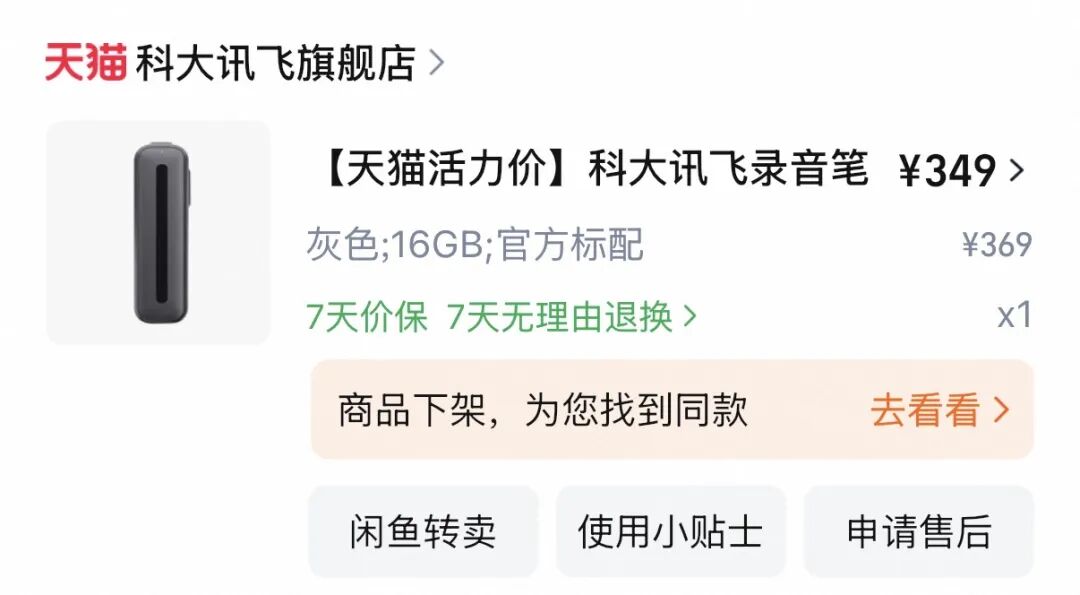
I suspect Xu Gao agonized for a long time over whether to enter the domestic market, and this is why.
Price isn't the issue — if enough people buy, the price is justified. But Plaud's pricing clearly targets only high-income white-collar workers. The ideal user is precisely the primary market professional — investors, FAs, founders, tech media.
The first time I saw Plaud in the wild was when Brainwave host Nixon wore a Plaud Pin wristband. I asked what he possibly recorded all day, and his answer left zero impression. Nixon's main gig is XR product management, and given that he also thinks Looki is amazing, I have certain doubts about whether product managers understand ordinary user needs.
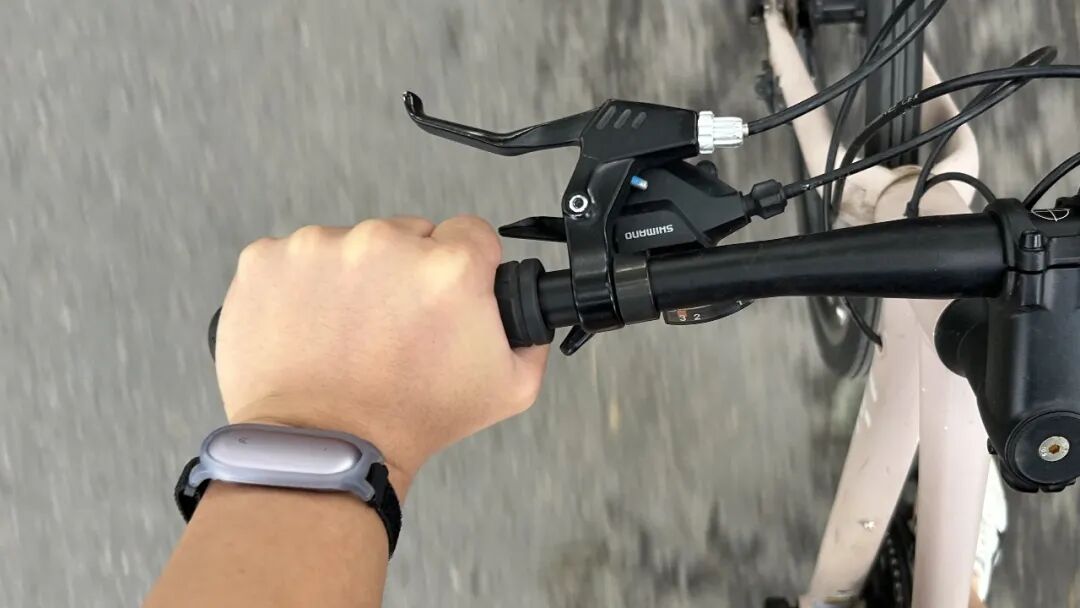
The current product form and pricing make Plaud inherently unable to break out of its niche. We all chat about it in tech WeChat public accounts, but if some short-video influencer ever goes after it and creates a Zhongxuegao-style incident, slapping it with a "recording刺客" label — that sounds pretty plausible, right?
This is the fate of guerrilla warfare: you can only hold small hills, circle the wagons, never break through.
Moreover, since Plaud is a collection of micro-innovations, others can catch up with slightly bigger innovations.
For instance, I use DingTalk A1 most simply because it has a physical voice memo button. When I'm walking and suddenly have an idea, I pull it out, press it, release, and it automatically sends to my DingTalk chat — essentially a physical button for WeChat voice messages.
I initially assumed Plaud did this first — they'd been shipping for two years, surely they'd thought of this small feature. Only after getting the Note Pro did I discover: this thing has just one button, and its exclusive feature is highlight marking — press during recording to flag that section for prioritized summarization.
Nice, everyone gets one innovative feature. This fully demonstrates that micro-innovation is still innovation — if you don't build these small features yourself, others simply won't do it for you.
One final critique: Plaud's worst product is the Pin. I don't know what mindset Xu Gao was in, but all Plaud products have just one button. The Pin takes this to the extreme — no button at all, only haptic feedback. Sometimes you press and nothing happens, sometimes it mysteriously records all day. Using it creates intense uncertainty.
I recently gave my Plaud Pin to a Hebei friend who loves dating. She wore it on dates and had the same experience as me — it's hard to tell whether this thing is on or not.
This dating-enthusiast friend also discovered another problem: Plaud can't summarize non-work scenarios. After a date, Plaud auto-summarized it as "Team Dynamics and Project Progress."
The corporate stench is strong with this one 👍
The Hebei friend tried again with "key quotes" mode. Plaud's conclusion: "No particularly outstanding remarks were found in this conversation."
This sentence was bolded, enlarged, and highlighted — as if mocking the male guest's verbal poverty 😭
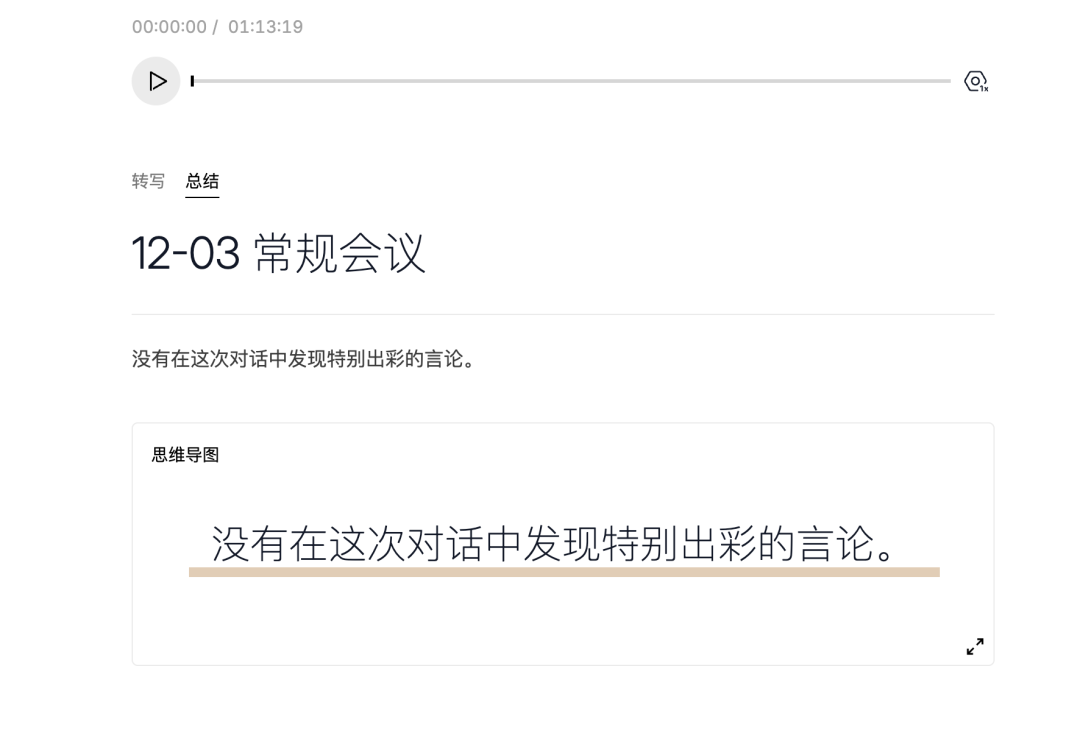
This perfectly illustrates that life-recording scenarios need dedicated hardware, and can't be solved crudely with 24/7 recording.
Work scenarios and life scenarios are fundamentally incompatible because the needs are completely different — work demands accurate meeting notes, life demands lightweight idea capture. These two needs can't be served by one piece of hardware, so more interesting things will emerge.
Because AI cannot replace your presence. It doesn't know what you care about, doesn't know which sentence matters profoundly to you.
The value lies not in recording everything, but in choosing what's worth recording.
That act of choosing is thinking. When you're walking and suddenly have an idea, pressing the record button — in that moment of pressing, you're already examining the idea, judging it worth recording. That judgment itself is the process of thought.
Socrates said, "The unexamined life is not worth living." Extend this one step further: records未经审视、未经主动选择 are equally worthless. AI can summarize a date as team dynamics; it doesn't know which random sentence you cared about.
So life-scenario recording hardware must be actively triggered — it needs a button, letting you choose that this moment is worth recording. At the same time, it must be light enough to carry everywhere: ring, earring, necklace, bracelet.
Form doesn't matter, but I sincerely recommend earrings to all you founder bros — since we're all shipping vaporware anyway, sounding cooler matters more.
Back to recording cards.
Plaud thriving proves one thing: AI hardware isn't about giants swallowing everything — AI hardware will become increasingly diverse.
Hardware won't be as boring as the past decade, with one iPhone monopolizing everything. AI can satisfy more long-tail needs, and these needs will spawn more independent hardware.
These diverse AI hardware products share one commonality: they're all Made in Shenzhen.
The products we discuss, along with the hype-chasing Amen Ring and Odyss necklace, are almost all Shenzhen-designed, Shenzhen-manufactured, Shenzhen-produced.
This is the victory of Shenzhen's supply chain. Plaud could start building hardware in 2022, pivot quickly in 2023, and control BOM costs — all thanks to Shenzhen's supply chain.
In AI hardware, California tells stories, Shenzhen builds things. In the end, Shenzhen built the things, and California's stories still aren't finished. Now I see that hardware founder bros' storytelling abilities are getting pretty solid too, not inferior to Silicon Valley compatriots at all 👊🇨🇳🔥
Shenzhen's supply chain advantage gives Chinese companies absolute competitive dominance in this赛道. Plaud is just the beginning — more interesting products are on the way.
iPhone's monopoly is ending. California's and America's monopoly is ending too.
(Images in this article generated by ChatGPT, writing assisted by Claude Code, with significant contributions from Muqiu)