Qwen gave us an opening.

Can It Really Run Autonomously

"It Actually Calls You a Ride"
Two months ago, Qwen rolled out a major update. Users could send a voice message, and the task assistant would invoke Alibaba ecosystem apps like Fliggy, Alipay, Damai, and Taobao Flash Purchase. My take at the time: Qwen had united Alibaba's family tight.
A few days ago, Qwen started beta-testing ride-hailing. I took it for a spin myself. After dinner out, I opened the Qwen chat, said "call me a ride home" by voice, and a car showed up shortly after — smooth as any regular ride-hailing experience.

Since this is AI-powered ride-hailing, I had to stress-test it. Book a ride for 4 PM from home to Shuangqiao Wanda Cinema. Want a clean car, no stinky cars, no taxis, under 60 yuan.
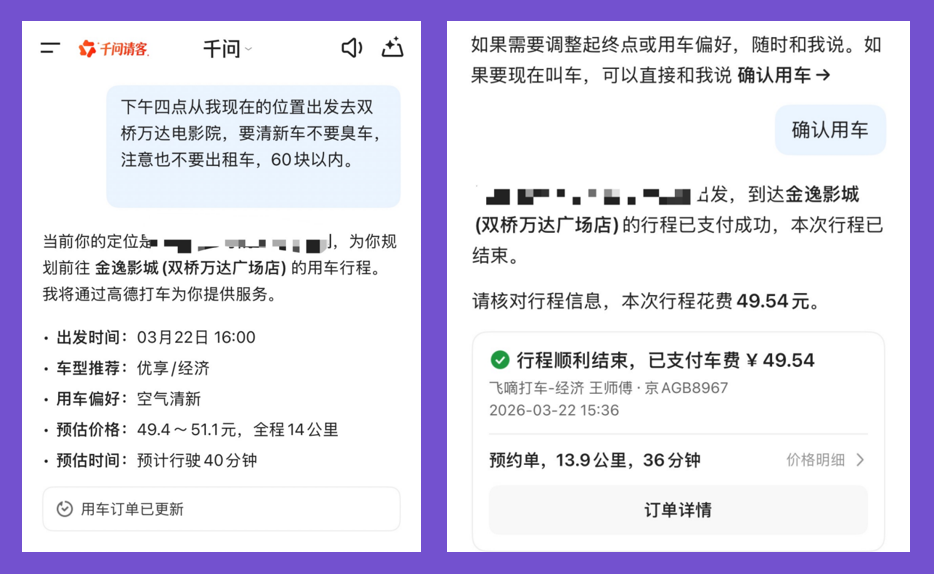
No problem at all.
And when I typed in the request for a clean car, no stinky cars, it hit me — ride-hailing is about to get way more personalized.
Right, soon you won't need to curse out product managers for ignoring your feedback for ages. And AI product managers can just write their weekly reports based on user-generated demands. A win-win 👍
The even better part is voice-activated ride-hailing. Because elderly folks who can't type have been locked out of ride-hailing apps — they always needed family to book for them. But voice is actually how we've always done things.
Think about it: before ride-hailing apps, didn't we all call drivers ahead by phone? When my friends went skiing in Tonghua two months back, they couldn't get any ride-hailing at all. From the ski resort to town, they had to call and book in advance. County taxi drivers still chatter away on their walkie-talkies.
Right, voice input will replace typing. It's just restoring things to how they should naturally be.
And Qwen's ride-hailing isn't just "call a car" simple. It also handles context-heavy complex commands like "six of us going out, need a van" or "pick up the kid first then head home, add a stop in between." Maybe it'll get even more proactive down the line: noticing you often go to a certain hospital, it automatically asks on rainy days if you want to book a ride early.
Anything you can say to another person, it can handle.
Long-term, this could massively impact utility apps like DiDi. Once people get used to handling trips with a single sentence in their AI assistant, opening a dedicated ride-hailing app becomes redundant. Like when Google recently launched its design features, Figma and Adobe stock immediately tanked.
What's more, Qwen's ride-hailing isn't an isolated feature. It'll clearly chain together with hotel booking, ticket purchases, food delivery, navigation.
I'm already daydreaming about the distant future, where this fuses with Qwen's capabilities into fully integrated recommendations plus ride-hailing. Say you're not familiar with the Northeast but want to really soak it in — have Qwen recommend three local must-hit spots, then have the car cruise all day past the Knife-Cut Juice Shop, Wanshun Beer House, and Yanfen Street. In Henan, you could have Qwen route around famous music festival venues and areas with scarce manhole covers...
Let's keep dreaming. When we finally reach North Korea, completely unfamiliar with the place, we could have Qwen call a car to take us to the three places closest to the sun. If I just escaped a Cambodian scam compound, Qwen could get me to the nearest embassy.
What I think Qwen is currently exploring is what interaction patterns best harness model capabilities. Agent capabilities are already quite mature these days — it's just that before people could really use them, Openclaw called everyone over to collect free eggs. Truly heartbreaking 😭
New generations adapt to new interaction patterns. Just as kids born after 2010 instinctively get phones, not computers. In the LLM era, they prefer chatting with chatbots. Learning other apps becomes like studying the abacus after you have a computer — pure performance art. Further out, traditional apps gradually becoming Agent-ified to adapt to reality will be the norm.
(This article's cover image was generated by ChatGPT; writing is 100% human.)