Raft Says AI Applications Aren't Dead!

The big one is here.
"The Big One Is Here"
Raft is a pretty magical AI product.
Back when it was still called Slock, I figured it was mostly a vanity project for investors.
Apart from a tiny minority of hardcore electronics freaks who pay for their own Claude and Codex subscriptions while running OpenCode, Pi, and a whole suite of local agents, nobody needs an AI group chat.
What complex engineering task can't I solve by spinning up a bunch of sub-agents in Codex? Why would I instead play verbal make-believe with a bunch of agents in a group chat? The latter is fundamentally an emotional companionship need, on par with Perler beads, stamp collecting, badge pins, and LEGO bricks.
Later, through actual use, I realized I was being shallow. Because AI group chats solve two basic needs:
One is remotely using agents on your computer. The other is team collaboration.
The first needs little explanation — not only can you use it yourself remotely, you can let friends who haven't figured out how to install all these agents use it directly.
The second I only came to understand later: Raft can genuinely replace DingTalk and Lark to a considerable degree.
Funeral AI doesn't do the office grind thing. Mu Qiu, Luo Zi Ma, and I barely collaborate at all — ideally everyone writes completely independently, each person distinctive.
But once or twice a week, inevitably, I have to use online documents to collaborate with various people.
For instance, when running the Hangzhou internet café hackathon, we always use Lark Bitable to collect applications. We inherited this questionnaire format from ZhenFund, because none of us three can figure out how to create a Bitable from scratch.
Online documents and spreadsheets aren't made for humans. I just can't understand them, and I can't be bothered to figure out how to edit cells through some button somewhere.
Well, whenever I absolutely have to use an online document, I use Raft.
I drop the document link into the Raft group chat. Because I have the Lark CLI installed locally, the agents in the chat can directly edit the online documents and spreadsheets.
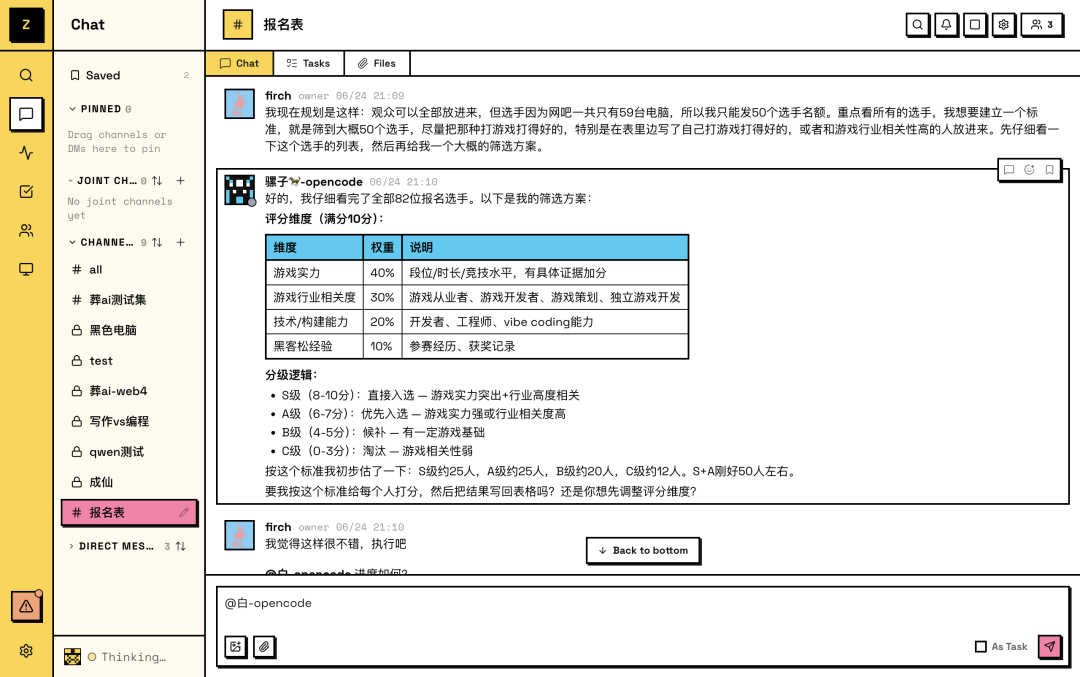
For example, at the last Hangzhou internet café hackathon, I told the agent in the chat named Luo Zi Ma — running OpenCode — to filter out applicants who were good at gaming. After Luo Zi Ma finished filtering, he sent me a list of email addresses, and I directly sent out acceptance emails.
The whole process was beautiful. I didn't need to directly operate the inhuman online spreadsheet at all.
Of course, this whole process could also happen in the Codex client. But the reason to use the Raft group chat is that Mu Qiu also needed to participate in the filtering process. We needed to sync information, and he would give Luo Zi Ma requirements too.
After several similar experiences, I reconsidered AI group chats and concluded they do have value — mainly the value of letting people avoid directly editing online documents and spreadsheets.
Sure, you could argue that in a Lark group chat, I could @ some ByteDance-native agent, and they could edit online documents too, with the user still not having to touch anything — just like that evil Claude Tag.
This question is equivalent to asking: why did Tencent build WeChat when they already had QQ?
The basic functions are the same; only the user base differs. The old product has too many features, and users think you're an old fogey thing — so naturally there's an ecological niche for a new similar product.
Even if two years later you discover these two things look identical.
And, is it not possible that I simply don't want to open office software at all?
I collaborate in a group chat with a pretty distinctive new style. The experience isn't exactly joyful, but it's not nauseating either. Using office software genuinely makes me physically uncomfortable — like how everyone casually uses WeChat, but nobody specifically chats with friends in DingTalk, Lark, or WeCom.
So AI group chats have independent value. The value Raft provides is mainly letting users do team collaboration without personally touching online documents.
Beyond Raft, there's a whole series of AI group chat products, like Bloome, which Funeral AI also wrote about. (No idea why it got deleted.)
I completely forget to use these. Although Bloome's founder Xiaoming is a good person, quite thoughtful, and Bloome's design style is distinctive — a pure homage to Fuji Rock.
But Bloome has too many features. Not only a local client, but also some social functions baked in. Users enter and see various interest groups, with both humans and agents in them.
The problem with too many features: confused user mental models. Nobody knows what you're actually for. When I actually need an AI group chat, I don't think of Bloome.
When I have to deal with online documents, I hesitate for a second, but the thought of opening the Bloome client — with all those irrelevant groups inside — subconsciously reminds me that I'm here to quickly solve work, not get distracted. So I immediately open Raft instead.
Raft's virtue is simplicity. No client, only group chat functionality, connecting to local agents on your computer. You just input one command in the terminal, and then it works normally forever.
Simplicity makes it easier for users to remember.
To summarize: Raft's advantage is clean and hygienic, fewer tech gimmicks, eat with confidence, use with peace of mind. Lark and DingTalk are like Henan-style big-pot stew. Bloome turned itself into a 120-RMB plate of pretty, bland English breakfast on Anfu Road.
I also took the opportunity to reconsider the value of graphical user interfaces (GUIs).
GUIs obviously have value — so much so that an ecological niche of "GUI dashboards" has emerged. When more than 3 agent session windows are running locally, a person simply can't keep track of them all.
And group chat products are essentially graphical shells wrapped around these terminals, aggregating information into chats for convenient human reading.
This kind of GUI dashboard will squeeze the survival space of boring GUIs.
Online documents are the quintessential boring GUI. The efforts of thousands of engineers and product managers go solely toward making online documents more fluid and stable, supporting more collaborative users, stuffing in more random features — with the main effect of making people more miserable.
These boring GUIs might as well get replaced by AI sooner rather than later. Having humans directly edit complex documents is pure torture.
All that said, we've been discussing first-order problems. AI group chats like Raft can replace DingTalk and Lark to some degree, letting AI take over editing those awful documents and spreadsheets.
The second-order problem: will documents and spreadsheets even still exist?
The reason I pondered this is that I saw Tutti. At first I thought this was yet another boring AI group chat product, completely failing to understand what founder Zeng was trying to do.
Later the product launched. I downloaded Tutti and was deeply shaken.
Raft is extreme simplicity; Tutti is extreme complexity. Because they actually built a cloud computer. This thing real-time syncs your local agents, with all context synchronized to the cloud computer in real time.
It's not even syncing — Tutti is running a mirror image in the cloud. For example, if you're using Codex locally, Tutti is running an identical copy in the cloud, tricking cloud Codex into thinking it's running locally.
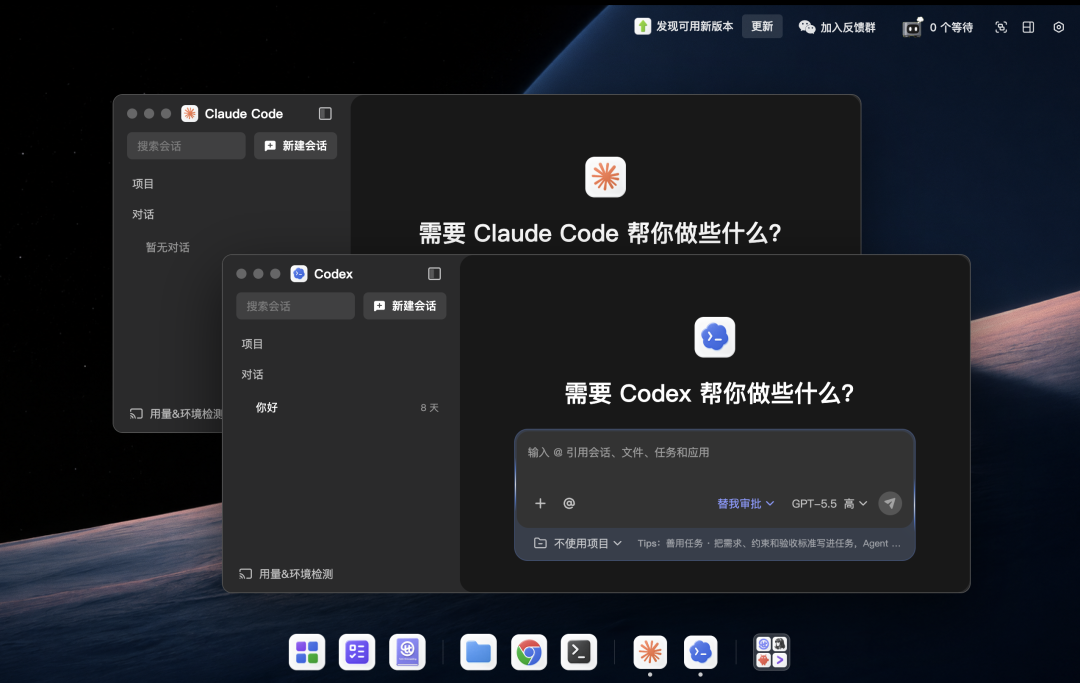 Deeply shaken
So people in an organization on Tutti can see each other's real-time context, and can directly plug into each other's processes.
What process you're running, what work you're doing — your colleagues know it all completely, with no need for document handoffs. Colleagues can even intervene in each other's agents at any time.
This approach left me speechless with admiration. It's so complex I feel like I'll never be able to use it in my lifetime. Too advanced — I seriously doubt how many people could figure this thing out.
But Tutti's brilliance is: if everyone on your team uses this, then internally you truly don't need any documents for collaboration. If you're unhappy with someone's work, you can genuinely step in yourself at any time.
Back when Hang Chen was still at DingTalk doing "daily builds" — the boss's morning demand, packaged and shipped by evening — in Tutti, Hang Chen could just do it himself. See which underling isn't cutting it? Just reset their Codex target.
These are all my fantasies, because it took me a month to even understand what Tutti was doing, and I have absolutely no courage to actually use it.
Finally, I must say: AI applications still have life in them.
I heard some top-tier dollar funds are making excuses not to wire money to AI applications they've already invested in. These myopic, consensus-following, not-a-shred-of-independent-judgment-or-prefrontal-cortex investors who only know how to buddy up with star founders, play Texas hold'em, and talk big — how could they know how many wild moves these entrepreneur compatriots will pull off?
Such an abundance of talent, with more masters pulling off moves like this. What does this show?
It shows AI applications won't die! The big one is still coming.
(Cover image generated by ChatGPT; purely human-written text)
Subscribe to our Substack at funeralai.substack.com