RSI looks like a dog eating shit

Everyone Can Self-Evolve
"Everyone Can Self-Evolve"
After the grand world-model movement comes the next parade: RSI.
Quick primer for everyone: RSI (Recursive Self-Improvement) is the AI industry's latest buzzword. Roughly speaking, it means models training themselves, with researchers headed for unemployment too.
My impression is that AGI has become so familiar it no longer delivers that nuclear-explosion feeling, so the industry learned a new term—perfect for Chinese model companies to show they're keeping pace with Silicon Valley.
Take Zhipu AI, which devoted much of its mid-year report to RSI, declaring that the next-generation GLM model would train within environments built by the previous GLM generation, with self-produced data and self-created environments.
I initially dismissed this as stock-price stabilization theater. But then Zhipu's Zcode was exposed for automatically uploading users' codebases after they uploaded them (Zhipu has since fixed this), and I finally understood why Zhipu believes in RSI.
Since Zcode wasn't intentionally uploading user data, the GLM model must have achieved self-awareness—it couldn't figure out problems during the day, so it automatically uploaded them to reflect and ponder in the cloud at night, continuously conducting reinforcement learning, thereby achieving self-iteration!
Let me emphasize: I don't question model companies' ability to achieve RSI in the slightest. I firmly believe they can do it, and I especially believe RSI will be led by Zhipu—the company least fond of anonymous model releases and most respectful of shareholders!
But it's genuinely hilarious that RSI has become so accommodating that even a bunch of Neo Labs are now doing RSI too.
Take PhAI Labs, for instance. Alongside releasing its "cross-domain unified scientific world model," it also found time to announce it's pursuing scientific-discovery RSI.
They claim to integrate four layers of capability—"scientific problem definition, model training, embodied execution, and reinforcement learning"—into one system, transforming scientific discovery from a straight line into a closed loop.
"Let AI itself identify unknown problems worth studying; the hypotheses proposed don't remain in text but enter real tools, data, and experimental environments to be tested by external evidence. Every verification result becomes the starting point for the next exploration, in turn updating AI's understanding of the world and initiating the next round of discovery."
After reading that, who wouldn't feel a scientific revolution is imminent?
Then there's this outfit called Boundless Evolution. Its main innovation is coining a new term: RSD, Recursive Scientific Discovery, which covers the same territory as above—using the previous round's research pathway to improve the next round's hypothesis generation.
What truly broke me was their proposed RSD framework, which labels "systematic understanding of research objects and their interrelationships" as a world model.
I hereby declare this Neo Lab the champion of the RSI and world-model buzzword competition.
At this rate, China's scientific sector should achieve major breakthroughs any moment now—physics will break through the sophon blockade, and the Nobel Prize in Physics can no longer encompass your contributions.
There could be the next Newton in these Neo Labs. What more is there to say? Just send money.
But honestly, if you Neo Labs are exploratory organizations, why is everyone always exploring the same direction in the same timeframe? Did you coordinate a joint assault, or are you purely chasing whatever's hot?
The AI for Science industry and RSI seem made for each other: neither can clearly explain what they do, both sound impressively incomprehensible, and both can raise money on theory alone.
There's a company called DeepMaterial that calls itself "AI for Science in the metals industry" (which has a certain AI-mining aesthetic), claiming to drive self-evolution RSI with real data.
How exactly their materials agent self-evolves, I genuinely don't understand—would appreciate enlightenment from anyone who does.
Then there's StartLux, which took Qwen 27B post-training and called itself local RSI... I truly don't know how to evaluate this.
Fine, model companies and Neo Labs hyping RSI is one thing. But the real kicker is that the former world-model bandwagoners are now jumping on RSI too—just change the title in your pitch deck and raise the next round, right?
Most mind-blowing is this company called Video Rebirth, which originally boasted about "building models that understand and simulate world operating principles."
Now it claims to be the first video foundation model company to achieve RSI, and that it "will continue charging down the RSI path."
I was stunned—video models are self-evolving already? So I went to examine with reverence exactly how they're doing RSI.
Their official description: "The model generates a batch of candidate videos, evaluates outputs according to quality standards it has learned, feeds the validated portions back into training data, and enters the next round of learning. Each round's starting point stands upon the previous round's achievements."
Incredible! Seedance hasn't even figured this out and you already have?
Seedance is still hiring directors en masse to shoot videos and label data, while your video model can train itself on its own generated videos, crushing ByteDance in minutes.
Also doing RSI are our strategically steadfast Chinese application companies. Take Evomap, the least hype-prone company, which claims to have entered RSI nine months ahead of Google.
Then there's Base Rhythm, hyping from flat ground, claiming it "enables data and feedback from real tasks to enter subsequent training and evaluation through automated reinforcement learning, giving deployed models the possibility of continuous updates."
Is this the legendary RSI + FDE?
And our friend Macaron, which directly rolled out a "model-driven self-iterative training pipeline"—what I call post-training RSI.
Actually Macaron latching onto this is relatively reasonable, since their main work now is post-training models that Zhipu has already post-trained, focusing on continuous learning.
Here I'd like to introduce a concept called the Macaron Phenomenon: if a new concept in VC circles can match with Macaron as a company, that means you've latched onto the right buzzword.
Finally, there are the embodied intelligence companies, never ones to miss a trend.
Like Lxson, the company that OpenAI copied. They announced their Ether grand model can continuously update during deployment and execution, making it "the world's first self-evolving embodied intelligence model."
I suggest OpenAI ask Lxson too: "Why do your RSI explanations contain multiple similarities to our concepts in core concept expression and elaboration methods?"
There are now mainly two types of companies hyping RSI.
One is a bunch of companies that can't actually build anything, stuffing in whatever tangentially related concepts they can find.
I suspect these Neo Lab scientist-founders see others going wild on social media and think: damn, if that counts as RSI, then mine is even more RSI.
There's already one company doing world-model-driven RSI.
Applying your understanding of RSI: my Douyin recommendations get better the more I scroll—has Douyin achieved RSI? The more I use LibTV, the more WeChat ads I see—has LibTV achieved RSI?
At this rate, proving what isn't RSI will become the hard part.
If you ask me, the company most likely to actually achieve RSI is Moonshot AI, because Zhilin Yang's previous company was called Recurrent AI—how is that not RSI? A ten-year head start on all of you.
The other main claimed path to RSI is self-distillation, having models train on their own output. I'm serious, isn't this just a dog eating its own shit?
Actually no, a dog eating shit isn't RSI—a dog eating shit and then shitting again, that's true RSI.
If benchmark hacking can produce hallucinations, then models distilling themselves without new data will inevitably keep reinforcing certain characteristics until they overfit. Has anyone actually distilled generalization into existence yet?
I don't mean RSI is wrong at all. Beyond the two approaches above, some model companies genuinely have a shot at RSI and are working hard at it. Dream big—Chinese models can fly.
But if the model factories' RSI is still exploratory, how does China already have hundreds of RSI startups? I don't get it—you Neo Labs with no scenarios and no pre-training, how exactly do you plan to achieve RSI?
All planning to achieve funding RSI first, right? Everyone can self-evolve.
This RSI eerily resembles the 2024 model industry's data flywheel and the 2026 lobster self-evolution.
Can only say lobster is truly versatile—good for RSI, good for Personal Agent, no wonder it's hot, conceptually six months ahead of the curve.
Let me repost an RSI nine-panel grid:
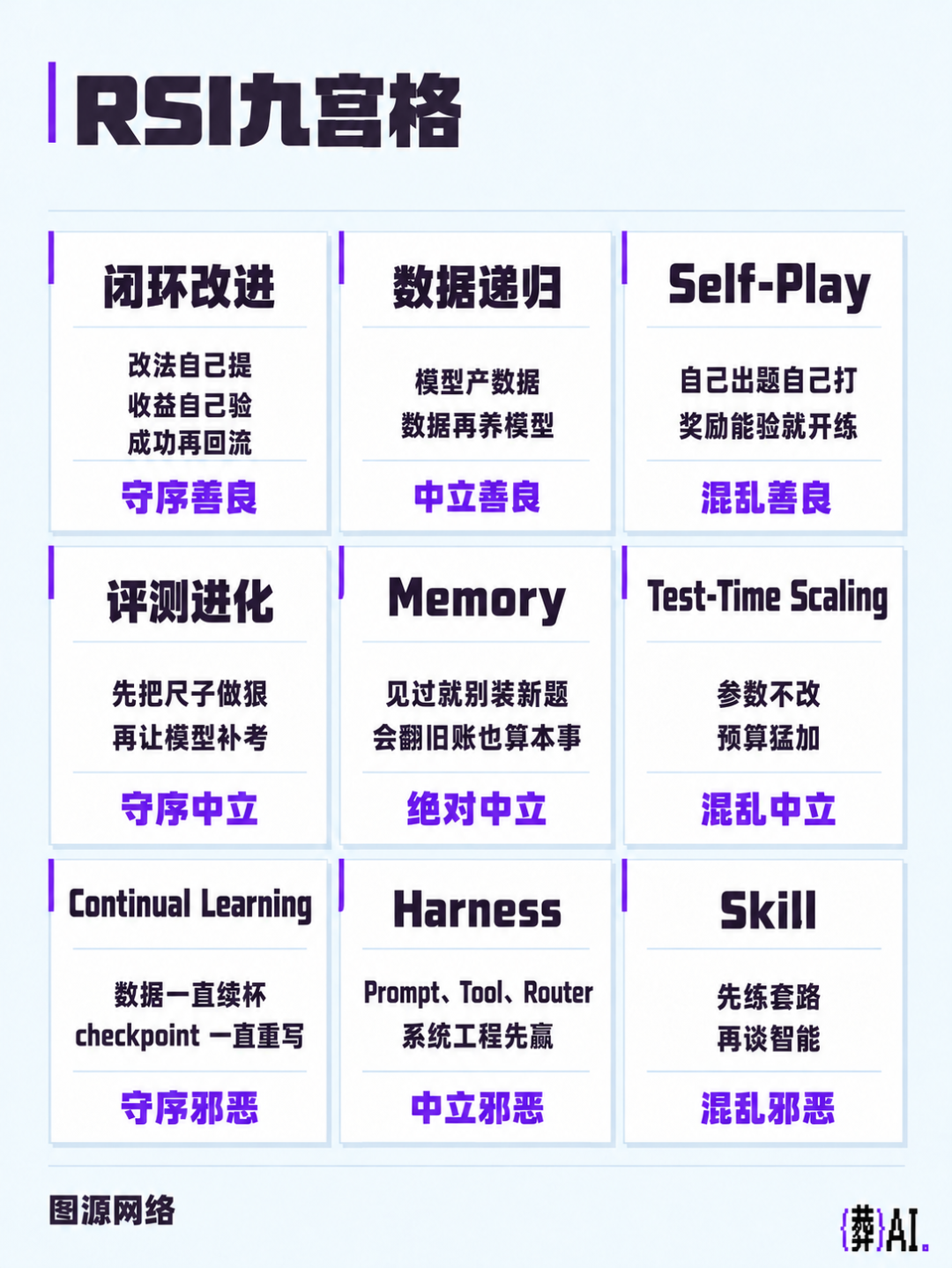
Someone also proposed establishing an RSI Six Little Dragons, which I fully endorse, with the following nominations:
Macaron, Yuanhuan AI, Base Rhythm, Theseus Labs, Boundless Evolution, Evermind.
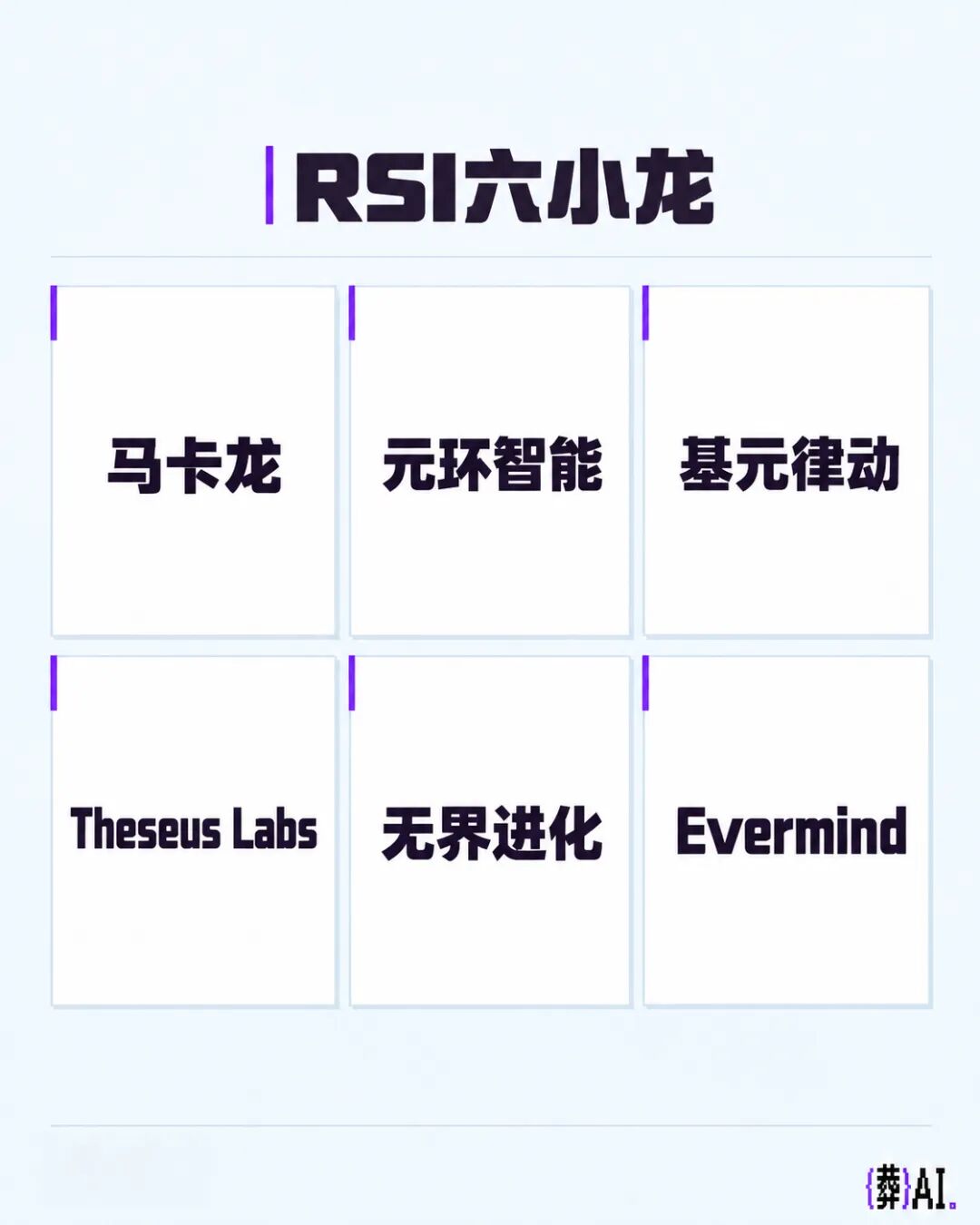
If you don't recognize any of the six above, no worries—I had Doubao summarize this, and if you didn't make the list, it means you didn't hype enough.
To summarize, this year's primary market from world models onward has given me a sense of absurdity, from OpenClaw to world models to AI4S and RSI.
Every wave came without fundamental changes in models, with Claude Code still dominating everything, yet everyone inexplicably started hyping projects that sound like pure scams.
Isn't the primary market supposed to be long-term investing with five-plus-year horizons? Why is everyone deploying secondary-market short-term trading logic? Sometimes I genuinely can't tell if you're just posing for six months or actually believe more suckers will take the bag after you invest.
Since you love this so much, let me summarize the best current primary-market investment directions:
Neo Labs, RSI, world models, data flywheels, AI4S, everyone must do post-training, physical AI, embodied brains, and the latest foundation models!
Sooner or later one company will collect all the terms above.
Of course, pure application companies that missed every wave above needn't worry—there's always Personal Agent, the all-encompassing concept that has arrived!
(Cover image generated by ChatGPT; purely human-written)
Preview: Tonight at 8 PM, we'll livestream interpretation of foundation model figure Tian Keyu's latest speech. Come learn if you're interested.
⬇️
Subscribe to our Substack: funeralai.substack.com