Seedance 2.5 Cuts Itself Off from Netizens

Military-grade facilities
"Military-Grade Infrastructure"
It's been almost two weeks since Seedance 2.5 launched. Even random video agents like OiiOii have come back to life just to run Seedance 2.5 ads, so we figured we had to actually test whether it's all that.
After testing it on and off for a week, my biggest takeaway: I seriously suspect every blogger breathlessly praising Seedance 2.5 is some rich second-generation kid with suspiciously large unexplained assets. Someone should look into that.
Because when I use Seedance 2.5, I have zero bandwidth to observe skin texture, voice simulation, motion capture, or cinematic camera work. All I can think about is price, price, and fucking price.
Right now on Dreamina, generating one 720P 15-second video with Seedance 2.5 costs 390 credits — double what Seedance 2.0 charges.
At the consumer rate of 50 RMB for 500 credits, if you generate a video with five tries, a 30-second clip costs 390 RMB.
Meanwhile, Kling 3.0 Omni costs roughly 135 RMB for a 30-second video with five tries, and MiniMax H3 runs about 75 RMB.
Bros, you're not even in the same order of magnitude anymore. You playing some "the whole world's video model prices got slashed in half except me" game?
Of course, it's a market economy. Pricing is free, and good stuff should cost more.
But price segments your audience and their needs. Seedance 2.5 users feel real pain:
I don't batch-generate three videos at once like before, nor do I casually try things out on a whim;
I have to make sure my reference images and prompts are absolutely flawless before I nervously click that upward arrow button.
Because one click is nearly 100 RMB, people. This isn't a joke. That's enough to live in Northeast China for five days.
From a pure pricing perspective, Seedance 2.5 is already, and can only be, a non-civilian-grade productivity tool.
The ripple effect is that Dreamina's AI social narrative now has a superstructure that can't keep up with its economic base — who's gonna spend 78 RMB to generate 50 seconds of face-swapped skits just for laughs?
I even wonder if AI short drama companies would want to double their costs just to improve viewer experience.
Because I opened Hongguo Short Dramas and took a look — virtually every hit show has the classic old-AI-model problems: oil painting texture, garbled fonts, misaligned perspectives, uncoordinated movements. And absolutely nobody cares.
You're watching short dramas, who gives a damn about all that? Plus you're watching on an electric scooter, you can't even see the details clearly, you get it?
Even under those obviously AI-made works, people are lavishly praising: "So amazing 👍👍👍 real actors are gonna be unemployed 👍👍👍"
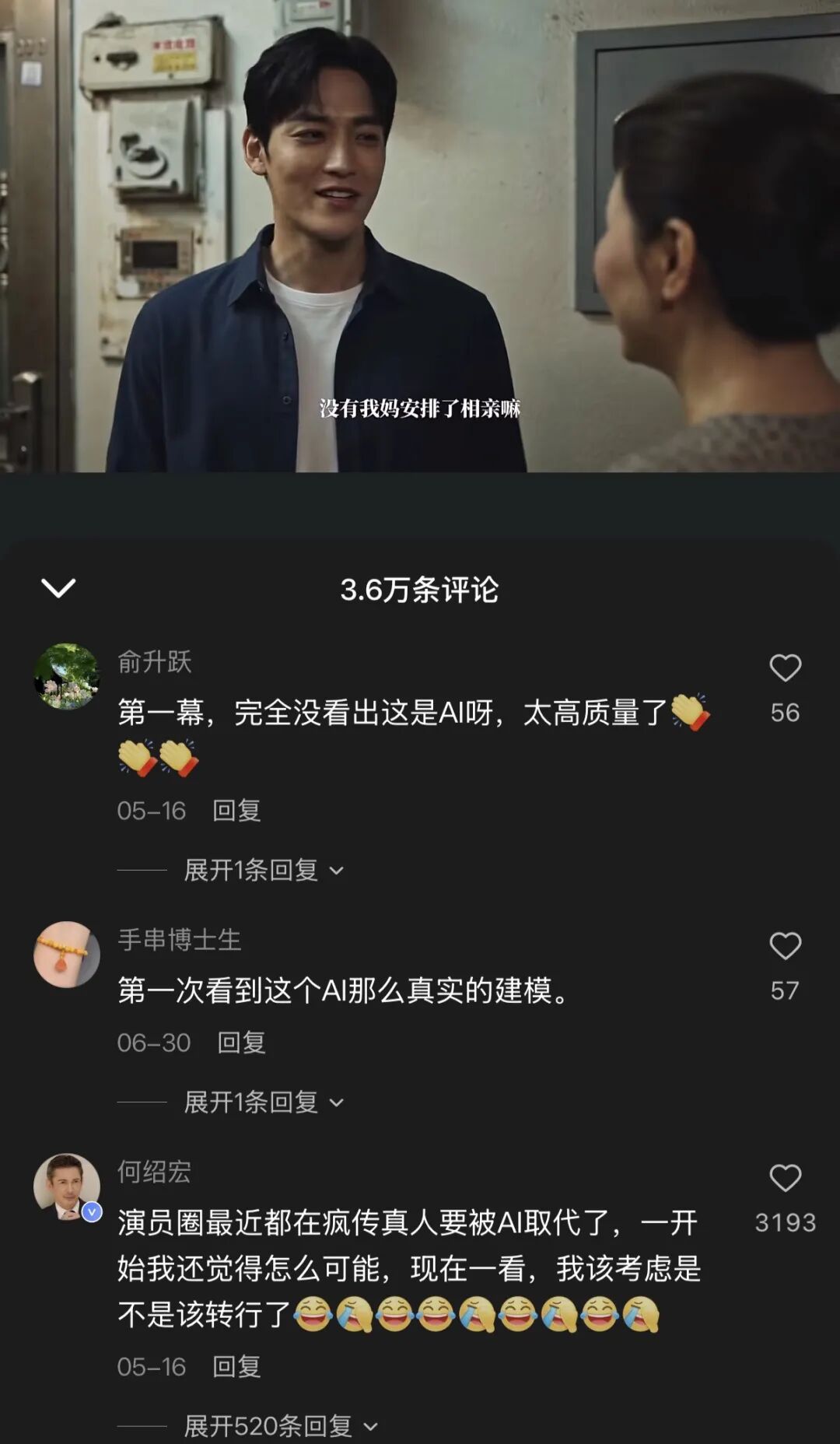
This is currently the most popular, most realistic-looking one
Is it possible that people watching AI short dramas have no demand for improved video quality? Is it possible this audience doesn't care about visual quality at all, but rather about how melodramatic the plot is and how fast their hormones spike?
I suggest ByteDance go study McDonald's, ask them why they chose to launch the Twelve-Piece Fries instead of a Gold Leaf Fries Bistro. They'd get it.
I also tested it hands-on, mainly looking at how big the gap really is between Seedance 2.5 and 2.0.
First, the short drama angle. The First Half of My Life has been trending again lately, so I had both 2.5 and 2.0 recreate its most famous scene.
Here's 2.0's version ⬇️
It definitely has plenty of stereotypical 2.0 problems throughout:
Faces look like they're caked in powder and wax, greasy and reflective;
Expressions are Botox-stiff, basically the same tense mask from start to finish with no micro-variations, especially everything above the eyebrows stays completely static;
Movements and voice are both exaggerated and on-the-nose, probably trying to convey emotion through this kind of over-the-top approach;
Subtitles also have typos and garbled characters.
2.5's version is this ⬇️
It does solve most of these problems.
The skin can't be called textured, but at least it looks human;
Expressions aren't stiff anymore, even has some micro-expressions going;
And it even controls background crowd characters well, which was surprising;
The most godly part is the auto-generated BGM and sound effects actually sync cleverly with the plot, very high completion.
But there are also plenty of flaws. Most obviously, it changed the original line's "Chen Junsheng" to "Chen Junming."
Also, at first my prompt matched the original — "I'm here to find the mistress" — but after Seedance 2.5 detected the word "mistress," it took matters into its own hands and generated this thing ⬇️
Mhm, 2.5 directly replaced all instances of "mistress" in the dialogue with "relevant personnel," and all names became "someone." Fully sanitized.
What I want to say is, first, as a model with draw costs several times higher than competitors, Seedance 2.5 is not entitled to user forgiveness — any flaw should be magnified several times over. So low-level errors like mispronouncing a character's name are absolutely unforgivable on Seedance 2.5.
Second, if Seedance 2.5 is meant to serve professional short drama teams, not being able to generate lowbrow plots is pretty laughable. You can't seriously think everything on Hongguo is positive-energy short dramas.
But ultimately, even a perfect, fully-powered, zero-error Seedance 2.5 — would it really win over short drama teams? I personally have deep doubts.
Right, who uses Hermès as a grocery bag? Who hires college students for summer jobs? Who makes gutter-tier short dramas on Seedance 2.5? Same logic.
I think Seedance 2.5 jacking up its positioning like this, the endgame is probably the film market. Not necessarily pure AI movies, maybe using AI to generate a few difficult big spectacle shots and seamlessly stitching them into live-action footage.
If that's the use case, you do need bigger, faster, stronger, and it would indeed be worth however many draws it takes.
So I had 2.5 generate a short with as many natural disasters as possible. Results below ⬇️
Although it still has the old problem of background crowd blending, the explosions, car flips, and that final moment of tsunami shattering glass are visually several tiers above other models.
Words might not convey it, so here's a comparison with the same prompt on MiniMax H3 ⬇️
Compared to Seedance 2.5, other models in text-to-video are basically divorced from the word "realistic."
But ultimately, this is just having AI do what special effects used to do. Whether it actually makes economic sense, I genuinely don't know. Anyone who knows, drop it in the comments.
Oh, one more thing — all the Seedance 2.5 videos above were generated using detailed second-by-second shot breakdown prompts.
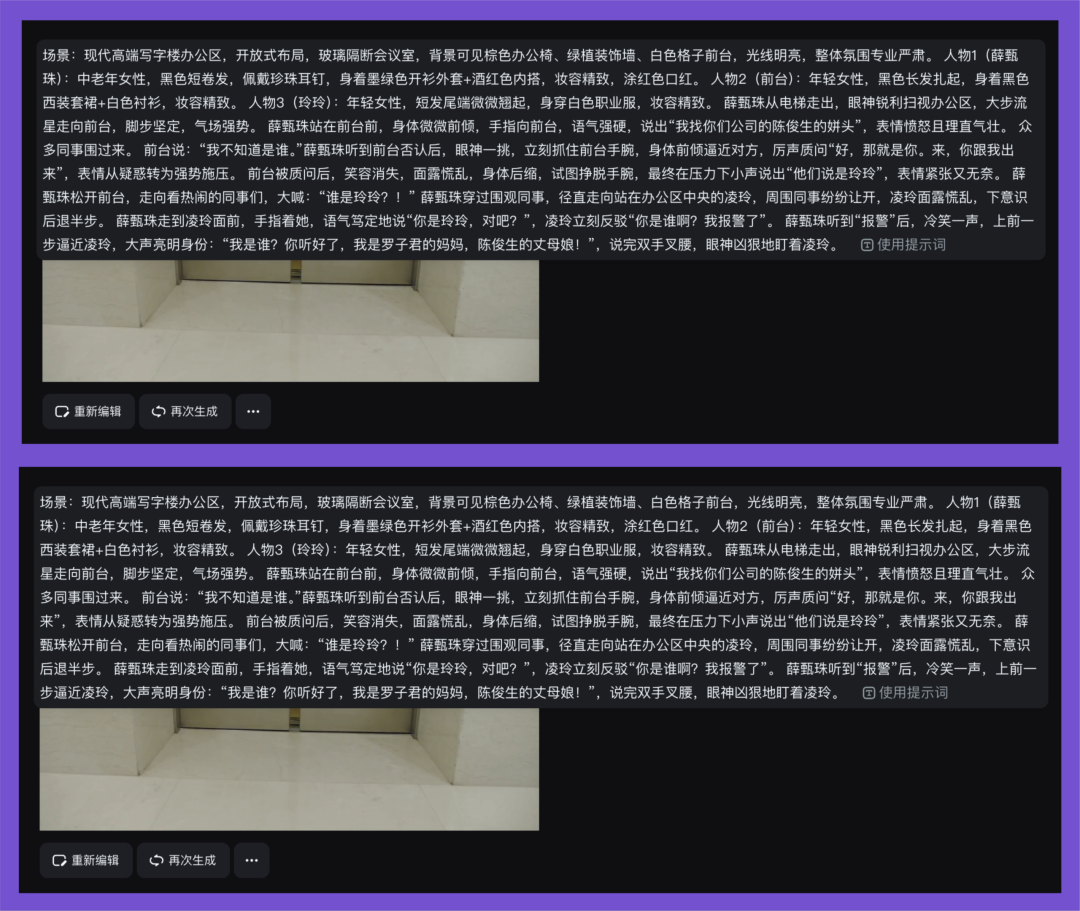
Not because I love writing scripts, but because when I just threw over a few summary sentences like before, Seedance 2.5 would fall apart and generate complete nonsense.
But when I gave it clear second-level prompts, Seedance 2.5 performed excellently.
The subtext: if you can't write precise prompts, don't use Seedance 2.5.
This trait of only following orders and not daring to improvise is the exact opposite of MiniMax H3.
If MiniMax H3 is a model that's slightly lacking in professional work but great for casual folks to have fun with;
Seedance 2.5 is that model that's powerful and excellent at work, but regular people would die trying to figure out how to use.
Seedance 2.5 is cutting itself off from internet users. ByteDance might as well rename itself to ByteSuicide.
Another point Seedance has been hyping is "physical law realism" and "long-term temporal consistency," mainly targeting industrial manufacturing, autonomous driving, and Embodied Artificial Intelligence — supposedly using Seedance 2.5 to generate training data for robots.
Damn, they're basically importing the world model playbook.
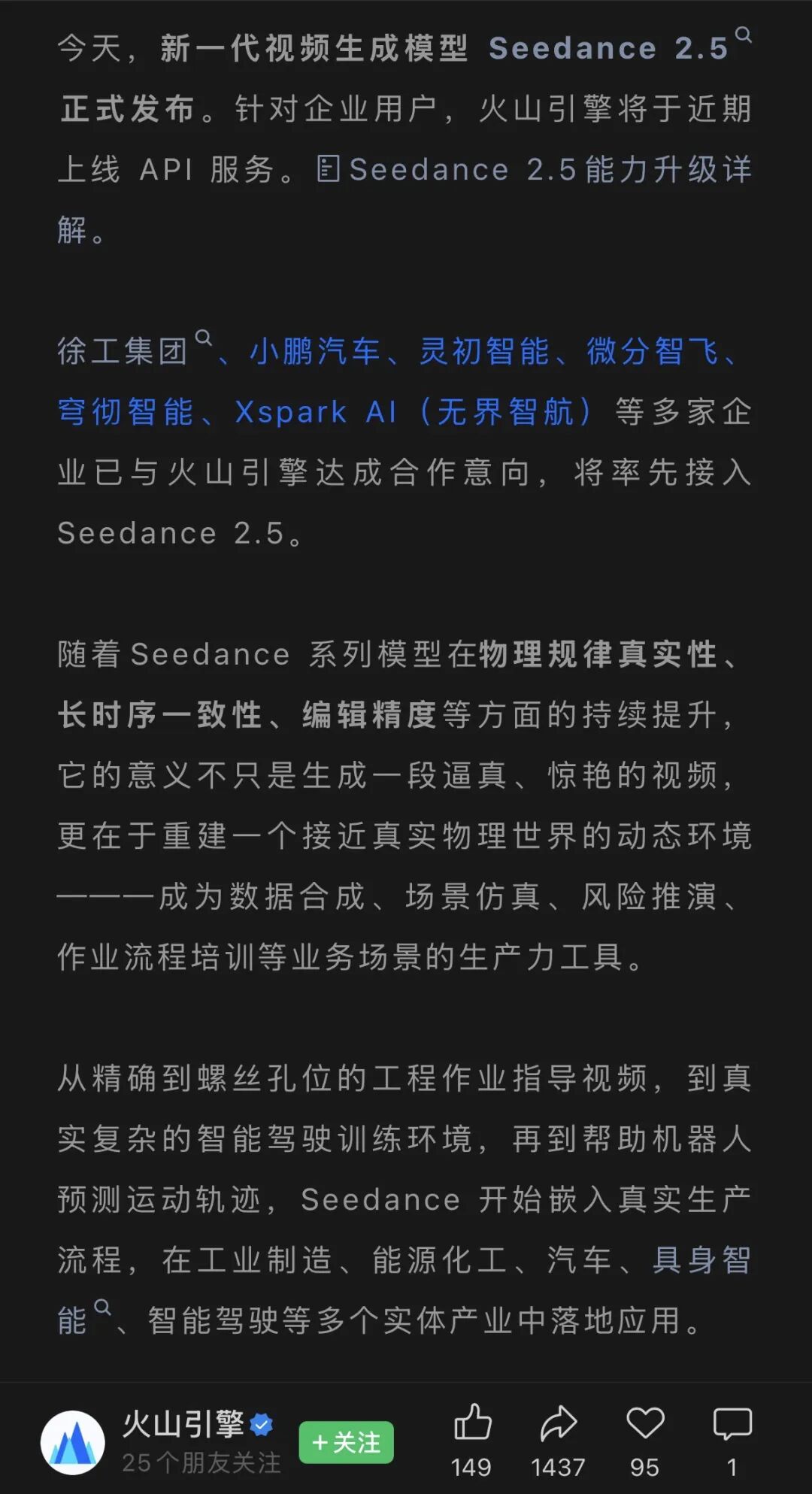
I briefly tested a few physics-involved scenarios. Like biting a lighter ⬇️
It didn't explode 🥺
Okay that one was a joke, mainly this one: "A yellow rubber duck stuck to a table is placed between two black-and-white dominoes in a row on a wooden table. A long wooden stick fixed to a black rotating platform rotates clockwise, striking the first domino on the left" ⬇️
No explanation needed — even a vocational college student who spends all day at internet cafes can tell this doesn't follow physics.
Of course, I also tested other video models, and none could complete this task either.
Putting on my armor: we didn't test enough scenarios in this category. We're considering building a dedicated physical world benchmark on our video-arena.com for evaluation, where the masses will certify whether their videos follow physical laws.
Let me boldly offer some strategic advice to ByteDance:
If you really don't know what to update next, just merge Dreamina and Lark into CapCut. You'd save costs, boost efficiency, and make big news. Otherwise I still don't know what the difference between these two things even is 😅.
Qiu Mu says he suggests bringing Malvin back to manage CapCut, Dreamina, and Lark.
Oh right, speaking of Dreamina — the most ruthless thing Dreamina did was launch a "generate ultra-long video" feature alongside Seedance 2.5, capable of spitting out 3-minute videos in one go.
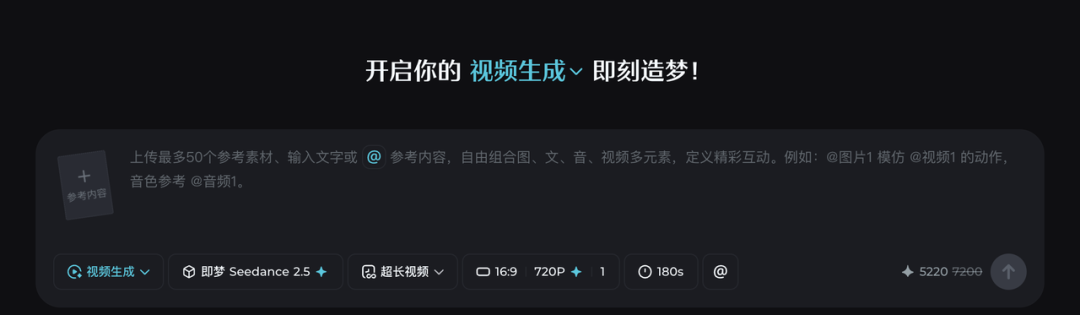
LibTV next door is even crazier, doing 5-minute videos in one shot.
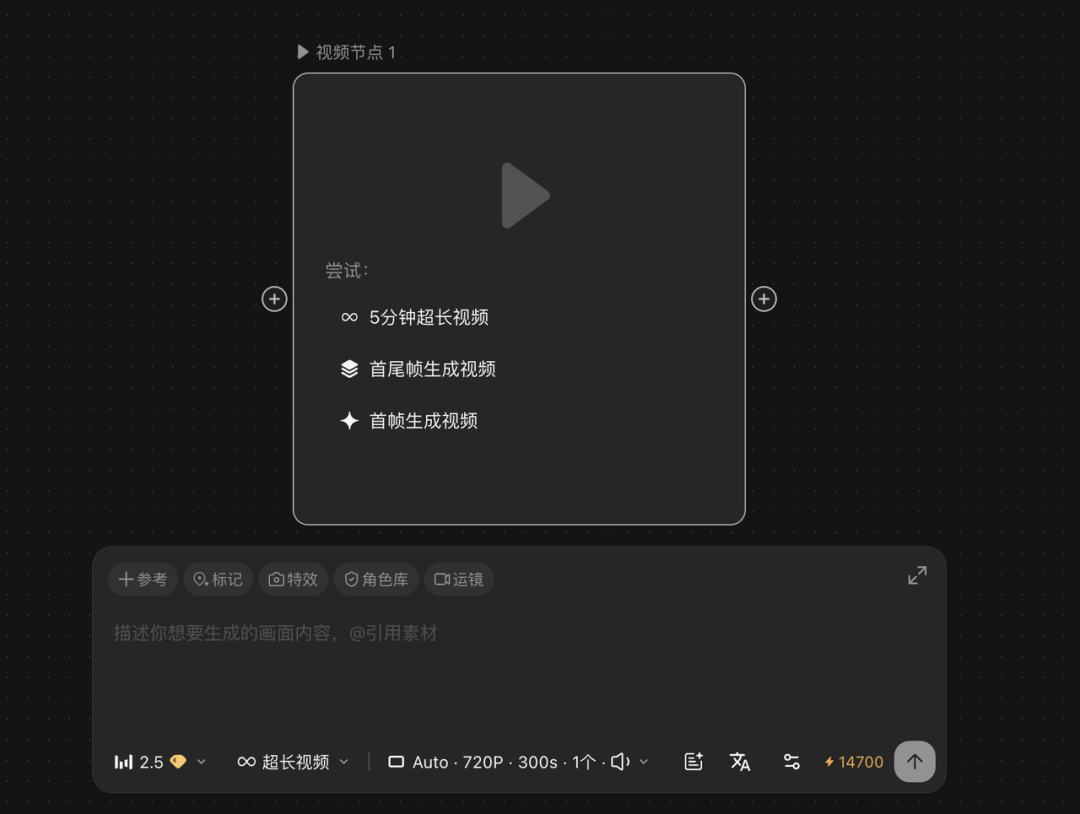
I genuinely don't know who'd dare use this feature on China's most expensive video model? Two draws and you could buy an electric scooter to go deliver food.
I suspect they really think this way, because LibTV next door, afraid you can't afford Seedance 2.5 annual membership, now supports Huabei payment.
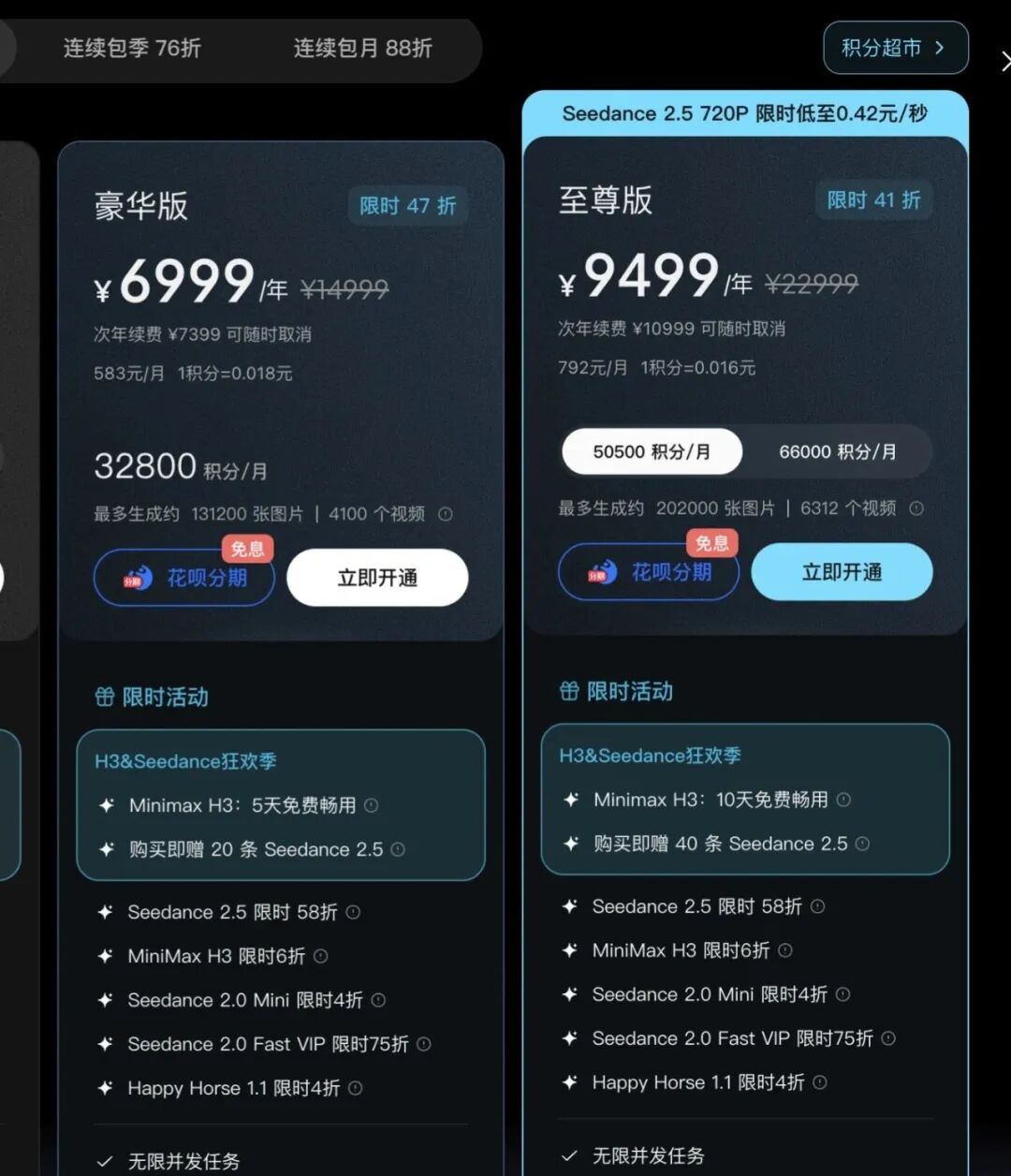
And isn't this obviously just generating 15 seconds first, then referencing that 15 seconds to generate more, sons and grandsons without end. If you wanted, you could develop a 24-hour ultra-long video agent tomorrow.
This feature feels a bit like launching a satellite, some Great Leap Forward token-burning going on here.
Let me wrap this up.
Professional creators finding Seedance 2.5 improved and all the problems above aren't contradictory. Because this is a model productization problem.
Seedance 2.5 took a step backward in model productization, thinning out the prompt engineering layer, making the model more rigidly follow instructions, more oriented toward professional creators who can write detailed, precise prompts.
Conversely, MiniMax H3 took an extra step in model productization, specifically optimizing for film post-production scenarios.
Text models are the same situation. Moonshot AI's K3 took an extra step in model productization, aggressively pushing one-shot generation of polished web mini-games. Qwen 3.8 Max took a step back — a strong base model with engineering capabilities, not a standalone model product.
Everyone's talking about models swallowing products. Sure, model capabilities are improving fast, but with great power comes great responsibility — does the model further absorb product-layer functionality, like Seedance 2.0, K3, and H3 did? Or step back and be a hardworking background model, like Seedance 2.5 and Qwen 3.8 Max?
This is a product positioning question. Choose professionals, and it's hard to also serve regular folks.
Seedance 2.0 was still CapCut. Seedance 2.5 became Premiere Pro. Forgetting your roots, ByteDance 😭
I love Seedance 2.5, I admit Seedance's model capability is absolutely top-tier — I just see Seedance going this self-isolating route and feel depressed and bitter inside, man.
Right, in this AI era of mass saint-making, how can ByteDance resist just stacking stats to make money, running 70% gross margins, without coming out to shout "I have a dream"?
Martin Luther King? Martin Luther Ming! Yesterday, today, Ming-day 😭
(This article's cover image generated by ChatGPT, purely human-written)
⬇️
Subscribe to our Substack funeralai.substack.com