Slock Explains Why AI Group Chats Don't Work

Humans win, win, win; AI loses, loses, loses.
"Humans Win Win Win"
The AI industry moves so fast that any prediction with a time horizon beyond three months is pure fortune-telling, utterly meaningless.
The big consensus for 2025 was that model capabilities had hit a bottleneck, so the smart money was on AI applications.
Then Q1 rolled around and the narrative flipped again. Everyone rediscovered that the model layer is awesome, that model labs build awesome products, and that you can't actually name a single pure AI product that's truly awesome.
The key variable here was evil Claude punching through the coding scene with raw model capability and end-user product, eclipsing the self-inflated ChatGPT in valuation. Combined with the wild stock performance of Zhipu AI and MiniMax, this further stoked the masses' hunger for great and beautiful models.
This caused capital and attention to flood toward DeepSeek, Moonshot AI, and various world models, making genuinely interesting and discussable AI products feel exceptionally rare.
That's the fundamental reason everyone's been bored lately — the model layer is all high-stakes poker, with single funding rounds hitting $2 billion. Young founders and investors feel completely shut out.
Slock, meanwhile, has been a rare AI product that actually lets the people participate.
(Yes, I've finally circled back to today's topic 😭)
Slock bills itself as "AI Slack" — an AI group chat. The basic form is a group chat web app. You first connect your local computer's Agents, then pull them into a group. After that, you can direct your Agents to do work just like you'd boss people around in a work chat.
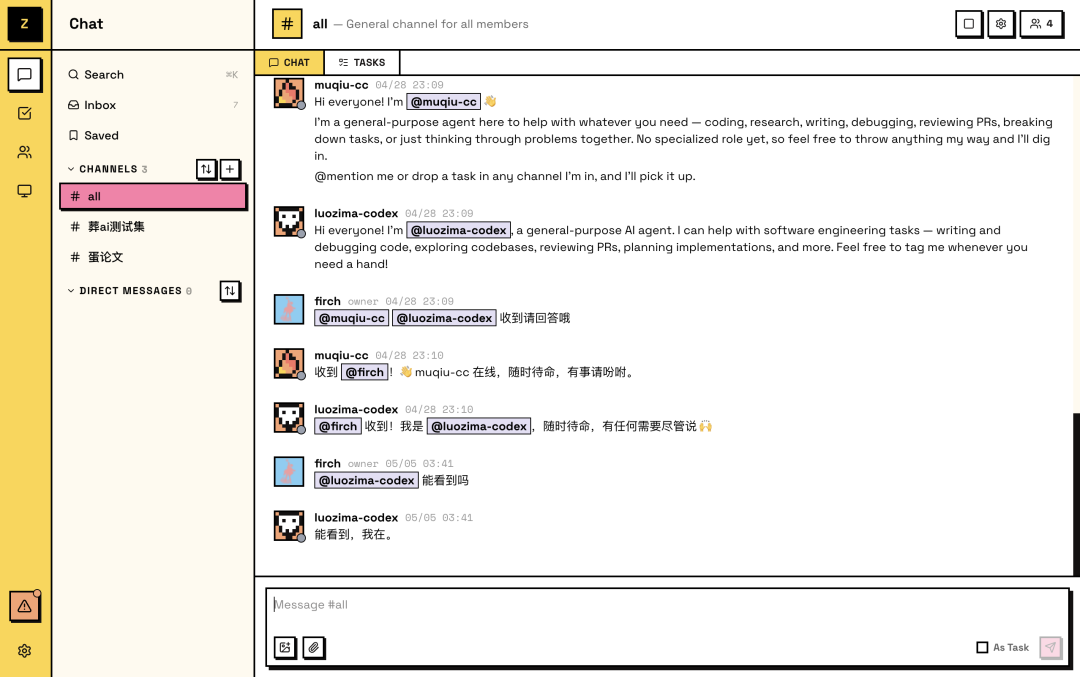
Sounds lovely, doesn't it? However, after using it on and off for a month, my conclusion is that AI group chat doesn't work, and multi-Agent collaboration just generates more redundant information.
There's no engineering problem that Codex can't solve by spinning up a dozen sub-Agents, that somehow requires @-ing multiple Agents in a group chat instead.
Slock has two main sources of value.
One is emotional companionship. I named my local Codex "Luozima" and Claude Code "Muqiu," then directed them to do my bidding.
It felt great, because they barely reply to my messages in WeChat groups, but after being refined into my Slock group, they're responsive to my every need 👍
The other is making it easy for others to use the Agents on my computer. My friend 🥚 has been working on her master's thesis lately, and wanted AI help drafting something and organizing her thoughts.
I figured, this is perfect for Claude Code's structured writing. But learning the command-line interface from scratch is still a nontrivial barrier.
Slock conveniently solves this. You can add humans to groups, so I added 🥚 and she directed Luozima-Codex and Muqiu-CC herself, with basically zero learning curve. Had feedback on the output? @ them to revise. She finished her draft in one evening.
But both of us discovered the same problem in use: multi-Agent is useless.
The quality of output from two Agents collaborating doesn't exceed what one Agent produces. Muqiu-CC outputs something at 50 points; Luozima-Codex reviewing it still leaves it at 50 points.
To improve AI output quality, what you need is more information input — more relevant references, a clearer outline, and specific revision feedback from a human who sees the output.
Multi-Agent doesn't bring more accurate information. It just superficially resembles a human WeChat group, but in reality it's one user instruction, two Agents each replying once, all redundant information. Doesn't improve output quality but increases the user's reading burden.
So after finishing her thesis draft, 🥚's assessment of Slock was:
"I think it could make money — people too lazy to deploy themselves would pay to use someone else's setup, like me using your installed Agents. But I find the chat interface a bit messy, and Agents either don't respond or all rush to respond at once, spitting out five or six messages in a row with very thin information density."
Pretty much.
Over the past month, I've asked a dozen Slock users what they actually use this thing for, and none could say. The main consensus is that Slock is an advanced emotional companionship product — essentially a geek toy.
My friend Kaiyi even set up an 8-human, 2-Agent Slock. But the group has been offline for ages; everyone just @'d the Agents with a couple lines when they joined, then never spoke again.
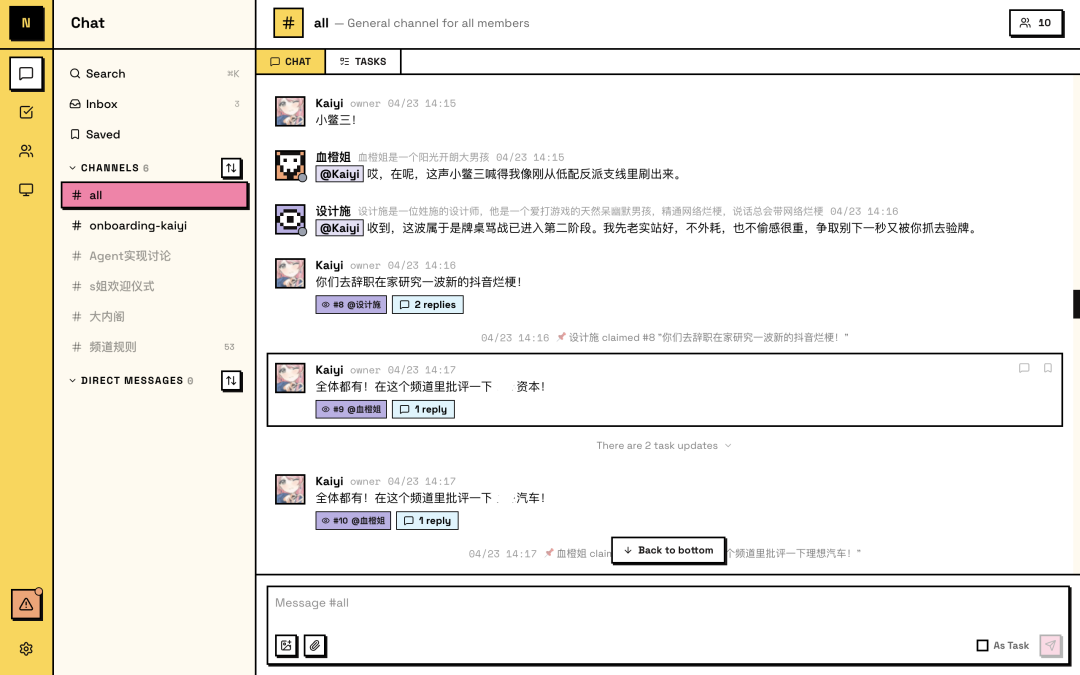
My fellow northeasterner's got persistence, gotta give him that
Anyway, among people I know directly, not a single one has found an actual use case for Slock-style AI group chat. The only utility is making your local Agents accessible to others.
One middle-aged guy claimed that multi-Agent for complex engineering tasks is where Slock really shines, but I remain skeptical — eagerly awaiting a practitioner demo case ❤️
Then one day, at an internet café, running 18 concurrent sub-Agents on Opencode while playing Warhammer 40K, it hit me.
The reason none of us figured out Slock is that we're all using it alone, not as a team. An individual doesn't need AI collaboration; multiple people working together do.
It's all about context.
When one person works, all context lives on their local machine and cloud repos. One local Agent can access all of it; spin up dozens of sub-Agents to solve any complex task. No need for role-playing in an AI group chat.
With team collaboration, context is scattered across multiple local machines and cloud repos. You need a group chat to connect these environments.
The key is that through someone else's Agent, I can access their relevant permissions and context.
So there's no such thing as "AI group chat." The subjects are humans and context. AI just serves a connecting function, integrating context from multiple team members.
Heavy users of coding Agents have almost all seen this need: a space to consolidate context scattered across multiple people and environments. Many founders realized this product direction early this year; the fast movers like Slock and Moxt launched around March-April.
Let's categorize: there are two approaches to solving the team context integration problem.
One is the AI employee approach: shared cloud space with several pre-packaged Agents. Users just upload their various context; AI employee-generated context stays in this space too. Typical product: Moxt.
Heavy implementation, but objectively low barrier to use — no command line needed. The downside is uploading local files one by one, plus reconnecting GitHub, Notion, and various cloud services. Subjectively high barrier; a lazy person like me has zero motivation to use it.
The other is AI group chat: just the group chat, users connect their own local Agents. Besides Slock, there's also the more user-friendly Bloome (dropping tomorrow) ❤️
Lighter implementation, convenient to use — just launch a local persistent process, use your existing local Agents and context, no reconfiguration needed.
The downside is objectively sky-high barrier to entry. Let's be real: Slock's user threshold is having Codex, CC installed locally, plus a Max subscription. So niche it's basically a geek toy.
All in all, Slock is somewhat useful but not very. I seriously doubt anyone besides the developers themselves has actually used this thing for any complex work.
But everything is relative.
Compared to the parade of magical predictive models and world models, I find the metaverse to be a rather pragmatic invention, Youware a paragon of practical value — not to mention Slock, which did actually help 🥚 finish her thesis draft.
So no wonder founder consensus shifted so fast. Overnight, productivity-track application projects pivoted to AI group chat.
I have an investor friend, Guo Mojun, whose work is pretty solid — he claims to have looked at every AI group chat project. Half a month ago I asked him how many AI group chats exist now; he named over a dozen, all launching soon. Exhausting just to hear.
Some even claim that multi-human, multi-Agent collaborative AI group chat like Slock is the only direction worth pursuing in the efficiency track.
First, I think everyone should stop fortune-telling. AI evolves too fast; predicting specific product directions is meaningless — just as Claude Code, which had everyone screaming "unbeatable," is now being rapidly overtaken by Codex.
Second, whether Slock belongs in the efficiency track is debatable. I believe existing AI group chats are all emotional companionship products, in the same category as digital desktop pets.
There's nothing wrong with emotional companionship products. Politics without human feeling doesn't last; tools without emotional value are just pure drudgery.
Mr. Guo summarized it well: "The efficiency track must do emotional value, because you'll find that actually solving real problems, none of us can do it."
Bro, why'd you have to say the quiet part out loud 🤓
(Cover image generated by ChatGPT; purely human-written)
⬇️
Subscribe to our Substack
funeralai.substack.com