TapNow Wants to Trap You in the System

That's terrifying.
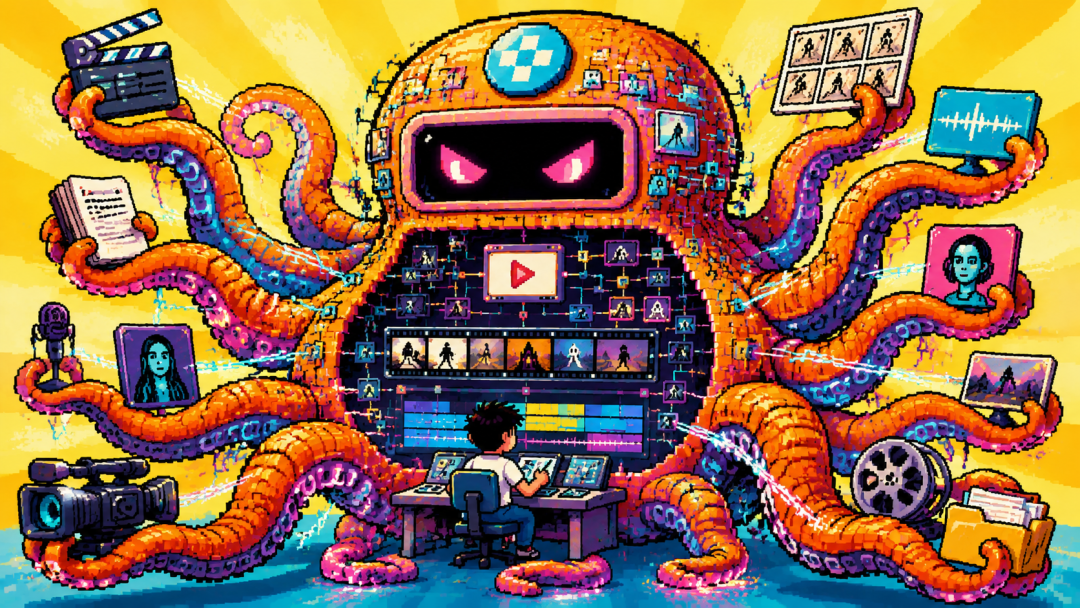
"Terrifying"
As you may know, last Saturday in Shenzhen, we co-hosted an unprecedented horror film hackathon with TapNow.
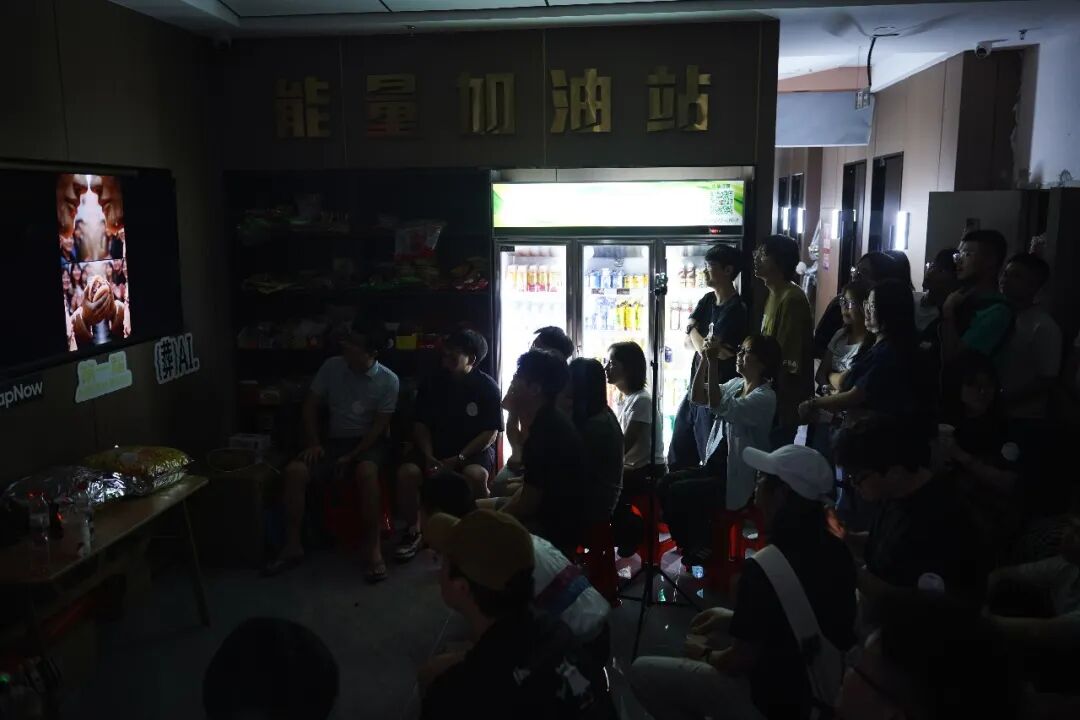
We figured horror was pretty niche and spent the lead-up worried no one would show. Over two hundred people registered, though, and the venue was packed to capacity the entire time — by the end I couldn't even find a seat 😭
Two attendees signed in, didn't even linger for the internet café ambiance, headed straight to a nearby McDonald's to work, and returned that evening to submit their project before quietly slipping away, their deeds unsung.
At past hackathons in internet cafés, the scene is usually chaos — people playing Delta Force, League of Legends squads going at it, the whole place buzzing with merry energy. But this time, making my rounds, I found our participants had zero interest in games. Everyone was just sitting there, connecting nodes on their canvases, making videos.
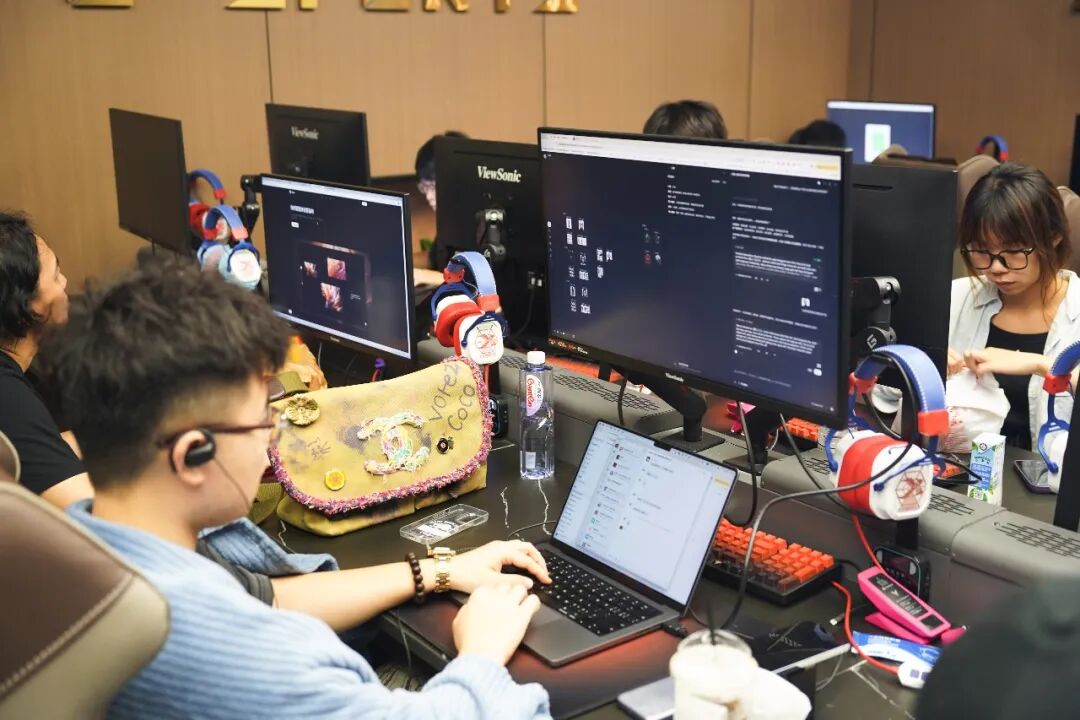
All to say, this horror hackathon drew actual professionals, people seriously doing AI art. Next time we won't need an internet café — a cram school art studio will do just fine 👍
Jokes aside, there were genuinely impressive works on display, and none of them relied on cheap jump scares. They tackled social issues with real thematic depth, which was pretty humbling for Xianyu and me, who usually just pump out AI slop.
We genuinely hadn't expected anyone to produce watchable films in just eight hours.
The piece that stuck with me most that day was Erjin's Mountain Home ⬇️
Well, "stuck with me" because I watch Japanese mockumentary explainers on Douyin all the time — last year's viral Magical Girl Yamada, for instance — so it felt familiar.
According to Erjin, he drew inspiration from Broadcast Prohibited, the godfather of Japanese mockumentaries, and wanted to create something in that same style.
He started with only a vague concept: a news story from last October about a couple at a highway rest stop with a child who appeared to be a feral human. Through ongoing AI conversations, characters and relationships like a veterinarian and an exorcist got added to the roster, and the story's logic fell into place.
Once the script was finished, he moved operations to Creative OS — a new release from TapNow that they bill as a "creator edition" of Codex:
First, he had it research and study the shot composition and visual style of Japanese mockumentaries like Broadcast Prohibited, building custom Skills from scratch when none existed;
Then he offloaded all the tedious, batch-processed, no-brain-required work — generating prompts, converting to three-view diagrams, breaking down scripts, auto-generating storyboards — dumping it all on Creative OS to grind away at;
While Creative OS spun its wheels, Erjin sourced voice acting, polished narration, and did more meaningful work that actually showcased authorial voice.
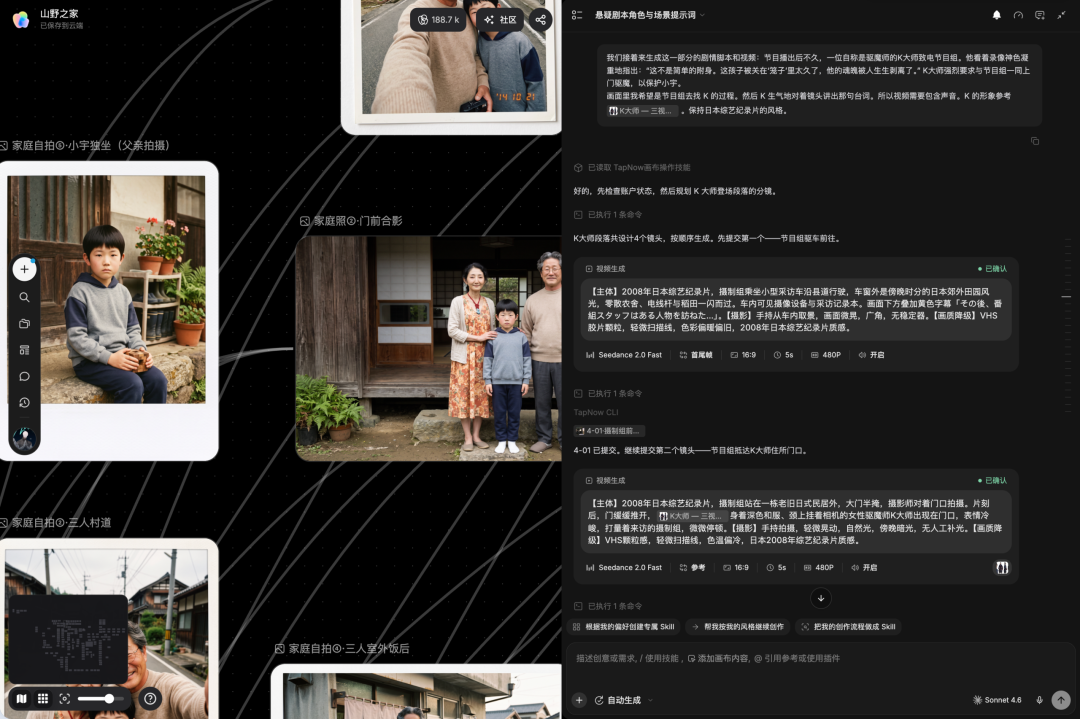
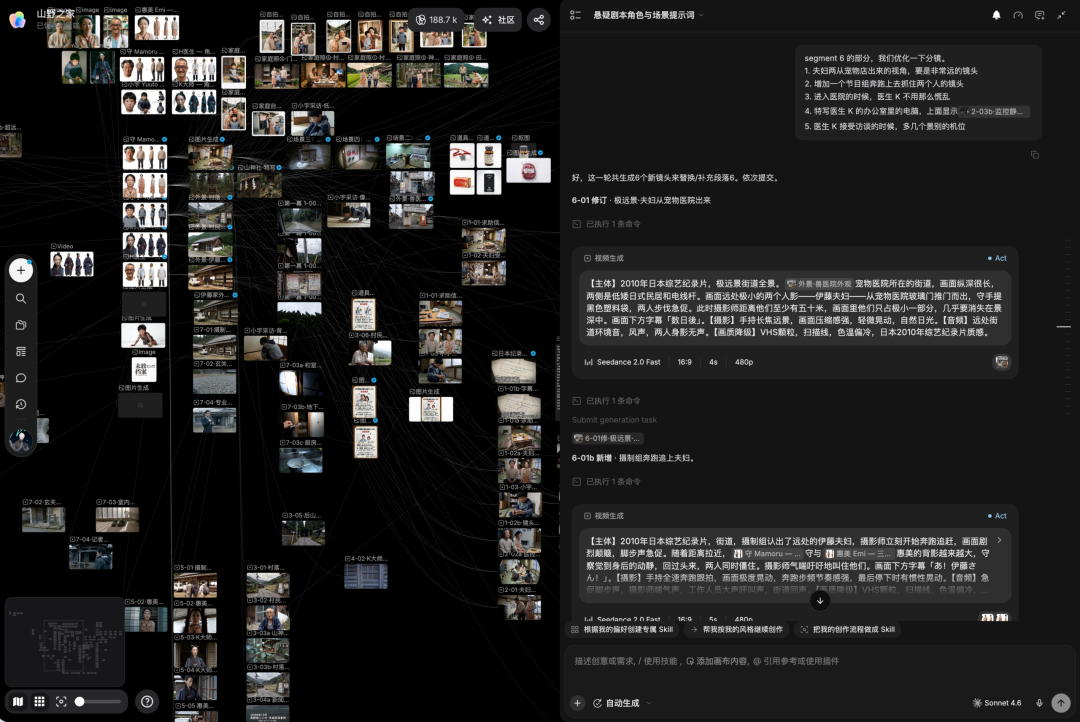
Case closed — no wonder these contestants could crank out films in eight hours, they were using Creative OS as manual labor. Absolute steal.
Another piece with a similarly bizarre style was Seulgi's Reincarnation, which drew thunderous applause during the screening and ultimately took first place in the individual competition ⬇️
The film was short but structurally complete — felt like it could air as a public service announcement against human trafficking on the subway tomorrow.
Seulgi is a third-year film studies grad student and also directs at an AI studio, so when creating, they already have a crystal-clear vision of the final product in mind: what videos to generate, how to connect them — all mapped out.
I figured, then, that adding a chat box to TapNow's canvas must be pure dead weight for creators like them. Creative OS's writing has that AI sheen to it anyway; having it write scripts is basically serving uncanny valley content to uncanny valley consumers, right?
In other words, for professional creators making AI shorts, don't you ultimately just need a canvas to arrange videos? Forcing yourself to dialogue with TapNow's Creative OS — isn't that just comedy?
But Seulgi pushed back: having a window to exchange ideas while making videos is inherently valuable. Otherwise solo creators just grind away in silence, no feedback, no critique, too isolated — it's a recipe for becoming a shut-in.
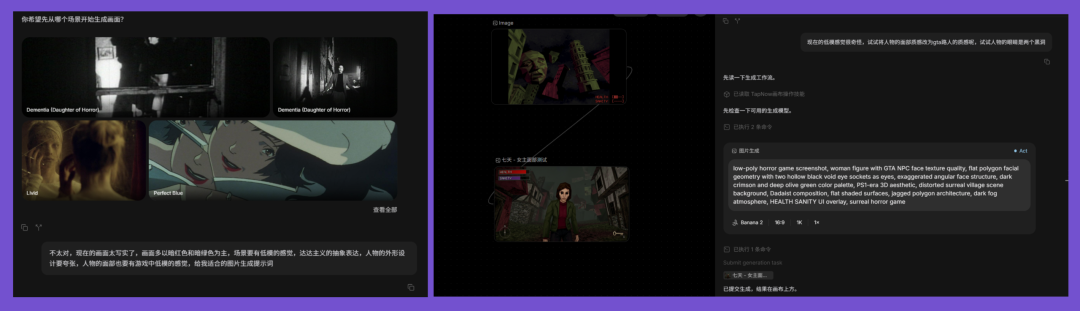
And besides, while Creative OS and its ilk may lag behind formally trained artists on pure artistry, it's more than sufficient for saving time and effort on commercial work. The client isn't a Cannes jury, right.
Fair enough, I suppose. Maybe it's just for illiterate hobbyist AI video enthusiasts like us.
We also ran a team competition at this horror hackathon, with first place going to a piece called Smoke Plague ⬇️
Now this was immersive horror — screening an anti-smoking film in Shenzhen, I felt like I'd activated VR mode the moment I stepped out of the internet café.
Good thing our venue was non-smoking, or the situation could've gotten out of hand.
The pacing was solid too, well-matched to the soundtrack — more commercial-feeling than the other entries.
To deeply study this film, I cloned the project directly in TapNow, then used Creative OS's Skill Creator to steal the creator's entire creative approach.
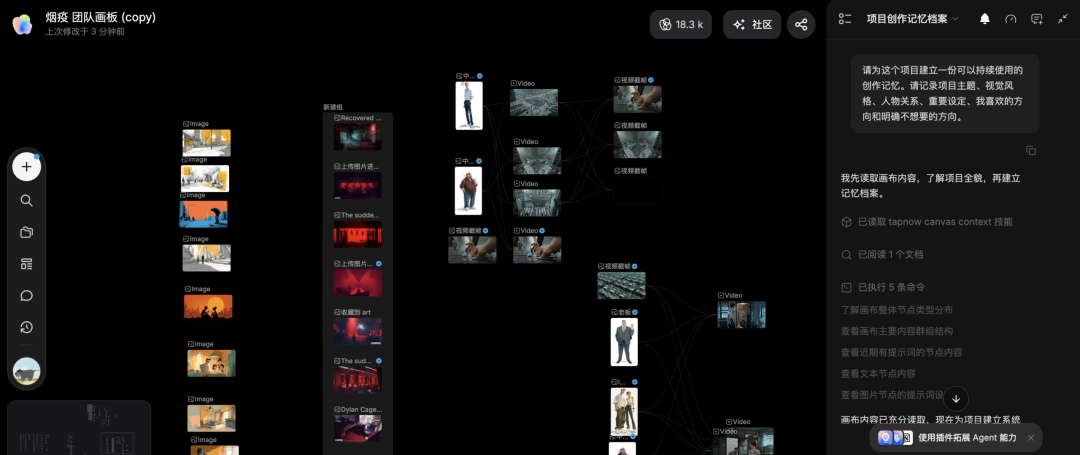
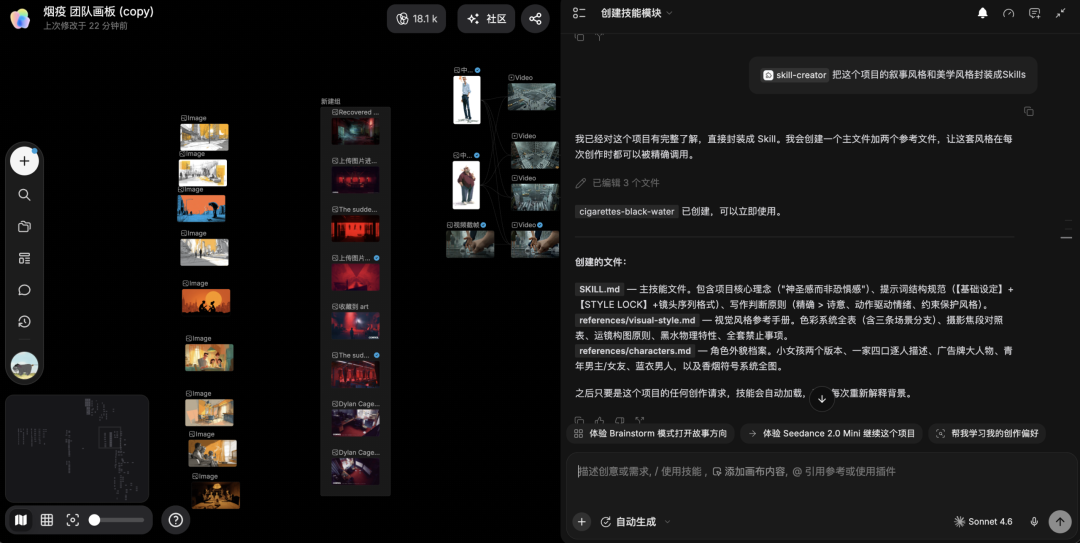
Then I reused that Skill to have Creative OS make me a video satirizing electric scooters running rampant everywhere ⬇️
Since it was one-click generation, plenty of flaws, but you can see the style and narrative structure were copied decently enough.
No wonder TapNow is so gung-ho about hosting competitions and events — they're directly internalizing and recycling creators
Having learned this trick, I decided to try making a horror short myself.
I started with just a few keywords in my head: Doubao, phone, doppelgänger, that sort of thing. Xianyu and I held a meeting on Lark to deeply discuss plot structure, then exported the meeting notes and Lark documents.
One nice thing about Creative OS is that it can use plugin extensions to connect directly to Lark and analyze the content.
Like so:
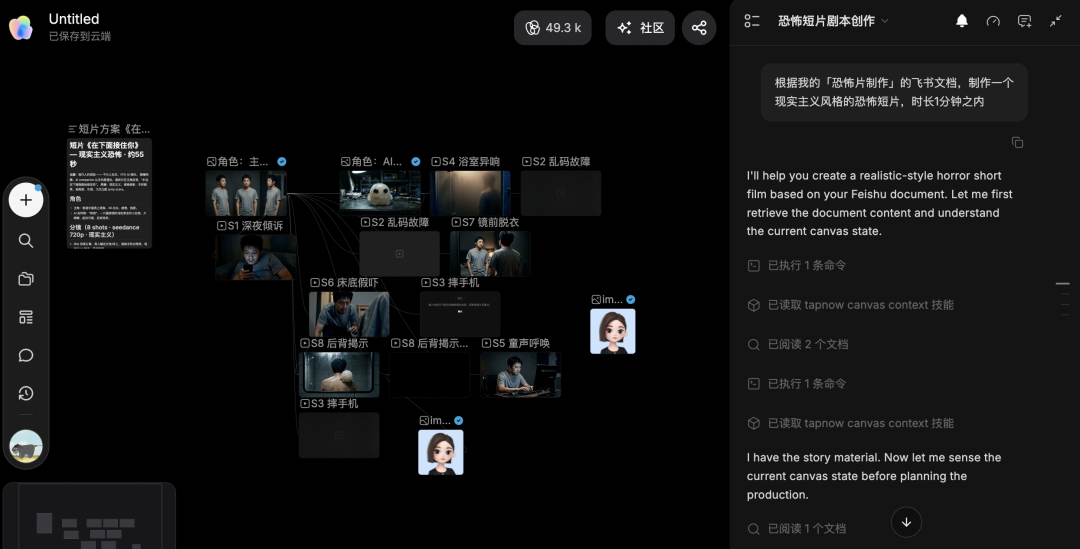
It did organize things for me. Though honestly this plugin extension feels a bit unnecessary — I could just generate a PDF from the Lark doc and send it over. Using this feature requires figuring out CLI and such, what normal person can make sense of that?
But beyond Lark docs, it can also read meeting context, work history, and group chats, so for team collaboration it might actually have some use.
With the worldbuilding established, I started using Creative OS's Brainstorm mode to flesh out characters and plot.
This mode sounds fancy, but it's basically multiple choice. I give Creative OS a general direction, it gives me several options, and once I've selected my way through, characters and plot are locked in.
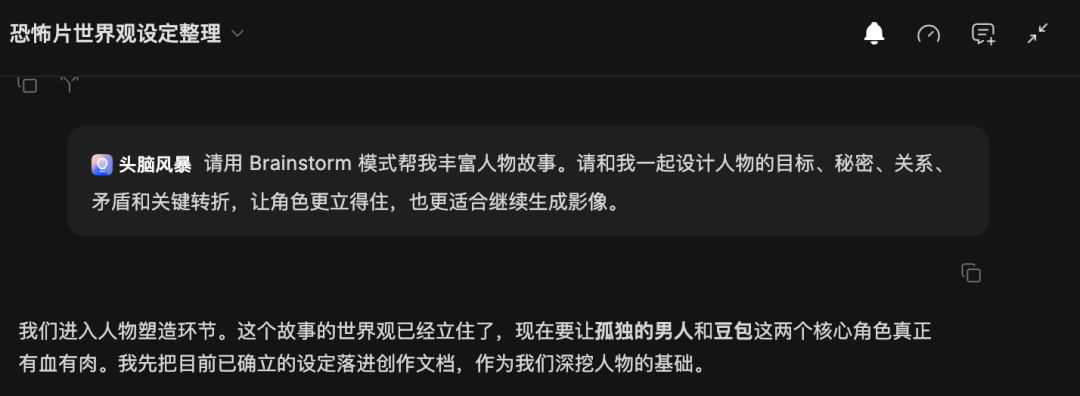
At its core this relies on the underlying large language model's capabilities — it's basically a visualized conversation interface, somewhat creative but nothing revolutionary.
That said, I did find myself using this feature frequently. After working on a film for hours, you don't want to think anymore, and you're too lazy to open another AI chat window, so you just ask here.
Especially when paired with Skill Creator, it feels less like working alone and more like a team operation:
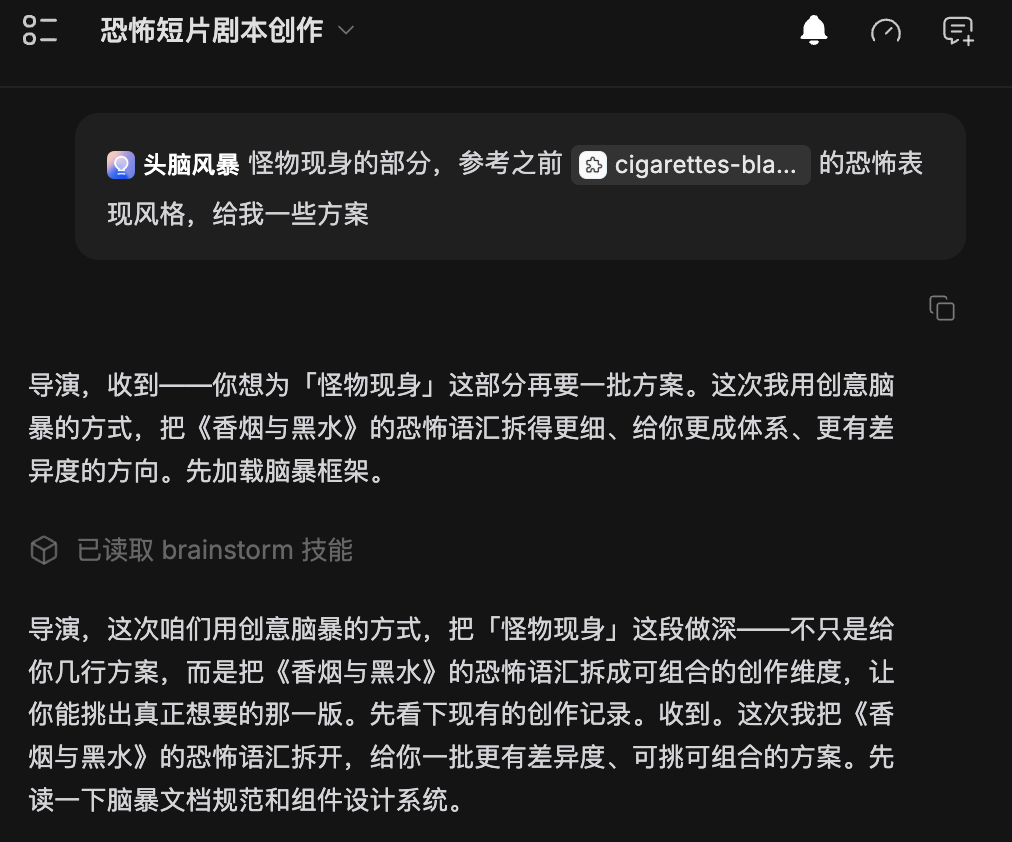
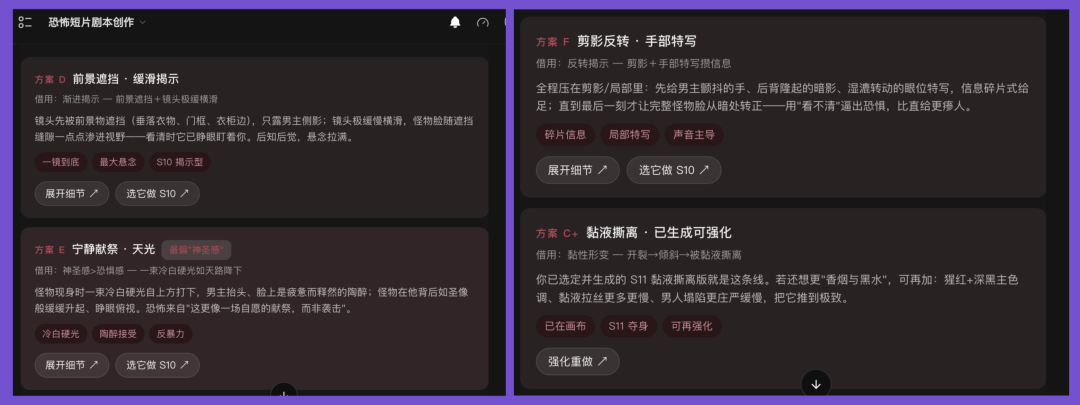
The whole time I just clicked wherever possible, typed only when absolutely necessary, let AI decide anything I didn't have to think about myself. In the end it took three or four hours to generate all the video.
With all videos generated, I used the plugin extension again to fully automatically import all storyboards into Frame.io — a tool that lets teams watch and review footage together.
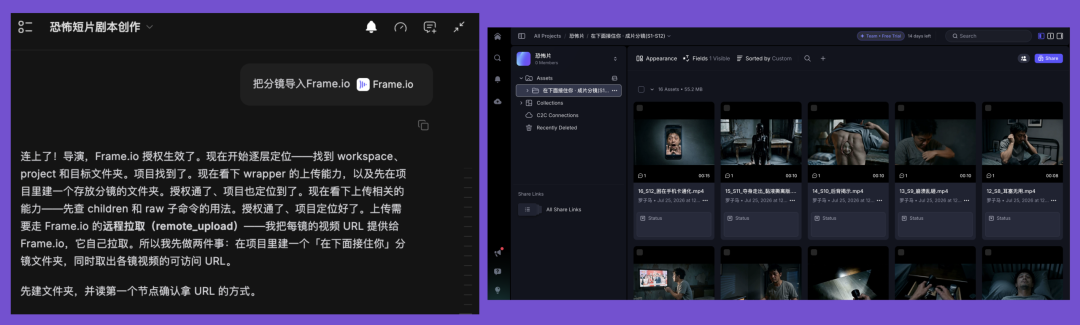
This connection was a bit tricky, but it worked in the end
Then I had Xianyu and Qiu Mu — two liberal arts grads — review the footage on Frame.io. Given their abysmal artistic literacy, they passed everything unanimously. The final film is below ⬇️
Though the film itself was pretty low-effort, the process helped me understand what TapNow is trying to do with this Creative OS update:
They want to keep you inside their canvas, from ideation to scriptwriting, from character development to story construction, all the way to final assembly and output — ideally never leaving the TapNow webpage, doing the whole film start to finish right here.
No wonder they keep emphasizing they're not an Agent but a system — turns out they want to trap creators inside the system 😢
Actually the thinking is sound. For creators making AI videos, being able to start everything on the canvas creates strong immersion. And Creative OS doesn't just answer questions — it generates assets and nodes based on conversation, which users can manually adjust, effectively offering creators a new workflow.
This approach works for noobs like me. I make videos just for fun; if someone packages all these video-related tools into a one-stop service, I'm definitely going to find that convenient and fast.
But several creators I interviewed at the event said their scriptwriting was mainly done through conversations with Gemini, ChatGPT, and other AIs they'd been using all along. Those AIs feel familiar, and they've built up memory over time — no need to migrate to this new Creative OS to experiment.
Plus, while Creative OS advertises unlimited context, it keeps mentioning how it's "compressing" something during conversation, which is... hard not to read into 🙂↔️
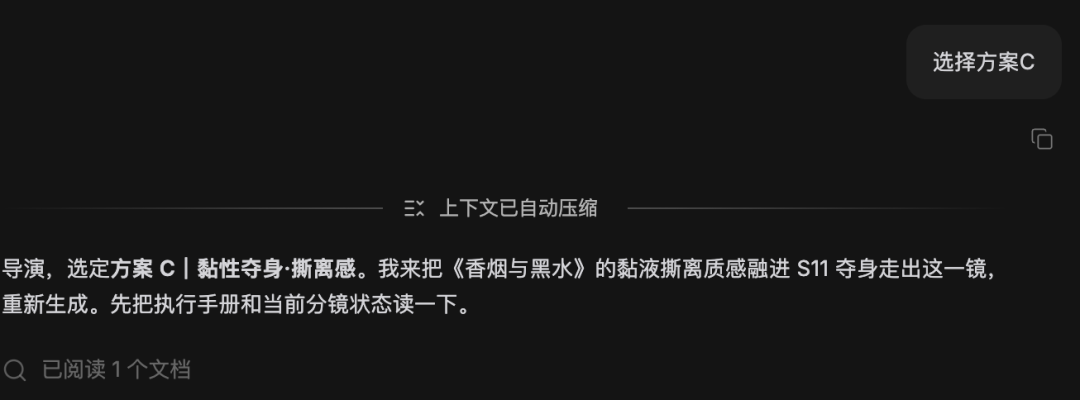
Though their product manager explained that this context compression condenses previous content into an outline, which doesn't affect Agent performance.
Alright. I'll believe that.
Then there's the previously mentioned Skill Creator feature — this genuinely can attract a lot of creators. And I have to say, TapNow treating their product as a service business is a good thing.
But AI video Agent startups aren't service businesses, because canvas products have no moat — you update today, someone copies tomorrow. What you're really competing on is price, or more precisely, Seedance's discount depth.
So your products have no differentiation, and users have no loyalty. You think you're a private club, but you're actually a crypto exchange — you're not earning usage fees, you're earning transaction fees.
Of course, this doesn't mean all product updates are meaningless. I previously criticized TapNow for being pure canvas, for not treating us idiots like humans — so they added the chat box, threw in all these convenience features, and they'll definitely get some new users.
But whether this is merely a chat box update, or truly the "system" TapNow claims, making themselves the Codex of AI video — that still needs market validation.
According to them, they're also launching some kind of "unified creative system" App ecosystem, which feels like they're about to market themselves as the Windows of AI video 🤣
My attitude is they can say what they want — Codex is dead anyway...
(Cover image generated by ChatGPT, text 100% human-written)
⬇️
Subscribe to our Substack: funeralai.substack.com