What's Quark up to?
Bottom-Up Product Development

"Building Products from the Bottom Up"
Quark recently rolled out something called the "C Plan" to compete with Doubao. The concept-manufacturing energy feels so Alibaba.
So everyone opens the Quark app, stares at it for a while, and... nothing looks different?
The home screen search bar has a new assistant button. Tap it or swipe right, and you enter Quark Chat.
My first reaction: that's it?
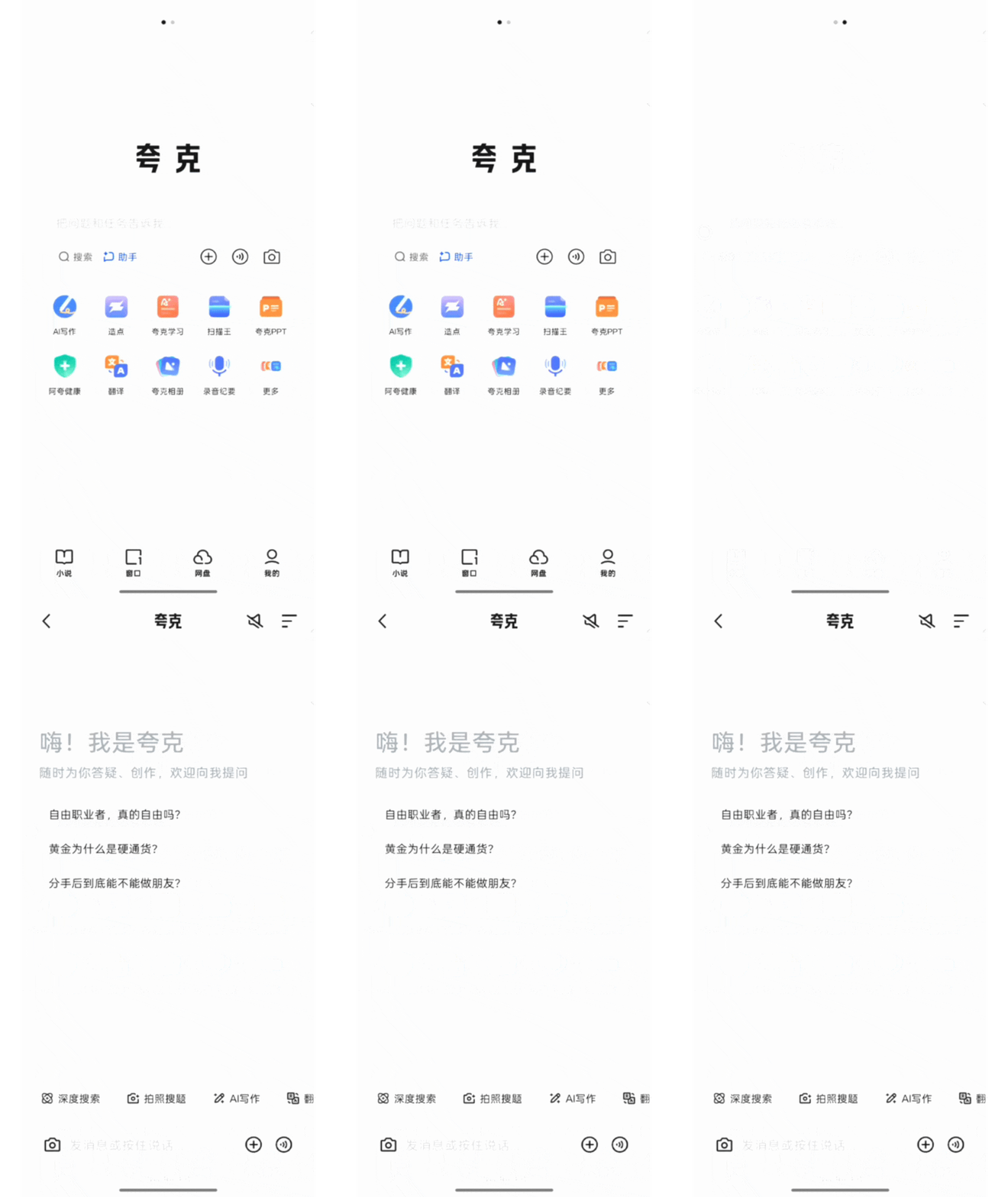
But close and reopen the app, and the change hits harder — this Chat, with your previous context, now lives permanently on the home screen.
If you're a Doubao or Yuanbao user, you immediately get that low-friction feeling of open-and-ask.
Dual home screens — now that's interesting. A product with hundreds of millions of users, built over six years, daring to make your first instinct not browser + search bar + toolbar?
But who needs another chatbot? Isn't this abandoning their core strength?
After two queries, though, I felt the difference.
I asked it to find some TV shows. Chat attached direct streaming links. Two taps and you're watching — no ads, no popups, no registration points.
Quark Cloud Drive's advantage shows even more clearly on study-related questions.
I asked: "I'm a patriotic young person preparing for the 2026 Sichuan University international politics grad school entrance exam." After listing reference books, Quark attached cloud drive links — including past exam experience PDFs from Sichuan University's politics program 🤓
Absolutely unbeatable.
I also tested the same news question on both Quark and Doubao: Why did Sarkozy go to prison?
This really highlighted the difference. Doubao gave a concise answer — two paragraphs explaining why Sarkozy was jailed. Felt like it wanted me to get back to short videos ASAP.
I hadn't even enabled deep search; this was just normal conversation.
Quark's answer was far more detailed. After briefly addressing the core question, it laid out key case facts, extensively quoted multiple parties' statements, and even noted Sarkozy's cell size and outdoor time as supporting evidence.
Plus, Quark appended short videos too — from Bilibili, Zhihu, and articles and clips from other platforms.
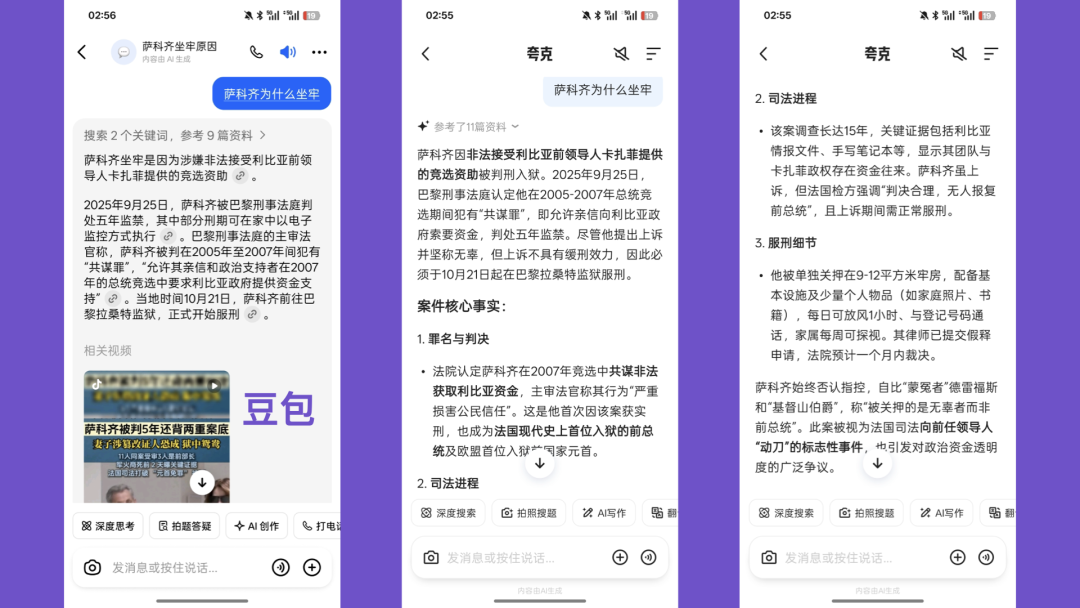
Comparing the two: Doubao's strength is concision; Quark's is explanatory power — more structured, detailed yet fluid storytelling. It also supports real-time voice conversation, quite smoothly.
The reason: Quark is running Alibaba's latest Qwen3 model, customized and fine-tuned for this.
The parameter count feels no smaller than Max, with update cycles far faster than the 2B version.
The model's massive scale and agentic pre-training give Quark Chat strong information-structuring capabilities. Even with very long context, response quality holds up. And it's not shy about burning tokens — likely confidence in architectures like Qwen3-Next with lower inference costs.
Still, Quark and Doubao are both chatbots at their core. Same basic form.
Model capabilities are strong enough now that for most everyday questions, their answers aren't fundamentally different. Whether Quark's more structured conversational style can attract more users — that's a question only practice can answer.
Both are conversation. Neither breaks the mold.
The key is tools.
Quark has built dozens of useful mini-tools — photo album, cloud drive, scanner, homework solver, health assistant, and more. These aren't rushed additions; they're accumulated and refined over years, tested by hundreds of millions of users.
Behind this difference lies a completely different product path.
What's ChatGPT's logic?
I have super strong model capabilities. The dialog box is the entry point. Add Search to find information in conversation. Add Tool Use to let AI call various tools for you. Then maybe build a browser.
Model capability first, then find application scenarios.
Doubao follows the same logic. Doubao has to build its own AI podcasts, audio generation models, video generation models, then integrate photo editing, image generation, video creation into the app. Model capability first, then design features upward.
Quark is the opposite: bottom-up logic.
First satisfy seemingly scattered user needs, then use model capability to connect multiple tools.
Quark started with a clean, minimal search bar — a browser with fewer ads. Noticing users had more long-tail needs, it built Scanner, cloud photo album, cloud drive, format conversion, even AI ID photos. Each tool validated and polished by real users.
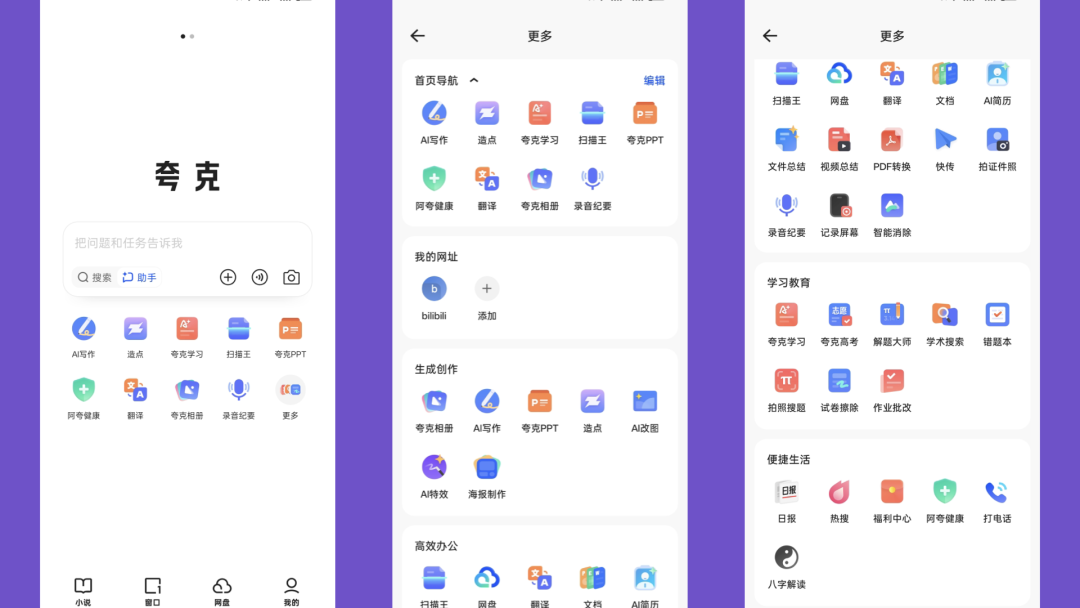
In the previous search box era, search and mini-tools were separate. You typed a query, Quark returned results; to use other tools, you had to exit search.
Now, Quark may not think there's a new user need called "conversation" — but rather a conversational mode. When model capabilities hit a ceiling, they can activate tools and let AI do the work automatically. Essentially using AI to string together task modes, achieving agentic use.
I think this change should come to PC browsers faster. Users browsing web pages, saving images, saving videos to cloud drive, storing photos in albums — all this lives inside Quark. Open Chat and that content is directly searchable or usable.
GPT can't do this. You'd screenshot and upload to ChatGPT. Same with Doubao — manual file import required.
I previously wrote "GenSpark Is Rebuilding Baidu". GenSpark borrowed Quark's all-in-one aggregator approach, combining all tools and functions in one entry point.
GenSpark is overseas, using Quark's thinking and the update velocity of browser game aggregators to rebuild the search box, rebuild Baidu. They've indeed launched many features quickly. But this is nothing like Quark's decade-long, step-by-step tool ecosystem.
ChatGPT has money and talent, but building all these tools from scratch to user satisfaction takes time. Manus tries to solve this with a general agent approach — same problem.
Tools only become powerful when combined with user habits. Take them out in isolation, and they're not that special.
That's the moat. You can copy Quark's tool list, but not its validated user preferences. Core competitiveness isn't in AI itself — it's in complete, closed-loop ecosystem integration with time-earned depth.
Most importantly, the timing is just right. If model capability was still at GPT-3.5 level when Quark launched Chat, it would only offer emotional companionship value. Only when models' agent capabilities and tool-calling abilities are strong enough can conversational mode truly deliver.
But the current version is still very early. Few mini-tools are actually usable in Chat. In my testing: image-to-PDF conversion, file format conversion.
If Quark successfully achieves agentic use, it proves two simple logics: First, fewer ads beats more ads. Second, tools refined by massive user bases beat vibe-coded rush jobs.
Keep doing simple things consistently. The rest has nothing to do with grand narratives.
(Images in this article generated by ChatGPT, writing assisted by Claude Code)