Wu Mama Tells China's AI Story Well

Pure, Grand Narrative: Telling the AI Story Well
"Telling the AI Story Right"
This newsletter spends all day writing about how AI products tell stories. Sadly, the storytelling skills of young founders seem to be on a steady decline.
Today, let's look at some proper, unadulterated grand narrative.
Storytelling is genuinely a technical craft. Sapiens devoted an entire book to arguing that human civilization is driven by storytelling.
In secondary markets, the value of a story can be quantified directly.
For instance, Alibaba held a Cloud Computing Conference, CEO Eddie Wu told a story, and Alibaba's market cap jumped by nearly HK$300 billion that day.
The story was told tremendously well. Arguments were well-supported, logic tightly interlocked. This is the kind of grand narrative capability that's become exceedingly rare these days.
So, in Wu's "Path to ASI," how exactly was the logic constructed?
A good story must confront the core question, then answer it in its own way.
Wu's story did exactly this. The question he set out to answer is the most fundamental tension in AI: can the large language model technical path actually achieve AGI, can it make AI surpass humans? Yann LeCun, Fei-Fei Li and other skeptics have raised clear objections: current LLM training data all comes from the internet, and the internet's existing high-quality data is nearly exhausted.
More importantly, training solely on human-generated text means AI cannot spontaneously develop physical perception, and therefore cannot truly surpass humans.
AI can perform well on tests, even win IMO gold medals, reach PhD-level competence. But it lacks subjective agency, lacks native creativity.
From an information theory perspective, the essence of the world is information, and the quality of information input determines output quality. If AI cannot interact with the physical world, it can only circle and compete within text and programming domains.
So this is the most fundamental contradiction in the AI industry:
For AI to surpass humans, it must be able to interact with the physical world and acquire massive amounts of unprocessed, firsthand raw data.
This "information theory dilemma" is the core contradiction that Wu's narrative needed to resolve.
With this fundamental contradiction understood, let's look at Wu's speech — everything falls into place.
Wu opened by establishing his thesis.
Rather than giving the answer directly, he first raised everyone's expectations — elevating the goal from AGI to ASI, superintelligent AI.
AGI is merely the starting point, merely reaching human-level general cognitive ability. What we're after is ASI that far surpasses human intelligence, capable of self-iterative evolution.
Excellent. With the goal set, next comes the path to realization.
Wu then proposed an "AI Development Trilogy" for reaching ASI.
Phase One: Intelligence Emergence. AI thoroughly learns existing knowledge on the internet. This has largely been completed.
Phase Two: Autonomous Action. AI begins interacting with the physical world, with the key being learning to use tools. We are in the early stages of this phase.
Phase Three: Self-Iteration. AI acquires the full volume of raw data from the physical world, enabling self-iteration and self-learning, ultimately achieving ASI. This remains far in the future.
The elegance of this trilogy's logic lies in how its third phase directly responds to the core contradiction raised at the outset. This naturally leads to the next question: how exactly is this critical third phase to be achieved? How does AI self-iterate to surpass humans?
Nobody knows, so we can only listen to Alibaba Cloud's narrative.
To close the logical loop, Wu further decomposed Phase Three, aka self-iteration, into two core elements.
First element: AI must be able to connect to the real world and acquire raw, firsthand data.
This returns us to the core question raised at the beginning: AI that only learns secondhand knowledge has no future. Like autonomous driving — you can't have humans write rules for every real-world traffic situation, humans could never finish writing them all. Humans must let AI learn to process raw camera footage itself, to understand and learn on its own.
Second element: AI must learn to learn autonomously, Self-learning.
After interacting with the physical world, AI needs a continuous learning mechanism, able to constantly acquire new data and receive real-time feedback, autonomously optimize, correct deviations, and achieve self-iteration and intelligence upgrading.
Excellent. At this point, Wu's narrative has achieved logical self-consistency. How does AI surpass humans?
By connecting to the real world to solve the information input problem, then driving intelligence upgrading through autonomous learning.
Theory complete. How to prove you can actually do it?
This leads to Alibaba Cloud's two strategic judgments. These two judgments correspond respectively to the two core elements proposed earlier — theory meets practice, as they say.
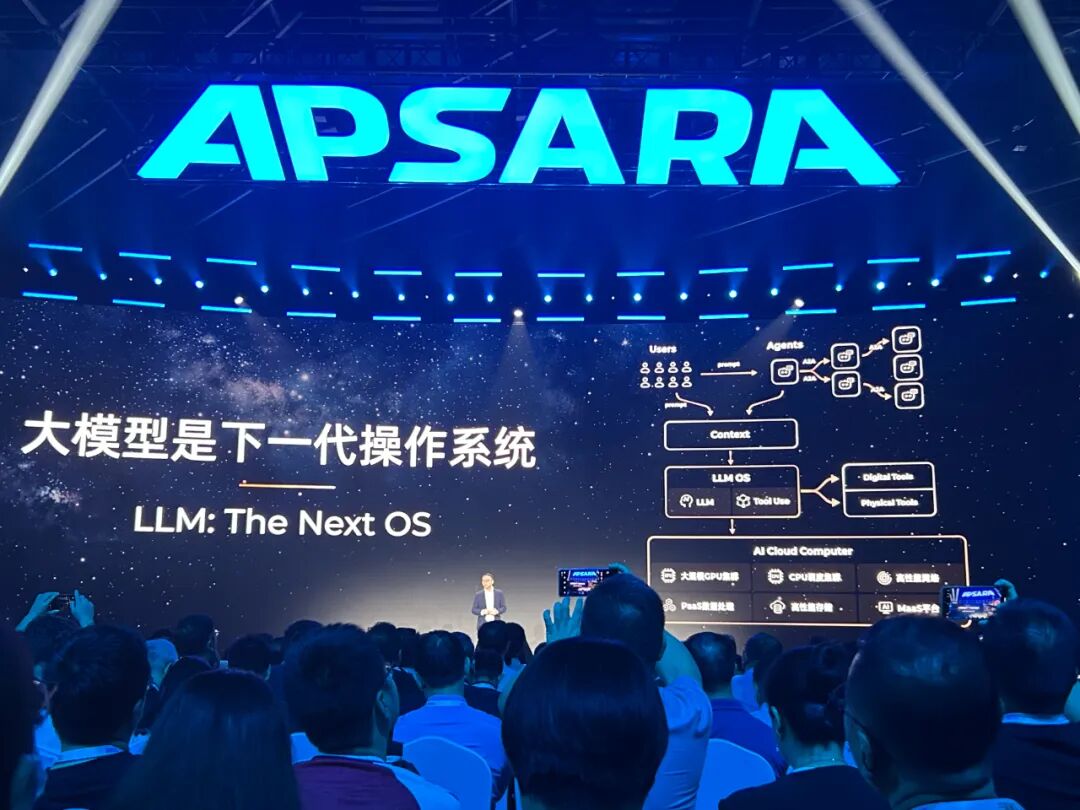
First judgment: Large models are the next-generation operating system.
The core of this judgment is that large models must interact with the real world by calling tools, by calling Agents, to acquire more raw data.
For example, Zhipu AI's recent AutoGLM 2.0, which lets AI complete tasks like ordering takeout or writing positive reviews based on user instructions — relatively simple interactions with the physical world.
Behind this, it calls Alibaba Cloud's Wuying AgentBay. AutoGLM 2.0 actually runs on a cloud Android phone, with AI directly using apps installed on that cloud phone. Very direct, very brute-force interaction logic.
Moreover, today non-technical users with decent logical reasoning can already use natural language to have coding Agents create some functional small tools.
In the future, more non-technical domain experts will be able to structure the knowledge and experience in their minds, creating various Agent mini-tools. When these Agents can interconnect through protocols, can call upon various services and devices in the physical world, a vast Agent ecosystem will form.
(Call back: this is the story MuleRun wanted to tell.)
The core value of this large-model OS lies in interacting with the real world by calling tools and Agents. This is precisely the means to achieve "Element One: connecting to the real world."
And precisely for this reason, Qwen must choose open source. Because to build the Android of the AI era, it must be an open ecosystem, allowing as many scenarios and devices as possible to connect in, maximizing the possibilities of connection.
The logic all ties together 🤓
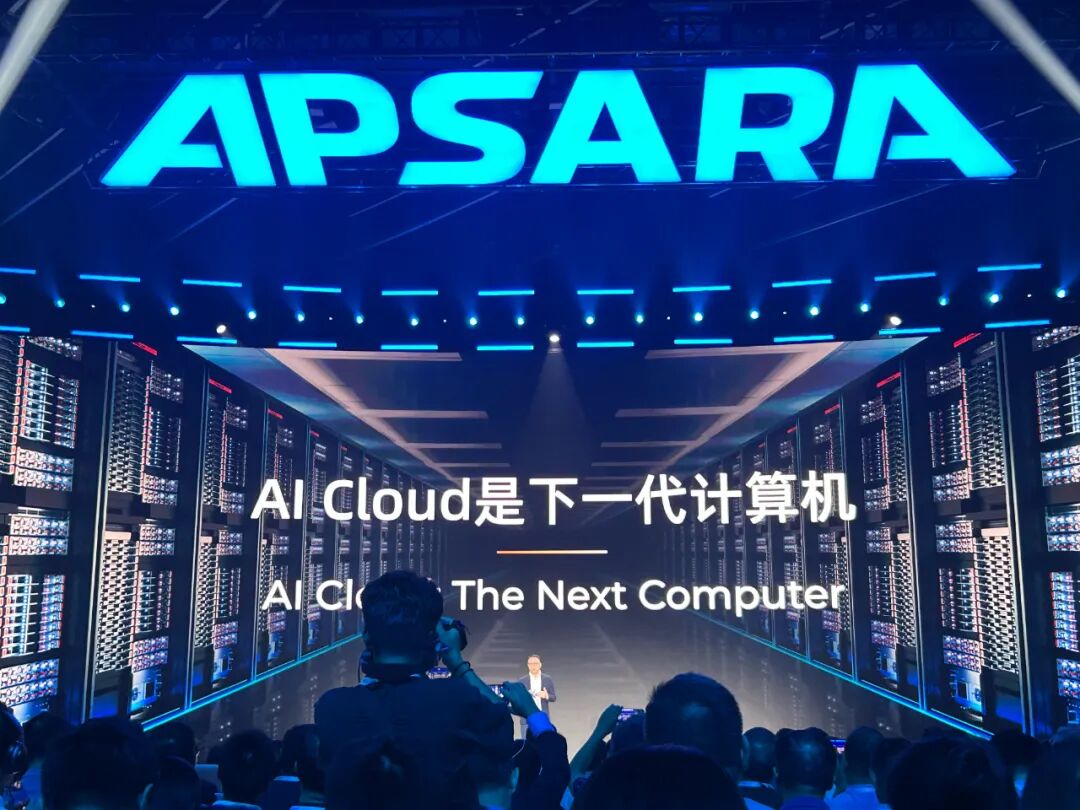
Second judgment: Super AI Cloud is the next-generation computer.
Whether it's the Agent ecosystem connecting to the real world, or AI models conducting self-iteration, the entire system must run on actual computing infrastructure. This requires massive computational resources behind it.
This new "operating system" of large models needs to run on a new computer. The massive computing power this new computer provides is precisely what supports "Element Two: AI self-learning."
The two strategic judgments combined form a closed logical loop: Alibaba Cloud's two core strategies are the practical implementation of its "ASI Trilogy."
Now looking back at the entire narrative. From proposing the "information theory dilemma" as the core contradiction, to giving the "ASI Trilogy" to break down the goal, then providing solutions through two core elements, then binding company strategy to those solutions, and finally proving capability to achieve it all.
This is what proper, closed-loop grand narrative looks like.
Of course, as the saying goes, the weapon of criticism cannot replace criticism by weapons.
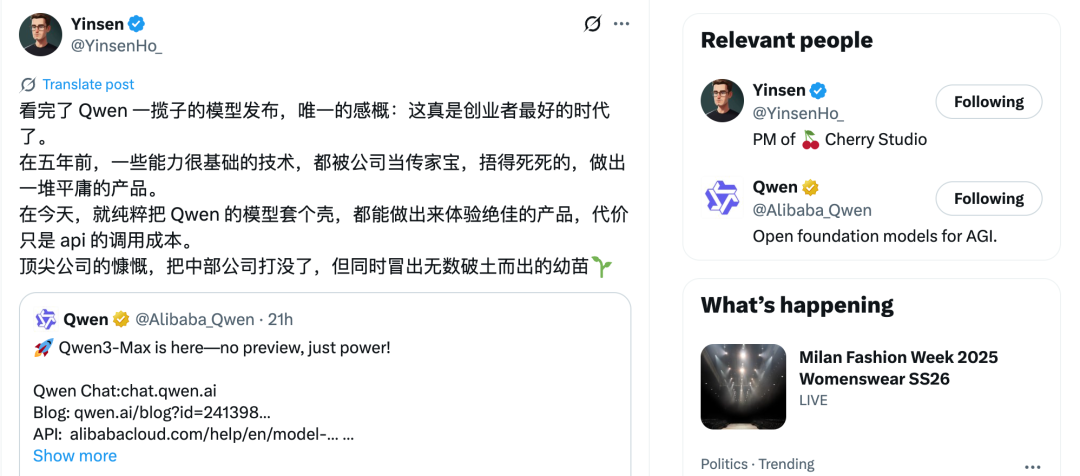
Most convincing of all was that Tongyi released seven models in one go that day. From Qwen MAX to Wanxiang 2.5, text generation, visual understanding, speech recognition, video generation — everything you could want.
Everything you could want. Now that's truly endless win, winning without limit 🥵
(Article illustrations generated by ChatGPT, writing assisted by Gemini CLI.)