Wuchao treats DingTalk like a toy to tinker with.

"I just felt like it was the right thing to do."

"I just felt like it had to be done"
Yesterday I broke down how Plaud excels at guerrilla tactics, and how Chinese AI hardware keeps getting more formidable thanks to Shenzhen's supply chain.
I happened to be in Hangzhou listening to Wu Zhao's speech on how he's remaking DingTalk, so I figured I'd check out what hardware DingTalk dropped and how he's spinning the Agent OS story.
My biggest takeaway from the whole talk: Wu Zhao is basically treating DingTalk like a toy box. The man has ideas. 😭
Let's start with the software.
Open the new DingTalk, and the traditional message list is gone. The home screen is a blank DingTalk ONE, with a voice input bar at the bottom.
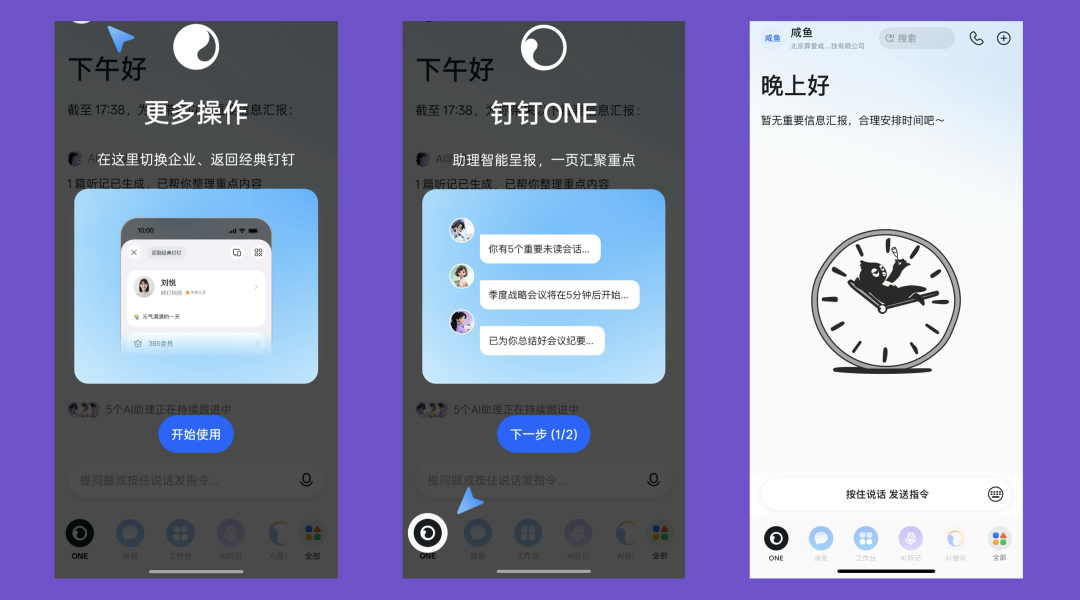
You can use the voice bar to send messages to lists
Want to send a message? You have to tap the Agent bar at the bottom, and "Messages" is only the second option. The traditional message list has been demoted to just one Agent among many.
This is a pretty radical change. DingTalk has hundreds of millions of users — making this kind of overhaul on a product at that scale takes serious guts.
Really, it's the courage to say goodbye to what you once were.
From what I gathered, Wu Zhao rebuilt DingTalk with a simple mental model: he's the boss, AI is the grunt labor.
A boss doesn't want to fill out forms or open a bunch of chat windows. Just hold down and tell the AI what to do, then let it execute. Like when I posted on DingTalk yesterday: "Send the Plaud draft to Muqiu for layout" (Muqiu hasn't read or replied).
Pretty nice. Can't get people to do what you say, but everyone can boss around AI. Everyone's an AI boss now.
That's how DingTalk ONE is designed. One super-entrance (DingTalk ONE), one router (Wukong), multiple Agents. You hold the voice input bar and speak, and Wukong — the AI assistant — breaks down your request and dispatches it to the right Agent to execute: send messages, edit documents, check calendars, book travel.
Wu Zhao is betting that the traditional list-based interface is outdated, and that people need a new AI-driven office experience.
Extrapolating from the software rebuild to hardware, you get this device called DingTalk Real.
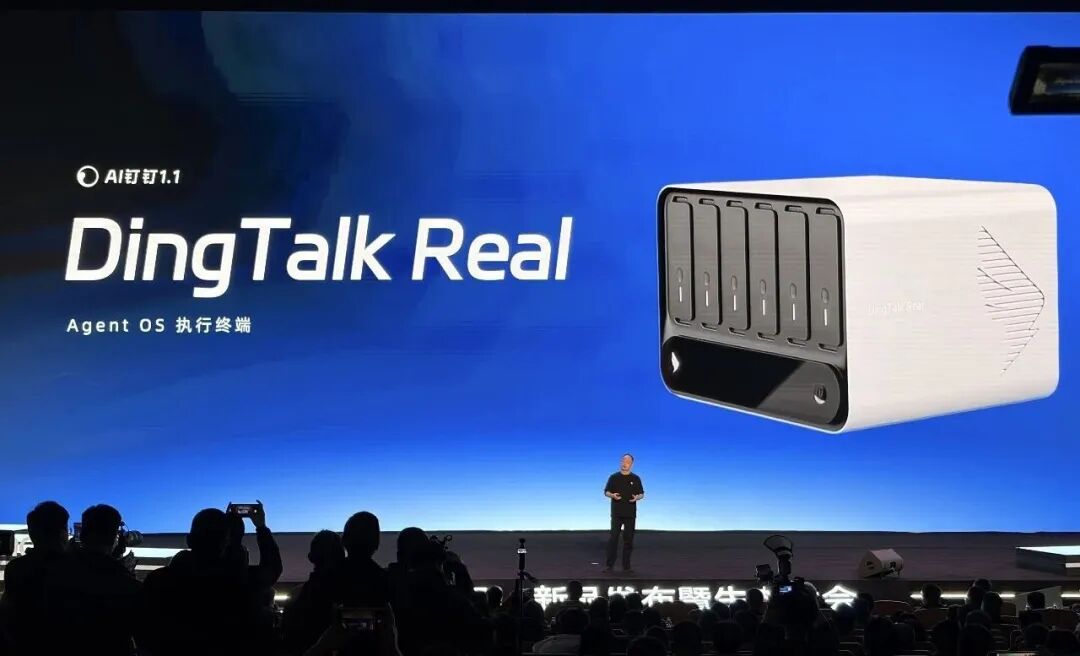
For personal devices, a super-entrance + router + multiple Agents can be handled in software. But at the organizational level — coordinating dozens of devices — you need an operating system sitting above those devices. You can't let everyone's phones and computers do their own thing; you need something to string them together and orchestrate them centrally.
A company with dozens of devices needs a runtime environment, permission management, clear rules on what data can and can't be accessed.
That's what Real is supposed to do: an operating system that runs multiple Agents and taps into the enterprise environment, a standalone corporate host.
But the use cases DingTalk Real is targeting right now are the same ones every AI browser is pitching: travel price comparison, resume screening, form-filling, Agents keep working after employees clock out. Nothing that stretches the imagination. It's just opened for applications, and no one has actually used it yet.
In DingTalk's Agent OS design, there's a layer focused on Agent development and model training — a platform where companies can use their own data to build custom solutions. Any Agent built here can run on Real. So they're going for an Agent development platform concept, basically.
What did impress me was the pricing. For just 199 yuan a month, you can co-create with Wu Zhao "the world's first enterprise AI hardware built specifically for Agents." What can I say, folks?
DingTalk packed in so many other ideas. I've never seen a launch event with this density of random stuff.
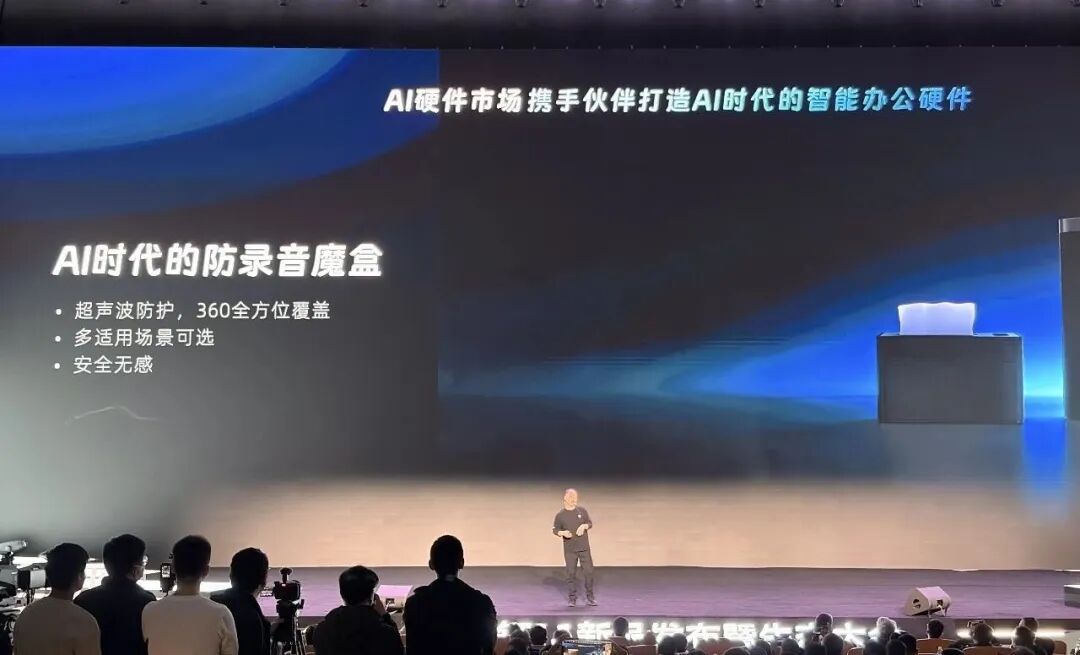
Like the AI anti-recording box. One of Wu Zhao's friends told him everyone's recording conversations these days, could he make something to block that? So Wu Zhao made a magic box. Flip it on, and no device within 10 meters can record.
Using their own spear against their own shield — he's the first to close that loop.
Then there's AI Print. Now you can generate posters in DingTalk, with layer editing too — basically rebuilding Lovart from scratch. And DingTalk built the backend for Lovart: after you generate something, you can choose to have it printed and mailed to you. That strings in a whole bunch of Meituan-Wanwu stuff. It's a real need for small entrepreneurs and solo operators — no more hunting for designers or print shops.
Wu Zhao also did a little Q&A with himself on how to guarantee DingTalk Real's safety guardrails. His solution: make sure you can unplug it. Truly, the simplest answer is the deepest. I suspect if you asked him how to prevent AI from betraying humanity, he'd say remember to unplug the AI.
There's also an AI homework grading device, an AI digital receptionist, a pile of miscellaneous hardware. Wu Zhao's basically built a bunch of electronic toys. When he retires, someone should send him to rebuild Disney.
You can say Wu Zhao's shipping vaporware, but you can't say he lacks ideas, or that these ideas aren't practical.
That's exactly why I love using the DingTalk A1 recording card — purely because it has a physical voice memo button that saves me the trouble of pulling out my phone.
Listening to the whole talk, my first feeling was: everyone's the boss of DingTalk now.
The remaining story is that DingTalk is for AI to use. DingTalk handles calling all this hardware, software, and Agents; humans just need to give DingTalk orders.
Near the end of the event, Wu Zhao actually got emotional for a few minutes. He said every morning he wakes up excited by AI progress. Since starting college in 1995, every product we've used — from Windows to iPhone to AI — has been defined by American companies. Microsoft, Google, Apple, OpenAI, all American. Now there's finally a chance to define it ourselves. 😭
Truly great. Gotta have that confidence. 😭
For someone who's already succeeded with one product and now has to revolutionize themselves — without confidence, you won't swing that knife inward, you won't kill your past self.
Wu Zhao's been back less than a year and already pulled off this much. I think DingTalk's best days are still ahead.
At the very end, Wu Zhao also described his own approach to innovation. He said innovation is hard inside a team — any innovative move gets a lot of people asking why. The man said he doesn't know why, he just felt like it had to be done.
The event closed with a pretty hype music video, something like Wukong raising his thousand-pound staff to smash the old world. Two lines from the lyrics:
"Now I stride alone above the nine heavens, no longer fearing the road ahead even if it's rough... The Great Sage returns in a new form, who beneath the heavens dares not look up."
I'm genuinely curious what was going through the man's head watching that video.
(Images in this article generated by ChatGPT, writing assisted by Claude Code within Cherry Studio)