YouWare Explains Why AI Founders Need Divinity

Believe in the power of belief.
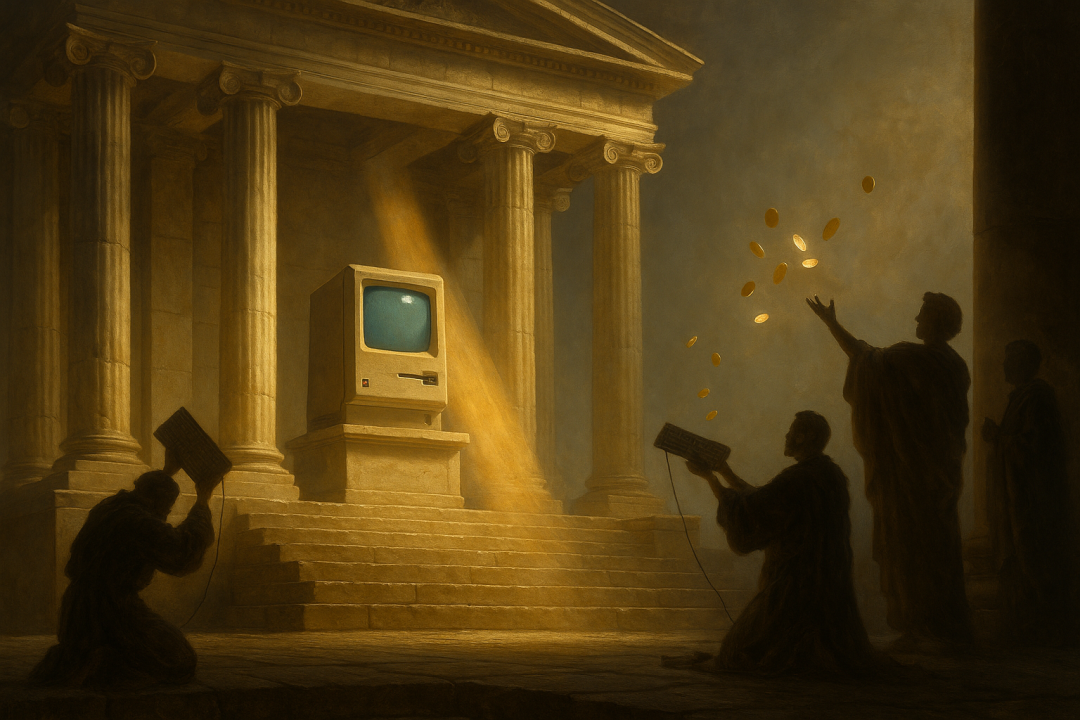
"The Power of Believing in Belief"
I've been working with my co-founder on a writing product lately (no update last week, my bad), and took the opportunity to try out YouWare, which had been trending recently.
My take: YouWare is a decent communication tool for product managers. But how on earth does it command a $200-300 million valuation?
One theory is that a key figure behind Moonshot AI put money into YouWare and took a sizable stake, while Leon Ming mainly reached out to Moonshot AI's existing shareholders for his angel round rather than talking to other institutional investors.
Of course, these are just surface-level observations. To understand this investment, you have to step outside rational product analysis and believe in the divinity of AI founders.
Let's talk product first, then divinity.
My workflow: I sent YouWare a screenshot of a demo webpage and told it to convert it to a retro first-gen Mac aesthetic. After a few rounds of back-and-forth on fonts, color schemes, and other details, YouWare did produce a passable webpage.

I sent this to my co-founder, and it was indeed more intuitive and clearer than trying to describe it verbally.
As someone who can't code, I found YouWare somewhat valuable. But my co-founder's reaction upon learning its valuation: "Guess there's really nowhere else for money to go."
I seriously doubt that if Leon Ming had built YouWare inside ByteDance, it would've even earned him a promotion 😭
Let's get into the product itself.
YouWare's fundamental problem is that Leon Ming hasn't figured out the interaction model. It's a textbook case of the "one-sentence generation" AI product.
I've specifically roasted this category before. For generative AI to produce sufficiently accurate, usable output, it must rely on users providing substantial, original information input. If you only feed it one or two sentences, what the AI generates will inevitably be mediocre, vague, randomly assembled information garbage.
Getting AI to generate a truly usable webpage requires very specific, extensive interaction and integration with front-end and back-end code. There's no way users can accomplish this through a few sentences of conversation.
Of course, you could argue that YouWare doesn't provide tool value but emotional value — that it's building a community.
Leon Ming himself compares YouWare to taking photos with a smartphone. He says that in the future, people will create through programming just as they take pictures with phone cameras now.
This analogy completely falls apart.
AI-generated content, especially content produced from one or two sentences, lacks the most critical element — human self-expression.
People share smartphone photos because the act of photographing embodies their own aesthetic judgment. When others like your photo, they're affirming your agency.
But when you make a nice-looking webpage with YouWare, nobody thinks you're impressive. At best, they think the agent is capable.
Without self-expression, there's no social currency. Without social currency, there's no willingness to share. What people want to see is something connected to you as a person. Post a landscape photo versus a selfie — the selfie gets more likes every time.
That's why I've only seen interviews with Leon Ming in media coverage, yet never encountered anyone on any social platform I regularly follow sharing something they made with YouWare.
And it's not just Chinese internet — same on the English internet. On Product Hunt, YouWare has exactly 6 upvotes (I was the sixth one, supporting founders 👊🔥💻). On YouTube, there are only a few introductory videos with a few thousand views each, and the comment sections are full of people complaining that the creators are doing sponsored content...
This is enough to make the point: YouWare's product logic simply doesn't work.
What Leon Ming is actually doing is building a website creation tool that was popular in the early 2000s — except it's 2025.
Which brings us to the real question: how does a tool with broken product logic and limited real value get a $200-300 million valuation?
The answer is divinity.
Here, I formally propose the Theory of Divine AI Founders.
To understand the various spectacles of AI entrepreneurship today, you can't rely solely on rational logic of product and business. You have to understand this theological system, where roles are clearly divided:
The Gods: Haloed figures, the source of belief, responsible for creating grand narratives.
The Priests: AI content creators. They use the tools created by these gods to produce seemingly profound content, offering it up to social networks. This content is the sacrifice, its spread is the sermon, continuously reinforcing the gods' status.
The Believers: Investors. They offer up capital, pretending to believe they will reach the promised land.
It's a perfect self-reinforcing cycle: gods create narratives, priests amplify narratives, believers vote with their money, ultimately elevating the gods to even greater heights.
So Leon Ming was able to raise tens of millions of dollars with no product whatsoever. Because investors weren't betting on the product — they were betting on the halo around the founder, on the faith in the identity of "former Moonshot AI product manager."
They weren't investing in YouWare. They were gambling on the possibility that Leon Ming becomes the next Yang Zhilin.
AI entrepreneurs shouldn't provide any concrete product at all. They should create divinity. Make investors and content creators believe you are a god, or believe you can become one.
In the face of divinity, the product itself is merely a trivial prop.
Believe in the power of belief, friends. (Images in this article generated by ChatGPT o3, with assistance from Gemini 2.5 Pro and the in-development Proma for writing.)