User Base Breaks 10 Million, Dream Dimension's Shen Qiajin: AI App Entrepreneurship Is Riding the Waves — You Have to Catch Every Surge of Foundation Models

The next most important frontier is multimodal AI and agents.
As AGI capabilities expand rapidly and costs plummet, multimodal AI interaction has become an irreversible trend in content consumption.
In 2023, Shen Qiajin, who had accumulated extensive experience in interactive content, founded IdeaFlow in Shenzhen. In February 2024, the company's flagship product "Dream Dimension" (造梦次元) launched, aiming to build a next-generation AI interactive content platform for young users. Gaorong Ventures participated in the company's Series A round in 2024.
As of June 2025, the Dream Dimension app has accumulated over 10 million users. With its rich library of original AI content, diverse gameplay mechanics, and highly engaging interactive experiences, the product has cultivated exceptionally strong stickiness among young users. Daily active interaction time exceeds 100 minutes, making it one of the most time-intensive products in the AI content space.
As an AI-native application, Dream Dimension's interactive content and core gameplay are driven by large language models. Beyond calling upon the most advanced models available on the market, the platform also co-develops with model providers. Currently, daily token consumption on the platform has surpassed 100 billion, reaching 160 to 180 billion during weekends and holidays.
With its broad user base and massive volume of feedback, Dream Dimension has also become a proving ground — or "colosseum" — for large models. "When new-generation models come out, providers love to have our product be the first to integrate them, to test how well the models perform."
But Shen Qiajin is more eager to emphasize a different point: building AI applications today means "riding the waves." "Large model development comes in successive waves. We have to stand within each wave, and be the first to translate the latest AI technology into interesting content and experiences that users can consume. We want to forever be the first AI content company to do this."
Recently, at an AI application company joint livestream recruiting event organized by Gaorong Ventures X Boss Zhipin, Shen Qiajin, founder and CEO of IdeaFlow, shared his thinking on AI application entrepreneurship — including the driving forces behind this wave of AI applications, the product growth journey, and the two most important priorities ahead: multimodality and Agent.

The following is Shen Qiajin's sharing (edited):
1
Large Models Have Made Interactive Content Platforms Possible
From 2018 to 2022, I was working in interactive content. My previous startup focused on interactive video. Back then, we discovered a substantial segment of young users with strong demand for interactive content — especially lightweight interactive content.
But the market lacked corresponding supply. For instance, games released by game studios were often designed with overly complex mechanics to maximize monetization; large-scale UGC interactive content platforms were difficult to establish because the barrier to designing quality interactive content was too high for ordinary users.
Starting in late 2022, we saw that this wave of disruptive progress in large model technology made building an interactive content platform possible, and enabled breakthroughs in interactive content supply, interactive experiences, and user behavior. We believe that closely following model technology development trends and converting model capabilities into consumable content will bring tremendous surprises.
What's even more exciting is that two capabilities of large models are improving far faster than we imagined. First, the continuous improvement of large model reasoning capabilities — reasoning determines the degree of AI intelligence. This doesn't just mean models can output more satisfying content; it also means AI is evolving from Assistant to more reliable Agent, and even Multi-Agent. Second, the continuous evolution of large model multimodal capabilities, which can provide users with sufficiently interesting content consumption experiences.
Against this backdrop, what changes will occur in content consumption? And what kinds of creators will produce this content? These are questions Dream Dimension has been continuously exploring.
We've found that one major trend is that idea generation and realization have become simpler because of generative AI, enabling infinitely rich content. And such content must be interactive — today, when users consume AI content, they are simultaneously creating.
Additionally, the boundaries of content formats and interaction forms are gradually blurring. Nowadays, having AI generate images, text, video, PowerPoints, podcasts, or making a design, writing a webpage and deploying it — all have become extremely simple. The ability to attract user participation has become more important; the format itself matters less.
2
Rich Content and Diverse Gameplay Drive Growth
Based on these convictions, since Dream Dimension's launch, we've insisted on achieving healthy growth through rich content and diverse gameplay mechanics.
Dream Dimension offers more than just chatting with AI. We've created rich types of original AI content, with the largest category being interactive stories, where users can interact with characters in each story chapter, or complete certain tasks or challenges.
Beyond aggregating content types like image play, audio, and video, we've also continuously launched gameplay with game-like and even social attributes, such as murder mystery challenges, dress-up games, simulation raising, and multiplayer interactions.
The improvement in model reasoning capabilities has also driven Dream Dimension's diverse gameplay to become increasingly effective and cover increasingly broad themes.

Dream Dimension rapidly completed cold start upon its February 2024 launch and has grown continuously, largely driven by user viral behavior.
This new generation of "AI Native" users, beyond having strong creative enthusiasm, also possess abundant "secondary creation" enthusiasm. When they experience interesting interactive content in the product, they spontaneously record or screenshot it and post on social platforms, attracting more users to download and experience the product. As of June 2025, Dream Dimension-related content has accumulated over 630 million views on Kuaishou.
3
Inside Dream Dimension: Creator Ecosystem and IP
An active creator ecosystem and hit IP are key to an AI interactive content platform's long-term user retention.
Today, Dream Dimension has attracted over 230,000 creators, who bring more than 3,000 new works to the platform daily. Our content creation tool "IdeaFlow Studio" enables creators to produce AI content more efficiently and with lower barriers, freely realizing diverse gameplay.
Recently, we are about to launch a creation Agent. After creators issue instructions, the model will automatically perform intent recognition, plan task workflows, and call corresponding toolsets to complete the entire creation process, ultimately generating rich interactive content. Based on Dream Dimension's previously built mature workflow and creation tool infrastructure capabilities, these validated best practices are internalized into the Agent system, making the creation process simpler and more intuitive. This will significantly lower creation barriers, substantially improve creation efficiency, and especially bring breakthrough experience improvements in multimodal content creation.
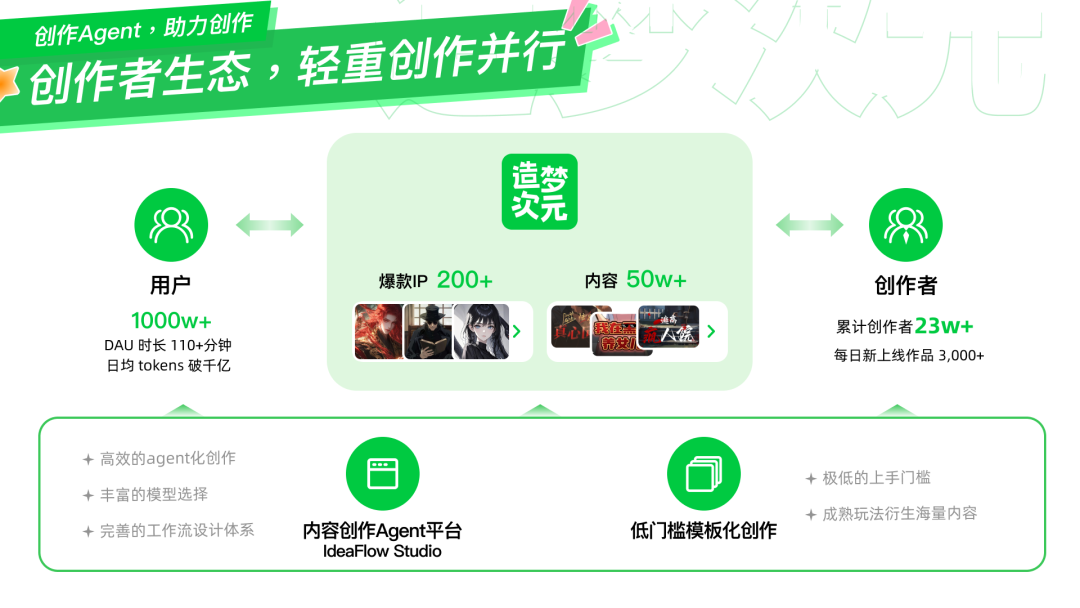
In the large model era, creation will become increasingly simple, and the speed of AI-generated content will far exceed human consumption speed. But we firmly believe that creators remain crucial, both now and in the future, because humans provide unique perspectives and expression. When everyone can use AI to produce content, smart creators will more actively build IP. Only creators who continuously invest in building strong IP can win user attention in the content ecosystem and obtain long-term compounding returns.
As Dream Dimension's content and characters grow increasingly numerous, IP has begun to emerge. Creators act like agents or labels for these IP, consciously operating fan communities, creating topics, and seeking commercial monetization pathways.
Currently, Dream Dimension's monetization mainly comes from virtual items on the platform, paid interactive content (serialized short dramas), character tipping, and more. These monetization mechanics operate based on a complete creator incentive mechanism, to motivate creators to invest more energy in optimizing and operating their IP characters and producing quality content. For example, a popular paid item called "Mind Reading" allows users to unlock a character's "inner OS" during interactions. The more popular the character, the more Mind Reading uses are consumed, and the more rewards the creator receives.
In the future, we will do more extensions around IP, such as launching virtual outfits, conducting IP collaborations, and even doing IP联动 with smart hardware. We are also exploring using AI technology to generate personalized items. Future virtual items will generate exclusive interactive effects in real-time based on users' interaction history, emotional preferences, and relationship depth with characters.
4
2025's Most Important Priorities: Multimodality and Agent
Dream Dimension positions itself as a product company, not a technology company. We don't build our own models; we primarily collaborate with leading model providers. Through deep exploration of AI capabilities, we connect the conversion chain from cutting-edge AI technology to the most interesting content.
To date, we have co-developed many models with companies like ByteDance and Alibaba, including character models, memory solutions, and Agent solutions. These solutions have been gradually deployed in the Dream Dimension app, converting into content that users can consume and experience.
This year, the large model world has two main priorities — multimodality and Agent — both of which will further iterate interactive content supply and consumption.
In the multimodality direction, many large models have achieved new breakthroughs this year. First, the "gacha" probability of multimodal large models has decreased significantly. For example, GPT-4o's autoregressive approach has proven very effective. Previously, large models needed to generate several images or videos before selecting a usable one — acceptable for creators; but for ordinary users, since this couldn't deliver a mature, consumable content experience, users would likely churn.
Second, the speed at which large models generate content — especially video — has improved markedly, able to produce a video segment in tens of seconds or even 10 seconds, with high quality. For example, videos generated by Google's latest Veo 3 model have reached near-indistinguishable-from-reality quality. Applied to content consumption, this enables us to realize more diverse content types, such as AI audio, AI short dramas, and so on.
Next, with the development of MoE and other technologies, as well as large model providers' infrastructure investments, multimodal large models' real-time capabilities are growing stronger, with increasingly fast output speeds. This will catalyze our content experiences to reach something akin to real-time livestreaming with AI characters.
The other major priority is models' strengthening reasoning capabilities, laying the groundwork for general Agent capabilities. Recently, models like Gemini 2.5 Pro, Doubao 1.6 Pro, and Moonshot AI's K2 have demonstrated leading capabilities in Agent tasks, complex reasoning, and code generation. Some models can even "think on demand," automatically determining when to activate deep reasoning.
Enhanced reasoning capabilities will first enable richer callable capabilities during content consumption, such as models automatically calling various MCP services. For example, calling location services: when a user travels to Shenzhen today, the AI will remind them it's going to rain, ask if they brought an umbrella, and send them a nearby convenience store location. Or when a user casually says "so tired today," the AI character will automatically call time services, combine it with the user's historical sleep data, and reply "It's so late already, you usually crash by 11pm — are you cultivating immortality by staying up tonight?" then proactively play soothing white noise to help the user relax.
Second, this supports us in building more powerful creation tools. Agents will help authors with intent recognition, task decomposition, and tool calling, enabling higher complexity with lower barrier creation experiences. This will more rapidly facilitate the production of diverse gameplay and various themes, with better gamified gameplay effects, making the platform's content experiences more magical.
Additionally, Agents can automatically recommend suitable element combinations based on creators' style preferences. For example, in ancient Chinese-style creation, when an author mentions "Jiangnan misty rain," the Agent will rapidly associate with oil-paper umbrellas, black-awning boats, bluestone roads, and other imagery, generating corresponding scene description snippets for author reference. In multimodal presentation, creators only need to sketch the core plot, and the Agent can coordinate image, text, audio, and other resources, converting text into dynamic comic storyboards with background music, making creation results more intuitively displayed.

IdeaFlow's company culture is eight characters — authentic and effective, resilient and extreme. We output authentic information, take effective actions, resolutely solve hard problems, and push things to the extreme.
In our entrepreneurial journey, we often find too many concepts in the market that may affect our judgment; there are also many hard problems — if you choose to avoid them, to not tackle them, you will likely permanently lose competitive opportunity.
Riding the waves of large models, we hope to maintain sharpness, maintain execution capability, and evolve from creating a new type of AI content to becoming a true AI Native content platform.