Jieti Medical raises 2.6 billion yuan, advances brain-computer interface clinical validation with 42 long-term implants

From Neural Signal Acquisition to Motor Function Reconstruction
Jieti Medical, an implantable brain-computer interface (BCI) company, recently disclosed that it has raised approximately 1.4 billion yuan since the second half of 2026; as of September, its cumulative funding has reached 2.6 billion yuan. Gaorong Ventures participated in Jieti Medical's Series C round this July. Other shareholders include strategic investors Tencent, Alibaba, Geely Capital, and CATL; state-backed institutions SDIC Unity Capital and Shanghai SDIC Pioneer Fund; and professional investment firms Aobo Capital, Yuanlai Capital, Qiming Venture Partners, Yuanhe Origin, Lilly Asia Ventures, Source Code Capital, Fortune Venture Capital, CASSTAR, CDH Investments, CICC Capital, Danhe Capital, and E Fund Management.
Founded in 2021 and headquartered in Shanghai, Jieti Medical focuses on the R&D and clinical translation of minimally invasive implantable BCIs. The company was co-founded by Zhengtuo Zhao and Xue Li. Zhao holds a PhD in biomedical engineering from the University of Texas at Austin, while Li earned her PhD in electrical and computer engineering from Rice University. Starting with ultra-flexible neural electrodes, the team has gradually built a product portfolio covering electrodes, implants, algorithms, and surgical equipment.

WRS 01: From Neural Signal Acquisition to Motor Function Restoration
Jieti Medical's flagship product, WRS 01 — short for its 256-channel minimally invasive implantable BCI system — is primarily aimed at restoring motor function in patients with high-level spinal cord injuries. The system captures neural signals through ultra-flexible electrodes implanted in the brain, decodes the user's movement intentions, and translates them into commands for external devices such as computers, smart wheelchairs, and robotic arms.
According to the company, WRS 01 is the first fully invasive BCI product to enter the National Medical Products Administration's special review pathway for innovative medical devices, and has been designated as a "global new" medical device. It is currently in the registrational clinical trial stage.
Practical use of the product has already expanded from screen-based interaction to three-dimensional space. One subject, who became paralyzed from the neck down in a car accident, was able to control a robotic arm through imagined arm movements three months after implantation, completing actions such as grasping, moving, and handing over objects. Jieti Medical disclosed that in cursor task testing, the system's latency from neural signal acquisition to computer control was below 0.05 seconds, with peak information transfer rates reaching 390 bits/min. These figures reflect performance under specific test conditions; long-term outcomes still need to be evaluated through ongoing clinical studies.
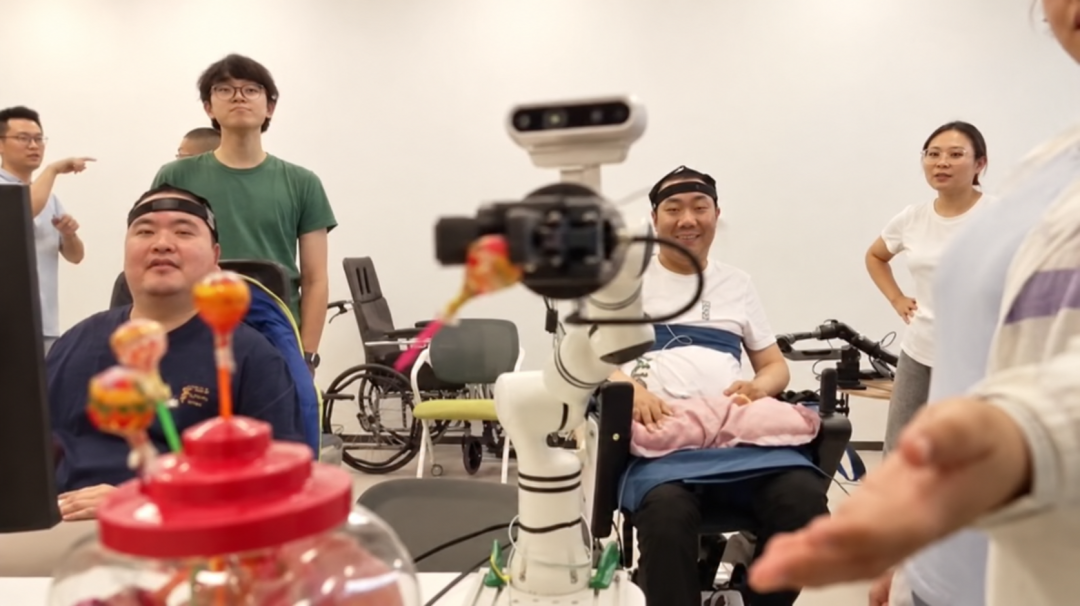
Subject (left) using brain-controlled robotic arm to pick up a lollipop
42 Long-Term Implants, Registrational Trial Fully Enrolled
As of October 28, Jieti Medical has completed 42 long-term implants, with subjects accumulating over 5,000 days in vivo and more than 10,000 hours of brain-controlled use. According to public reports cited by the company, its number of long-term implants has surpassed Neuralink's 27.
In August this year, WRS 01's multi-center registrational clinical trial completed enrollment of all subjects. Jieti Medical stated that this makes it the first fully invasive BCI product globally to complete registrational trial enrollment. Compared with earlier exploratory cases involving only a small number of patients, the expanded subject pool will allow the product to be validated across more individuals, use scenarios, and longer timeframes — accumulating data for subsequent regulatory submissions.
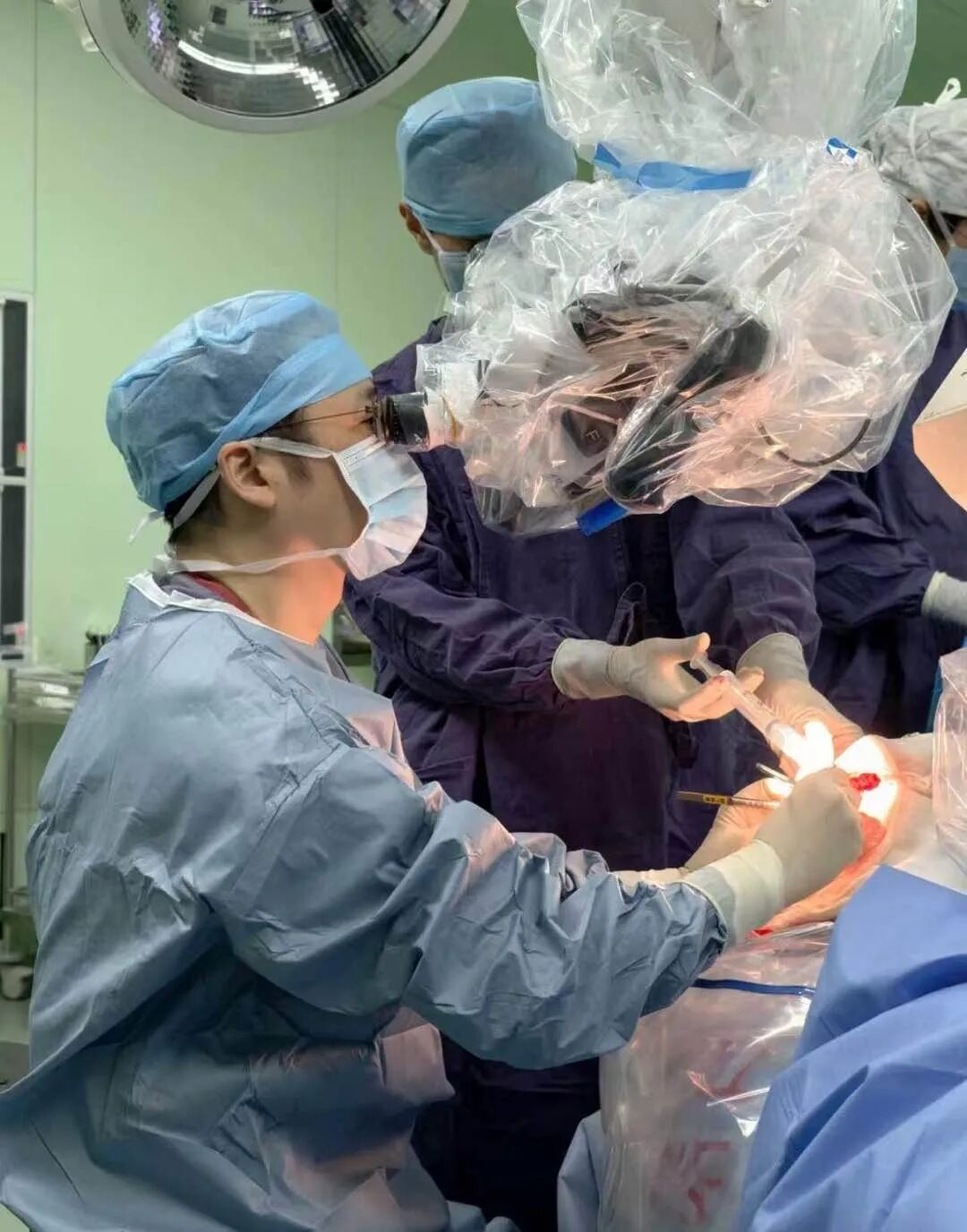
Scaling up implantations has also placed new demands on surgical tools. For the implantation of eight ultra-flexible electrode filaments, Jieti Medical developed a semi-automatic flexible electrode implantation system that assists surgeons through microscopic visual guidance and handle-based remote operation. The company noted that this system has already obtained a medical device registration certificate, making it the first certified surgical medical device for flexible electrode implantation worldwide.
From Manufacturing to Testing, Building a Product Delivery System
For medical devices intended for long-term human implantation, technical performance in the lab is only part of productization. Whether electrodes can be manufactured stably, whether different channels remain consistent, and whether complete systems can pass reliability verification are equally critical to clinical advancement.
To address this, Jieti Medical established a "BCI Innovation and Manufacturing Base," comprising a medical-grade MEMS fabrication center, a GMP production platform, and a dedicated fully invasive BCI testing platform. The MEMS center handles precision manufacturing of ultra-flexible neural electrodes; the GMP platform covers production and quality control from electrodes to complete systems; and the dedicated testing platform, completed in October this year, conducts testing for electrode performance, multi-channel consistency, and long-term reliability.
To address the time-consuming process of testing each of the 256 channels individually, the company also developed a high-speed multi-channel electrochemical workstation supporting automated channel switching and multiple performance tests. Jieti Medical claims this equipment reduces product testing time from several days to approximately one hour. The gradual establishment of manufacturing, implantation, and testing capabilities provides support for WRS 01's subsequent clinical validation and scaled delivery.
Beyond motor function restoration, Jieti Medical is also advancing R&D in neural modulation and language function restoration. With registrational trial enrollment now complete, the company's next phase will focus on accumulating data on product safety, stability, and real-world effectiveness — pushing brain-computer interfaces from clinical exploration toward sustainably deliverable medical products.