Little Genius, All-Rounder, or Aesthete? 9 Founders on How AI Companies Define Great Talent | Ronghui

AI Native Founder Live
As large language models continue to leap forward, AI is moving from foundational technological breakthroughs toward scaled application deployment. At the same time, AI startups themselves are changing: smaller teams, higher talent density, flatter collaboration, and the efficiency dividends released when every individual works deeply with AI — these are becoming defining features of a new generation of AI Native organizations.
For top talent, career opportunities in the AI era are shifting too. What kinds of companies are worth joining? What kind of people do AI startup teams actually need? And how are roles in algorithms, product, growth, and commercialization being restructured by AI?
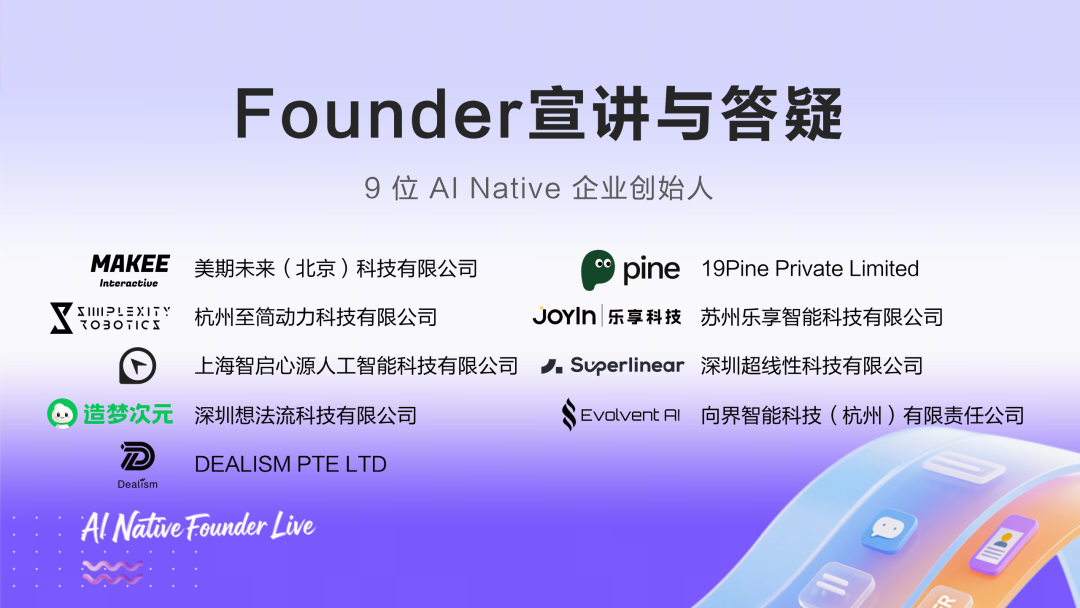
Recently, Gaorong Ventures partnered with Volcano Engine's V-START Accelerator and Liepin to launch AI Native Founder Live, an online recruitment event featuring nine AI company founders and executives. The nine companies — either Gaorong portfolio companies or from Volcano Engine's V-START Accelerator — spanned high-potential sectors including Agent, embodied intelligence, AI applications, AI education, and AI content communities. The livestream drew over 22,000 viewers.
In this online direct-hire event, the nine companies brought not only hot job openings but also shared their latest practices on how product, organization, and talent are co-evolving. Scan the QR code at the end of this article to watch the replay and submit your resume.

The Evolution of AI Native Organizations
High-Density AI Talent × Deep AI Collaboration
In her opening remarks, Luxi Yang, Partner at Gaorong Ventures, shared observations from extensive engagement with AI startup teams: their organizational forms are iterating rapidly.
First, AI Native companies tend to be more nimble and flat. There is more crossover between product, technology, marketing, and operations, and more "full-stack" talent emerges in early teams. Second, AI capabilities are being distributed to everyone in the organization. When every member can achieve greater leverage through Coding Agents, automated workflows, and similar tools, a small team can deliver what once required a much larger organization. High-density AI talent × deep AI collaboration will unlock unlimited organizational dividends.
Meanwhile, talent evaluation in the AI era is shifting from "does their background and experience match" to "do they have actual capabilities, a portfolio of work, and the ability to collaborate with AI." "What's exciting is that many young candidates today are naturally heavy users of large models and AI applications. We believe that when they join AI organizations, they will unleash the creative potential of human-agent collaborative innovation."
Jinkai Huang, Co-founder of Evolvent AI, shared his perspective on AI-native organizations from the vantage point of a young entrepreneur. Evolvent AI is building self-evolving Agents. In his view, whether Gen Z and post-95s become a major force in AI entrepreneurship depends not on age but on possessing an "AI-native identity." Whereas the previous generation of entrepreneurs might habitually ask "how can AI empower existing businesses," AI-native entrepreneurs more naturally ask "what should AI-native itself look like."
This also changes how young teams organize. Huang noted that Evolvent AI treats "using AI to build AI" as its daily operating mode. On delivery timelines, what once might have taken months can now be compressed to day-level demos and week-level PoCs. Of course, young teams also need to continuously build up capabilities in organizational management, industry networks, and commercialization experience.
Zaomeng Ciyuan, a leading AI content community in China, is also pushing AI Native practices internally. Junjie Xu, Co-founder and Head of Consumer Business, shared that Zaomeng Ciyuan's product managers and operations colleagues no longer just output requirement documents — they now directly output product pages in code that meet launch and aesthetic standards, with rapid data feedback through gray releases. At the same time, the team is building "workstations" for "AI employees," accumulating shared organizational context so that AI better understands each person's responsibilities, product definitions, and stage goals. Ultimately, the team's goal is collaborative evolution between humans and AI: AI handles the baseline work, organization, generation, and follow-through, while humans retain judgment, trade-offs, accountability, and taste — freeing the team to spend more time on high-value decisions.
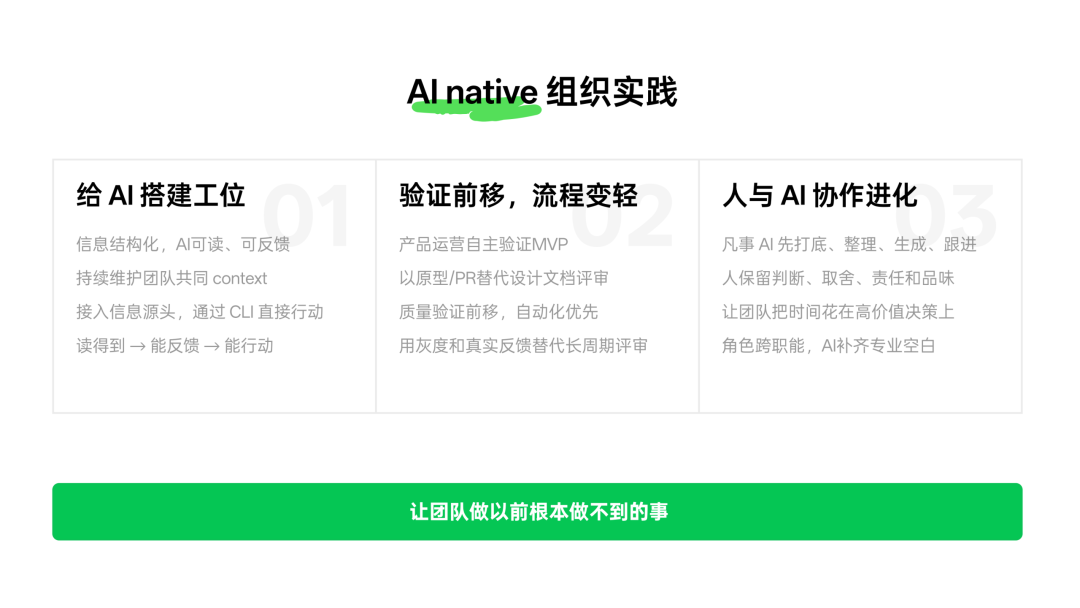
Chaoxianxing Technology has built Lessie AI, a People Search AI Agent product. Founder Beichuan Yu explained that it's not just R&D using Claude Code internally — product, growth, operations, finance, and HR are all using AI tools to boost organizational efficiency. Where a requirement once might have passed through 5-6 nodes including product, design, front-end, back-end, testing, and acceptance; today, with AI enablement, some requirements can be compressed to product directly outputting code, with engineering review and then launch — just two or three nodes.
Clearly, AI Native organizations are not simply "everyone using AI tools." They embed AI into the full process of requirement validation, product design, code implementation, business growth, and organizational collaboration.

From Agent to Embodied Intelligence:
Pushing Intelligence from Screens into the Real World
In 2026, beyond large models and AI applications, Agent and embodied intelligence have become absolute stars in the AI industry. These companies are pushing intelligence from screens into the real world, and with that comes new demands on organizations and talent.
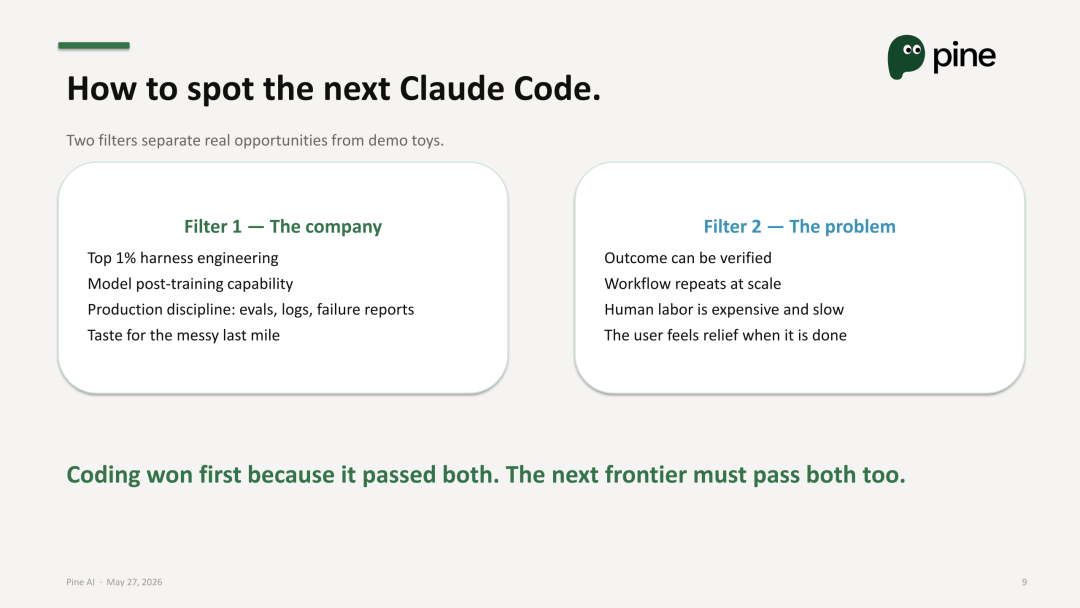
Vincent Sun, Co-founder & CTO of Pine AI, shared that over the past year, Coding Agents represented by Claude Code have been reshaping software development. The next Claude Code-level opportunity, however, may not be on screens but in the real world.
Influencer marketing, recruiting, brokerage services, deal matching, customer follow-up — large swaths of real-world workflows remain highly manual. These tasks tend to be time-intensive, relatively repeatable in process, and verifiable in outcome — making them ripe for Agent-driven reconstruction.
Vincent believes that companies that can truly complete closed-loop task execution in vertical scenarios will derive core competitive advantage not from the model itself but from engineering capabilities, post-training capabilities, and data flywheels that continuously accumulate experience. Whoever can build this capability system first will have the chance to create the next Claude Code-level product.
As a practitioner in this direction, Pine AI can already complete tasks directly via phone, email, web operations, fax, and video conferencing — covering both personal task management and enterprise operations — pushing AI from "answering questions" to end-to-end "solving problems."
Leo, Founder of Dealism, focuses on the practical impact Agents can have in marketing and sales. The company builds conversational sales Agents based on the "vibe selling" concept, aiming to give individual creators, small business owners, and large sales organizations AI sales agents that can understand buyers, communicate with high emotional intelligence, and convert leads. Leo pointed out that Agentic AI is essentially about agent-ifying workflows. Beyond coding, there are still vast vertical industries and functional roles in the extremely early stages of "agentification."
Dealism has introduced the concept of "Agent Resource" internally — configuring Agent Resource the same way you configure Human Resource. The team first agent-ifies its own marketing, sales, and content operations, becoming superusers of its own product, then packages these best practices for customers.
Embodied intelligence is a critical piece of AI moving into the real world, and startups in this space are in a rapid growth phase. Fang Zhong, CHO of Simplexity Robotics, introduced the company's mission to build scalable embodied robots, constructing a model, hardware, and data closed-loop platform for real-world scenarios. The core founding team comes from Li Auto's autonomous driving team. "If autonomous driving was the first half of embodied intelligence, then general-purpose humanoid robots are the second half. We welcome candidates to join Simplexity and work with a team that has量产验证 [mass-production validation] and real battle experience from the first half."
In the embodied intelligence wave, Simplexity Robotics adheres to three principles — corresponding to its slogan: Simple is Scalable. First, models must be simple enough. The team learned from autonomous driving practice that the more human-designed elements in a model, the worse its scalability tends to be; conversely, simpler models improve as data volume grows. Second, products must be simple enough. Simplexity wants to keep complex technology R&D in-house while giving users an out-of-the-box, low-learning-curve experience — letting embodied intelligence truly enter real scenarios. Finally, organizations must be simple enough. The team stays flat and efficient, project-driven, with fewer layers and bloated processes. More energy goes to rapid validation, collaboration, and delivery.
Lexiang Intelligence is building consumer-grade embodied intelligent robots for the global market. Li Qingyuan, Co-CTO of Lexiang Intelligence, emphasized that compared to industrial or demonstration robots, consumer robots face more complex, higher-frequency, and more emotionally charged real home environments. Beyond technology, they must truly achieve stability, usability, and warmth. To this end, Lexiang has assembled a diverse team with backgrounds spanning humanoid robots, autonomous driving, and robot vacuums. "We want to use the most hardcore technology, global vision, and battle-tested experience to make robots not just a frontier concept but a truly accessible life companion."
Going forward, as AI penetrates every corner of the real world, fast-growing startups will need not just algorithmic or engineering capabilities. Core talent will also need deeper understanding of real business processes, user scenarios, and commercial outcomes.

AI Applications:
From "Assistance Tools" to "Complete Experiences"
As model capabilities strengthen, AI applications are also evolving from single-point features to complete experiences. Users need not just a "tool that can answer questions" but new product forms that deliver results in specific scenarios.
Qingxun Liu, Founder and CEO of Meiqi Weilai, shared how his company's AI education product Wala English makes contextualized education possible through AI. In Wala English, children enter a virtual world using avatars they customize through捏脸 [face-sculpting], interacting with NPCs and storylines to complete knowledge acquisition within context. To generate one such AI contextual lesson, AI must write the script, design pedagogical exercises, generate images, videos, and music, design interactive exercises, and ultimately integrate all elements into a complete deliverable course for children.
This also changes role capabilities. Liu noted that today's product managers and designers need to understand Agent and large model capabilities, while pedagogical researchers and screenwriters are no longer just writing content themselves — they must research how to train Agents, design Skills and workflows to make Agents perform better.
Zhiqi Xinyuan's core product Refly.ai focuses on the AI Agent intelligent office赛道 [track], with its latest OpenDesign enabling designers to express designs through Agents and output pixel-perfect interfaces.
Jinwei Li, CMO of Zhiqi Xinyuan, also shared AI-native practices in AI application development and iteration. Like many teams, OpenDesign's product, design, operations, growth, and even commercialization colleagues all directly participate in writing code, responding to user needs and driving product iteration in real time. "To enable this, the team gives everyone an unlimited Token budget, encouraging bold experimentation with the strongest models." Li added that harder than growth is catching growth. To handle "viral traffic," the OpenDesign team uses internal AI for automated processes — such as automated Code Review and automated judgment of which requirements are worth pursuing — enabling minute-level response to developers globally.

AI Native High-Potential Talent Profile: Deep in Real Scenarios, Bold Enough to Deliver Directly
All nine company presentations ultimately converged on the same question: What kind of people do AI Native companies actually want to hire? We distilled several key traits.
First, heavy AI usage. AI Native companies expect candidates not to "use AI to assist a bit" but to integrate AI into their core workflows.
Second, full-stack mindset. Full-stack here doesn't just mean front-end and back-end capabilities, but understanding the relationships between product, technology, users, growth, and business outcomes. "With AI enablement, everyone should theoretically be more full-stack and more business-savvy."
Third, ability to deliver work directly. In the AI era, talent evaluation no longer looks only at resume credentials. Whether candidates have done AI projects, can rapidly validate ideas with AI, and can turn ideas into launchable products becomes a critical criterion.
Fourth, willingness to go deep into real scenarios. Whether in Agent, AI applications, or embodied intelligence, AI's true value must be validated in the real world.
Fifth, acceptance of higher density, faster pace, and broader responsibility boundaries. AI Native companies typically have smaller teams and flatter organizations; role boundaries blur. For candidates, this means higher demands — and earlier opportunities to participate in 0-to-1 and 1-to-10 growth.
In the AI era, "there are always people who are young." Gaorong looks forward to continuing to partner with ecosystem platforms and allies to build efficient connection venues between AI startups and top talent, accompanying more AI Native Builders to jointly create new possibilities in this rapidly evolving wave.
Scan the code to review this livestream and apply for your desired AI Native role.