A Conversation with HuaYi Quantum: Unveiling Its First-Generation Ion Trap Quantum Computer, with World-Leading Performance | Gaorong Ventures

Twenty-five years of technical groundwork in quantum computing, six months to assemble the first commercial prototype.
For decades, the computing world has followed "Moore's Law." For classical computers, all tasks are broken down into binary — a classical bit has only two states, 0 and 1 — while a quantum bit, or qubit, can exist in a superposition of both 0 and 1 simultaneously, storing vastly more information than a classical bit.
Quantum computers are a new type of computer that harnesses the principles of quantum mechanics, capable of processing complex computational tasks in extremely short timeframes. As the number of controllable qubits increases, their computing power grows at a staggering exponential rate, enabling them to solve large-scale computational problems that classical computers cannot.
Today, demand for quantum computers is becoming increasingly urgent in fields such as artificial intelligence, new materials discovery, drug development, and finance. Overseas, tech companies including IBM and Google have all made moves in quantum computing. According to IDC data, global investment in the quantum computing market will continue to grow, reaching nearly $16.4 billion by the end of 2027.
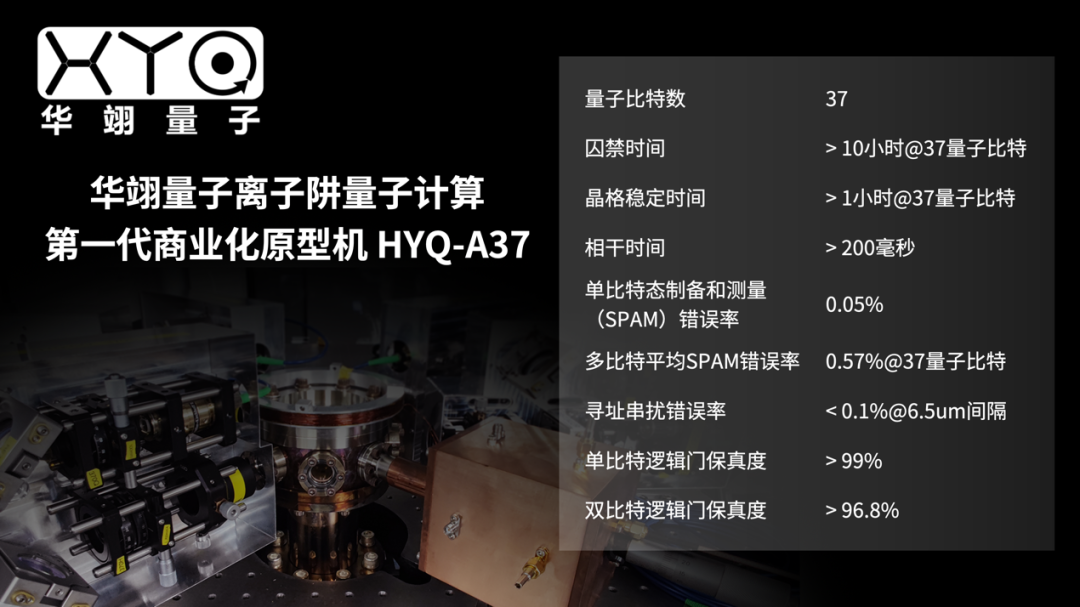
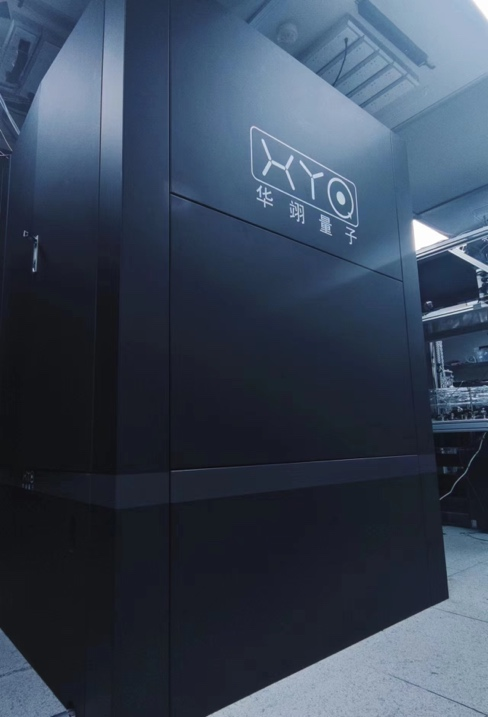
In this scientific race, China's quantum computing R&D capabilities have also demonstrated considerable strength. Recently, Huayi Quantum officially released its first-generation commercial prototype ion-trap quantum computer, the HYQ-A37, offering quantum computing capabilities with up to 37 qubits. Several of the HYQ-A37's performance metrics have reached world-leading levels, and overall it is comparable to the most advanced ion-trap quantum computers in the world today.
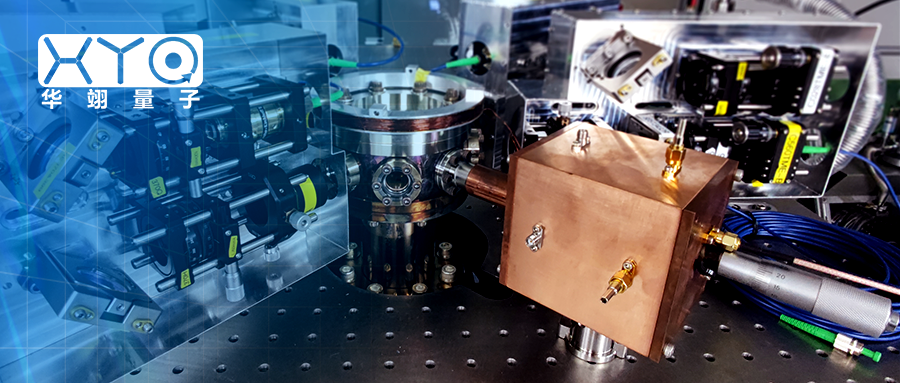
Huayi Quantum was founded in January 2022 and is the first domestic company focused exclusively on the ion-trap quantum computing technical approach. Its founding team comes from Tsinghua University's Center for Quantum Information. The company's founder and chief scientist is Professor Luming Duan, an internationally renowned quantum information expert and director of Tsinghua University's Center for Quantum Information. The CEO is Dr. Lin Yao, formerly an associate researcher at the Institute for Interdisciplinary Information Sciences, Tsinghua University. Gaorong Ventures led Huayi Quantum's angel round in April 2022.
In a recent conversation with us, Dr. Lin Yao, CEO of Huayi Quantum, shared how humanity's dream of quantum computers is becoming reality, the team's focus on the ion-trap technical approach, and how quantum computers will transform human computing and productivity.

Q: Today we see tremendous global emphasis on R&D investment in quantum computers. Scientists and tech companies have been exploring this direction for many years — what are the major milestones along the way?
Yao: The development of quantum computers has experienced multiple ups and downs. In 1981, physicist Richard Feynman proposed that it would be impossible to effectively simulate quantum systems using classical computers. He further noted, "If we want to simulate the complex quantum phenomena in nature, we need a machine that operates in a quantum manner." Feynman is also considered the first person to conceive of quantum computing.
Entering the 1990s, quantum computing algorithms saw tremendous advances. Among them was Peter Shor's prime factorization algorithm (Shor's algorithm), proposed in 1994 at Bell Labs, which mathematically proved that quantum computers could quickly calculate the prime factors of integers — igniting the first wave of enthusiasm for quantum computing.
Afterward, scientists continued exploring how to build a true quantum computer. The ion trap was the earliest physical system attempted for quantum computing. In 1995, Ignacio Cirac and Peter Zoller proposed using ultracold trapped ions to implement quantum gates, and the foundation of ion-trap quantum computers became complete.
Around 2000, companies including IBM and Google began research programs on superconducting quantum computers. The process was not smooth sailing, as practical quantum computers still faced numerous difficulties in scaling up.
In 2019, Google's Quantum AI team published a paper in Nature stating that Google's quantum computer had achieved quantum advantage, even "quantum supremacy" — further igniting industry enthusiasm and proving that quantum computers could surpass classical computers on specific computational tasks. Since then, quantum computer technology and applications have continued to break new ground.
Q: Why are tech companies willing to invest in quantum computing for the long term, or more fundamentally, what is the ultimate significance of scaling this peak?
Yao: Quantum computing fundamentally represents a leap in humanity's computational capability. In the past, to increase the computing power of classical computers, we had to keep shrinking transistor sizes and increasing integration density to gain more power — but this was essentially linear growth. Quantum computing is humanity's first opportunity to increase computing power at an exponential rate, which is also the highest known upper limit for computational growth.
Simply put, as the number of bits (n) grows, CPU computing power increases linearly as n, GPU computing power increases as n², while quantum computing power increases as 2^n.
Computing power is one of the key elements driving advances in human technological capability and transformative productivity gains, and in turn, shaping humanity's future.
Q: Currently, mainstream international approaches to realizing quantum computing include superconducting quantum computing, ion-trap quantum computing, topological quantum computing, and others. How should we understand ion-trap quantum computing, why has Huayi Quantum focused on this technical approach, and what advantages does it offer?
Yao: The core of choosing different technical approaches lies in how to construct the most basic qubits and quantum logic gates.
How does an ion-trap quantum computer operate? Imagine that a certain number of ions are trapped in an ion trap within an ultra-high vacuum environment, with each ion corresponding to one qubit. The quantum state of an ion is typically represented by its internal energy levels; through laser interaction, an ion can be excited from one energy level to another, enabling operations on the qubit. Lasers can also cause ions to interact with each other, implementing quantum logic gate operations — that is, performing logical computations between qubits.
The benefit of this is that when scaling up the quantum computer, one only needs to trap more ions, which can be achieved through appropriate control and system design without introducing additional equipment or hardware. This reduces the marginal cost of scaling and thus facilitates commercial applications.
Moreover, for future quantum internet implementation, the most promising approach currently is using photons as the medium. As early as 2001, Professor Luming Duan and collaborators proposed the famous DLCZ (Duan-Lukin-Cirac-Zoller) quantum repeater scheme, using the coupling of photons and storage particles (typically atoms) as a quantum interface, laying the foundation for research into long-distance quantum communication and large-scale ion-trap quantum computing. When it comes to networked scaling of quantum computers in the future, the ion-trap technical approach has natural advantages.
Additionally, the ion-trap approach is inherently fully connected, allowing operations on any two qubits within the system; the superconducting approach only supports interactions between adjacent qubits.
To summarize, compared to other approaches, the ion-trap route offers advantages including large quantum volume, strong scalability, convenient parallel operations, and relatively low scaling costs. It also has a scientifically complete system and is considered one of the most promising routes for achieving large-scale quantum computing today.

Q: Huayi Quantum recently released its first-generation commercial prototype ion-trap quantum computer, the HYQ-A37. How does it perform, and where does it stand globally?
Yao: Huayi Quantum's first-generation commercial prototype, the HYQ-A37, offers quantum computing capabilities with up to 37 qubits, implementing programmable universal quantum computing and adiabatic quantum computing.
In terms of qubit scale, Huayi Quantum's current-generation prototype is at the highest international level for the ion-trap technical approach. For example, American quantum computing company IonQ's best product currently achieves 32 qubits; Quantinuum, controlled by Honeywell International Inc., recently released a system offering 32 qubits of computing capability.
Furthermore, thanks to the unique properties of ion qubits, Huayi Quantum provides high-fidelity gate manipulation based on identical qubits, universal quantum logic gates, and high-quality scalable qubit systems with longer quantum coherence times.
Addressing the problem of computational errors, the HYQ-A37 innovatively uses acousto-optic deflectors (AODs) to perform independent addressing of qubits in large-scale ion crystals. Using AOD addressing technology and a self-developed high-resolution, high-throughput optical objective system, the addressing laser spot diameter was successfully reduced to several micrometers, achieving addressing crosstalk error rates below one-thousandth, and successfully realizing 99% single-qubit quantum logic gate operation fidelity and 96.8% two-qubit quantum logic gate operation fidelity.
Just recently, we also found that the HYQ-A37 achieved self-transcendence — after achieving stable trapping of 62 ions, it broke the world record again, maintaining a one-dimensional ion crystal containing 92 ytterbium-171 ions for several hours without decoherence, laying a solid foundation for large-scale ion-trap quantum computing.
Q: How long did the team spend developing this generation of prototype?
Yao: The HYQ-A37 began formal R&D and team assembly in September 2022, and was completed in six months. The reason we were able to achieve this so quickly lies in our long-term accumulation in the research community, thorough prior preparation, and technical validation.
At Tsinghua University, the research team led by Professor Luming Duan has repeatedly set international records in quantum information, including the first realization of stable trapping of 202 ion qubits, completing multiple related technical breakthroughs that prepared the technical foundation for large-scale ion-trap quantum computers.
We have also continued advancing frontier research in quantum computing, quantum simulation, and other fields. For example, in the direction of ion quantum simulation, the research team used ion qubits to first realize large-scale quantum simulations of the Jaynes-Cummings-Hubbard model and the Rabi-Hubbard model, with effective space dimensions for the quantum simulation problems reaching 2^77 and 2^57 respectively (quintillions of orders of magnitude), far surpassing the direct simulation capabilities of existing classical supercomputers.
Of course, an efficient team is also critical. Quantum computer R&D requires building a multidisciplinary team spanning physics, computer science, mathematics, optics, electronics, and other fields. Currently, Huayi Quantum's core members are all PhDs and postdocs from relevant research directions at Tsinghua University, with extremely solid technical foundations. We also highly value talent creativity, encouraging the team to actively complete creative work and to discover and solve problems in uncharted technical territory.
Q: In the next phase of R&D, where will Huayi Quantum's focus lie, and how is the roadmap planned?
Yao: In the coming years, Huayi Quantum's development focus will remain on quantum computing hardware performance. We will launch a series of quantum computers with larger qubit scales, higher fidelity, and more advanced capabilities. We always believe that only when quantum computer performance itself reaches a certain level will truly killer applications emerge.
Specifically, going forward we plan to release a new generation of quantum computers approximately every 12-18 months, with each generation increasing qubit scale by roughly 3x, consistently ensuring our technical indicators remain internationally leading. We expect to launch a quantum computer with more than 100 qubits next year; by 2025 or 2026, we hope to increase qubit numbers to the thousands scale.
Of course, to help customers better utilize quantum computing to solve problems, we are currently also fully developing and improving cloud service software to accompany the HYQ-A37 prototype, which will soon support customers in accessing quantum computing power through a quantum computing cloud platform. At this stage, we will primarily collaborate with cloud platform providers, focusing on supplementing their quantum computing power, and then serve end customers. This approach is similar to NVIDIA — our core product is hardware, but we also provide software, toolkits, and other resources to help users better utilize the hardware.

Q: Specifically, in which industries and scenarios could more advanced quantum computers be applied in the future, and what kind of disruptive changes would they bring?
Yao: After achieving quantum computers with more than one hundred qubits that also feature high fidelity and strong connectivity, we can expect to greatly accelerate heuristic algorithm research in fields including AI, new materials, finance, and biopharmaceuticals, producing significant application acceleration effects.
In new materials discovery, for example electrode materials, optical fiber materials, and others, quantum computing has natural advantages. Material discovery involves molecules and even atoms and electrons, and the computational process itself is quantum in nature. Especially in recent years, as organic materials have become increasingly complex in chemical formula, their corresponding information capacity has also grown larger. Using quantum computing can make simulation and discovery of new materials more accurate and faster.
In drug discovery, using quantum computing, one can precisely calculate drug-target binding sites and drug-related structures, and also perform precise modeling of drug molecules that current technical capabilities cannot achieve, accelerating the search for new life-saving drugs.
Quantum computers can also handle optimization problems very well, so there are substantial application opportunities in finance, operations research, logistics, and other fields. For example, international financial institutions have already used quantum computing to improve quantitative trading and fund management strategy adjustment capabilities, optimizing asset pricing and risk hedging.
Q: Large models and generative AI have been booming recently. How can quantum computers play a role in this field as soon as possible?
Yao: In the field of artificial intelligence, we also look forward to quantum computers demonstrating their potential as soon as possible. In fact, there is a dedicated field for this research — quantum artificial intelligence.
At the model layer, quantum computers can help with model generation and evaluation. Currently, we are focused on thinking about how to convert these models' computational problems into forms more suitable for quantum computing.
Moreover, artificial intelligence can fundamentally be reduced to optimization problems, and the goal is to find global rather than local optimal solutions — an area where quantum computing has advantages.
We also look forward to, as quantum computers continue to mature, enabling China's AI industry to reduce its dependence on GPUs and other computing equipment to a certain extent.
Q: Building stable and reliable quantum computers is a very challenging scientific and engineering problem, and truly pushing laboratory technology toward commercialization is equally challenging. How does Huayi Quantum view and meet these challenges?
Yao: As early as 2011, at the invitation of Academician Andrew Yao, Professor Luming Duan took a part-time position at Tsinghua University to build the Center for Quantum Information. Even then, they had a clear goal: not only to achieve breakthroughs in scientific research, but also to truly build an industrial enterprise.
In 2018, Professor Luming Duan returned to teach full-time in China, further planning how to achieve industrial promotion of quantum computing technology, and consciously focusing research accordingly.
From scientific research to industrial transformation, we also spent considerable time establishing new design concepts and adopting advanced architectural designs to improve hardware stability, integration, and engineering automation levels, because our ultimate goal is not to build laboratory instruments, but to make quantum computers truly meet commercial needs.
Finally, building ion-trap quantum computers also depends on the maturity of related equipment and solutions in electronics, optical control, vacuum, cryogenics, and other areas. In this regard, the maturity of China's domestic optics industry has laid a solid foundation. We have also proactively built up supplier reserves for core components upstream and downstream. Currently, the localization rate of core components for Huayi Quantum's ion-trap quantum computers exceeds 90%. Going forward, Huayi Quantum will continue to scale new heights, constantly accelerating quantum computing application research and industrial landing.