A Conversation with Tigerobo's Chen Ye: Escaping the Information Flood, Building the Gateway for the AI Era

The entry point for the PC era was search; for the mobile internet era, it was apps. Where will the information entry point be for the next era?

Preface: Today, information floods toward our screens from every corner of the world at breakneck speed. Yet this geometric explosion in total information volume has not improved our efficiency in accessing useful information. In the surging "information deluge," we are encountering a new kind of information scarcity.
Where does valuable information hide? What products can help us access information efficiently? Does an "ultimate ideal form" exist for the connection between people and information? What technical challenges remain to be solved? Recently, we sat down with Chen Ye, founder and CEO of TigerBot, for a fascinating conversation on these very questions.
In 2017, armed with the vision of "building the next-generation information gateway," Chen Ye left his position as Senior Vice President at Meituan to found TigerBot. Gaorong Ventures invested in TigerBot's angel, Pre-A, and Series A rounds.
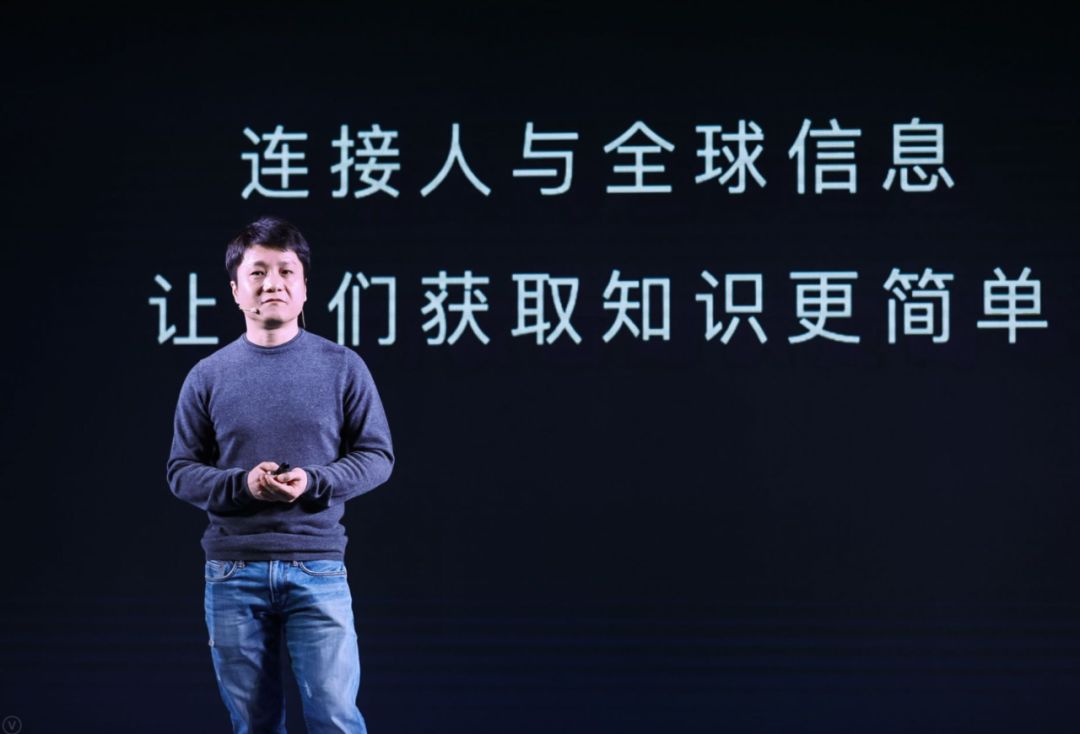
This July, at an industry conference, Chen Ye posed a question to the audience: According to data from the China Internet Network Information Center, in the first half of 2019, Chinese internet users spent an average of 27.9 hours online per week. "Much of that time goes to recommendation apps. Many of you here have spent hours scrolling through Douyin. But ask yourself honestly — has our efficiency in acquiring valuable information and knowledge actually improved?"
The audience's reaction only confirmed Chen Ye's point.
"The answer is no. When you need to find professional information, it's still inefficient."
Looking back at the history of internet information development: the emergence of search engines in the PC era dramatically boosted information acquisition efficiency; entering the mobile internet era, information became fragmented across various apps. Despite having more than enough killer apps occupying users' time, people still struggle to access useful information efficiently — in fact, the process has become increasingly passive and aimless.
Another critical factor hampering information efficiency is that more and more valuable information has sunk into the deep water, becoming fragmented and privatized. "It might exist on Zhihu, Xiaohongshu, WeChat Official Accounts, in Moments, in conversations between you and your friends."
"After long division, comes unity." Chen Ye believes that collecting, reconstructing, summarizing, and structurally presenting this deep-water valuable information represents enormous demand today.
The opportunity for "unification" in the information landscape has arrived.
The Future Form of Human-Information Connection
What will this "unified" landscape look like?
In Chen Ye's mind, there is an ideal form for human-information connection — having your own personal assistant. "We want to reorganize all the world's information to make it more structured and reach deeper domains. You ask a question and get a genuinely useful answer, like your personal assistant. This is the product design philosophy we've consistently upheld."
At the 2019 World Artificial Intelligence Conference in late August, TigerBot released a robot — the TigerBot Personal Assistant — that began to approximate this ideal form.
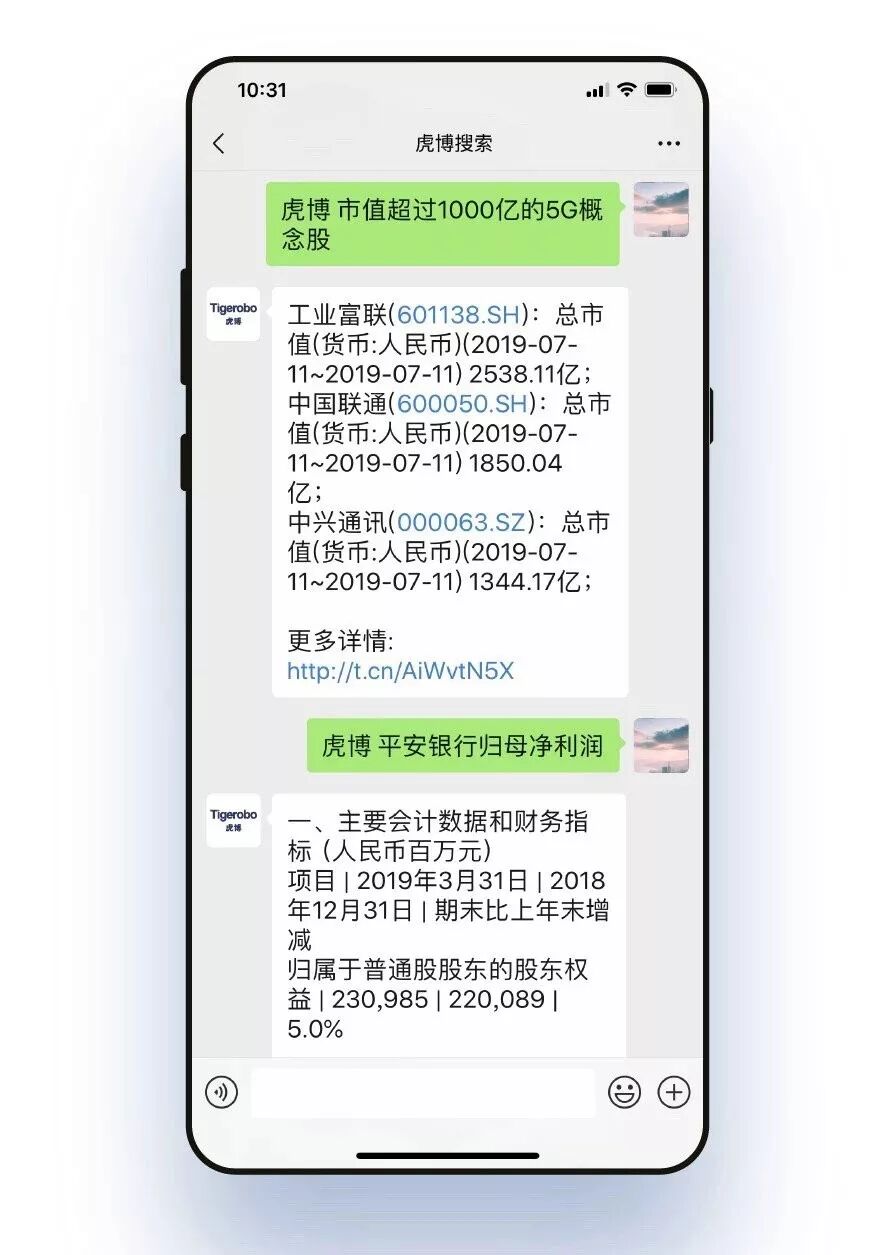
Dubbed the industry's first intelligent Q&A robot focused on financial information and data, the "TigerBot Personal Assistant" allows users to ask direct questions about global markets, macro industries, company research, or market indices, receiving answers in a conversational format. "You can communicate with it naturally, like a friend, and get precise answers you want. It's like having a finance-savvy companion who never runs out of responses."
For example, typing "TigerBot, 5G concept stocks with market cap over 100 billion" into the chat interface yields real-time basic information on several matching stocks.
"The entry point in the PC era was search; in the mobile internet era, it's various applications. Where is the next era's information gateway?" Chen Ye hopes TigerBot can provide the answer.
"This gateway should be natural, one-stop, seamless." In Chen Ye's view, an information gateway product should follow first principles, returning to the most primitive form of information exchange — face-to-face human conversation.

The "Ambition" in the Information Jungle
How far are we from this next-generation information gateway? The pace of technological development will determine the answer.
Artificial intelligence can be divided into two levels. The first is perception — computer vision and other perceptual technologies have made leapfrog progress in recent years, with broad commercial deployment. The second is cognition, where natural language understanding stands as "the jewel in AI's crown."
As key NLP (natural language processing) technologies like semantic analysis, word segmentation and clustering, and machine translation advance, information will be mined, connected, and presented more effectively. For instance, content previously difficult for computers to extract — PDFs, tables, images, audio — can now be extracted and restored, unearthing deeper information. Using NLP, we can also cross cultural barriers to understand natural human communication and emotional exchange. Moreover, Chen Ye notes, "human thinking is structured. Based on NLP technology, we can find and structurally present the content users want according to their needs and habits."
Chen Ye hopes to tackle these key technologies with his team and achieve genuine commercial deployment. Before returning to China in 2014 to join Meituan, he served as Principal Scientist and R&D Director at Microsoft, eBay, and Yahoo in the US, leading development of Yahoo's behavioral targeting system, eBay's recommendation system, and Microsoft's search advertising auction mechanism. He also won Best Paper awards at three top AI conferences (15th and 19th ACM SIGKDD, 34th International ACM SIGIR) and published over 20 influential papers in AI and machine learning.
At Meituan, where he "worked alongside Xing Wang and Tao Zhang for three years," Chen Ye led the group's advertising platform, building an industry-leading local services marketing platform. During his tenure, he helped grow the group's annual advertising revenue from 10 million to over 4 billion.
In founding TigerBot, Chen Ye makes no secret of his ambition. The name "TigerBot" fuses the ferocity of the "tiger," king of the forest, with the wisdom of the "PhD," pinnacle of academia. "On one hand, I encountered the world's most advanced technologies at companies like Microsoft and Yahoo; on the other, I witnessed the explosive growth of China's mobile internet. I want to combine both to build a world-class AI enterprise."
Today, Chen Ye still insists on technical exploration and research, frankly admitting that "writing code can bring the same joy as beating levels in a game." Additionally, TigerBot has assembled a world-class technical team. Co-founder and Chief Scientist Dr. John Canny chairs the Computer Science Department at UC Berkeley and invented the Canny edge detection algorithm. Junbo Zhao, who joined TigerBot in the first half of 2019, leads algorithm and frontier technology exploration. Zhao holds a PhD in Computer Science from New York University, where he studied under Yann LeCun, a world-renowned AI master and 2018 Turing Award winner.

TigerBot's Two Years: Finance First
When founded two years ago, TigerBot chose finance as its primary deployment scenario. Financial industry data is like oil or oxygen — every decision heavily depends on it. Moreover, finance is a microcosm of the economy; using technology to improve efficiency carries profound social significance.
Based on deep learning, NLP, and other technologies, TigerBot independently developed seven key technologies for the financial domain: intelligent search, intelligent recommendation, machine reading comprehension, machine summarization, machine translation, machine sentiment analysis, and machine writing. "TigerBot insists on building core technology in-house and making it world-class. Currently, our hypertext information extraction, machine translation, and machine summarization in financial domains are industry-leading." According to TigerBot, blind tests by top investment banks and brokerages showed its machine translation capabilities surpassing Google in its covered domains.
TigerBot has also accumulated rich data resources. It has organized massive amounts of structured, unstructured, and semi-structured data from global financial markets into a deep, large-scale underlying data system spanning market data, macroeconomics, industries, announcements, research reports, news, and alternative data.
Based on this leading underlying technology and data architecture, TigerBot has established a "C+B" dual-engine model in finance.
On the B2B side, TigerBot uses AI to empower institutional clients' intelligent transformation, providing services including intelligent search, intelligent investment research, sentiment monitoring, professional translation, and NLP infrastructure services. Its clients span professional financial institutions, government agencies, media, and research organizations, including the People's Bank of China, Xinhua News Agency, Jiangsu Provincial Institute of Scientific and Technical Information, Haitong Securities, CICC, Harvest Fund, and Sino-United Bank.
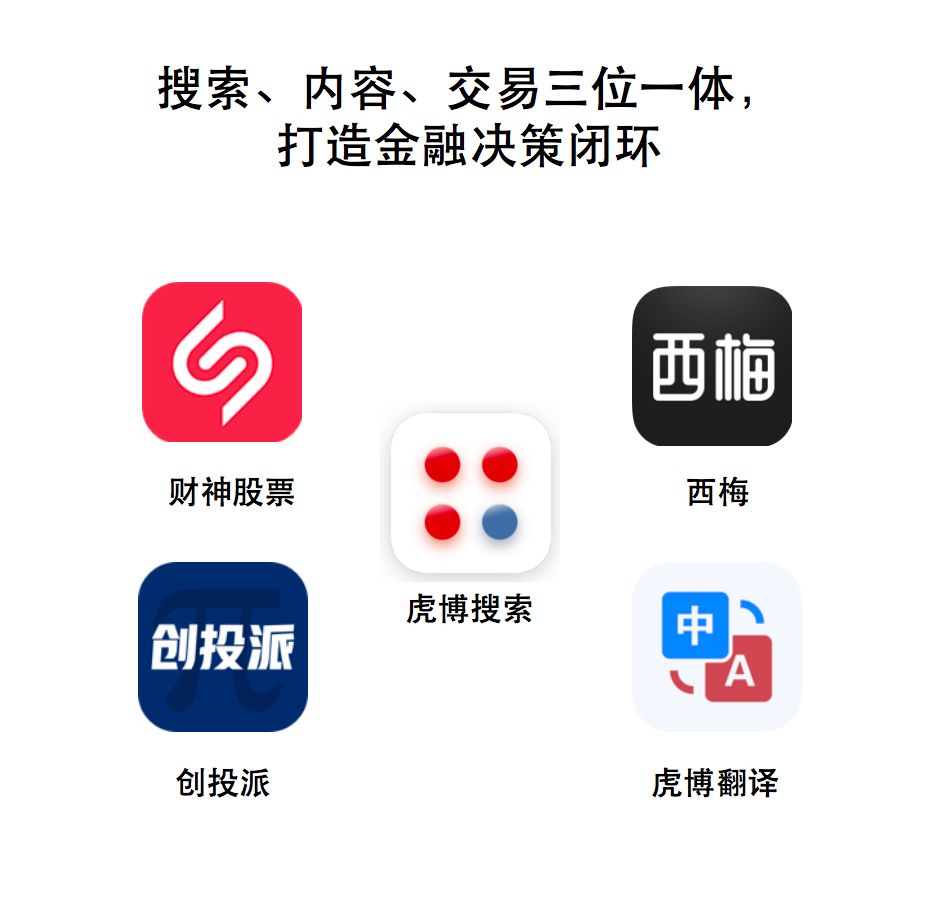
For C-end users, TigerBot has developed a series of products around search, content, and transaction needs: TigerBot Search, Ximei, Chuangtou Pai, Prospectus, and Caishen Stocks, accumulating millions of users. Its flagship product, TigerBot Search, targets institutional and individual users focused on capital markets, enabling deep mining of valuable information and data across global financial markets with real-time, fully automated acquisition, parsing, understanding, and summarization — dramatically improving users' efficiency in obtaining financial information.

The Road to Future Information Forms
How should the path to the future be forged? Chen Ye revealed two goals for TigerBot's next phase.
First, going consumer. "We've found TigerBot's products have very high stickiness, including TigerBot Search and TigerBot Personal Assistant — once people use them, they love them." Early in TigerBot Search's launch, an active Zhihu user recommended it organically, boosting daily active users by over 70% overnight. Going forward, TigerBot will continue launching and optimizing consumer products based on user needs.
Second, expanding across industries. In the future, TigerBot will export its underlying technologies accumulated in finance to other verticals, including education, healthcare, and entertainment. In consumer industries, for example, TigerBot's B2B technology can provide data services and precision marketing for brands; on the consumer side, it can offer credible consumer big data review applications based on precise mining of massive information. Cross-industry applications represent the release of TigerBot's foundational capabilities.

Below, the ten-question conversation between Gaorong Ventures and Chen Ye:
Gaorong: In TigerBot's view, what should efficient human-information connection look like? Regarding information acquisition, do you have an ultimate ideal form in mind?
Chen Ye: I think the ideal form is having your own personal assistant. As technology continues to break through, our interaction with everything in the world will change. Perhaps everyone will have a personal assistant — maybe a robot, maybe wearable — but the core is unlimited brain capacity, continuous learning, and deep understanding of you. It can become your assistant, colleague, mentor. You won't perceive it as a tool, and it may be smarter than all your friends. At that point, robots will handle most of people's transactional work, freeing humans to engage more in decision-making and creative work.
But that ultimate form still seems quite far away. Many sci-fi movie depictions where information pops up for you wherever you go — I think that's overdoing it. The ideal form should be a combination of active and passive.
Gaorong: In your view, where can truly valuable information be found today?
Chen Ye: I see three points. First, it exists in vertical industries. Data and information are becoming increasingly deep-layered. TigerBot started from finance, where much useful data lies beyond search engines' reach. For example, a report in PDF format — mainstream search technology hasn't done well understanding and mining it. Similar trends exist in other domains.
Second, information is becoming fragmented. It's not concentrated in a few media outlets anymore. It might exist on Zhihu, Xiaohongshu, WeChat Official Accounts, in Moments — this is more fragmented.
Third, it's becoming more privatized. This has become especially noticeable in the past year. Much information content shows this trend. For example, after buying something on Taobao, you quickly get pulled into various groups, and your future communication, repurchases, advertising, and content all happen within those groups. We have all kinds of groups, interest circles, and friend circles — these are private networks. And technology from the past 20 years has been essentially blind to this data.
Gaorong: So will professional information producers still matter in the future? In what ways will information be continuously produced?
Chen Ye: Of course they matter. Currently, the information we aggregate is still somewhat cold; we need more high-quality content to be dynamically produced. Today's mobile internet apps have dramatically lowered the barrier to content production, but we can't deny that much UGC content isn't high quality.
In the future, we hope to provide new gateways and methods for users to produce higher-quality content. For example, using gamification to encourage content production.
Gaorong: Currently TigerBot's technology focuses mainly on processing text information. Will you consider expanding into video in the future?
Chen Ye: Yes, video content processing will be a very important core competency, and we've already begun exploring this. Currently, even in academia, key NLP tasks for short video haven't been defined. We hope to leverage TigerBot's talent and technology advantages to define these key tasks, including video content understanding, editing, and distribution, and apply them in our products.
Currently, China is probably the fastest-moving country in the world for machine understanding of short video. The US doesn't have this problem — they don't have that much short video to process. We do.
More importantly, short video consumption and production methods are still relatively primitive and can't yet be called efficient. We hope that through understanding video content, we can increase the certainty of your short video acquisition, enabling automated tagging, better searchability and shareability, and true understanding of you.
Future applications for these technologies are extremely broad, spanning production, distribution, and commercialization. For example, helping users generate dynamic content from static content.
Gaorong: Which TigerBot technologies would you call industry-leading?
Chen Ye: Currently, our hypertext information extraction, machine translation, and machine summarization in financial domains are industry-leading. For machine translation, our research on the algorithm model Levenshtein Transformer processes more than 3x faster than the most commonly used translation models for machine translation and text summarization tasks. Additionally, we're industry-leading in hypertext information processing — we were the first to achieve fully automated machine extraction of primary market information. Machine summarization is also industry-leading: a long piece of text, the machine reads it once and summarizes the key points.
Gaorong: You have both technical and commercialization backgrounds. How do you balance "engineer thinking" with commercial thinking? What capabilities should technology-driven companies have to succeed?
Chen Ye: To build a truly technology-driven startup and break through, you need to clear three hurdles.
First hurdle: technology. Especially for domestic tech startups, your technology needs to be good — not just good, but frankly better than BAT. If you can't compete on technology, you're eliminated at the first gate.
Second hurdle: good enough product. Getting from technology to product isn't easy; you need very sharp instincts for user needs.
Third hurdle: turning product into commodity. You need your own business model where users don't just like the product, but are willing to pay for it.
So when choosing their arena, technology-driven startups should forget about artificial intelligence and find places with genuine user needs. Ideally, needs that existing technology can't satisfy well, but AI can solve beautifully. In the deployment process, remember that user experience is the sole purpose, not technical advancement. There's a straightforward word — compromise. In fact, good product design requires compromise. At AI's current stage, look at deployment realities. Making useful products is what TigerBot cares about most, not how cool the technology is. In our deployed scenarios, we've improved users' information acquisition efficiency by at least 10x, even hundreds or thousands of times.
Gaorong: In your view, where is the big opportunity for the next decade?
Chen Ye: Looking back at the past decade of China's mobile internet explosion, it was based on the keyword "connection." That is, treating the internet as a channel — e-commerce connects people and goods, social connects people and people, search connects people and information/knowledge. This produced giants like BAT; in the US, Google, Amazon, and Facebook.
My view is that the next decade's explosion will be based on "efficiency." Something that originally took a month or longer — today AI can do it in real-time, instantly. In this continuous development, we await an inflection point from quantitative to qualitative change. We believe this inflection point will come, but the opportunity before it lies in efficiency.
Gaorong: What are TigerBot's product values? What will TigerBot absolutely not do?
Chen Ye: We want to use the best technology to create the best product experience. We want everyone to enjoy AI technology in a freer, more equal, more peaceful environment — one that simplifies your work and leaves more time to enjoy life with family and loved ones.
We want to create valuable information. Perhaps today an internet product with 100 million DAU can monetize well, but with valuable information, 1/10 the DAU can be worth more. We want positive companionship with users, helping them become better.
So we don't want to build products that merely addict users. Some products, in our view, have excellent operational methods but don't solve fundamental needs. In our consumer-facing efforts, we'll learn product operational thinking, but we'll start from users' underlying needs.
Gaorong: What are TigerBot's key priorities for the coming period?
Chen Ye: First, going consumer. We've found TigerBot's products have very high stickiness, including TigerBot Search and TigerBot Personal Assistant — once people use them, they love them. Going forward, we'll continue launching and optimizing consumer products based on user needs.
Second, expanding across industries. In the future, TigerBot will export its underlying technologies accumulated in finance to other verticals, including education, healthcare, and entertainment.
Gaorong: I heard you still insist on writing code? What's TigerBot's team culture like?
Chen Ye: Yes, I still spend most of my time on research and writing code, and will continue investing in R&D.
In terms of team composition, R&D personnel account for about 70% of TigerBot — typical engineer geek culture, quite simple. On technical issues, people can argue until they're red in the face; once goals are set, everyone executes with full force.