Dialogue with CASI's Huaqiang Xu: "Following Nature's Way" in Drug R&D | Gaorong "Future"

CasKedy announced the completion of a nearly RMB 100 million Pre-A+ funding round.
Today, drug R&D universally faces three major challenges: high risk, high investment, and long development cycles. How can these risks and uncertainties be minimized as much as possible? And is there a solution grounded in "first principles" behind this?
Dr. Huaqiang Xu, founder of Cascadia Therapeutics and director of the Chinese Academy of Sciences (CAS) Key Laboratory of Receptor Structure and Function / CAS Shanghai Institute of Materia Medica Center for Drug Target Structure and Function, has long been engaged in structural research and drug development of nuclear receptors and G protein-coupled receptors (GPCRs). As a renowned structural biologist, Dr. Xu has led his team in resolving the three-dimensional structures of nearly one-third of human nuclear receptors and a series of important GPCRs, publishing over 260 research papers in internationally renowned academic journals, including more than 30 in Cell, Nature, and Science. He has obtained over 10 patents and received multiple awards including the 13th Tan Jiazhen Life Science Achievement Award. Additionally, Dr. Xu has participated in and led the development of blockbuster drugs such as Advair and AVANDIA (rosiglitazone).
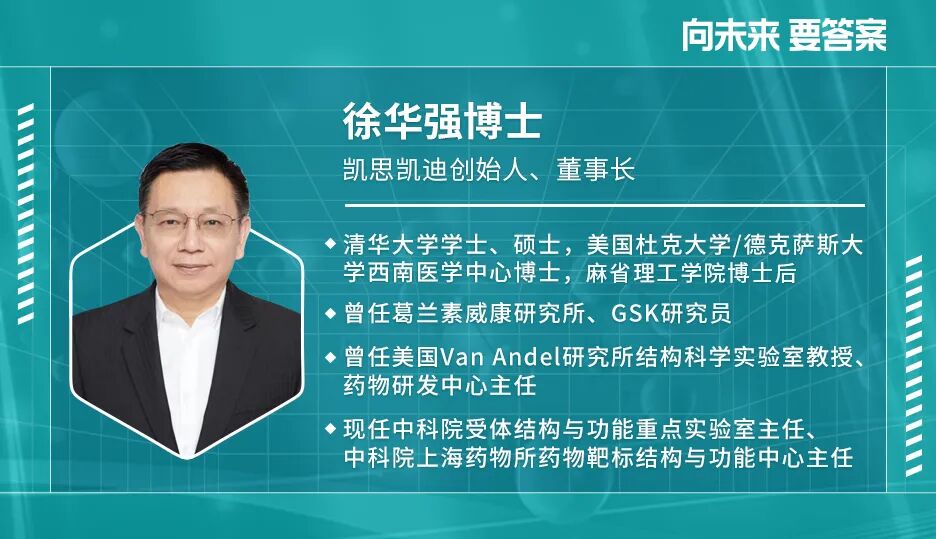
Building on nearly three decades of accumulation, Dr. Xu is committed to bridging basic science and applied science, translating more fundamental research findings into practical applications, and developing drugs for major diseases affecting human health. Facing a transforming pharmaceutical industry, he believes that "new drug R&D needs to follow the first principles of biology — that is, to follow the intrinsic physiological laws of the human body. As the saying goes, 'the Dao follows nature.' The reason we say 'all medicines have some toxicity' is often because this principle has been violated during drug development." At the same time, innovative drug R&D must return to the original source of drug innovation — the discovery and validation of drug targets. The two major hormone receptor families, nuclear receptors and GPCRs, are the two most important classes of drug targets in the human body and are also hotspots for R&D among pharmaceutical companies at home and abroad. Cascadia Therapeutics, as an emerging biopharmaceutical company, focuses on innovative drug development targeting nuclear receptors and GPCRs, concentrating on unmet major clinical needs in metabolic diseases and inflammatory diseases. Recently, Cascadia Therapeutics announced the completion of a nearly 100 million yuan Pre-A+ funding round, led by Westlake Innovation Investment, with existing shareholders Gaorong Ventures, Fuhui Venture Capital, and Gemdale Capital continuing to participate. Gaorong Ventures had led Cascadia Therapeutics' Pre-A funding round in October 2020. At this juncture, we also spoke with Dr. Huaqiang Xu — this is the fourth installment in Gaorong's "Future" series.

Q: With nuclear receptors and GPCRs as targets, Cascadia Therapeutics' core R&D team has accumulated more than 20 years of experience in innovative drug development for metabolic diseases, inflammatory diseases, and other areas. Why have you remained focused on this direction for two decades?
Huaqiang Xu: The human body is a living organism of multiple tissues and organs, and communication between tissues and organs is accomplished through signaling molecules. We can simply understand that among the various tissues and organs of the human body, hormone molecules serve as the primary signaling molecules to transmit biological information, thereby realizing corresponding physiological functions.
Over the years, our research thread has been to use structural biology approaches to study the regulatory and mechanistic actions of hormone molecules and their relationship with disease, and then to design next-generation drugs based on the three-dimensional spatial fine structures of drug molecule-hormone receptor interactions. The body's hormone receptors mainly comprise two major families — nuclear receptors and GPCRs — which influence physiological processes such as metabolism, immunity, nerves, and reproduction. Among them, there are 48 nuclear receptors in the human body, including classical endocrine nuclear receptors, glucocorticoid receptors, thyroid hormone receptors, etc. Additionally, there are some called orphan receptors that lack clear endogenous ligands but are also important for the body's metabolic balance, such as fatty acid receptors and bile acid receptors. GPCRs are the largest class of protein families among membrane receptors, with more than 800 GPCRs in the human body, widely distributed in the central nervous system, immune system, cardiovascular system, retina, and other organs and tissues. These two major hormone receptor families are also the two most important classes of drug targets. Among currently marketed drugs, more than half target these two types of receptors. It can be said that a large part of modern pharmacology is built upon hormone receptors. For example, there are more than a dozen drugs acting on glucocorticoid receptors, two of which still generate billions of dollars in annual sales to this day. We firmly believe that the potential of nuclear receptors and GPCRs as drug targets remains enormous. In the field of innovative drug R&D, a company's core competitiveness lies not only in how many resources or personnel it has, but also in the depth of its understanding of the subject matter itself. Our core team's understanding of nuclear receptors and GPCRs is internationally leading. Our team has resolved the structures of 16 nuclear receptors and more than 70 GPCRs. These accumulations and foundations give us confidence that in this niche area, we can go further and more steadily.
Q: What innovative drug pipelines does Cascadia Therapeutics currently have in progress, and what unmet major clinical needs do they address?
Huaqiang Xu: Cascadia Therapeutics mainly focuses on unmet clinical needs in metabolic diseases, inflammatory diseases, and other areas. Compared to the long road of scientific exploration, each of our lives is short, and an effective research career for a scientist is only a few decades. During years of life science research, I often think about whether the scientific questions I focus on have sufficient research value — value that includes not only breakthroughs in basic research itself but also the extension of value in the translation and application of basic research findings. Similarly, the foothold and starting point for founding a pharmaceutical technology enterprise must also have sufficient significance and value, and must be able to solve major disease problems affecting human health.
Major diseases affecting human health include tumors, metabolic diseases, and autoimmune diseases, among others. To some extent, it can be said that the number of patients with metabolic diseases far exceeds that of cancer patients, but new drug R&D investment for the two is not proportional to the number of patients. Currently, there are still many metabolic diseases for which no drugs exist.
Cascadia Therapeutics currently has 12 new drug product pipelines in progress. Among them, the most advanced drug — CS0159, a non-bile acid full agonist targeting the bile acid receptor (FXR) — received approval from the U.S. Food and Drug Administration (FDA) and China's National Medical Products Administration (NMPA) to initiate clinical studies in October 2021 and January 2022, respectively. CS0159 has now launched Phase I clinical trials in the United States for the primary sclerosing cholangitis (PSC) indication, recently completed Cohort II dosing, and has received FDA orphan drug designation for PSC.
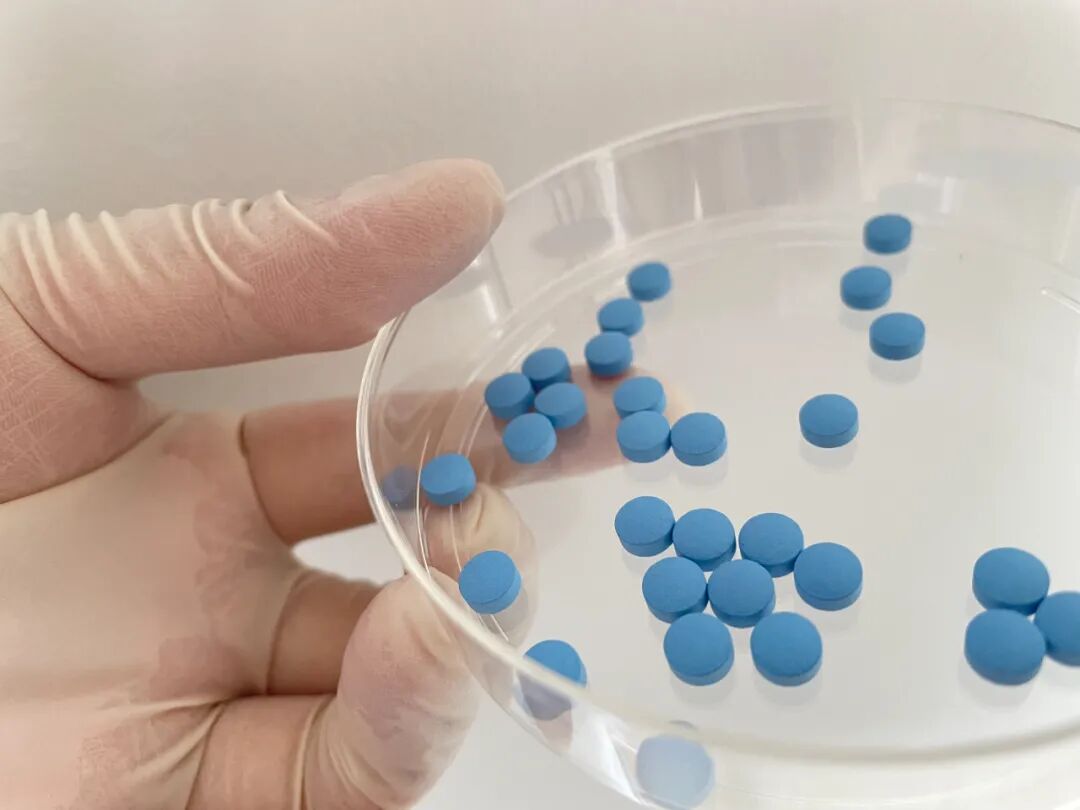
Non-bile acid full agonist CS0159 targeting FXR
Bile acids are important emulsifiers that help the body absorb nutrients, but excessive bile acids can damage cells and must be strictly controlled. In fact, as a drug target, the bile acid receptor has seen more than a dozen companies conducting drug R&D over the past 20 years, many of which have failed. The reason for failure was not poor efficacy in clinical studies, but poor safety. By designing modulators through the bile acid receptor, based on this unique design mechanism and concept, we hope to enable our drug small molecules to simultaneously achieve good efficacy and better safety.
We know that every complex discipline has its own "first principles" — returning to the origin and building the entire edifice based on the unchanging "One." In the process of new drug R&D, we constantly follow the first principles of biology, that is, the intrinsic physiological laws of the human body. By capturing the structure and action patterns of hormone molecules in the human body, and based on understanding of the underlying logic of disease, we then design corresponding drug molecules, thereby anchoring a more solid starting point for the long and arduous journey of new drug R&D. As the saying goes, "the Dao follows nature." Returning to this principle and eliminating the root causes of disease, perhaps in the future we may no longer have to worry that "all medicines have some toxicity."

Q: As a renowned structural biologist, how do you view the development and future trends of structural biology?
Huaqiang Xu: Over the past 70 years, structural biology has laid the foundation for modern biology. Starting from resolving the DNA double helix structure, it changed humanity's understanding of life science and became the cornerstone of modern biology. The development of molecular biology cannot be separated from the contributions of structural biology. It can be said that structure is the foundation of function; without structure, function cannot be understood.
Structure is also the foundation of modern pharmacology. Without structure, drug development is like blind men touching an elephant; structure is like a bright lamp, illuminating the direction of our drug design.
Of course, as a methodology, structural biology has also undergone several revolutions, and I have personally experienced these technological changes and felt the positive impact of technological innovation. From early X-ray technology, to nuclear magnetic resonance, and then to cryo-electron microscopy, the efficiency with which we can answer scientific questions has become increasingly high, and the biological questions we can address have become increasingly broad and complex.
For example, our laboratory initially spent 10 years resolving the structure of the non-visual arrestin in the downstream signaling pathway of GPCRs; later, when we resolved the inhibitory G protein complex, an equally important scientific question took only one year. Today, our laboratory has the capability to resolve 100 GPCR structures in one year — compared to the earliest pace of one structure in 10 years, current efficiency has improved a thousandfold, and I believe the speed will continue to increase.
I personally believe that the revolution in structural biology is still ongoing. Of course, today's artificial intelligence technology can help structural biology with early recognition and model building, but the gold standard of structural biology remains experimental structures, which require experimental means to see clearly.

Q: We have also noted that while advancing the R&D process of the CS0159 program, your research team at the Shanghai Institute of Materia Medica has done considerable work in combating COVID-19. What achievements have been made?
Huaqiang Xu: In the most critical early period of fighting COVID-19, our research focus was on how the novel coronavirus achieves rapid replication, and whether the antiviral drug remdesivir could effectively inhibit coronavirus replication.
At the end of February 2020, after obtaining the SARS-CoV-2 RNA-dependent RNA polymerase (RdRp) gene sample, our team took only 46 days to resolve the high-resolution cryo-EM structure of the important coronavirus drug target RNA replicase and the inhibitor remdesivir, first elucidating the inhibition mechanism of the nucleoside inhibitor remdesivir (Science 368(6498):1499-1504).
This scientific problem was very challenging at the time. For example, structural resolution of HIV replicase or hepatitis C virus replicase in the past required nearly 30 years. Additionally, we also resolved the first high-resolution structure of the non-nucleoside inhibitor suramin bound to SARS-CoV-2 RdRp and elucidated its inhibition mechanism (Nat Struct Mol Biol 28(3): 319-325.). At the same time, our team also participated in the development of the oral nucleoside inhibitor VV116 (Cell Res 31(11): 1212-1214.), which has currently received emergency use authorization in some countries and regions.
In early 2022, as the Omicron variant spread, our team urgently resolved the high-resolution cryo-EM structure of the Omicron variant spike protein bound to the human receptor ACE2, and collaborated with other teams to tackle the structure of the Omicron variant spike protein and the specific therapeutic antibody JMB2002 — from project initiation to manuscript submission took only about 18 days. Just on February 8, Science published online our latest research breakthrough on the Omicron variant, explaining why Omicron spreads so rapidly and providing new ideas for the subsequent design and development of broad-spectrum anti-coronavirus antibodies.
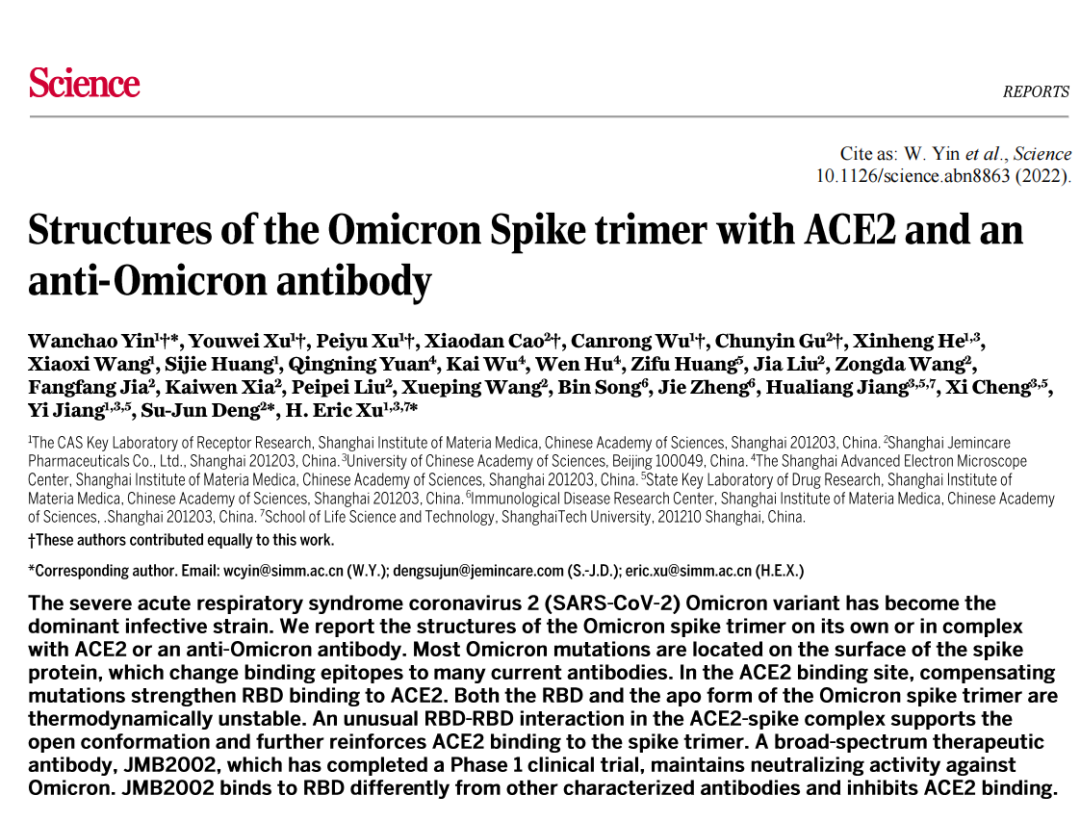
https://www.science.org/doi/10.1126/science.abn8863
In this process, we also recognized that facing major scientific questions, especially research on emerging and sudden infectious diseases, cannot wait or be delayed. If a team can unite and work day and night, with corresponding supporting resources, it is entirely possible to use our professional expertise to seize the time window for fighting the pandemic.

Q: What are the similarities and differences between doing scientific research and running a drug R&D company? What vision do you hold for the future of life science research and entrepreneurship?
Huaqiang Xu: In the new era of innovation-driven development, a large number of new drug R&D enterprises are flourishing, and the integration of industry, academia, and research is becoming increasingly close and smooth. I myself increasingly feel that if scientists can not only complete their research but also apply their scientific achievements in translation and application, and even use technology to build an enterprise that benefits industrial development and innovation, that should be a great fortune for scientific researchers! Doing scientific research is highly exploratory, allowing for a certain degree of "blue-sky thinking"; running an enterprise requires different mechanisms, such as clear goals, strong timeliness, and the need for phased deliverables. But the two also have commonalities — for example, in team management, how to unite the team and motivate members to work toward common goals and interests.
Cascadia Therapeutics' current phased goal is to focus on our key disease areas, expecting to obtain high-quality PCCs (preclinical candidate compounds) every year; at the same time, to accelerate the clinical trials of our pipeline programs, truly validating the concepts we uphold through clinical trial data — this will be a revolutionary change, and with the addition of this validation data, I believe the company will achieve remarkable growth.
I have always believed that the path of scientific exploration grows broader as you walk it. Although there will be more and more problems to solve, challenges will always exist. But if we can help more people enter this field, we can promote faster development of the discipline. Today, I am still very interested in experimental design, discovering and solving scientific problems, and basically write articles until after 11 p.m. every night. I also hope to pass these abilities on to more young researchers. Cultivating scientists is like cultivating Olympic champions — it requires years of unremitting training. I look forward to guiding more young researchers to gradually master the ability to see through phenomena to the essence of problems, and step by step approach solving these problems. Fortunately, Cascadia Therapeutics has established a core R&D team and an increasingly complete regulatory and clinical operations team, which will jointly advance our pipeline into the clinical stage. The team members are young, vigorous, daring to act, and very united — able to pull together as one. The company has recently begun to gradually build a commercialization team, in order to make advance preparations for subsequent substantive product commercialization operations. Our shared vision is "making diseases treatable with medicines, helping lives achieve health." We envision Cascadia Therapeutics becoming a first-class new drug R&D enterprise in the next three to five years.
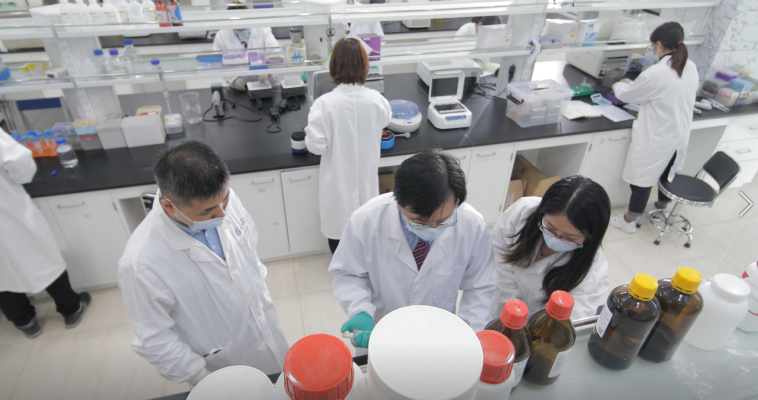
Nowadays, life science research and entrepreneurship are in full swing, but perhaps looking back 50 years from now, we will feel that the stage we are currently in still seems like the "Stone Age" of biomedical science, and we are just a group of pioneers rubbing sticks to make fire, trying to illuminate the path of exploring life and health. But we envision and firmly believe that in this long journey, the flames we ignite, the light and heat we emit, will illuminate the road ahead and warm those who come after.


"Tiny but Great" miRNA: How to Detect Cancer at Its Earliest Stage | Gaorong "Future"