AncorBio in the Hot ADC Race: Mining Differentiated Value in the Innovative Drug 2.0 Era | Gaorong Future

China will inevitably give rise to its own global MNCs.
In the early 20th century, Paul Ehrlich, the German scientist who pioneered modern drug development technology, proposed the concept of the "magic bullet" — the ideal drug would strike like a enchanted projectile, precisely hitting diseased tissue without harming normal cells.
A century later, this vision began to materialize in innovative drugs such as ADCs.
ADCs (antibody-drug conjugates) use chemical linkers to attach monoclonal antibodies to cytotoxic payloads, transforming the antibody into a "navigation system" that precisely recognizes specific antigens on tumor cell surfaces, then delivers the cytotoxic drug directly into the tumor — combining both targeting capability and killing power.
With their breakthrough efficacy, ADC drugs are reshaping the global oncology treatment landscape; in the first half of 2025 alone, outbound licensing deals in China's ADC sector approached $17.3 billion.
Anliko Biotech, founded in 2023, is an innovative drug company dedicated to developing breakthrough therapies for cancer and immune diseases, advancing toward its goal of developing world-class next-generation ADC and multi-specific antibody drugs. Leveraging innovative platform technologies, exceptional R&D efficiency, and differentiated pipeline positioning, Anliko has built a portfolio with multiple FIC (first-in-class) and BIC (best-in-class) candidates, rapidly advancing two ADC drug candidates to global Phase I clinical trials.
On December 16, 2025, Anliko Biotech announced the completion of a nearly $50 million Series A extension, bringing the company's total raised to over $100 million. In 2026, the company will also initiate a new Series B financing round. Gaorong Ventures co-led Anliko Biotech's angel round in 2023 and continued to participate in the subsequent Series A round.
Recently, Anliko Biotech co-founder and COO Kehua Fan shared at a biopharma innovation Demo Day co-hosted by Gaorong Ventures and PwC how the company is mining differentiated value in the fiercely competitive ADC race to become a pioneer of "Innovative Drugs 2.0."
From witnessing Innovative Drugs 1.0's heyday to launching a 2.0 startup
The past decade has been the most transformative period for Chinese pharmaceuticals. "During this time, China's pharmaceutical industry underwent a leapfrog development from generics to me-too innovation, and then to First-in-Class and Best-in-Class."
Anliko Biotech was founded by Dr. Hui Feng, former co-founder of Junshi Biosciences. Since returning to China from AstraZeneca in 2013, Feng spent ten years at Junshi. During his first entrepreneurial decade, he led Junshi's R&D operations and manufacturing, successfully advancing the launch of China's first PD-1 monoclonal antibody (Toripalimab), while also witnessing the takeoff of China's innovative drug sector. In Feng's view, national healthcare reform policies, the return of innovative drug talent, engineer dividends, CRO supply chain advantages, and the world's best clinical resources collectively propelled China's innovative drugs into their first golden age.
Hui Feng, Founder and CEO of Anliko Biotech
Kehua Fan comes from a clinical medicine background, having worked as a general surgeon and accumulated extensive experience in new drug clinical development and business development at major MNCs including IQVIA, GSK, Sanofi, and Pfizer. Over the past decade, Fan has focused on cross-border BD transactions and product pipeline strategy for Chinese innovative drugs. During his tenure at Junshi Biosciences, he successfully led multiple new drug out-licensing deals, including the overseas rights licensing of Junshi's COVID-19 neutralizing antibody to Eli Lilly and Company during the pandemic. "There's no doubt that Chinese innovative drugs are increasingly commanding attention on the world stage. From both demand and supply perspectives, the license-out momentum for Chinese innovative drugs will continue."
In 2023, Dr. Feng and the core founding team recognized that Chinese innovative drugs were entering a 2.0 era, "especially as biotechs move toward more specialized and refined division of labor, with innovation capability and differentiation becoming focal points, and more intensive integration and interaction with international markets."
From there, Anliko Biotech embarked on its new journey. The company has now established a highly efficient R&D and leadership team with extensive industry experience, having secured over 20 INDs (Investigational New Drug applications) and 3 BLAs (Biologics License Applications) in the past decade.
Building next-generation ADC and multi-specific antibody drug platforms
From its inception, Anliko Biotech's innovation path has been clear — to build validated technology platforms, select targets based on comprehensive biology and translational medicine research, and develop innovative drugs across diverse molecular modalities (including ADCs, bispecific antibodies, and TCEs) to address unmet clinical needs in oncology and immune diseases.
Feng has noted that "differentiation for differentiation's sake is meaningless; it must address an unmet medical need or solve existing drug deficiencies." The Anliko team identified pain points in the previous generation of PD-1 immunotherapy and set its sights on next-generation drugs with greater potential.
For ADC drugs, Anliko believes their value lies not only in improved efficacy, but more importantly in their ability to enrich responsive populations through biomarkers, ultimately delivering real patient benefit; bispecific ADCs simultaneously hit two tumor-associated targets, enabling broader coverage of heterogeneous tumor cells while enhancing killing power through dual-strike mechanisms and reducing resistance risk; TCEs (T-cell engagers for solid tumors), as an important bispecific antibody modality, directly recruit T cells to kill tumors by simultaneously binding tumor-associated antigens (TAAs) and CD3 molecules on T cell surfaces, showing significant potential in solid tumors.
Of course, current ADC and multi-specific antibody drug development still faces numerous challenges. To address this, Anliko has pioneered several core technology platforms.
STAR-Lite — proprietary bispecific antibody platform
Fan explained that one of the biggest challenges in bispecific antibody development is the heavy-light chain mispairing problem, often leading to poor molecular stability and complex CMC processes. Anliko employs a "common light chain" design, pairing two different heavy chains (HCs) with the same light chain (LC) to reduce mispairing between light and heavy chains while preserving light chain diversity. Additionally, single-cell production technology enables favorable manufacturing costs at CMC scale. "Based on this platform, we've developed different modalities, including TCEs, bispecific ADCs, and bispecific antibodies targeting complex immune diseases."
Hy-BEAM — next-generation ADC platform
For its ADC R&D platform, Anliko's strategy is from Transform to Transcend.
On one hand, Anliko achieves high drug-antibody ratios (DAR) through innovative hydrophilic linkers, improving in vivo pharmacokinetics (PK) and achieving precise balance between tumor cell killing and safety for normal blood/tissue. Based on hydrophilic linkers and topoisomerase I inhibitors (TOP1i), Anliko is committed to developing first-in-class ADC drugs positioned "top three globally." "Top-three global POC data is a critical consideration and the core key to winning in fierce competition."
Meanwhile, Fan pointed out that the two main payload classes currently on the market are TOP1i and MMAE, and future clinical treatment will inevitably face TOP1i ADC resistance challenges. On Anliko's ADC platform, the focus will be on payload innovation directions to address clinical resistance issues that future ADC drugs may encounter. Innovation directions include optimization of approved payloads, novel mechanism-of-action payloads, and synergistic payload combinations (dual-payload ADCs).
MTMTE — proprietary Masked TCE platform
"The biggest challenge in the current TCE field is that CD3 can easily activate immune responses in circulation, triggering severe side effects such as cytokine release syndrome (CRS), and the requirements for druggable targets are quite high."
Anliko's innovation lies in employing masking peptide technology, keeping the CD3 binding domain in a closed state in circulation, only releasing the potent TCE molecule upon activation by tumor-specific proteases after reaching the tumor site. Fan noted that this design not only shortens TCE half-life and reduces healthy tissue toxicity, but also addresses tumor heterogeneity through multi-target design, achieving the dual goals of "precise activation, potent killing."
Precision development strategy: core pipeline standing out from the red ocean
Returning to when Anliko first started in 2023, ADC targets on the market were mainly concentrated on TROP-2, Claudin18.2, HER2, HER3, and others. How could Anliko stand out in this fiercely competitive "red ocean"?
"What we're very clear about is adopting a biomarker-driven precision development strategy. Currently, Anliko's two most advanced ADC pipelines — ALK201 and ALK202 — both have clear biomarkers (FGFR2b and EGFR/cMET, respectively) to precisely enrich patient populations."
Fan introduced that both ADC candidates have entered global Phase I clinical trials, with dose escalation enrollment now complete. "In just over two years, from not even having PCC confirmed to entering global Phase I trials, with dose escalation nearly complete — overall progress has been quite rapid."
ALK201 — first-in-class FGFR2b ADC, poised to bring major breakthroughs in gastric cancer/lung squamous cell carcinoma treatment
If you follow the FGFR2b target, you can't bypass Amgen's monoclonal antibody bemarituzumab (Bema) targeting this target. This candidate recently failed in Phase III, but showed very promising OS (interim overall survival) and PFS (progression-free survival) data in the Phase II FIGHT study. Fan pointed out, "An important reason for the Phase III failure was that Bema antibody treatment caused ocular toxicity, preventing gastric cancer patients from continuing treatment and leading to early discontinuation, thus failing to demonstrate efficacy advantages."
Based on this pain point, Anliko Biotech initiated development of a next-generation molecule — a specifically FGFR2b-targeted ADC drug, aiming to balance efficacy and safety to find the drug's therapeutic window. By employing the company's proprietary hydrophilic linker and optimized payload, ALK201 has demonstrated encouraging efficacy signals and good safety across multiple tumor types, laying a solid foundation for it to become a cornerstone therapy for FGFR2b-overexpressing solid tumors.
Based on preclinical data, ALK201 achieved an HNSTD (highest non-severely toxic dose) of 60 mg/kg in cynomolgus monkey safety studies, "giving us a large therapeutic window in the clinic to escalate to a dose balancing safety and efficacy."
Furthermore, ALK201 has market potential beyond gastric cancer; FGFR2b is an important epithelial tissue tumor marker with very broad distribution across gastric cancer and other tumors, including squamous non-small cell lung cancer, breast cancer, urothelial carcinoma, and other gynecological tumors. In the future, ALK201 is expected to pursue combination therapies (combo) with tumor immunotherapy and chemotherapy across different cancer types, expanding clinical application from late-stage monotherapy to first-line combination treatment.
ALK202 — optimized EGFR/cMET ADC
The concurrently advancing ALK202 project is a dual-target EGFR/cMET ADC developed based on Anliko's innovative technology platform, with indications focused primarily on non-small cell lung cancer and colorectal cancer.
"The competitive landscape in this space is very crowded and intense." Fan noted that ALK202 achieved an HNSTD of 60 mg/kg in cynomolgus monkey safety studies, demonstrating excellent safety, "which gives us confidence that we can find an appropriate safety window during clinical development."
This exceptional safety profile stems from Anliko's meticulous refinement of ALK202's molecular structure. The R&D team optimized the affinity balance between the EGFR and cMET arms, enabling precise tumor targeting while significantly reducing "off-target" damage to normal tissue. Additionally, through scientific adjustment of DAR values, ALK202 effectively improved metabolic stability and homogeneity in vivo. This "precision tuning" design strategy, while avoiding systemic toxicity, greatly broadens the therapeutic window, providing safer and more tolerable treatment options for patients with advanced non-small cell lung cancer and colorectal cancer.
Currently, early clinical data for ALK202 preliminarily validates its potential to establish a new treatment benchmark in the non-small cell lung cancer space; Anliko Biotech is further expanding its clinical evaluation scope, targeting more biomarker-defined tumor types and patient populations.

Facing the future: China will inevitably birth its own Global MNC
Regarding next-stage goals, Anliko Biotech plans to further accelerate ALK201 and ALK202 into pivotal registrational clinical trials, establishing differentiated competitive advantages in their respective target indications. Additionally, the company will initiate clinical studies combining both projects with chemotherapy and immunotherapy, further expanding therapeutic potential in first-line patient populations.
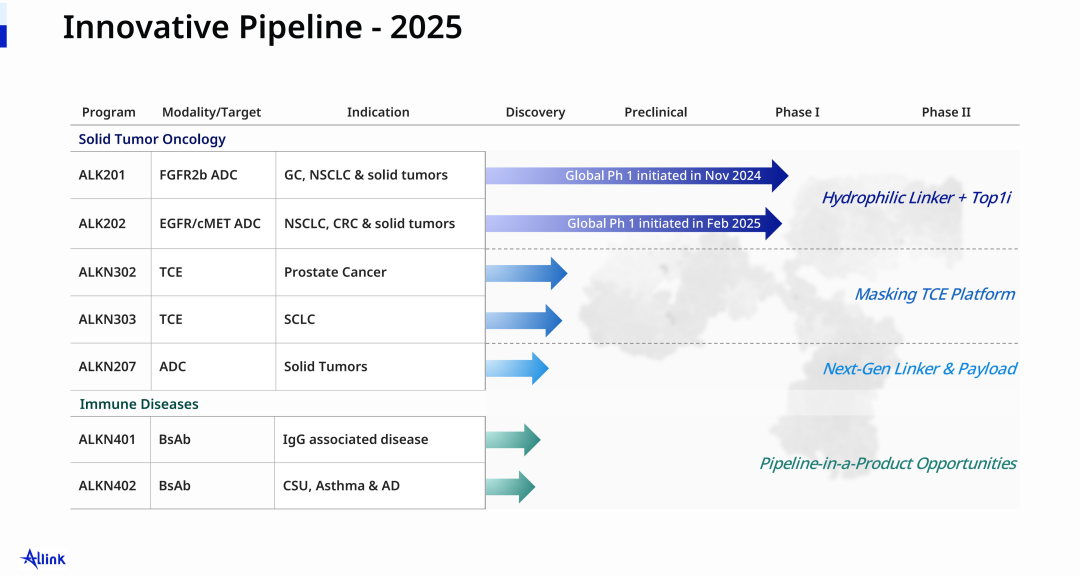
Anliko Biotech innovative pipeline
"Of course, going forward Anliko will continue advancing other pipeline programs, including TCEs, novel payload-based ADCs, and bispecific ADCs, with new PCCs expected to emerge in Q2 and Q3 next year."
Though the innovation story is still being written, Anliko Biotech has already laid a solid foundation in its first three years. We firmly believe that China will birth its own Global MNC, and "2.0 players" are staging impressive "corner overtaking" through solid technology platforms, differentiated pipeline positioning, and efficient clinical strategies.