Back in the Office: Rethinking What Makes a Great Organization | Ronghui Practical Insights
Stay stretched out, avoid rigidity.
As we return to the office, it's a good moment to take stock: Can teams actually collaborate effectively while working remotely? Does being at home sap momentum and lead to burnout?
"Remote work during the pandemic era has basically been our daily norm. The truth is, employees burn out sitting in offices too. The key is using goals to drive alignment."
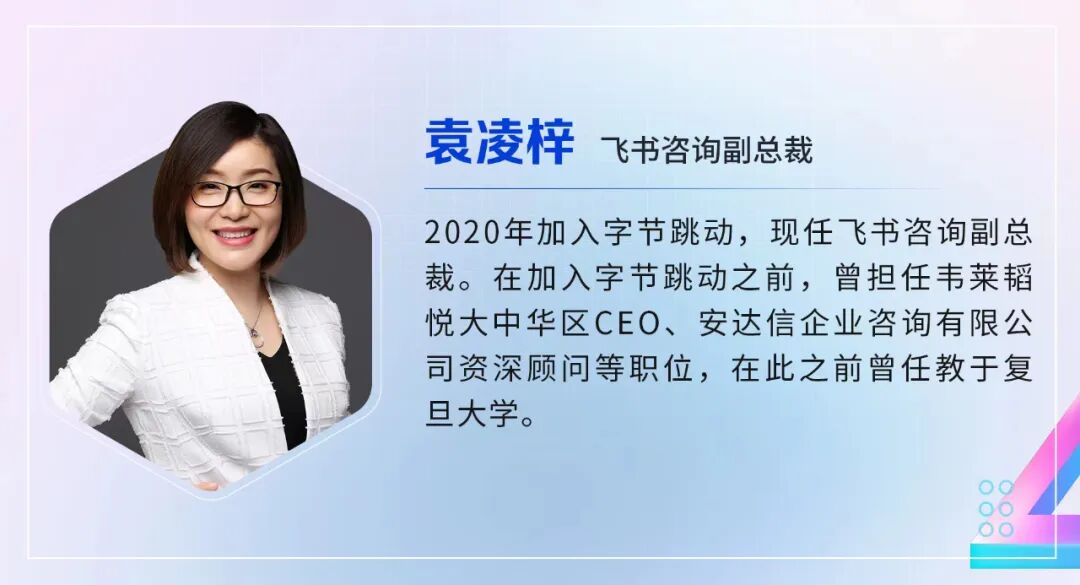
At the inaugural online session of the "Organizational Upgrade Season" co-hosted by Gaorong Ventures and Amazon Web Services, Yuan Lingzi, Vice President of Lark Consulting, shared the organizational development philosophy and talent principles that underpin agile collaboration in a pandemic context.
An organizational development ethos of "staying stretched," a hiring philosophy of constantly searching for the best talent in the universe, a management model of employee self-motivation enabled by platform support, and facing external changes honestly — these aren't merely reactive measures, but a new starting point for awakening organizational evolution.
Remote Work: The Key Is Using Goals to Drive Alignment
As a digitally native company, we're quite accustomed to remote work as a normal state. Using Lark's OKR, Docs, and Meeting tools, team meetings, interviews, virtual client visits, and performance conversations have largely continued without disruption. The real challenge is knowing whether employees can exercise self-discipline and actually deliver while at home. The crucial factor behind this is using goals to drive alignment. With clear goals, teams track and discuss progress continuously — even without meeting in person, everyone keeps pushing their work forward.
We use a bi-monthly OKR cycle with team alignment every two weeks, and we adjust market, marketing, client, and management strategies based on pandemic conditions.
OKRs aren't hard to understand or implement, yet very few organizations use them well. The reason is that in daily work, we easily get pulled along by numbers and tasks — many people don't have an "begin with the end in mind" approach to work.
We need to constantly remind ourselves: What are the organization's goals and my personal goals right now? Does what I'm doing today bring me closer to the goals the team co-created? The core is training everyone in goal-oriented and strategic thinking.
Moreover, even remotely, we can continuously convey organizational philosophy and cultural direction through tools and management practices. For instance, during the work-from-home period people had lots of online meetings — one data point: we hold nearly 80,000 meetings internally every day. We use what we call "Lark Read" meetings: document written beforehand, silent reading at the start of the meeting, then interactive discussion and conclusion — this also trains people in rapid problem-solving thinking.
But we also ask ourselves: Can remote collaboration fully replace offline communication? The answer is no. Despite detailed design and technological advances that try to create "companionship, visibility, and appreciation," when building an organization we still need to work hard to understand human needs. There's no energy exchange with someone through a screen. So don't build and develop organizations with a "tools-first" mentality.
The Organizational, Cultural, and Talent Philosophy Behind Efficient Collaboration
The efficient collaboration during the pandemic is underpinned by consistent organizational, cultural, and talent philosophies. You can't wait until remote work suddenly becomes necessary to have teams build habits of self-motivation and independent work.
1. Organizational Development Philosophy: Stay Stretched, Avoid Rigidity
As a young new-economy internet company, our organizational development philosophy wasn't purely defined from an HR perspective — from day one, it came from what kind of company the founding team wanted to build.
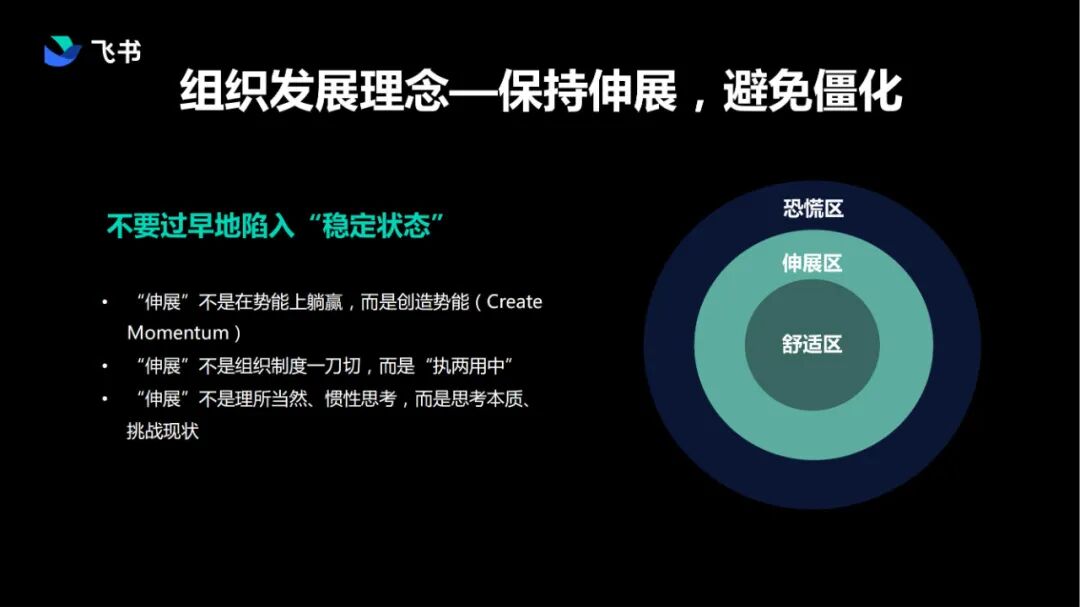
Today our organizational development philosophy can be summarized as "stay stretched, avoid rigidity" — don't fall into a "stable state" too early. We want every individual and every small team in the organization to step out of their comfort zone and into the stretch zone, to take on challenging things. We allow for some internal competition and fuzzy role boundaries, but not to the point of excessive tension or panic.
Why do this? Because facing the constant changes in the external environment, management needs to deliberately leave some white space, letting teams face the real world, return to first principles to think, and continuously make optimal decisions. Rather than judging based on processes, systems, or past experience.
So "stretching" isn't about coasting on existing momentum — it's about creating momentum. As individuals continuously break through, innovate, and grow, the organization can in turn grow new businesses, and ultimately the business radius keeps expanding.
2. The "Four Elements" of Organizational Development Philosophy
Behind this philosophy are four elements. First, establish baseline guardrails through systems. Requirements in recruiting, compensation, performance evaluation, and compliance are very clear.
Second, let excellent people make judgments to solve for the ceiling. Many frontline employees have strong ownership because they're given space for autonomous judgment — but the prerequisite is that the people are excellent enough.
Third, use good tools to ensure execution. As a technology-oriented company, when designing management systems we first ask whether they can be implemented through tools, making management online and trackable.
Finally, use culture to align philosophy. Based on the organizational culture team, we can approach corporate culture the way we approach growth, employer branding the way we approach marketing, and influence employees the way we influence customers.
3. Talent Philosophy: Excellent Talent Is Built Layer by Layer
Maintaining a self-motivated, high-energy state in teams requires the overall organizational atmosphere and talent density to catalyze it.
On talent philosophy, the first emphasis is increasing high-performing employees and continuously raising talent density. From the very beginning of the company, we've been committed to hiring the best talent, then building talent cohorts layer by layer like laying bricks. Along the way, everyone aligns by doing important things together, gets the business running and growing sustainably, which in turn attracts more excellent talent.
Second, use different kinds of people. Including cross-domain people, career switchers, people with breakthrough thinking. We believe experienced people can walk the safe path, but may not be able to overtake on the curve.
Third, constantly search for the best talent in the universe. We spend considerable time recruiting people whose capabilities match the role.
Future Trends in Organizational Evolution
1. Classic Model vs. Emerging Model
All entrepreneurial organizations, from the moment they start building, face the question: which organizational management model to pursue?
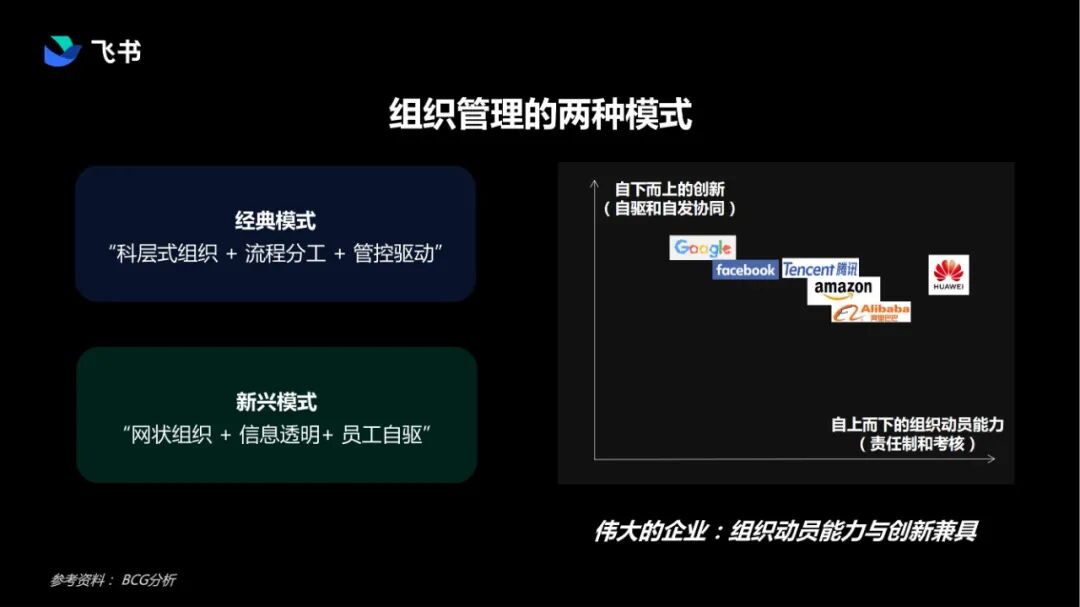
There are mainly two models. One is the classic model of "bureaucratic organization + process division of labor + control-driven," represented by Huawei and others — top-down organizational mobilization capability is very strong. The other is the emerging model of "networked organization + information transparency + employee self-motivation," where self-motivated individuals can achieve both personal and organizational goals on the platform, represented by Google, ByteDance, and others.
When young people today join teams in the emerging model, there are very few constraints from systems, processes, or boundaries. Without strong self-motivation it can be painful — like jumping into an ocean with no shipping lanes. This is quite different from the management logic of the industrial era, with its extremely detailed, hand-holding approach.
An important distinction behind this is that digitally native emerging organizations have good technical infrastructure, providing employees with opportunities for information transfer, knowledge accumulation, and self-equipping. For example, we use documents to accumulate all kinds of wisdom and innovative ideas. We believe that if employees have intelligent minds, upward psychology, plus technology-provided empowerment tools, there's opportunity to change employee management methods.
In the future, classic and emerging models will ultimately converge — great enterprises will possess both organizational mobilization capability and innovation capability.
2. What Makes a Good Organization?
What directions should future organizations evolve toward? What makes a good organization?
First, organizational evolution needs to consider the reconfiguration of production relations, being able to unleash new organizational productivity.
Second, organizations need to meet people's more complex, higher-level needs. Machines can replace much work, but the ultimate force in organizational evolution is people — we need to see people's diverse needs.
Third, organizational management has many subtle aspects; if there are tools and methods that can make experience replicable, sustainable, widely applicable, and learnable, then organizational evolution has a vehicle and ensures long-term sustainability going forward.
When our business is platform-based, the organization also evolves into a platform organization. This platform is primarily about empowerment and sharing rather than control, using good tools to liberate people, improve efficiency, promote communication and collaboration, and continuously generate wisdom and innovation.