At the Intersection of Generative AI and Life Sciences: Technology Acceleration on One Side, Clinical Demand on the Other | Ronghui x NVIDIA Inception Program

NVIDIA, Gaorong Ventures, and Cornerstone Robotics on the Acceleration of "AI + Healthcare"
AI is emerging as a powerful engine for human health, slashing the time and cost of drug discovery, enabling smart medical devices that give doctors their own "JARVIS," and pushing digital healthcare to new heights. The potential of AI-powered healthcare is being unlocked at an accelerating pace.
As NVIDIA CEO Jensen Huang put it, driven by AI and computing, "for the first time in human history, we have the opportunity to turn biology into life engineering, rather than just life science. When a field transitions from science to engineering, it becomes less random and improves exponentially."
- What AI solutions has NVIDIA — the company commanding attention in the generative AI era — already built for healthcare?
- How are medical innovators making AI a standard part of their R&D toolkit?
- From the perspective of clinical needs, what possibilities does AI open up for the industry, and what real-world challenges remain?
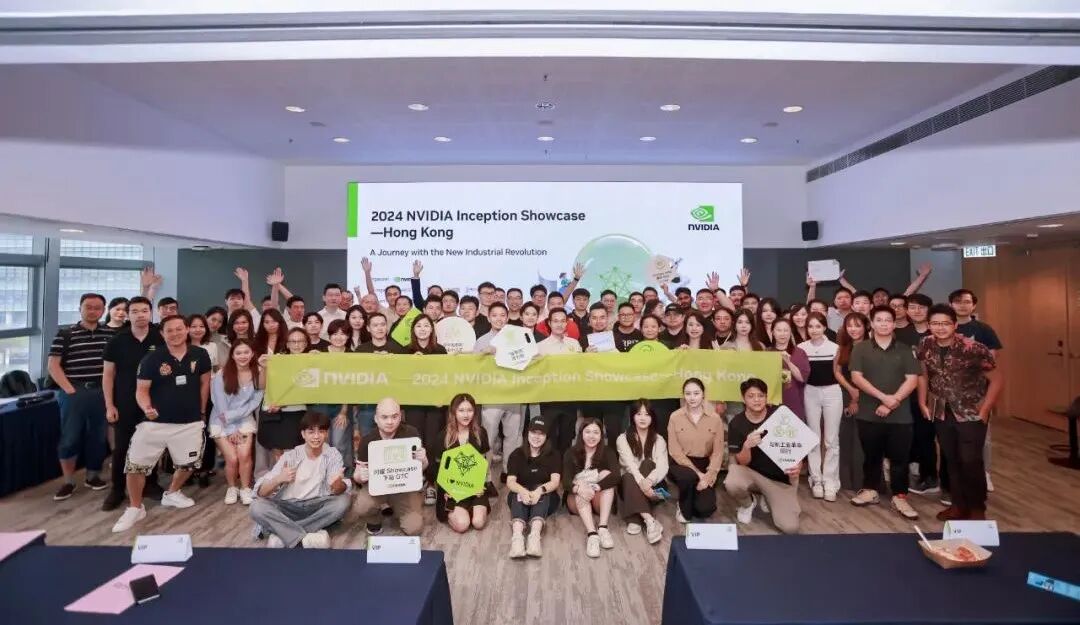
These questions were tackled at a recent roundtable during the 2024 NVIDIA Inception Showcase South China — Hong Kong session, held at Hong Kong Science Park and co-hosted by Gaorong Ventures. Speakers from NVIDIA, Gaorong Ventures, and Cornerstone Robotics shared their perspectives.
Helping Medical Companies Harness the Latest Generative AI Advances
Tianjing Zhang, Senior Developer Relations Manager, NVIDIA
NVIDIA is committed to advancing healthcare and life sciences. Tianjing Zhang, senior developer relations manager at NVIDIA, gave a systematic overview of the company's full-stack AI offerings in the field.

In recent years, NVIDIA has continuously upgraded the Clara suite of computing platforms, software, and services to deliver AI solutions across healthcare and life sciences — including BioNeMo for drug discovery, Holoscan for medical devices, Parabricks for genomics, and MONAI for medical imaging, among others.
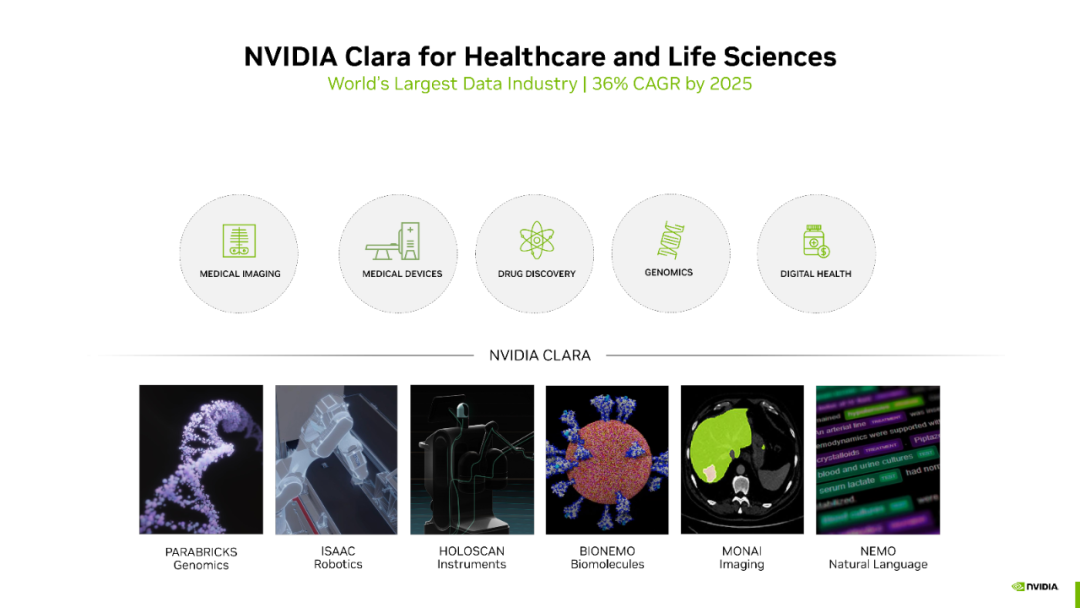
Zhang noted that healthcare and life sciences are becoming one of the most data-intensive industries, with a 36% compound annual growth rate in healthcare data between 2020 and 2025. NVIDIA aims to provide not just GPUs and accelerated computing, but also tools that help developers iterate quickly.
At this year's GTC conference, for example, NVIDIA introduced NIM — a set of optimized inference "microservices" designed to help enterprises deploy AI applications rapidly and securely. These microservices cover medical imaging, drug discovery, genomics, digital humans, and large language models, and are now available through the NVIDIA AI Enterprise 5.0 software platform. "We want to make it easy for healthcare companies to experience and run enterprise-grade generative AI models — whether testing NVIDIA's pretrained models, accessing APIs, or deploying via NIM — and seamlessly integrate AI capabilities into commercial applications."
Zhang then walked through NVIDIA's solutions for several key application areas. For medical devices, she pointed out that whether surgical robots, endoscopes, ultrasound systems, or diagnostic imaging equipment, every medical device will eventually become robot-like, capable of executing AI instructions in real time.
"NVIDIA aims to help medical device developers rapidly iterate through end-to-end hardware and software R&D to build the next generation of edge-computing, AI-powered medical devices." The sensor processing platform NVIDIA Holoscan, for instance, enables developers to perform real-time AI processing on front-end sensors with ultra-low latency and best-in-class edge AI performance.
In drug discovery, Zhang highlighted that computer-aided drug discovery is growing exponentially and still in its early stages. Data suggests generative AI could accelerate drug discovery by three years and save hundreds of millions of dollars. NVIDIA BioNeMo provides services for developing, customizing, and deploying foundation models for pharmaceutical R&D, offering more than ten generative AI models and cloud services to empower developers in small and large molecule design and protein structure optimization.
In genomics, as sequencing costs drop, data volumes will surge. "Our ability to sequence DNA has far outpaced our ability to interpret it." NVIDIA Parabricks is designed to optimize sequencing analysis workflows, helping genomics developers with sequence alignment, variant calling, and spatial transcriptomics research — while significantly improving accuracy, speed, and cost efficiency.
Finally, Zhang emphasized that digital healthcare represents another domain where generative AI could drive transformative change. "Healthcare information systems contain enormous amounts of data — prescriptions, dosages, medical records, and more." Generative AI could enable general-purpose and medical AI agents to generate clinical notes, support clinical decision-making, and develop virtual assistants. "Through multimodal AI, we can build smart hospitals where the entire hospital could eventually become an intelligent agent." NVIDIA is building a digital healthcare tool stack to help medical IT companies develop and deploy language models.
Using AI Tools to Solve Real Unmet Needs
Dr. Jiangtao Yu, Managing Director, Gaorong Ventures
Gaorong Ventures has deep roots in healthcare, having invested in numerous companies across drug discovery and biotech platforms, medical devices and diagnostics, and digital health and services over the years.
"Applying AI technology in product and service R&D has become a consensus — even a baseline requirement — for healthcare companies." Dr. Yu drew on portfolio company examples to illustrate how businesses are using AI to accelerate development across the board.

In traditional psychiatric drug development, the lack of understanding about how drugs affect the human brain often leads to high failure rates in clinical trials. Alto Neuroscience uses AI to predict patients' clinical responses to candidate therapies, upending psychiatric drug development and improving the odds of clinical success.
BioGeometry focuses on building a generative AI protein design platform for the bio-manufacturing sector. Its generative AI protein design model GeoFlow has achieved performance on par with AlphaFold3 in antigen-antibody complex structure prediction.
Shuimu BioSciences has built a cryo-EM platform to help pharmaceutical companies achieve targeted drug design, particularly for proteins like membrane proteins that are difficult to resolve using X-ray crystallography. The company's SMART software suite is the industry's only comprehensive tool platform covering the entire cryo-EM data computation process. Leveraging numerous AI deep learning algorithms, the SMART platform significantly improves the efficiency of cryo-EM data analysis, generating higher-resolution models with less machine time and data.
Westlake Valley Therapeutics is dedicated to applying AI to gene therapy development. In gene editing treatments, AAV vectors responsible for gene delivery are critical. The company uses AI models to more effectively screen and develop AAV mutants with specific organ targeting capabilities — a significant advance for developing more effective gene therapy strategies.
Dr. Yu also cautioned that from a healthcare perspective, AI remains a tool that accelerates processes; it may not be ready to solve everything just yet. Sufficient accumulation, including capital and time investment, is needed to strengthen AI infrastructure. "Moreover, we must approach this from the perspective of healthcare needs. Medical entrepreneurs need to ask — what critical health problems should we use technology to solve? What are the real unmet needs?"
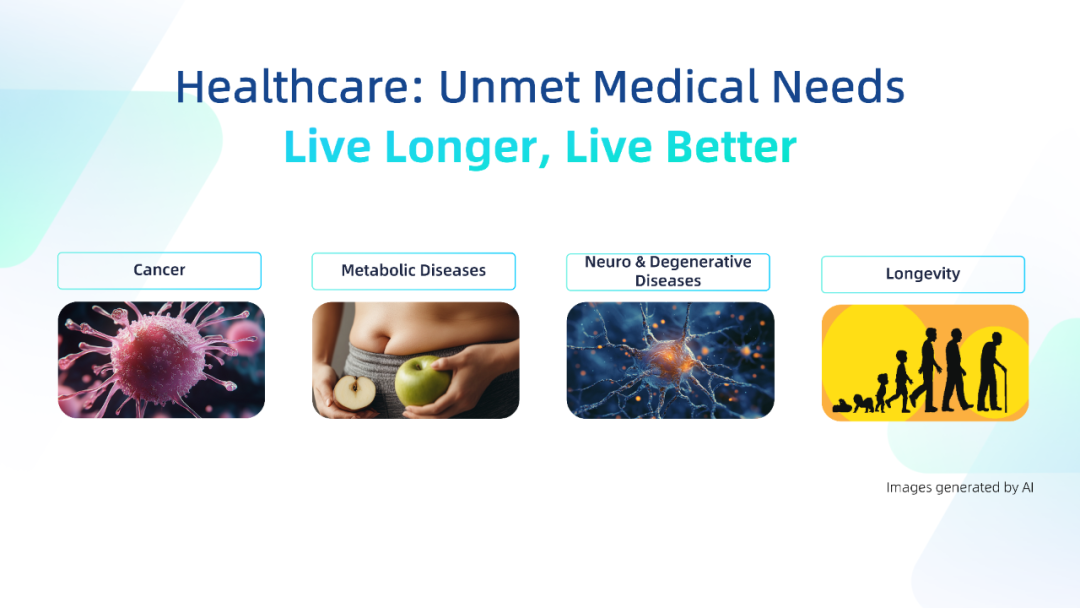
Dr. Yu identified several unmet needs worth attention today: oncology, metabolic diseases, neurological and degenerative diseases, and longevity — all ultimately in service of "live longer, live better."
As Chinese innovative healthcare companies begin expanding from domestic to global markets, Dr. Yu offered four recommendations for building global competitiveness: 1) develop a global perspective; 2) build differentiated competitiveness through innovative technology; 3) actively embrace AI; and 4) win with partners.
Generative AI in Surgical Robotics: Imagination and Challenges
Dr. Zerui Wang, Co-founder and CTO, Cornerstone Robotics
Founded in 2019, Cornerstone Robotics is dedicated to building safe and efficient surgical robot platforms. Its self-developed Sentire laparoscopic surgical robot has completed registered clinical enrollment surgeries and is poised for formal clinical deployment.

Dr. Wang began with a historical overview of human surgery. For centuries, surgeons performed open procedures, operating directly with their hands and observing lesions with their eyes — but large wounds meant slow patient recovery. In the late 1980s and early 1990s, laparoscopic surgery emerged, allowing access to deep and complex surgical sites with significantly faster recovery thanks to smaller incisions; the trade-off was increased learning difficulty and surgeon fatigue. Today, laparoscopy is commonplace and the gold standard for many procedures.
In 2000, the first generation of surgical robot systems received FDA approval, further revolutionizing surgical efficiency and outcomes. What advantages do surgical robots offer?
Dr. Wang explained that surgical robots enhance productivity across the board. First, they enable intuitive operation in confined surgical spaces with exceptional flexibility and precision. Second, they significantly reduce complex surgery duration. Third, they reduce surgeon fatigue and increase surgical volume — where a surgeon might average 1-2 laparoscopic procedures daily, robotic surgery allows 3-4. Additionally, they shorten the learning curve for minimally invasive surgery and extend surgeons' careers. "This is tremendously valuable because quality medical resources are often scarce."
How do surgical robots work? The master console encodes the surgeon's hand movements, which the robotic arms then decode to perform operations captured by the endoscope and fed back to the console. Cornerstone employs advanced algorithms to make its robots more user-friendly, fluid, and precise, creating an immersive surgical experience for physicians.
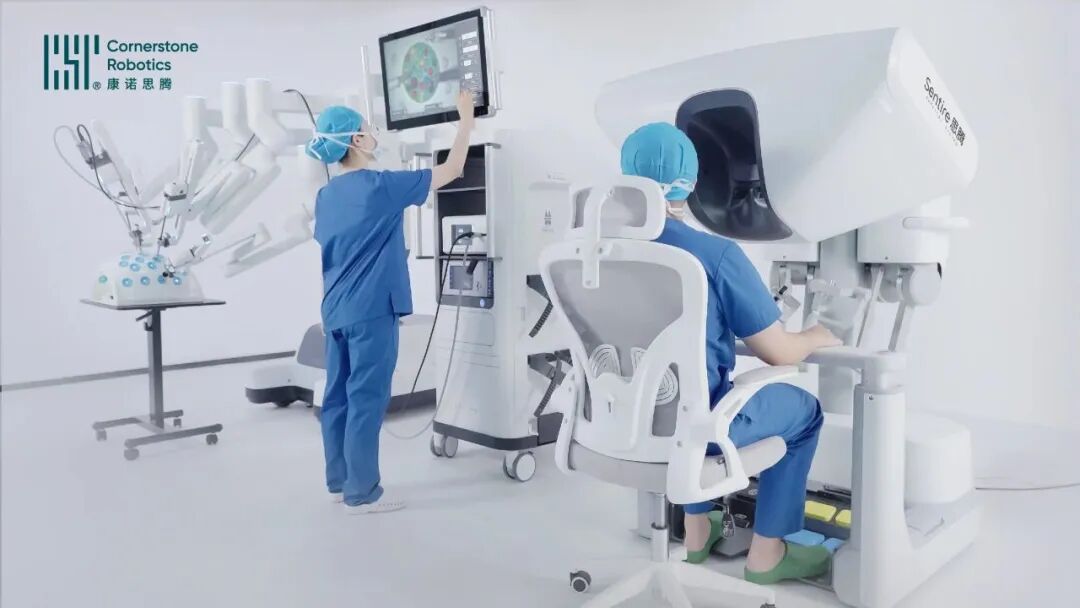
Dr. Wang cited 2022 statistics showing 8.6 million annual surgeries in the US, with 15% robot-assisted; China's annual surgical volume was 11.5 million, with less than 1% robotic. Global surgical robot penetration stands at 4%. Since its founding, Cornerstone Robotics has been committed to improving access to quality medical resources in China and globally, bringing more patients the benefits of high-quality healthcare through technological innovation.
Dr. Wang also discussed how generative AI might transform surgical robotics. "Ten years ago, when I was a PhD student, much of this existed only in science fiction; today, generative AI gives us hope of building a 'JARVIS' that assists surgeons in real time during operations."
In the near future, generative AI could assist with preoperative planning — analyzing optimal surgical pathways and procedural steps. During surgery, it could provide surgeons with more useful information such as real-time navigation, image enhancement, and risk prediction; it could also perform certain surgical operations such as automated organ retraction, cutting, and suturing. Postoperatively, it could help with analysis and continuous improvement — surgical phase segmentation, key anatomical structure indexing, action recognition and evaluation, and more.
Of course, surgical robots are medical devices, and product safety and effectiveness must be ensured through rigorous verification, validation, and regulatory approval processes. Thus, integrating generative AI into surgical robots will require time for experimentation and exploration, with particular attention to critical cost considerations as well as data and computing resource challenges. Cornerstone hopes to leverage the Greater Bay Area's supply chain advantages to improve surgical robot accessibility and continuously reduce costs.
There is no doubt that generative AI has permeated every corner of the healthcare industry, no longer merely "nice to have" but with the potential to expand humanity's exploration of the boundaries of life sciences. Pioneers at the intersection of medicine and AI will experience unprecedented acceleration — and will need to collaborate, address clinical needs, and tackle unknown challenges together.