How AI and High-Performance Computing Give Medical Innovation "Superpowers" | Ronghui X NVIDIA Inception Program

Transforming healthcare, revolutionizing people's lives.
NVIDIA's innovations in artificial intelligence and accelerated computing are reshaping multiple trillion-dollar industries, including healthcare — a field central to human destiny and well-being.
"AI is learning biology and chemistry, just as AI has already learned to understand images, sounds, and language." At this year's NVIDIA GTC conference, Jensen Huang shared how the company is collaborating with a broad ecosystem to advance medicine and drug discovery, saving lives and even helping to save our planet.
Today, NVIDIA provides cutting-edge tools to the world's leading medical institutions, accelerating fields from imaging analysis to scientific research and pharmaceutical development.
Recently, Gaorong Ventures partnered with the NVIDIA Inception program to host an online seminar on healthcare innovation, bringing together Gaorong's portfolio companies in medical innovation and NVIDIA Inception members for a discussion on how AI and high-performance computing are accelerating innovation in the healthcare industry.
Understanding NVIDIA's Healthcare Innovation Strategy

The Promise of AI-Accelerated Medical Innovation
Wenxiong Zhao, Director of Healthcare Sales, NVIDIA
Healthcare data accounts for 30% of global data volume, with a projected compound annual growth rate of 36% between 2020 and 2025. The industry still faces persistent challenges: uneven quality and efficiency of care, slow drug development timelines, and more. The combination of surging data volumes and massive unmet demand is driving AI adoption across healthcare and life sciences.
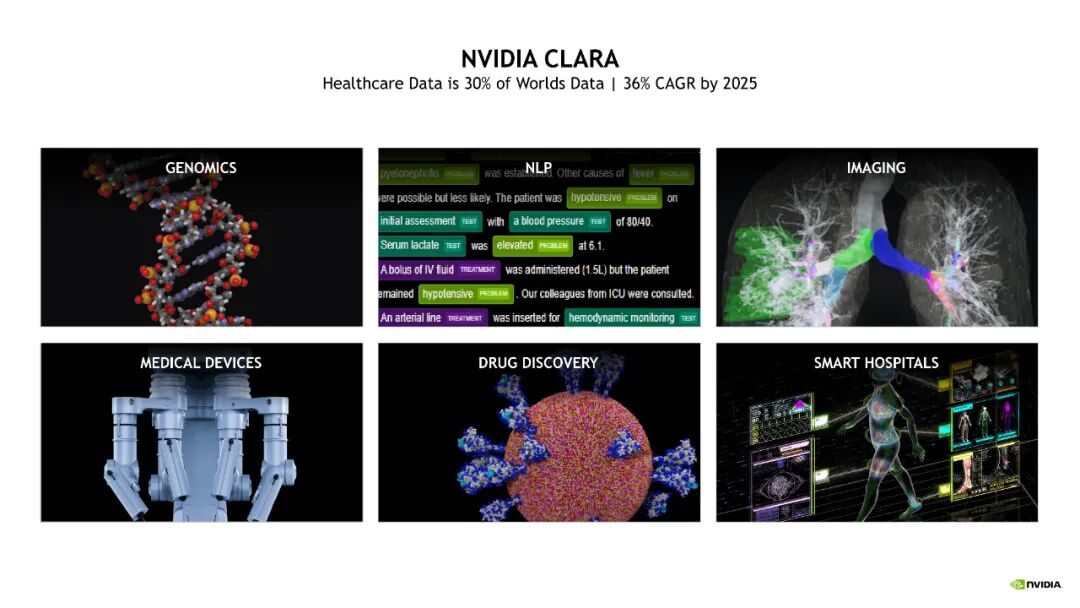
Looking at innovation trends in healthcare, we're seeing digital biology evolve into an information science. On one hand, as whole-genome sequencing costs have dropped below $1,000, the sequencing market has reached an inflection point, with applications spanning genome assembly, population sequencing, variant identification, and precision medicine. In drug development, from early-stage target discovery through compound screening, preclinical testing, and clinical trials, AI and data-driven approaches can help accelerate every step.
In medical devices, miniaturization, portability, and mobility are the dominant trends. Every medical device will become an edge AI endpoint. From a commercialization standpoint, the future won't be just about selling hardware — companies can adopt a SaaS-like model, delivering and monetizing through software on an ongoing basis. Notable sub-sectors include surgical robots, endoscopes, ultrasound systems, diagnostic imaging, radiotherapy equipment, and microscopes. With 16,000 medical device brands and over 2 million devices operating globally, this represents a vast market.
Since launching the NVIDIA Clara platform in 2018 specifically for healthcare scenarios, NVIDIA has established a comprehensive presence across the "model training → models → applications → AI edge computing platform" value chain.
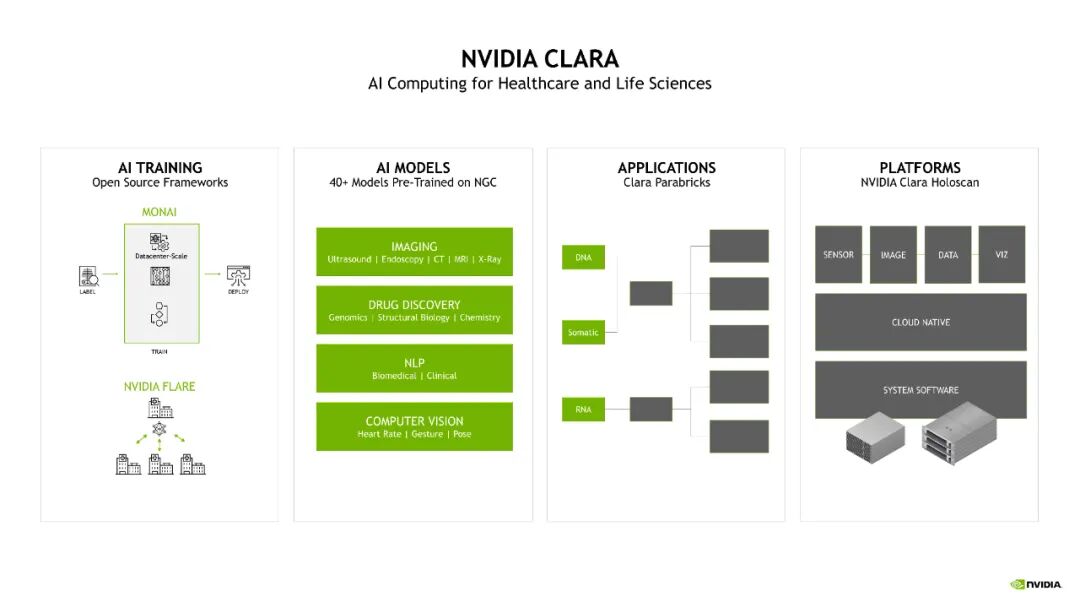
For AI training, NVIDIA has released MONAI, the world's most advanced open-source framework for medical AI, as well as NVIDIA Flare, which uses federated learning to address data privacy concerns in healthcare.
Additionally, NVIDIA has launched over 40 pre-trained models for the healthcare industry, spanning imaging, drug discovery, NLP, and computer vision — including BioMegatron and MegaMolBART, developed in collaboration with AstraZeneca. MegaMolBART is primarily used for reaction prediction, molecular optimization, and molecular generation, achieving high accuracy and specificity in molecular generation.
On the application front, NVIDIA introduced Clara Parabricks, a genomics analysis toolkit. Recently, in partnership with Stanford University, Oxford Nanopore Technologies, and others, NVIDIA published research on "UNAP," a third-generation gene sequencing AI workflow built on Clara Parabricks that can characterize pathogenic variants in just 7 hours and 18 minutes.
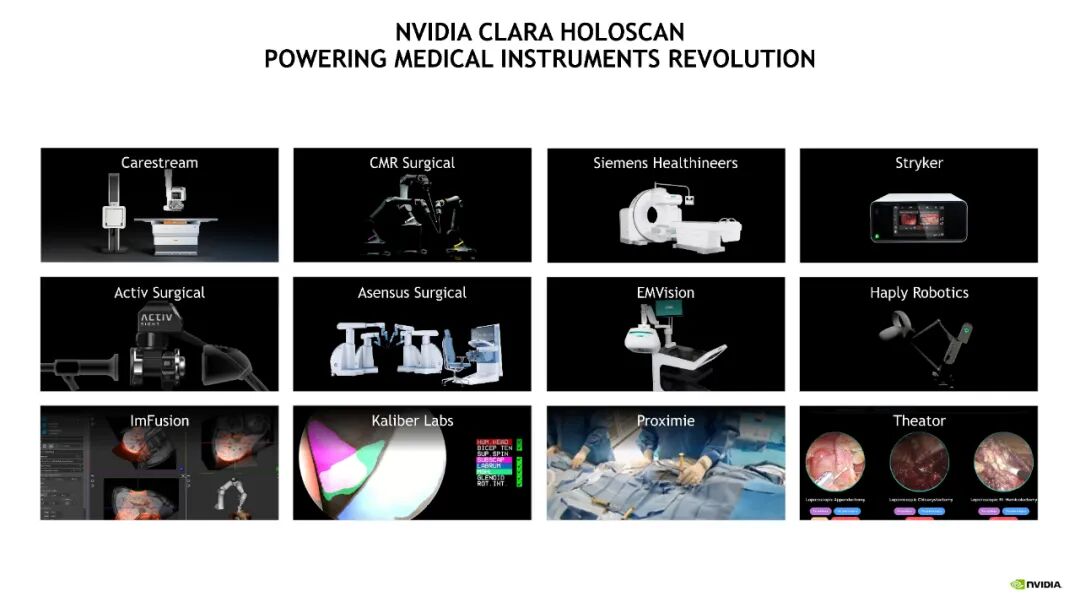
For medical devices, NVIDIA launched Clara Holoscan, an AI computing platform for medical devices comprising medical-grade software and hardware. Built on Orin — the same module that has achieved tremendous success in autonomous driving — Clara Holoscan enables real-time analysis for medical devices. In 2022, NVIDIA released Clara Holoscan MGX, a platform that allows the medical device industry to develop and deploy real-time AI applications at the edge, processing high-throughput data streams to deliver real-time insights, bringing the latest sensor innovations to edge computing while also enabling software-as-a-service business models for the industry.
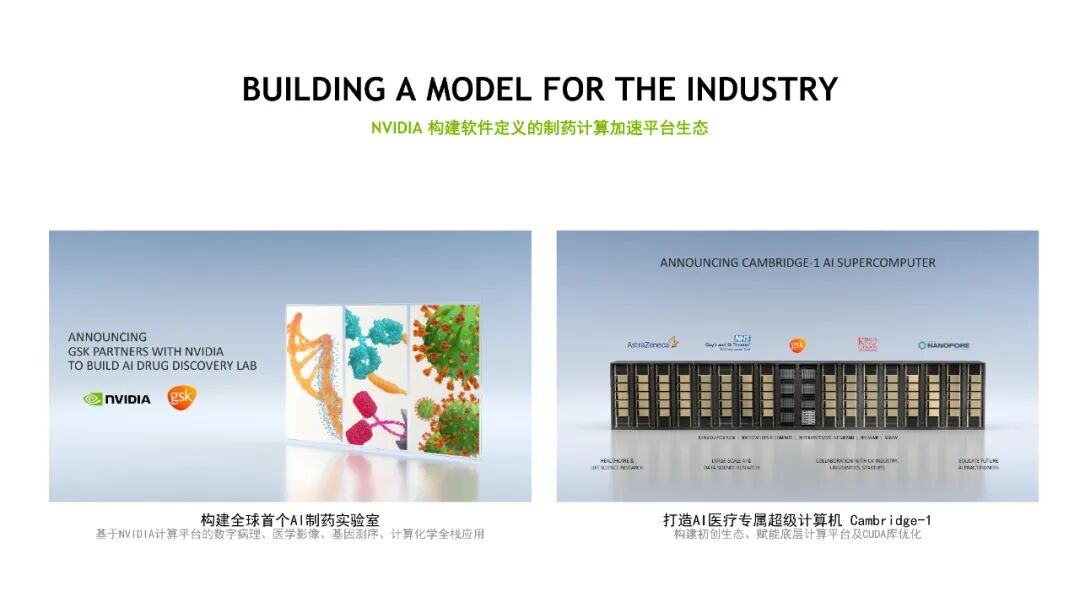
In July 2021, NVIDIA and partners launched Cambridge-1, the UK's most powerful supercomputer, equipped with 80 DGX A100 systems and representing decades of NVIDIA's work in accelerated computing, AI, and life sciences. Researchers and scientists can leverage it for drug discovery work. A similar trend is emerging domestically, with government-led initiatives to establish public drug discovery platforms, empowering local companies to use shared computing resources to accelerate pharmaceutical R&D.

NVIDIA Computing Platforms in Healthcare Startup Ecosystems: Applications and Insights
Tianjing Zhang, Senior Developer Relations Manager, NVIDIA
In medical devices and life sciences, a growing number of cutting-edge companies worldwide are already using NVIDIA computing platforms to accelerate their R&D.
Industrial-Scale Large-Scale Genomic Sequencing Analysis | UK Biobank The Regeneron Genetics Center partnered with UK Biobank to sequence and analyze exomes for all biobank participants using Clara Parabricks. Running Clara Parabricks on the DNAnexus platform helped reduce the time and cost of this genomic analysis — based on 8 V100 GPUs, whole-exome analysis that would take an hour on a 32-vCPU machine can be completed in 5 minutes, with approximately 40% cost reduction.
Using GNNs for Drug Molecular Feature Prediction | Absci Drug discovery company Absci relies on NVIDIA A100 GPUs to run optimized graph and transformer kernels, using them to accelerate neural networks. Absci's machine learning models can predict how various trastuzumab variants bind to their targets, while another model assesses developability — the likelihood that a drug candidate will succeed in testing and clinical development.
AI-Powered Surgery | Kaliber Labs In arthroscopic surgery, Kaliber Labs built AI models that parse endoscopic video, helping surgeons perform at a high level while reducing variability during procedures. Using Clara AGX improved model performance by over 5x and enabled real-time video parsing.
High-Throughput Digital Blood Cell Analysis | Scopio Lab Israeli medtech company Scopio Lab previously analyzed over 600 million peripheral blood smears manually under microscopes each year. Leveraging NVIDIA enterprise GPUs, the company developed large-scale object detection models that scan samples at the highest resolution, improving analysis efficiency by 60% and helping physicians rapidly diagnose diseases from blood samples.
As AI and high-performance computing deepen their penetration in the healthcare startup ecosystem, several new trends are emerging.
First, real-time analysis demand in the medical device industry is exploding. Notable applications include 4K 3D endoscopes, AI applications for surgical robotics, handheld ultrasound with system-level design capabilities, surgical microscopes, and domestic alternatives for angiography/radiotherapy equipment.
Second, AI attention in life sciences continues to grow. Notable areas of innovation include low-code AI drug discovery software for pharmaceutical companies, biotechs with combined wet-lab/dry-lab capabilities in HPC/AI plus strong pipelines, differentiated CROs/CDMOs, AI and lab automation applications in synthetic biology, and single-cell sequencing platforms.
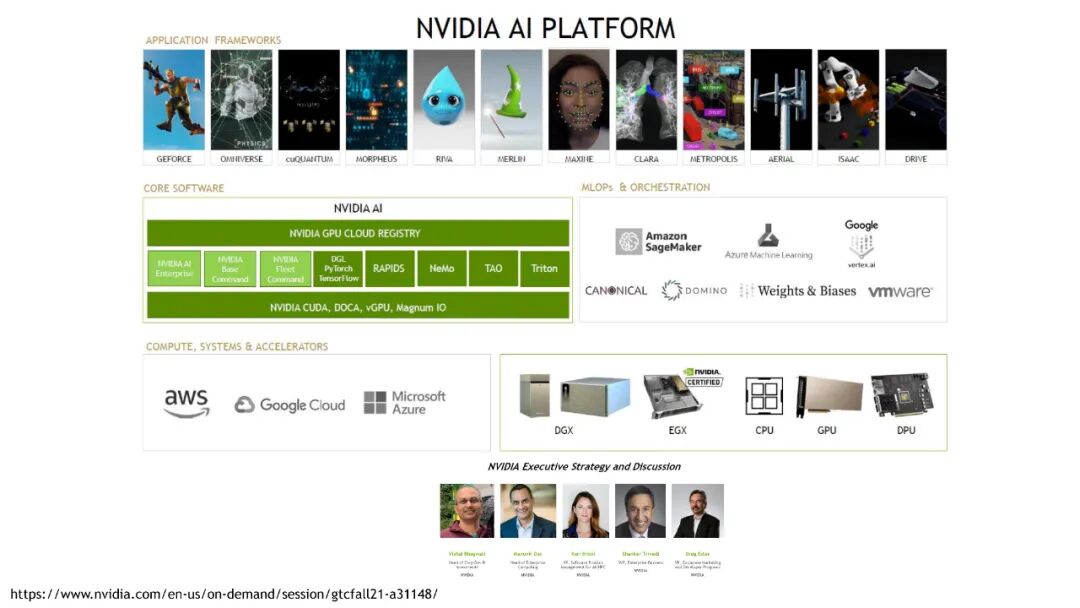
The essence of AI-enabled healthcare lies in applying mature technologies from natural language processing, computer vision, and other domains to the industry. Startups need to deepen their technical understanding and hands-on experience with TensorRT, Triton, Jetson, CUDA, and related technologies. What makes a startup truly stand out is typically deep domain expertise in healthcare — the deep learning stack can be built with sufficient capital and time.
Additionally, healthcare developer communities are emerging. Medical imaging already has several well-known developer communities, and open-source community culture is gradually taking shape in the pharmaceutical industry.
Looking back at NVIDIA's history offers several lessons for startups.
First, deeply understand your business model. NVIDIA has consistently pursued a strategy of using software to define computing platforms in industry AI, continuously expanding sector boundaries. Second, know your capabilities and limits. In the AI era, NVIDIA chose to empower industries rather than compete directly. For example, in healthcare, the company adopted a strategy of not pursuing regulatory certifications itself, instead focusing on industry SDKs and computing platforms — forming genuine complementary relationships with healthcare startups. Finally, stay true to your original mission. This is why NVIDIA created the Inception program: respecting entrepreneurs and growing alongside them.
The Path to Commercialization

Three Critical Keys to Breaking Through in AI+Healthcare Commercialization
Kun Yang, Partner, Gaorong Ventures
Since 2018, Gaorong has actively built its presence in specialized healthcare sectors and has become one of the significant players in China's healthcare investment landscape. We are strongly optimistic about the convergence of healthcare with frontier technologies. Multiple Gaorong portfolio companies are already leveraging AI, accelerated computing, and other technologies to tackle critical challenges in healthcare, with applications spanning new drug R&D, medical imaging, gene testing and editing, health management, healthcare IT, and proteomics. Looking ahead across the industry chain and clinical applications, AI will find its way into even more healthcare scenarios.
The future integration of AI and healthcare has the potential to permeate every angle of the industry chain. Today, domestic imaging AI products have been among the first to receive NMPA Class III certification and begin commercialization. AI-driven drug discovery is also flourishing, continuously rewriting the drug discovery and development process.
Yet when new technologies embark on commercialization, their real challenges are just beginning. How can AI+healthcare achieve commercialization breakthrough? We see three critical keys.
Key 1: Data Data for AI healthcare commercialization faces issues of legality, standardization, and sustainability. On legality, government-driven interoperability of healthcare data and data sharing between commercial entities and medical institutions are needed, with data security guaranteed. On sustainability, beyond manual collection, intelligent data interfaces can be established — with compliance always front and center. On standardization, industry standards and clinical protocols must be followed, collection interfaces expanded, and sample processing conducted effectively.
Key 2: Team and Business Model Critical questions to consider: Which industry segment to focus on? Whether new drug development, clinical trials, production processes, or medical services — the positioning determines team composition and direction. Product company or service company? A product company will ultimately be valued on its products; a service company must continuously deliver innovation. What kind of team is needed? This includes how to enable effective dialogue between AI and healthcare teams, and strategic resource allocation within the company.
Key 3: Payment From a product positioning standpoint: consumer product or medical product? On the payment side: will reimbursement come through public health insurance, commercial insurance, or out-of-pocket? Clinically, differentiated competitive advantages must be refined. If charging fees, what is the clinical evidence? Can you make the health economics case that AI approaches are more cost-effective and more efficient than traditional methods?
Today we are pleased to see that the AI+healthcare ecosystem has taken initial shape. Going forward, all participants need to build out this industrial ecosystem together, jointly addressing unmet clinical and industry needs.
Panel: How Healthcare Innovators Are Using AI and Computing to Accelerate R&D

Unknown: Accelerating Microbial Drug Discovery
Shuangwei Hu, Senior Director of AI, Unknown
Unknown is dedicated to AI-driven gut microbiome drug development, and is currently the only company in the industry to have achieved R&D across all four microbial drug modalities: FMT (fecal microbiota transplantation), formulated bacteria, genetically engineered microbes, and bacteria-derived molecules. Behind these four modalities lies a unified logic: learning from the billions of years of microbial evolution.
Unknown combines artificial intelligence with gut microbiome technology to enable high-quality data analysis, accumulation, and output, improving the efficiency and success rate of drug development.
In microbial analysis, the focus is on relationships between microbes and between microbes and metabolites, and ultimately their relationship to disease. Faced with high dimensionality and interactions that are difficult to compute uniformly, Unknown developed pre-trained language models to describe the complex, high-order associations between microbes in microbial communities. Currently, these show meaningful improvements over traditional machine learning on downstream tasks. The pre-trained models also offer strong transfer value, with this underlying data infrastructure shareable across different diseases, helping advance multiple formulated bacteria pipelines in parallel.
At a finer granularity than individual microbes, we also understand microorganisms from a protein perspective. In typical metagenomic analysis, protein function annotation is the rate-limiting step, requiring optimization of computational speed; simultaneously, remote homology modeling is lacking. Unknown has reduced average single-sample metagenomic analysis processing time from 48 hours at the beginning of last year to 9–12 hours, with strengthened concurrency capabilities, achieving overall costs 5–10x lower than industry averages. On this foundation, we are experimenting with combining protein sequence pre-trained language models and graph neural networks to simultaneously improve both the speed and capability of functional annotation. For speed, instead of searching large reference databases for similarity, we use model prediction computation. For capability, deep learning models demonstrate strong generalization, helping expand remote homology search capability and improve the comprehensiveness of metagenomic analysis.

Qitan Technology: Accelerating the Rapid Development of Nanopore Gene Sequencing
Yuan Zhuo, Director of Algorithm R&D, Qitan Technology
Qitan is the first high-tech enterprise in China to independently develop nanopore gene sequencers, successfully creating proof-of-concept prototypes, engineering prototypes, product prototypes, and commercial products. In 2021, it launched China's first mass-produced nanopore gene sequencer, QNome-3841, which is now on the market and being delivered to customers. Nanopore gene sequencing is the latest generation of commercialized gene sequencing technology, with a particularly strong connection to AI that requires deep coupling between chip and AI technologies.
Nanopores operate at a microscopic scale, involving extensive data analysis, data mining, and theoretical model solving. Because it is a multi-disciplinary integration, algorithms represent the final stage — any change in one stage affects the final result, requiring continuous validation and analysis as the system evolves. This demands powerful AI technology and computing capabilities as foundational support.
In actual algorithm work, we developed more suitable backbone networks and decoders specifically for nanopore signals, and have done considerable work on lightweighting. Currently, models under 10MB can achieve over 95% sequencing accuracy.

MemVerge: Big Memory Software Empowering the Healthcare Industry
Ming Chen, Head of China Business, MemVerge
MemVerge focuses on big memory computing, developing the industry's first and currently only big memory software. Big memory computing combines persistent memory hardware with big memory software technology, characterized by more abundant memory capacity, persistence, and high availability — enabling all applications to run in memory.
The healthcare industry (including single-cell sequencing, single-cell gene analysis, genome assembly, new drug R&D, and more) has strong demands for memory resource capacity, memory data access performance, persistence, and high reliability. Beyond high-performance computing platforms like NVIDIA's, the industry is also highly sensitive to memory.
MemVerge's first successful deployment in China was in single-cell sequencing data analysis, providing fused and persistent memory resources for single-host or multi-host configurations to eliminate disk I/O. Going forward, MemVerge hopes to deliver the revolutionary technology and value of infrastructure through healthcare industry partners, ultimately reaching end users.
NVIDIA Inception Program
The NVIDIA Inception Program is a global ecosystem initiative by NVIDIA to accelerate startup development. The program cultivates cutting-edge innovative enterprises, bringing revolutionary changes to various industries. It brings together renowned venture capital firms, startup incubators, accelerators, industry partners, and tech startup media to build an innovation and entrepreneurship acceleration ecosystem. Members receive product discounts, marketing support, technical support, financing platforms, customer referrals, and other services to help companies grow rapidly.
Scroll down to view more