The "Whole-Team Lobsterization" Playbook at an AI Startup: 30 People × 70x Efficiency Leverage | Gaorong Future

"Tokens as Combat Power"
Today's AI companies, while pushing the boundaries of intelligence and exploring new product forms, are also running AI-driven organizational experiments — with some even making "token consumption" a core metric for employees.
Mindverse (心洲科技) is one such young AI company. Its products include Macaron AI and the research lab Mind Lab. Its roughly 30 employees hail from DeepSeek, OpenAI, ByteDance, MIT, Tsinghua's Yao Class, Duke University, and other top institutions. To date, the team has published over 100 papers at leading AI conferences.
While the industry is still chasing more powerful general-purpose models, Mindverse is exploring the possibility of "one model for every person" — using LoRA to give everyone their own large model, aiming to better achieve Personal Intelligence. The company has built a trillion-parameter LoRA reinforcement learning system. Globally, only two teams can simultaneously run hundreds of trillion-parameter reinforcement learning instances via LoRA technology: Mindverse and Thinking Machines Lab, founded by OpenAI's former CTO.
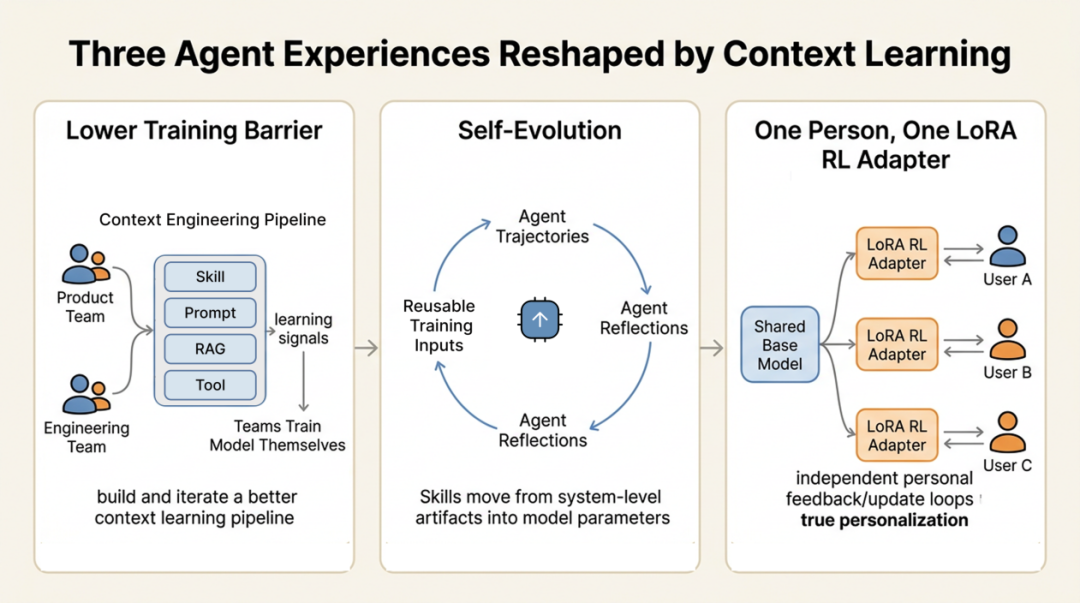
Additionally, Mindverse focuses on developing consumer apps for overseas users, covering over 5 million users. This includes Macaron AI, a Personal Agent product for individual life scenarios.

Recently, Mindverse has packaged a series of services on top of OpenClaw, including MindClaw, a personalized long-term memory solution now live on its official website and open-sourced (https://mindclaw-preview.macaron.im/).
Mindverse founder Andrew Chen shared with us the team's thinking on OpenClaw applications in building MindClaw, along with fascinating organizational practices like "full-team lobsterization" and "100% AI coding" — and how AI leverage has enabled "epic-level" organizational efficiency upgrades.
Andrew holds a bachelor's degree in Electrical Engineering and Computer Science from MIT and serves as R&D Center Director at Shenzhen Tsinghua University Research Institute. Here is his account:

Token Consumption Defines a "New Class"
The World Has Undergone a Fundamental Shift
-
This year, AI entrepreneurs share an intense feeling: from January to now, the world has changed dramatically. We're more excited than ever — more excited than our first day starting up at Shenzhen Bay Eco-Park. Of course there's anxiety too, because falling behind by even a week can mean getting left behind entirely.
-
After the Lunar New Year, whether it was the president of a consumer app with hundreds of millions of DAU or the CEO of a top AI hardware company, at least 20 CEOs told me: they're coding until 3 a.m. every day. Everyone's thrilled — what used to take a team two weeks can now be done by letting Codex run overnight. The world has undergone a fundamental shift. Human leverage has undergone a fundamental shift.
-
Today is the best time to be an AI entrepreneur because the market is enormous. Elon Musk recently unveiled the TERAFAB superchip factory project — projected to produce over 1 terawatt (1TW) of compute annually, equivalent to 50+ times current global AI chip production. In a market that's barely getting started, we've already seen trillion-dollar startups like OpenAI and Anthropic emerge. So we're all fellow travelers, exploring different futures together. Real competition remains remarkably thin so far.
-
As the industry embraces the OpenClaw ecosystem, everyone can build products within it and benefit. In a sense, OpenClaw has built the Android of the AI era. How to create this era's MacBook, or phones from Huawei, Xiaomi, and Samsung — that's the opportunity for each of us.
-
A strong industry signal recently: OpenAI, Anthropic's Claude Code team, Cursor, and even Stripe — a financial infrastructure company where stability matters most — are all fully transitioning to 100% Coding Agents.
Actually, before Q1 this year, including our own company, there was much debate about whether to migrate to 100% Coding Agents. Previously, there were excuses for not using AI coding — concerns about whether Agents could produce high-quality, production-grade code, about stability and maintainability. But today, none of those concerns remain valid.
- The reality of global AI usage may differ from what people assume. Of the world's 7 billion people, only 20% — about 1.5 billion — have used AI. You can map this as a pyramid based on user payment and token consumption:
Among 1.5 billion AI users, only about 20 million have paid for AI, at the subscription threshold of $10/month. Above them, roughly 2 million are Coding Agent users paying $200/month. At the very top, about 5,000 people globally consume over 1 billion (1B+) tokens daily.

- During the Industrial Revolution, steam engines and electricity upended social productivity, and machine usage divided society into bourgeoisie and working class. In the AI era, token consumption is defining a "new class." The productivity gap between those consuming 1B+ tokens daily and everyone else is astronomical.
Everyone is consuming and producing intelligence at different frequencies, speeds, and volumes. What determines the gap between people in the future may no longer be which company you work for or whether you own property, but rather where you stand in this pyramid of the AI world.

Organizational Transformation Based on OpenClaw
30 People × 70x AI Leverage
- Transformation one: Full-team lobsterization. We've packaged Coding Agent capabilities for every team member, initially "mandating" at least 20 minutes of daily OpenClaw or Coding Agent use. The result: every core team member has become a 100% believer in Coding Agents, with efficiency gains that can only be described as epic. Our growth team has just 3 people but manages 20+ "lobsters" — each distribution channel has its own dedicated Agent, tracking data 24/7, reviewing performance, and continuously iterating growth strategies.
Previously, some team members didn't use AI coding because they couldn't code. But OpenClaw packages AI coding and Agent capabilities in a chat interface for non-coders. Today, there's no excuse for not using lobsters — laziness is the only one.
-
Transformation two: 100% AI Coding. When even Stripe, a financial services company, has gone 100% AI coding, "do we need stability more than they do?" We might have complained about AI before because model capabilities were genuinely insufficient. But from now on, if something's not working, it's because we haven't used AI well enough.
-
Transformation three: Full context digitization. Agents can only complete complex tasks when given sufficient context. Recently, we've moved all company meetings and documents online, leaving traces of all communication, decisions, and data to accumulate context.
-
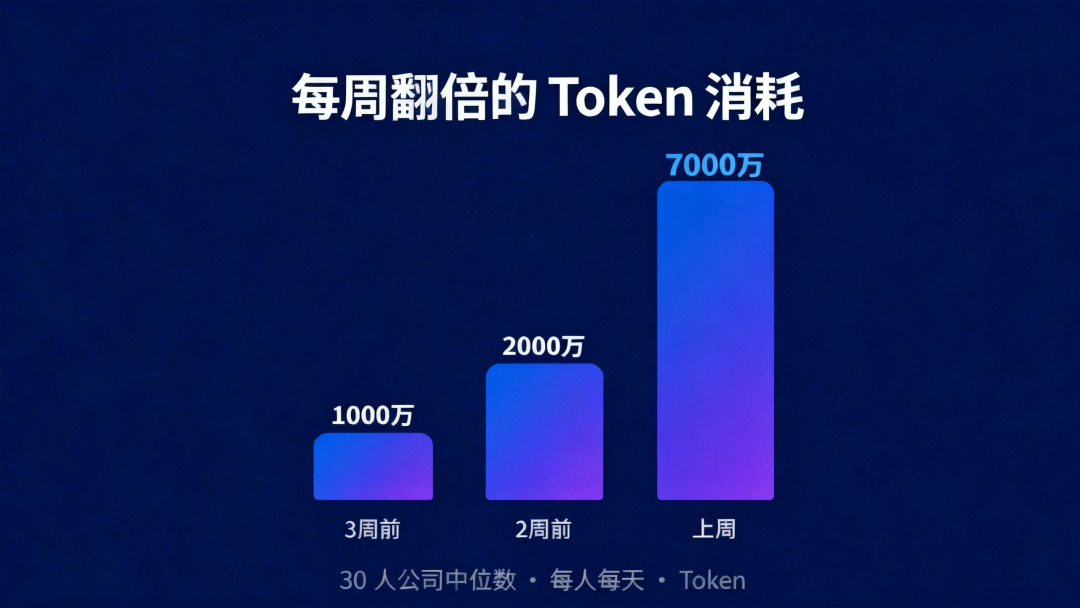
"Tokens are combat power." Over the past few weeks, per-person daily token consumption has doubled weekly — median was 10 million three weeks ago, 20 million two weeks ago, and hit 70 million in the final week of March.
What does 70 million tokens mean? Human reading, writing, and thinking runs at roughly 1,000 tokens per minute. At 1 million tokens per day, consuming 70 million tokens equals 70x human capacity. So perhaps we're not a 30-person company, but 30 people × 70x AI leverage — equivalent to 2,100 people in output.
-
We maintain an internal employee token consumption leaderboard. The top 5% already hit 1B+ tokens daily. I often observe their working state — it's another world entirely. Much of the time they code without touching the keyboard, using voice input, with Agents reporting back by voice too, because multiple Agents are working simultaneously.
-
Different team roles have begun their own AI practices: Product teams no longer deliver Figma files but directly deliver clickable demos. The growth team is fully lobsterized, with one dedicated Agent per channel. HR uses AI to auto-post jobs, receiving an average of 30+ quality resumes weekly.

After OpenClaw, What Else Can Be Done?
Macaron & MindClaw
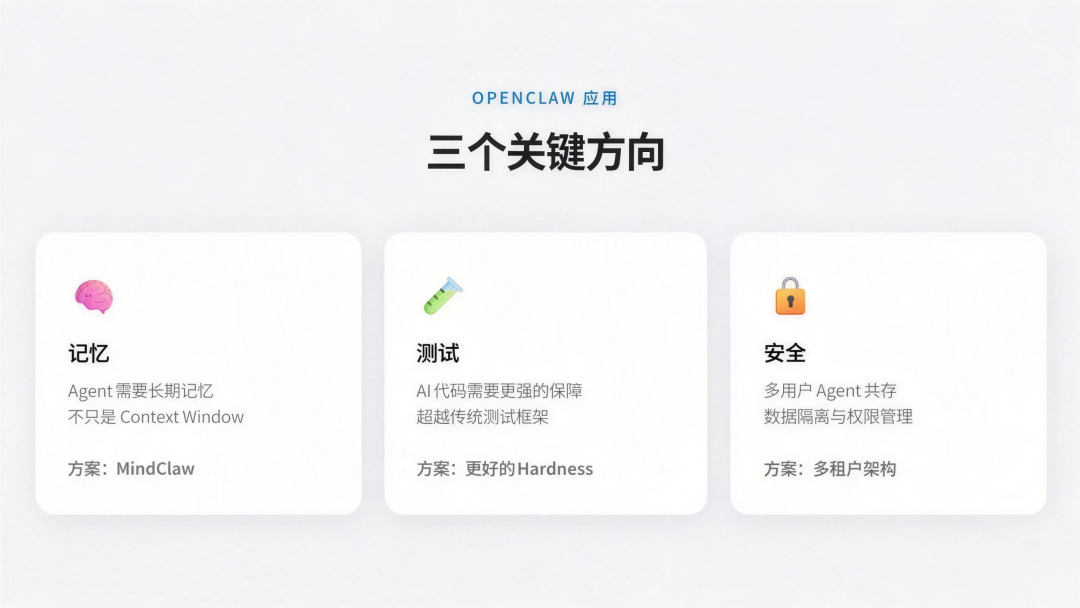
- Currently, there are three consensus key directions for building on OpenClaw: memory, testing, and security. Among these, Agents' long-term memory capability is the core bottleneck constraining their ability to execute truly complex tasks. OpenClaw's current File System has two limitations: first, it provides insufficient constraint on Agents — it looks like a large file system, but what actually matters are still the conditions in the Context Window; second, File System has a major drawback — it works well initially, but as file counts grow, hit rates decline, making it increasingly difficult to use over time.
Previous internet products, whether Douyin, Meituan, or WeChat, all got better with use. But OpenClaw may get harder to use, so new memory solutions are needed.
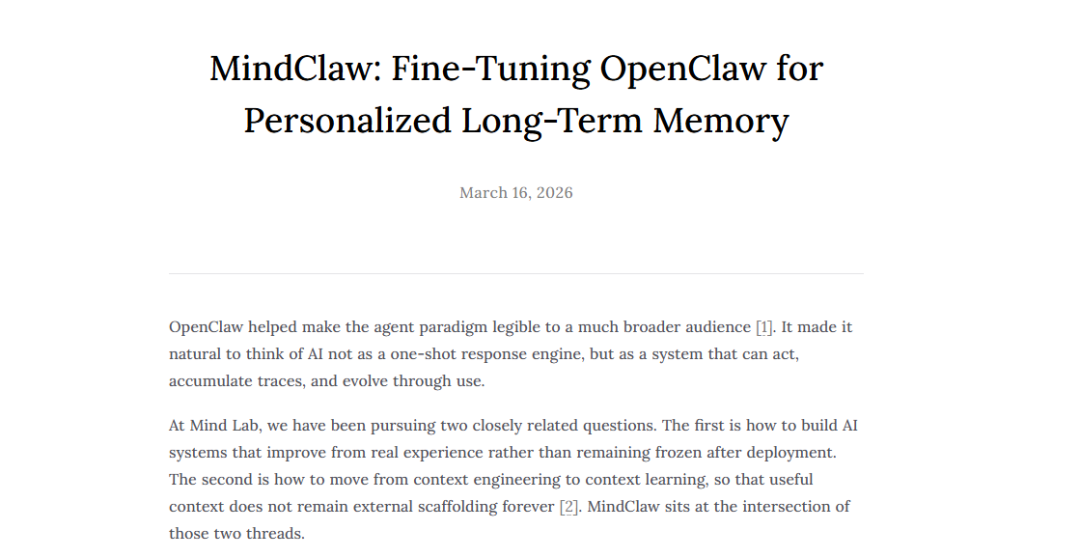
- MindClaw offers a long-term memory solution where "parametric memory" coexists with File System. Simply put, it trains a dedicated LoRA for each user's OpenClaw, continuously updating it through conversation to "gradually compress user preferences into model parameters," allowing the model to evolve and become increasingly personalized.
Compared to traditional Context Engineering, which aims to "help the model perform better in this conversation" and relies on retrieval with accumulating noise, MindClaw adopts Context Learning, using LoRA reinforcement learning to truly make the model better.
-
When code is 100% AI-written, testing standards must upgrade — better hardness is needed. Tools like Claude Code have constrained and checked code capabilities. For OpenClaw, how can AI code have stronger guarantees? How to do testing well, checking code node by node, enabling Agents to run stably for extended periods — these are areas where OpenClaw needs improvement.
-
Security is an urgent issue for OpenClaw to enter production-grade scenarios. Currently, Macaron products also provide multi-tenant architecture based on OpenClaw, with a series of security tasks: first, data isolation — strictly isolating each tenant's conversations, memory, and model parameters; second, permission management, including fine-grained access control and clear Agent behavior boundaries; third, resource scheduling for fair compute allocation, preventing single tenants from affecting overall service. Only by solving these security issues can OpenClaw truly evolve from a personal tool into a production-grade system capable of long-term stable operation.