As Google-backed AI drug discovery raises $5 billion, how will Anew Labs write China's AI pharma story?

A dual-engine approach powered by frontier models and an innovation pipeline.
On November 17, Isomorphic Labs, an AI drug discovery company founded by Nobel laureate and Google DeepMind co-founder Demis Hassabis, announced the completion of a $5 billion Series C round — a new record for a single funding round in the global AI pharma sector.
In China, Anew Labs, which started around the same time as Isomorphic and was spun out of ByteDance, also recently closed its first funding round of 2 billion RMB. It's the largest round in China's AI pharma sector this year, with Gaorong Ventures participating.

These two AI pharma companies, on opposite sides of the Pacific, are accelerating into the next phase of AI-driven drug discovery. Interestingly, from their origins inside tech giants to their parallel pursuit of both models and drug development, the two companies' paths share a series of notable similarities.
As early as September this year, the well-known overseas biopharma outlet Endpoints News had already compared Anew with Isomorphic. Its report called Anew a Chinese competitor in AI biomedicine and awarded it the annual "Endpoints 11" honor.
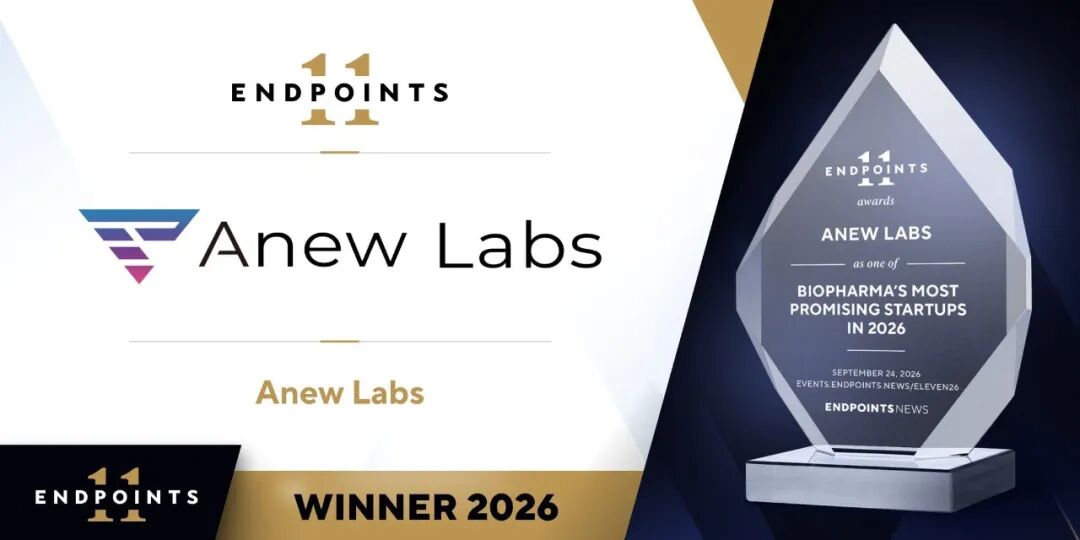
The report focused on two areas of progress: on the AI side, Anew published multiple research results and open-sourced models including protein structure prediction and molecule generation; on the drug development side, Anew has disclosed progress on multiple pipelines.
Anew Labs — "new life" by name — is charting an innovation path driven by both frontier models and original pipelines, writing a Chinese story in AI drug discovery.

From big-tech incubation to a fresh start
In 2021, the breakthroughs brought by AlphaFold were reshaping the scientific community's sense of what AI could do. Whether AI could move beyond predicting protein structures to actually designing drugs became a new frontier. That year, Demis Hassabis announced the founding of Isomorphic Labs. The Alphabet-owned company's goal was to rethink drug discovery with an AI-first approach.
That same year, Kai Liu founded an AI drug discovery division inside ByteDance — the predecessor of Anew Labs.
One came from the Google DeepMind ecosystem, the other from ByteDance. The two teams spotted the opportunity to apply AI to drug R&D almost simultaneously and began channeling the algorithms, engineering capabilities, and compute resources accumulated at tech companies into the field.
This starting point laid the foundation for long-term R&D: the ability to keep investing in underlying models, and the conditions to build teams spanning both AI and drug development, letting model research and real projects advance together.
In their subsequent development, the two companies made a similar choice: doing drug development themselves.
Doing drug development in-house from day one
From the outset, Anew made proprietary drug pipelines a core focus while also pursuing R&D partnerships with pharma companies.
Isomorphic likewise has been developing its own drug design engine and advancing both internal and partnered pipelines.
This route requires companies to possess two capabilities at once: continuously developing frontier AI models, and being able to choose research directions, design experiments, optimize molecules, and push drug projects forward.
Technology thus becomes tightly coupled with real R&D tasks. Problems in projects determine which directions models need to break through; experimental results test whether predictions are accurate; and newly generated data and experience feed into the next round of R&D.
Ultimately, model capabilities must translate into concrete drug results. Anew's disclosed progress is playing out on both levels at once.
Frontier AI models
In February 2026, Isomorphic released the IsoDDE technical report, highlighting three capabilities — structure prediction, binding pocket discovery, and affinity prediction — pushing AI further from understanding molecular structures toward drug design.
In September of the same year, Anew released its AnewDDE (Drug Discovery Engine) technical report. On the FoldBench benchmark, where both companies disclosed results, AnewFold's success rates on both protein–small molecule and antibody–antigen structure prediction tasks exceeded those of IsoDDE.
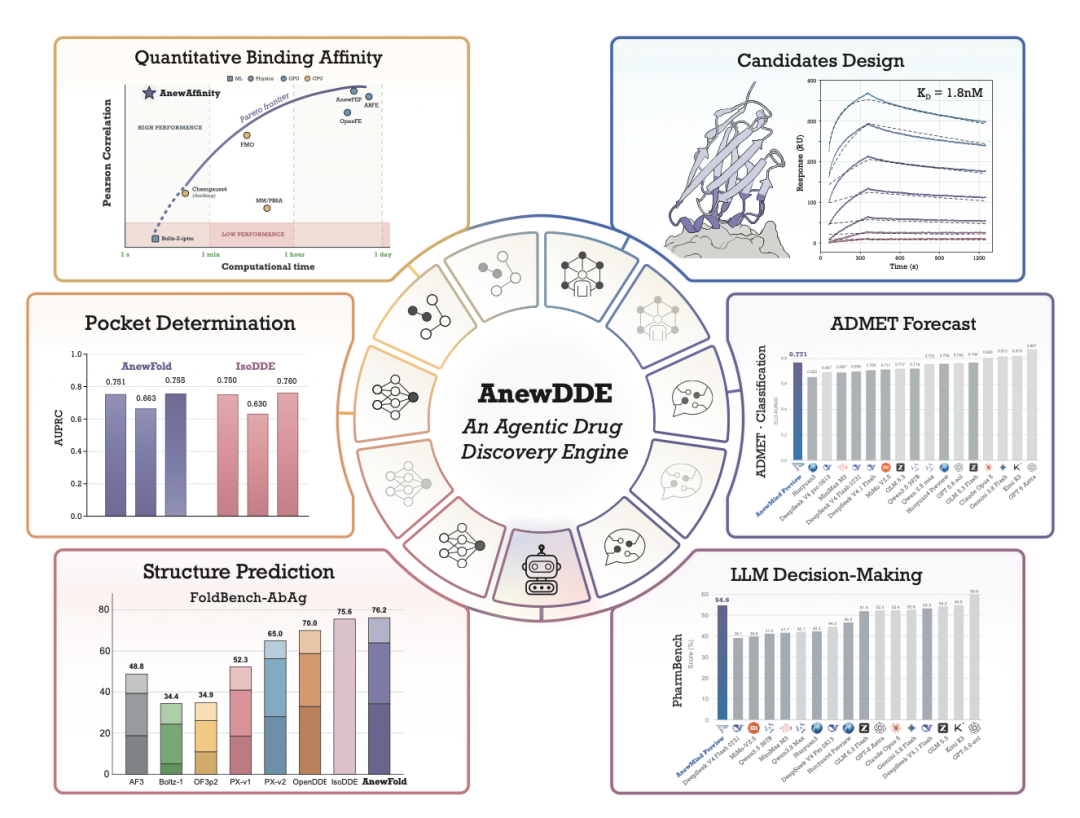
Anew's evaluation didn't stop at structure prediction. The report also showed its performance on tasks including molecular glue ternary complex prediction and cryptic pocket identification. AnewDDE further extends from prediction to generative design and R&D decision-making. Beyond structure, pocket, and affinity prediction, the report also demonstrated antibody generation and optimization, prediction of various drug properties, and the ability to incorporate wet-lab feedback into the next round of design.
At the same time, Anew also developed AnewMind, a large language model for drug R&D.
The team performed full-parameter post-training in the pharma domain at the hundred-billion-parameter scale, enabling the model to handle tasks such as drug property prediction, candidate molecule ranking, and multi-stage R&D reasoning. The accompanying PharmBench was designed by drug R&D experts around real cases, evaluating the model's ability to integrate evidence and make R&D judgments by progressively providing project background and experimental information.
Much of drug R&D involves judgments like these: what does an anomalous experimental result mean, how to trade off activity against other drug properties, which molecules are most worth synthesizing next, and which hypothesis should be validated first.
AnewMind attempts to handle precisely these questions that require combining knowledge, experiments, and project context.
Anew has thus built two complementary capabilities: AI models at the molecular level to understand and design molecules; and a scientific reasoning LLM that connects model outputs, experimental results, and R&D knowledge to participate in the next round of design and decision-making.
An innovative pipeline
Beyond models, Anew has also delivered a pipeline result that is a global first.
In April 2026, the Anew team gave an oral presentation at the American Association of Immunologists (AAI) annual meeting, disclosing an oral small molecule capable of potently inhibiting all three dimers — IL-17AA, IL-17AF, and IL-17FF — with potential to become an innovative therapy for psoriasis and other autoimmune diseases. The related research abstract was subsequently published in a conference supplement of the Journal of Immunology.
The challenge in this direction lies in using a single small molecule to simultaneously inhibit three protein dimers, especially achieving effective inhibition of IL-17FF. Previous small-molecule efforts focused mainly on IL-17A, and potent inhibition of IL-17FF had remained an unsolved key problem.
According to public information, Anew's small molecule is the world's first oral small-molecule inhibitor to achieve this complete coverage. The team disclosed not only activity data against all three dimers but also oral exposure and in vivo efficacy results.
This preclinical-stage pipeline provides direct experimental validation of Anew's technology: starting from AI-generated molecular scaffolds, and through design and experimental optimization, the team achieved a molecular capability that had not previously been possible.
This also extends the comparison between Anew and Isomorphic from similar backgrounds and paths to model performance and original drug results. For Anew, this is exactly the value it hopes to prove — using AI to create drugs that were previously difficult to achieve.

The Chinese AI pharma story: starting from the lab
For AI for Science, experiments play a dual role: they validate model predictions and provide data for the next round of model improvement. Whether a molecule can be synthesized, whether it has the expected activity, whether its properties meet requirements — all of these need to be answered through experiments. The speed and quality of experimental feedback directly affect the efficiency of model evaluation and iteration.
China has a complete and efficient CRO industry chain, as well as experimental capabilities spanning from molecule synthesis to biological testing. This means designs proposed by models can enter experiments faster, and experimental results can return to models and R&D teams faster.
As competition shifts from single-point prediction to continuously solving real R&D problems, this advantage can compound: completing more rounds of experiments in the same amount of time, generating more valuable feedback, and turning that feedback into better models and molecules.
Anew has already demonstrated the results of combining frontier models with original pipelines. What's more worth noting is that China's AI capabilities and experimental infrastructure are converging. This combination has the potential to become a long-term advantage for Chinese AI pharma companies competing globally.
From Google to ByteDance, from Isomorphic to Anew, both companies' explorations point to the same long-term goal: making AI a core force in creating new drugs.
Source: PEDaily (edited)