Westlake Valley Intelligent Pharma: Cracking the AAV Delivery Challenge with AI, Entering the Super Track of In Vivo CAR-T — Gene Therapy's Moment in China | Gaorong Future

Chinese gene therapies have a real shot at genuine innovation — even leapfrogging the competition.
During this year's National Day holiday, Dr. Lijia Ma, founder of Westlake X-Gene Therapeutics and Principal Investigator at the Westlake University School of Life Sciences, traveled to Spain to attend the 2025 European Society of Gene and Cell Therapy (ESGCT) Annual Congress. There, she shared her team's latest advances in AAV delivery vectors and in vivo CAR-T with international peers.
After her presentation, she posted on WeChat Moments: "In vivo CAR-T therapies using lentiviral and LNP delivery vehicles are booming; with breakthroughs in new technologies, we believe AAV — this classic in vivo delivery vector — will occupy an important position in the in vivo CAR-T field."
In vivo CAR-T is considered the "next-generation revolution" in CAR-T cell therapy. By directly engineering T cells inside the body, it turns the human body into the smartest cell manufacturing factory, dramatically simplifying the treatment process and reducing costs.
Founded in 2021, Westlake X-Gene Therapeutics focuses on deeply empowering gene therapy with AI technology. The team was "the first in the world to propose that AI technology could be applied to gene and cell therapy drug R&D." They chose to tackle the core bottleneck of gene therapy — tissue-specific delivery systems based on AAV (Adeno-Associated Virus) — to expand the boundaries of AAV gene therapy applications.
Recently, Westlake X-Gene Therapeutics engineered AAV variants for in vivo T-cell-specific targeting, pioneering the exploration of AAV's potential in the in vivo CAR-T field, with the hope of extending gene therapy indications from rare diseases to common diseases.
Gaorong Ventures invested in Westlake X-Gene Therapeutics' angel round in 2021 and continued to participate in its Pre-A round. We are delighted to document the company's journey to the global forefront of technological innovation and the incubation of breakthrough results.


AAV is a tiny, non-enveloped, single-stranded DNA virus that naturally exists in the human body. With significant advantages including high transduction efficiency, strong tissue and cell targeting, and low immunogenicity, it is currently the most widely used delivery vector in clinical gene therapy research. As of 2025, nine AAV gene therapies have been formally approved globally, covering multiple rare genetic diseases.
The star drug in the AAV gene therapy field is Zolgensma, which Novartis brought to market in 2019 for treating a rare disease called SMA (spinal muscular atrophy). This disease is caused by deletion or mutation of the SMN1 gene. Zolgensma uses AAV9 virus as a vector to deliver a functional copy of the human SMN gene into the patient's cells, thereby achieving a therapeutic effect. The drug costs up to $2.1 million per dose, already a billion-dollar drug.
At the same time, Zolgensma's efficacy and safety have drawn attention. On one hand, this therapy requires high-dose administration, with an intravenous injection dose reaching 1.1×10¹⁴ vg/kg. More concerning is that the ratio of the gene drug delivered by AAV9 to liver cells versus its actual target, the central nervous system, is 300:1. Consequently, Zolgensma carries a black box warning for acute severe liver injury and acute liver failure.
Ma points out that "the biggest bottleneck in the current AAV gene therapy field is the in vivo targeting problem of AAV gene delivery — that is, how to navigate more of the delivery vector, and more precisely, to the intended cells, such as the central nervous system, retina, and muscles, rather than the liver." Therefore, the team chose AAV innovation as its R&D entry point.

Observing an AAV viral particle that has evolved over billions of years, one can see some "protrusion" structures on its surface — these are AAV's capsid proteins. The morphology, surface charge, and amino acid composition of these protrusions largely determine which tissue cells AAV will preferentially "navigate" to after entering the human body. Therefore, modifying AAV's capsid proteins can change AAV's targeting.
There are 20 common amino acids in the human body; the sequence length of the capsid protein VP3 shown in the figure below is 735 amino acids — equivalent to a "long word" composed of 735 "letters." Therefore, "the process of designing capsid proteins is a search through 20^735 possibilities to find the optimal amino acid sequence that best fits and most effectively targets the desired cells." Ma calls this process the "letter search" game in the field of biological macromolecules.
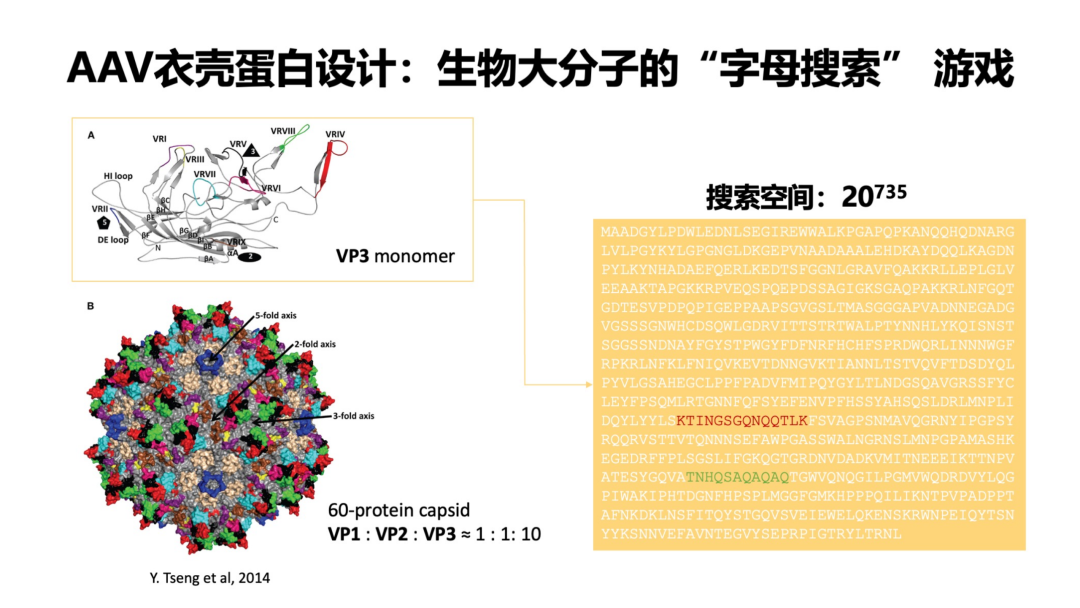
"Although the search space is enormous, this is a solvable problem. The reason it's solvable is that we now have excellent AI technology and wet-lab technology, allowing this letter search game to close the loop."
Over the past few years, Westlake X-Gene Therapeutics has built a platform called AIdit-CAPSID, an AI-driven AAV capsid protein evolution platform. It achieves AAV variant evolution through four core steps:
First, building a high-throughput AAV variant library;
Second, screening for AAV variants with tissue specificity;
Third, quantifying AAV tissue specificity and generating a large data matrix;
Finally, training AI models based on the above big data matrix, allowing the model to learn capsid protein features, and then screening which AAV variants are more worthy of next-round screening.
The above build-screen-quantify-train process forms a closed-loop iteration.

Based on this platform, Westlake X-Gene Therapeutics has already evolved multiple organ-targeted AAV variants, the vast majority of which have been validated in non-human primates.
About two years ago, an AAV variant capable of targeting T cells caught the attention of Ma and her team. "Wild-type AAV has a certain transduction capability for T cells. If we could obtain AAV variants that specifically infect T cells by modifying the capsid protein, then there would be an opportunity to apply them in the in vivo CAR-T field." But at that time, understanding of in vivo CAR-T was still very limited, starkly different from the booming scenario today.

"Miracle drug with a sky-high price," "one intravenous infusion, no repeated dosing needed" — in recent years, CAR-T cell therapy has become the "king of topics." Yet this therapy still has unmet clinical needs.
Ex vivo CAR-T therapy requires blood collection from the patient, a 19-24 day ex vivo manufacturing process before reinfusion, and lymphodepletion for the patient. Currently, mainstream drugs on the Chinese market are priced as high as 1.2 million RMB.
The logic of in vivo CAR-T technology is to use delivery vectors to directly deliver CAR (chimeric antigen receptor) genes into the patient's T cells in vivo, allowing these T cells to autonomously transform into CAR-T cells inside the body, thereby achieving precise treatment of cancers, autoimmune diseases, and more.
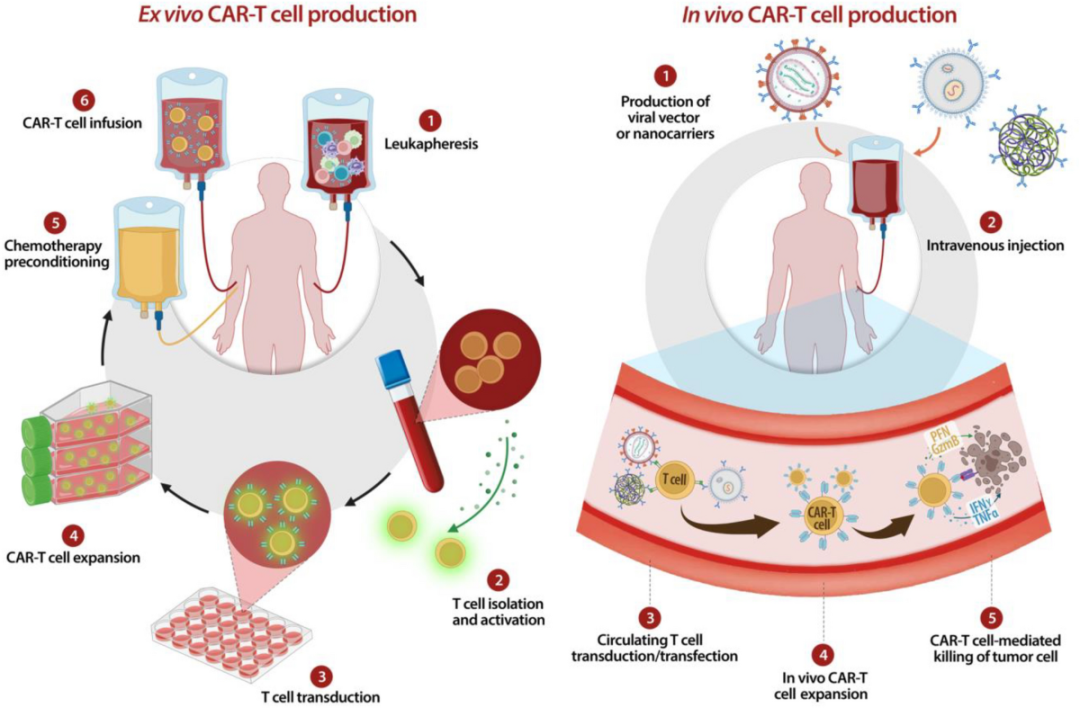
"Ex vivo CAR-T therapy is a highly personalized drug for patients; whereas in vivo CAR-T requires no ex vivo manufacturing, no lymphodepletion — it's essentially an 'off the shelf, ready to use' standard gene therapy drug, thereby significantly reducing drug costs and improving accessibility."
In 2025, in vivo CAR-T therapy has attracted tremendous attention due to multiple blockbuster BD deals, sparking a wave of next-generation immune cell therapies.
In March, AstraZeneca acquired Belgian biotech company EsoBiotec for $1 billion, positioning itself in in vivo CAR-T and other cell therapies.
On June 30, global pharmaceutical giant AbbVie announced the full acquisition of Capstan Therapeutics for $2.1 billion in cash — a startup only four years old whose core project had just entered Phase I clinical trials. Capstan's core R&D focuses on in vivo CAR-T technology using targeted lipid nanoparticles (tLNP) as the delivery vehicle.
On October 10, Bristol Myers Squibb (BMS) announced the cash acquisition of in vivo CAR-T company Orbital Therapeutics for $1.5 billion. BMS stated that "in vivo CAR-T represents an entirely new treatment modality that could potentially redefine how we treat autoimmune diseases."
As in vivo CAR-T therapy continues to boom, people have also begun to cast their eyes toward the widely applicable and potentially rich AAV delivery vector. In the more than a month following the ESGCT annual congress, Ma was invited to attend multiple conferences, introducing in vivo CAR-T therapy using AAV as the delivery vehicle to academic and industry audiences. "You can clearly feel the temperature change," Ma noted. "The industry is gradually recognizing that what were originally two technical directions for in vivo CAR-T have slowly become three delivery pathways — LNP, lentivirus, and AAV. In vivo CAR-T technology based on the AAV platform is gradually moving from non-consensus to consensus."
Coincidentally, a batch of startups at the global frontier of technology exploration are also accelerating their layout of in vivo CAR-T cell therapy using AAV as the delivery vehicle. Just on November 4, Azalea Therapeutics, an American biotech company co-founded by Nobel laureate Jennifer Doudna, announced the completion of an $82 million seed and Series A financing. The company will focus on T-cell-targeted AAV delivery technology and gene editing technology to advance CD19-based in vivo CAR-T for treating B-cell malignancies and autoimmune diseases into clinical trials.

Over the past period, the Westlake X-Gene Therapeutics team has preliminarily validated the application potential of its platform-evolved T-cell-targeting AAV variant AAV-TCE001 in in vivo CAR-T technology through a series of data.
First, experimental data shows that AAV-TCE001 can efficiently transduce primary T cells — the evolved AAV vector's ability to infect human T cells is significantly superior to wild-type AAV; and CAR-T cells generated by AAV-TCE001 can efficiently kill B cells.
"Beyond efficacy, there are generally some concerns for AAV gene therapy drugs — for instance, AAV targeting places it shouldn't go, or its immunogenicity in vivo." Ma noted that through early validation, the team found that AAV-TCE001 demonstrates excellent T-cell targeting specificity compared to wild-type AAV; and has evolved low immunogenicity, avoiding the body generating anti-AAV resistance that would clear the vector.
"The experimental data excites us tremendously — the results are far superior to natural AAV, giving us confidence that AAV variants have the potential to advance to the clinic."
Subsequently, Ma and her team conducted further validation. On the efficacy side, in both tumor and autoimmune disease animal models, AAV-TCE001 demonstrated excellent in vivo CAR-T generation capability and B-cell clearance capability.
On the safety side, after injection, AAV-TCE001-CAR viral copy numbers were extremely low in major organs including the liver. AAV-TCE001 significantly reduced liver viral burden by 100-fold, showing a substantial safety improvement compared to wild-type AAV.
Why can AAV variants efficiently target T cells rather than other organs? Ma and her team subsequently used cryo-EM to resolve the structure of the AAV variant, discovering that AAV-TCE001 has strong affinity with a very important receptor on the surface of human resting T cells, thereby achieving efficient transduction.
In summary, based on current experimental data and animal models, AAV-TCE001-mediated in vivo CAR-T has preliminarily demonstrated excellent in vivo T-cell targeting and de-targeting from the liver, as well as outstanding B-cell killing capability. In the future, it not only has the potential to become an innovative product of AI-enabled pharmaceutical development in the gene and cell therapy field, but will also advance AAV gene therapy from rare diseases toward common disease treatment.

Beyond AAV-TCE001, the Westlake X-Gene Therapeutics platform has also evolved multiple tissue-targeted AAV variants with high BD potential in a relatively short time, such as targeting the central nervous system, muscle, retina, and more. "R&D never ends, iteration never ends — we will continue searching for better products."
Ma indicated that she expects to see clinical data for in vivo CAR-T in about a year, at which point there will be relatively consensus understanding of dosage, pricing, and so on. Ma also emphasized, "Of course, the future holds much uncertainty. We need to rely on solid clinical trials, enrollment criteria, and data, taking one step at a time."
Looking at the global cell and gene therapy market, according to BCC Research data, the global market size is expected to grow from $7.2 billion in 2023 to $23.3 billion by the end of 2028. "In the cell and gene therapy track, China and the West actually started at the same time. We have tremendous opportunity, leveraging domestic knowledge accumulation, rapidly iterating technical capabilities, strong supply chain resources, and integration capabilities, to achieve genuine innovation and even surpass the competition."

2025 European Society of Gene and Cell Therapy (ESGCT) Annual Congress
Against the backdrop of multinational MNCs paying attention to Chinese assets, Ma and her team are also confident about future innovation competition. In September this year, at the "Star Start" 2025 Innovation Competition co-hosted by Novo Nordisk China R&D Center, Westlake X-Gene Therapeutics won first place in the finals.

The human genome is like a heavenly book; generation after generation of scientists have persevered, pushing us into the "functional genomics" era. "We hope that through technology development work, we can not only help scientists better understand the genome, but also hope that the technologies we develop can have genuine application value in the medical field, treating diseases and saving lives."
Ma stated that the team will continue to explore the innovative field of AAV in vivo CAR-T in the future, developing safe, efficient, and accessible gene therapy innovations for rare diseases, tumors, autoimmune diseases, and more, addressing more unmet clinical needs.