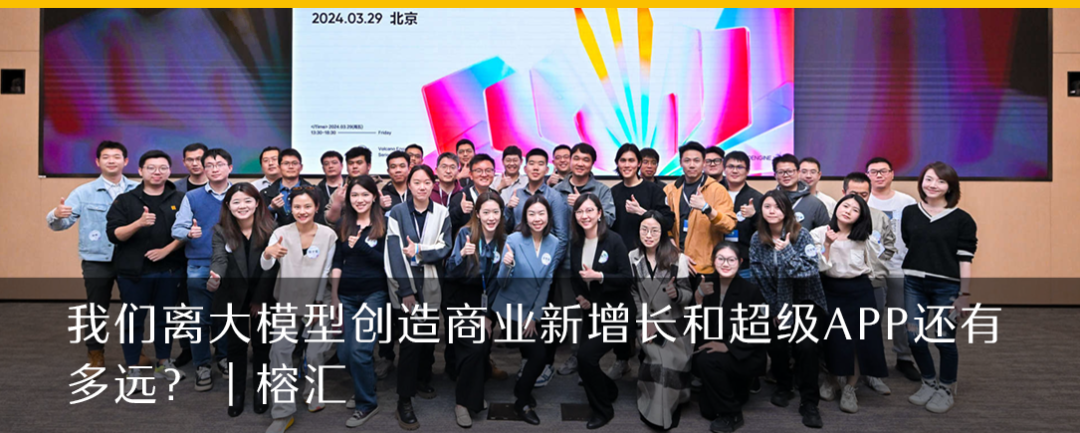
How ViewTravel Defines AI-Native Travel Products: From Itinerary Planning to Booking | Gaorong Ventures

Travel LLMs are putting this generation's young travelers in a league of their own.
How many hours have you spent scrolling through travel guides and planning itineraries for the upcoming May Day holiday? Generative AI and travel-specific large language models might make your trip easier than ever before.
Whether you want to take a citywalk in Singapore, see snow-capped mountains in Daocheng Yading, or book a photo shoot in Xishuangbanna, Vtrip's AI travel concierge can instantly plan an itinerary based on your preferences and one-click book hotels, tickets, and other travel products.
Today's Gen Z travelers have needs that are increasingly difficult to satisfy through traditional models. They crave personalized, spur-of-the-moment novel experiences while also demanding certainty in service delivery.
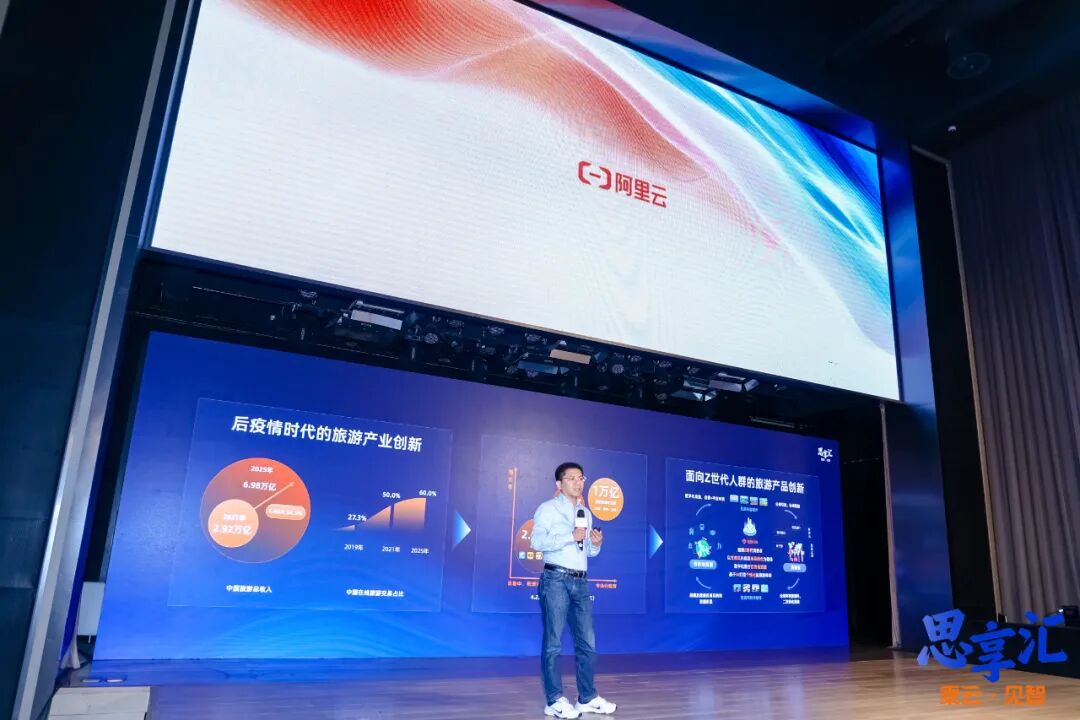
"The development of AI and large models gives us the opportunity to integrate destination resources through generative content and generative product combinations to create personalized travel experiences," said Hui Pengrui, co-founder and CTO of Vtrip, at an AI Salon co-hosted by Alibaba Cloud, Gaorong Ventures, and GeekPark on April 26. He shared how they define an "AI-native" travel platform and their thinking behind building a travel-specific large model.
AI-powered transformation of travel industry experiences and long-term growth is becoming a global consensus. As McKinsey & Company's report The Promise of Travel in the Age of AI notes, next-generation AI will dramatically simplify travel discovery, helping users obtain personalized travel recommendations and customized services while helping suppliers fulfill their delivery commitments to customers.
Vtrip was founded in November 2021 with the mission of becoming an AI-driven next-generation travel platform. Gaorong Ventures participated in Vtrip's angel round. Co-founder and CEO Li Shaohua is a former Alibaba vice president and founder of Fliggy, where he also served as president. Hui Pengrui previously served as a senior expert in data intelligence at Fliggy and a senior expert in adversarial intelligence at Alibaba's technology platform.
The following is Hui Pengrui's presentation (edited for clarity):
Vtrip has been around for roughly two and a half years. Let me briefly share some milestones.
- June 2022: Vtrip launched the industry's first AIGC travel video production and distribution platform.
- May 2023: Released VtripGPT 1.0, China's first travel-domain large model, and achieved scaled consumer-facing product deployment in the Hong Kong destination market.
- October 2023: Vtrip's full-chain AI solution won the gold award at the Ascend AI Innovation Competition.
- March 18, 2024: VtripGPT successfully passed regulatory filing review by the Cyberspace Administration of China and other authorities, becoming the first and currently only travel large model to obtain generative AI filing approval in China.

Some might say that starting a travel business in the post-pandemic era means riding a wave. But back in late 2021, many people asked us: why choose travel at the most difficult moment? I believe this stems from the core founding team's deep insights into the travel industry.
First, looking at China's overall travel market size: according to National Bureau of Statistics data, China's total tourism revenue in 2021 was 2.92 trillion RMB, roughly half of pre-pandemic levels. But by 2025, it's projected to recover to 6.98 trillion RMB.
At the same time, we saw another encouraging data point — China's online travel transaction penetration rate. In 2019, only 27.3% of China's travel market was online. With shifts in user mindset, transaction pathways, and habits after the pandemic, this figure rapidly climbed to 50% by 2021 and is expected to exceed 60% by 2025.
Consequently, China's online travel market is projected to reach 4.2 trillion RMB by 2025, with approximately 2.5 trillion in transactions occurring on OTA platforms. Brand-direct transactions from chain hotels, airlines, and major attractions will account for roughly 0.7 trillion. Additionally, over 1 trillion will be distributed across fragmented transactions at destinations.
Consider this: previously, when you wanted to take a vacation, you'd need to book flights, hotels, and tickets on different platforms. But today, you might habitually open Xiaohongshu, Douyin, and various new media platforms first, then complete your travel decisions and transactions there.
In this trillion-scale market, the connection between demand and supply is fragmented, inefficient, and quasi-private. Thus, how to use AI technology to integrate both ends of supply and demand is the challenge before us.
Vtrip's answer is to build an end-to-end industry solution that directly connects destination resources with consumer demand — centered on Gen Z consumers, using generative content and product combinations as vehicles, integrating destination resources digitally, and ultimately creating personalized travel experiences through AI.

We believe that so-called AI-native travel products mean all products and services revolve around user needs, driven by AI technology throughout the entire process. Based on intelligent understanding, reasoning, and service capabilities, we design product interactions and reshape user experiences.
We examine user needs across three major stages: pre-trip, during-trip, and post-trip. Previously, before traveling, users spent enormous effort on research and itinerary design, purchasing fragmented products across various platforms. During the trip, they had to gather further information and make decisions about local experiences, dining, transportation, and attractions. After returning, they'd spend considerable time editing their social media posts.
Around these three stages, Vtrip's AI travel concierge product chain is divided into five functional domains — inspiration and discovery, itinerary planning, transaction and purchase, on-ground fulfillment, and content sharing — each containing numerous scenarios and needs where AI technology can reconstruct interaction models.
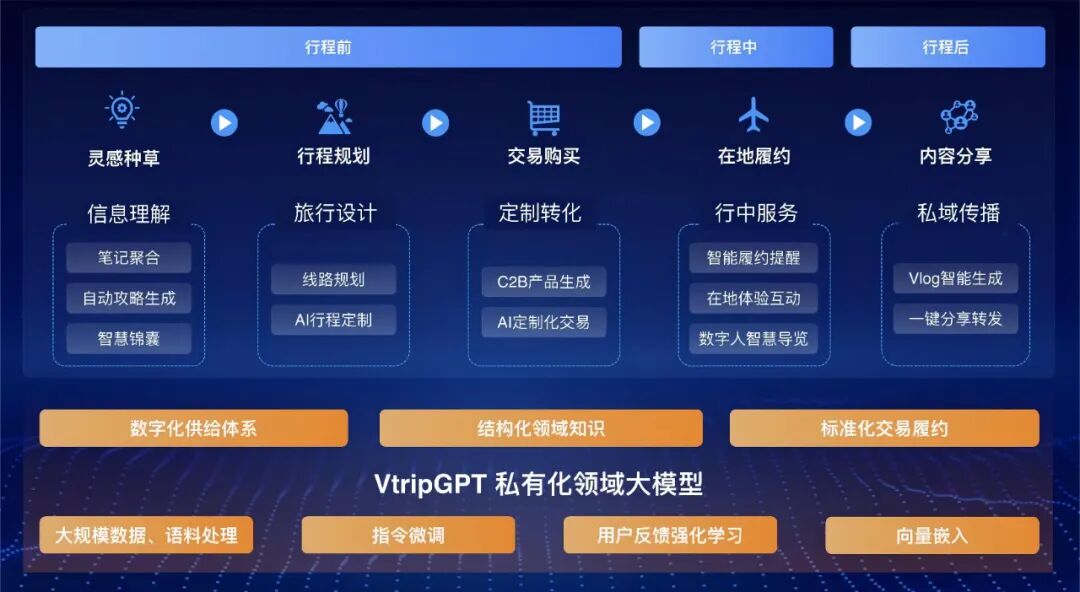
Behind this product solution and interaction experience lies Vtrip's proprietary VtripGPT large model. VtripGPT incorporates multiple industry open-source foundation models, features full-parameter training at 70B+, supports context length up to 16K, achieves 25 million tokens of single-destination domain samples, and employs SFT supervised fine-tuning and RLHF expert feedback.
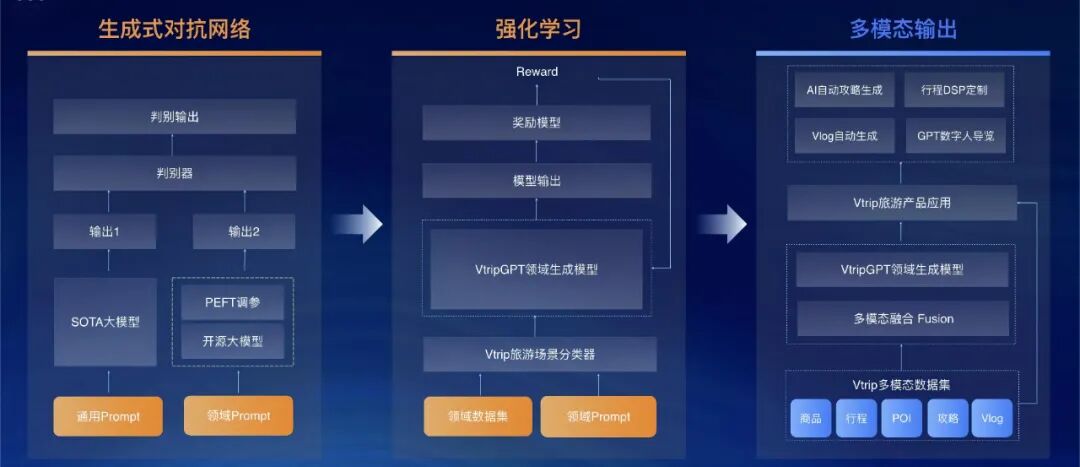
At the architectural level, VtripGPT employs a three-layer structure, pioneering industrial-grade application of travel-specific models.
First, based on foundation models, it uses generative adversarial training to align with industry-leading models.
Second, through reinforcement learning, it introduces massive domain-specific data and trains the model based on RLHF feedback mechanisms.
Third, it incorporates Vtrip's proprietary multimodal datasets into the model, forming multimodal fusion, then achieves productized output and business scenario deployment.
For industry-specific large models to truly deliver value, vertical domain data is crucial. Vtrip drives the construction of the optimal travel industry model through full-process data accumulation — such as pre-trip comprehensive platform travel information, self-produced high-quality destination guides, and user preference collection; during-trip high-timeliness attraction data and local life recommendations. Simultaneously, Vtrip has built the industry's most granular tag system, establishing a leading foundation for travel content data.

So what can Vtrip's AI products actually do? Here are four scenarios.
- AI Travel Guide Assistant: Aggregates high-quality information across the web plus proprietary content to provide users with high-quality, precise destination guides. Users interact through full voice conversation, and the large model generates content based on understanding of user intent.
- AI Itinerary Design: Enables dynamic, personalized itinerary design for thousands of users, flexibly combining destination products to help users achieve better independent travel experiences. Also supports preference optimization and itinerary modification for customized adjustments.
- Smart Fulfillment: Provides on-ground itinerary reminders, digital tickets, and local itinerary recommendations to optimize the fulfillment experience.
- AIGC Content Generation: Based on high-quality attraction photos and videos, helps users automatically generate travel photography and vlog content.


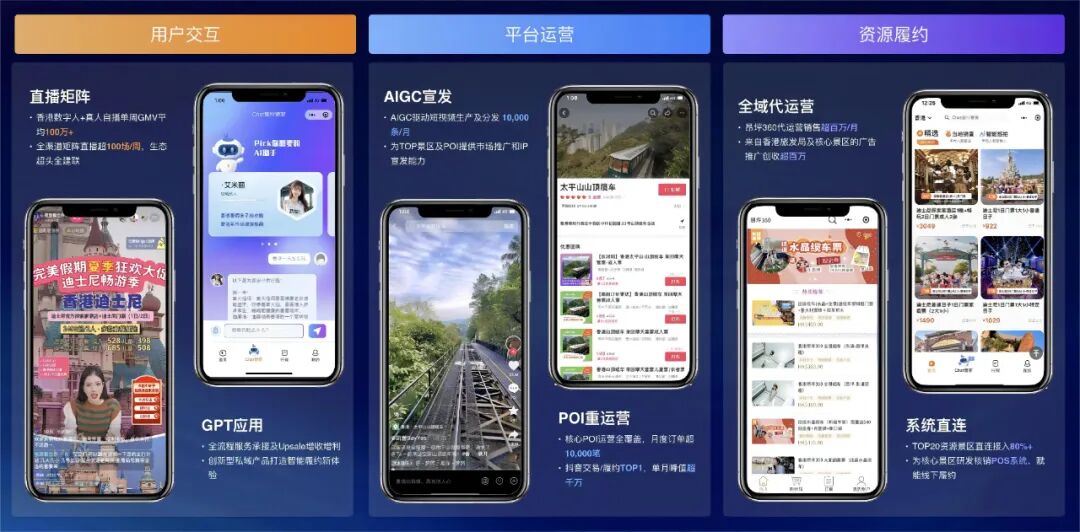
Currently, Vtrip's AI travel product solution based on VtripGPT has been deployed across multiple travel destinations. Taking Hong Kong as an example, Vtrip achieved coordinated linkage across user interaction, platform operations, and resource fulfillment through AI technology. During the 2023 summer period, it achieved tens of millions in fulfillment revenue, serving over 100,000 travelers. Behind this, Vtrip built a knowledge base of 100M text entries and 100GB of image data, completed private deployment and training of the VtripGPT model specifically for the Hong Kong destination, and can support approximately 100,000 DAU in concurrent consumer-facing product usage.
In summary, compared to traditional travel products, AI-native travel platforms have three advantages.
- Interaction: Unlike traditional one-way interactions based on search, recommendation, and advertising traffic distribution models, AI products can interact with users through natural language understanding, lowering barriers while more precisely understanding user needs.
- Supply-demand matching: Based on AI technology architecture, it can generate content and product combinations in real time according to user needs.
- Fulfillment: Drives merchants to achieve smart fulfillment through more standardized, productized approaches, ultimately delivering quality destination experiences for users.

Vtrip's vision is to build a bridge for hundreds of millions of Chinese people to explore the world. To enable more users to truly enjoy customized, personalized travel, Vtrip will continue deepening its foundational AI technology capabilities, including accumulating destination data and user data, continuously iterating algorithms, and optimizing model scenario adaptation.
We look forward to a future where more users can embark on their journeys through a different possibility, enjoying the democratized travel experience that AI brings.