Day-Arc Global Ultra-Long Livestream! AI Research System "FARS" Produces 100 Papers in 10 Days

In a world of infinite questions, build an infinite mind.

"In a world of infinite problems, we need to build infinite minds."
At 11:00 AM on February 13, Analemma officially launched a global public livestream on its company website and across multiple social media platforms to broadcast the deployment and operation of its fully automated research system, FARS.
FARS (Fully Automated Research System) is an end-to-end AI research system developed by Analemma, capable of autonomously completing the entire research workflow — from literature review and hypothesis generation to code writing, experiment execution, and paper composition.
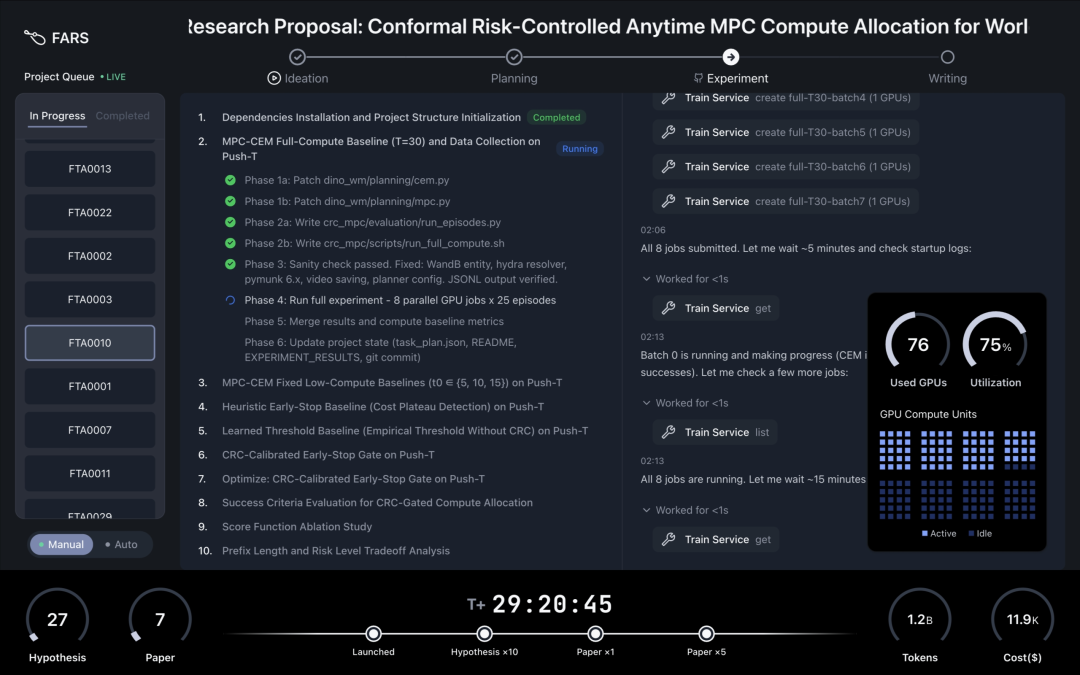
The FARS livestream interface
This livestream marked FARS's first large-scale deployment, with the goal of autonomously completing 100 papers during the broadcast. The livestream was expected to last a month; in fact, by February 23 — just 228.5 hours after launch — FARS had finished all 100 papers, hitting its target ahead of schedule.

It was described as an "unprecedented, groundbreaking ultra-long livestream" that opened a new chapter in fully transparent AI research system execution.

Analemma is a research lab founded in March 2025 by researchers and engineers, led by Tianxiang Sun, the lead developer of the MOSS large language model. The company is dedicated to building systems that expand human capabilities in thinking, exploration, and discovery — transforming scientific discovery from a craft dependent on individual ability into a scalable industrial process.
Gaorong Ventures led Analemma's angel round in 2025 and continued to follow on with an oversubscribed investment in subsequent rounds.

FARS: An End-to-End AI Research System Targeting AI4AI
In recent years, discussions and explorations of AI for Science (AI4S) have gradually moved into deeper waters, with growing expectations that AI could assist humans — or even work independently — in more scientific research tasks.
Analemma launched FARS because it recognized that as the frontier of human knowledge rapidly expands, research systems built around human researchers face numerous structural constraints: high barriers to entry, redundant effort, and an exclusive focus on "successful results" while ignoring "failed results." LLM-based automated research systems could help alleviate these constraints, enabling scientific discovery to proceed more efficiently, scalably, and at lower cost.
FARS's breakthrough lies in creating a fully end-to-end research system with no human intervention, driven purely by AI.
Currently, FARS focuses primarily on AI research, and it calls this paradigm of using AI to accelerate and automate AI research itself AI-for-AI (AI4AI).

How Is FARS Designed? From First Principles
In its design philosophy, FARS is built on first principles of research systems: efficiently and reliably expanding the boundaries of knowledge. Analemma believes that in an ideal research system, every research output should consist of a clear hypothesis and a reliable verification result. As long as the hypothesis itself is sound, its verification result — whether positive or negative — constitutes meaningful knowledge.
Therefore, FARS outputs take the form of "short papers": each paper focuses on a clearly bounded research contribution, encourages reporting of negative results, and is not constrained by length or structure requirements.
In its technical architecture, FARS operates as a multi-agent system composed of four agent modules: Ideation, Planning, Experiment, and Writing. The Ideation agent conducts continuous automated literature review and hypothesis generation based on preset research directions. Each hypothesis, once generated and passed through automated evaluation, is handed off to subsequent agents for sequential processing, ultimately producing a complete academic paper.
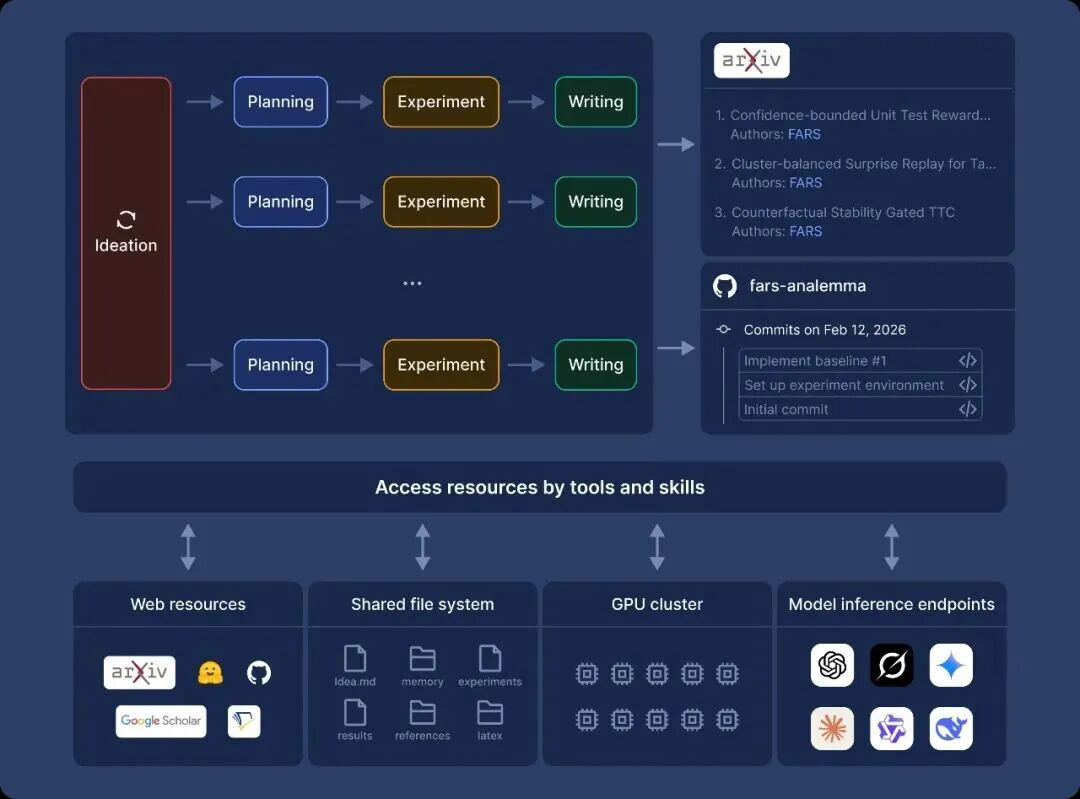
FARS technical architecture

Livestreaming AI4AI Research at Scale — Hitting the Target Ahead of Schedule!
Analemma believes that scale is critical for automated research systems, which is why it chose to conduct FARS's first deployment publicly. "We hope this approach will allow us to gather feedback from researchers, reviewers, and engineers more quickly, and accelerate the process of AI-built automated research systems entering the real world."
For this livestream, FARS pre-launched the Ideation agent to produce 20 "pre-fabricated" Ideas, after which 20 research pipelines were activated one by one, with system throughput continuously increasing. Meanwhile, the Ideation agent kept working, steadily producing new Ideas that entered a waiting queue. These 20 Ideas covered multiple frontier directions including AI safety and alignment, efficient inference and compute optimization, multimodal learning and generation, reinforcement learning, knowledge editing, and spatial reasoning — with one even exploring how to use LLMs for quantitative finance.
FARS produced its first paper after 6.5 hours of continuous operation, on large model safety issues
Before the livestream, Analemma noted, "We've never deployed FARS at this scale before, so we feel the same uncertainty and curiosity about its working process and outputs as anyone else: we want to know whether FARS can produce interesting research results, and what impact FARS will have on the current norms, incentive mechanisms, and operating methods of the human academic community."
Excitingly, as of February 23, the 100th research paper was completed 228.5 hours after FARS launched, achieving the predetermined goal ahead of schedule.
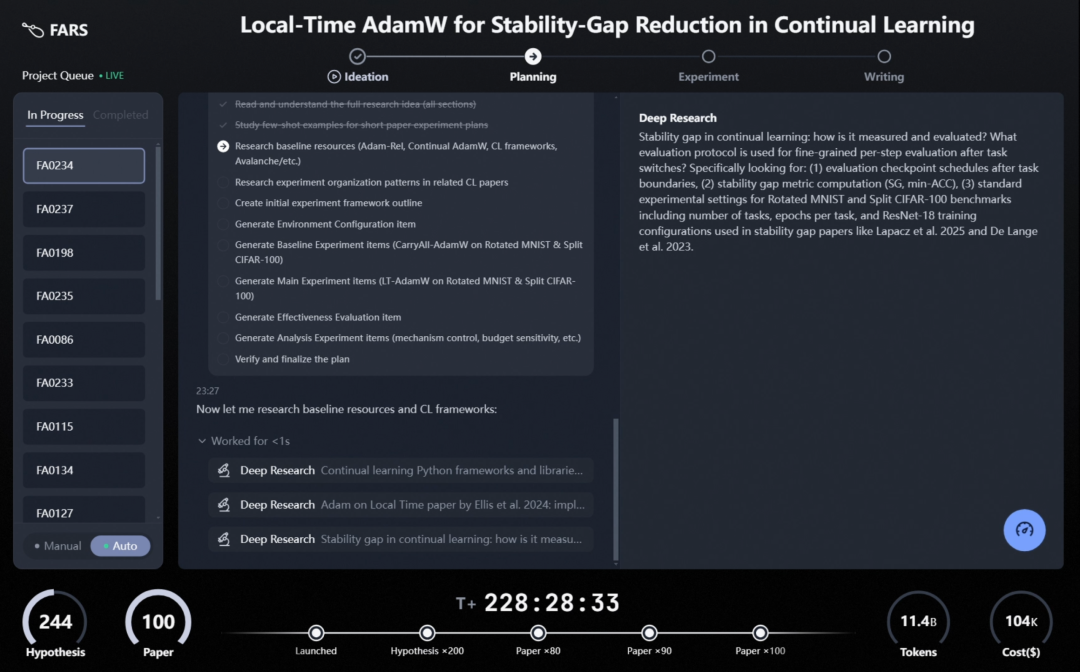
FARS completes 100 research papers
In this public deployment experiment, FARS consumed a total of 11.4 billion tokens at a total cost of $104,000, generating 244 Hypotheses in total. On average, each paper took approximately 2 hours, 17 minutes, and 5 seconds to produce, consumed about 114 million tokens, and cost roughly $1,040.
The team then used Agentic Reviewer (paperreview.ai), developed by Stanford University, to conduct AI peer review of FARS's 100 papers according to ICLR review standards. (According to public evaluations by its developers, Agentic Reviewer has achieved human-level consistency in review judgments.)
The review results showed that FARS papers scored between 3.0 and 6.3, with an average of 5.05. Scores clustered most densely around 5.2 (appearing approximately 57 times), with a smaller number of low-scoring papers (3.0–4.5) and very few receiving high scores above 6.0. For reference, the average score for human submissions to ICLR 2026 was 4.21, while accepted papers averaged 5.39.
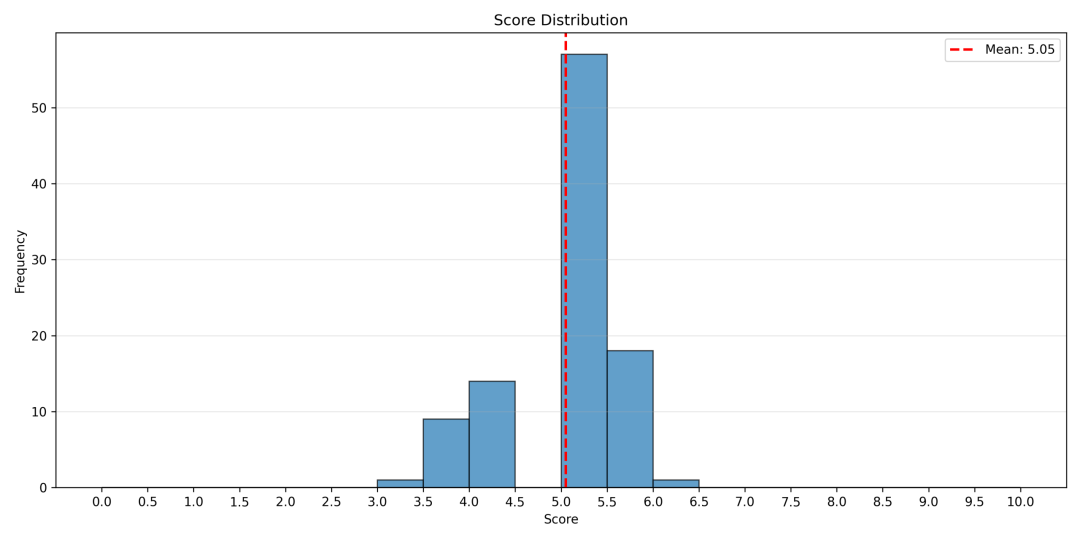
Score distribution of FARS's 100 research papers on paperreview.ai
Research proposals, experimental code, final papers, and AI review results for completed projects have all been updated on the FARS website, where they have begun receiving feedback.

"As a starting point, the results are already quite impressive"
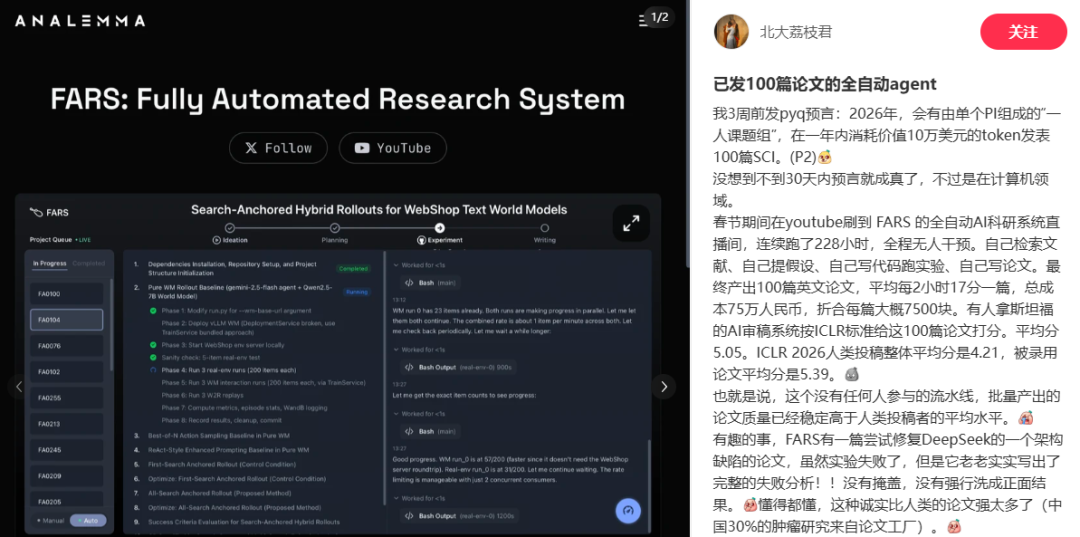
"Algorithmic honesty," "encourages reporting of negative results"
FARS continues to run. As Analemma believes, "The next era of science will be shaped not only by better inspiration, but by systems capable of reasoning, experimenting, and iterating — making scientific discovery no longer dependent on rare flashes of insight, but a continuous process supported by solid infrastructure."
We look forward to AI exploring and illuminating more unknown territories in the world.
FARS Research Project List: https://analemma.ai/fars
FARS GitLab: https://gitlab.com/fars-a
Join Analemma: career@analemma.ai