Stepping Inside OPPO in the "Year of AI Phones": *Benfen* Is the Foundation, AI Is the Open Sky | Ronghui

Study OPPO's culture, co-create an intelligent future.
Starting from an old factory building in Dongguan, OPPO has spent 20 years building countless stunning products, navigating multiple transformations and eras, with operations now spanning over 60 countries and regions worldwide.
"A corporate culture centered on 'benfen' [doing the right thing] and the original aspiration to create great products are OPPO's two core competitive advantages for weathering cycles."
Earlier this year, OPPO declared 2024 as the inaugural year of the AI phone, believing that AI could fundamentally reimagine the smartphone experience. The company aims to bring generative AI capabilities to approximately 50 million users this year and has called on industry partners to build and innovate together.
This July, Gaorong Ventures brought together 50 founders from fields including large language models, AI applications, smart hardware, and global brands to visit OPPO's Shenzhen headquarters, to discuss and answer the following questions—
// How should we understand OPPO's benfen values? Why do businesses today need equanimity and benfen more than ever?
// How does OPPO build and implement corporate culture in substance, not just in name?
// How does OPPO define and create AI phones that make hearts skip a beat, using technology to make user experiences more "elegant"?
// What new possibilities will the convergence of AI and intelligent interactive terminals bring to human-computer interaction and social engagement?
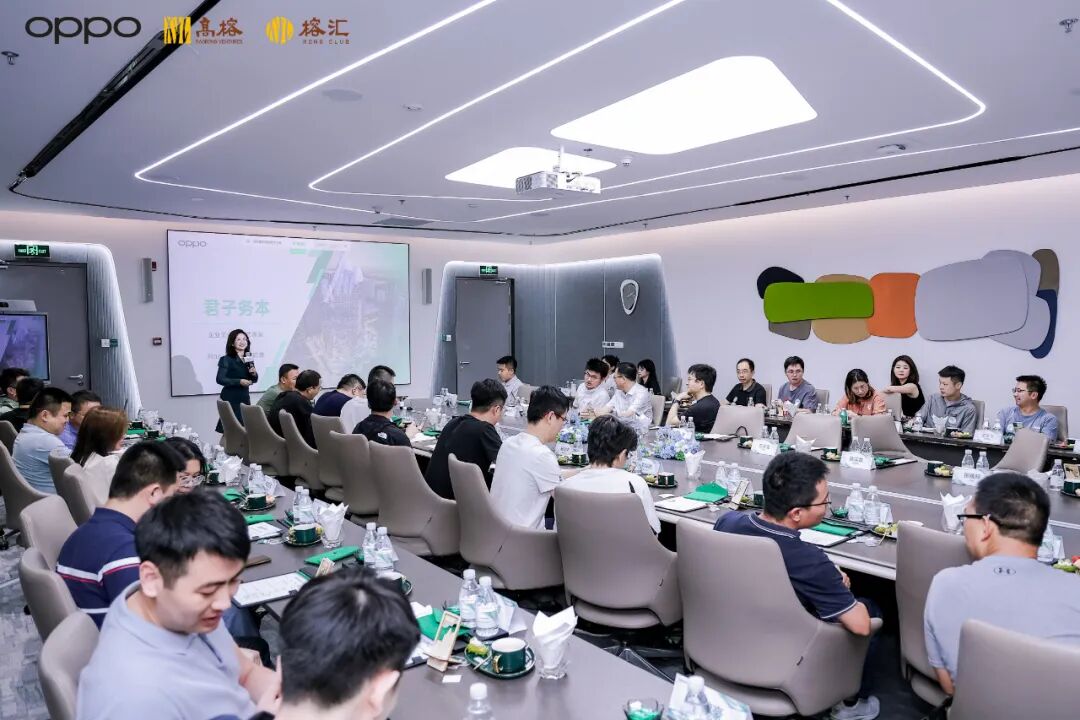

OPPO has lived through the audiovisual electronics era, the feature phone era, the mobile internet era, and the era of intelligent connectivity. Today it welcomes the new era of AI phones. Dai Chen, Head of Leadership Development at OPPO's Chuanxi Academy, shared how OPPO's corporate culture took root and evolved alongside the company's business transformations.
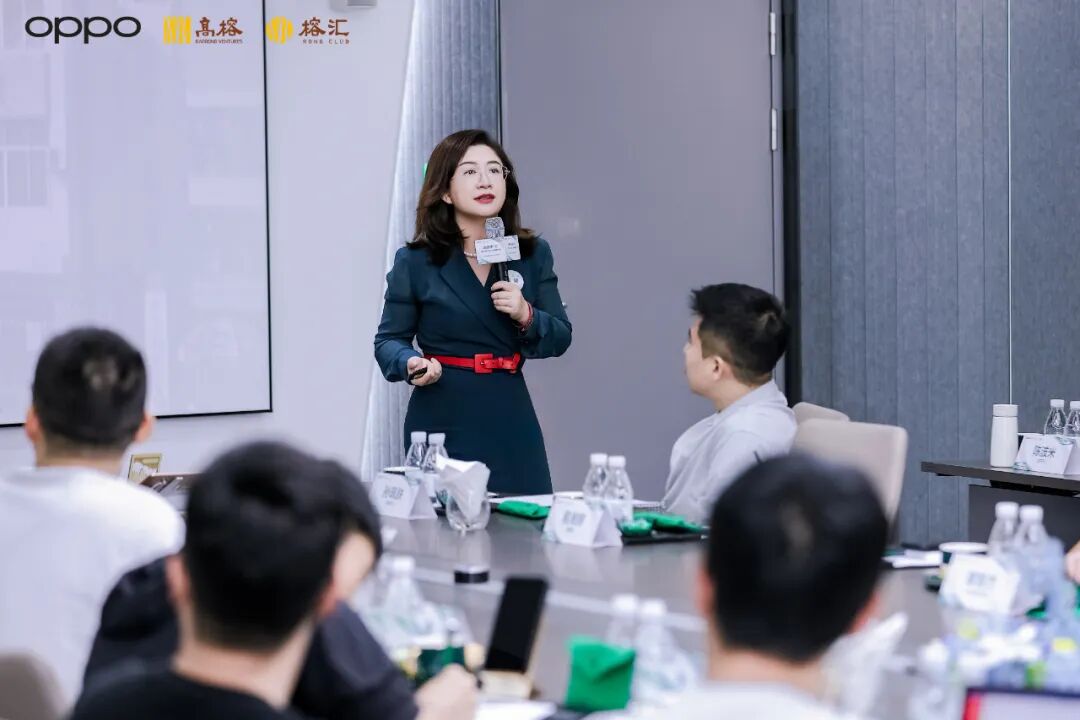
Tracing back to 2004, OPPO was committed from day one to creating great products and building a healthy, enduring enterprise.
OPPO's corporate culture quietly took shape as a set of original management principles and business philosophies. These included equanimity and benfen; maintaining sufficient minimum growth speed in business operations; sharing benefits; consumer orientation; and following the "chicken rib principle" when selecting markets — that is, the focus rule of starting with products that large companies found "not tasty enough to eat, yet too wasteful to discard," then concentrating advantages for an all-in breakthrough. This led to OPPO's approach of "daring to follow after others, then leading from behind" and "actions speak louder than words — if you're going to do it, do it best."
Building on these principles, OPPO gradually formed and updated its corporate culture. In version 1.0, it defined its mission to consumers, employees, business partners, shareholders, and society. Its vision was to set an example of a healthy, enduring Chinese enterprise worldwide, with values including benfen, integrity, and consumer orientation.
Around 2012, as smartphones began dominating the mainstream market, OPPO decided to transition from feature phones to smartphones, paying a massive price to buy back feature phone components previously ordered from suppliers. "Values aren't slogans written on walls — only those you're willing to pay a price to defend are true values."
Over the following decade-plus, smartphones went through explosive growth, peak shipments, and market decline. OPPO maintained its market leadership through excellent products and innovative technology, transforming from a manufacturing enterprise to a technology company, while continuously iterating its corporate culture to what is now version 4.0. Some updates adapted to external changes — for instance, in the latest version, "pursuit of perfection" became "pursuit of excellence," and "openness" was added as a new value to better embrace an uncertain future. Yet two cores remained unchanged — values centered on benfen, and the vision of a healthy, enduring enterprise.
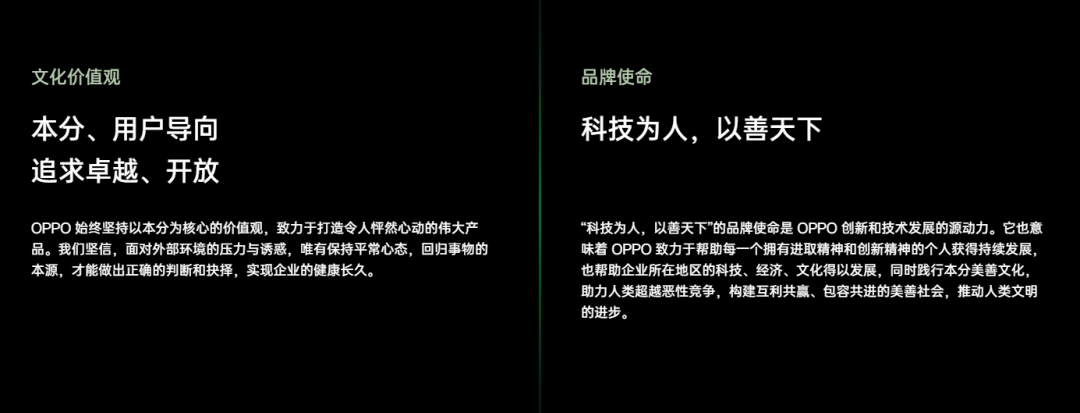
How to understand benfen values? Chen shared five dimensions.
// Isolate external pressures and temptations, maintain equanimity, return to the essence of things, and do what is right. // Stay focused on what matters most. // Benfen means holding oneself accountable, not others. When problems arise, first look inward and take initiative. // I don't take advantage of others, seeking long-term mutual success with partners. // Benfen stands above integrity — even without explicit promises, one should do what ought to be done.
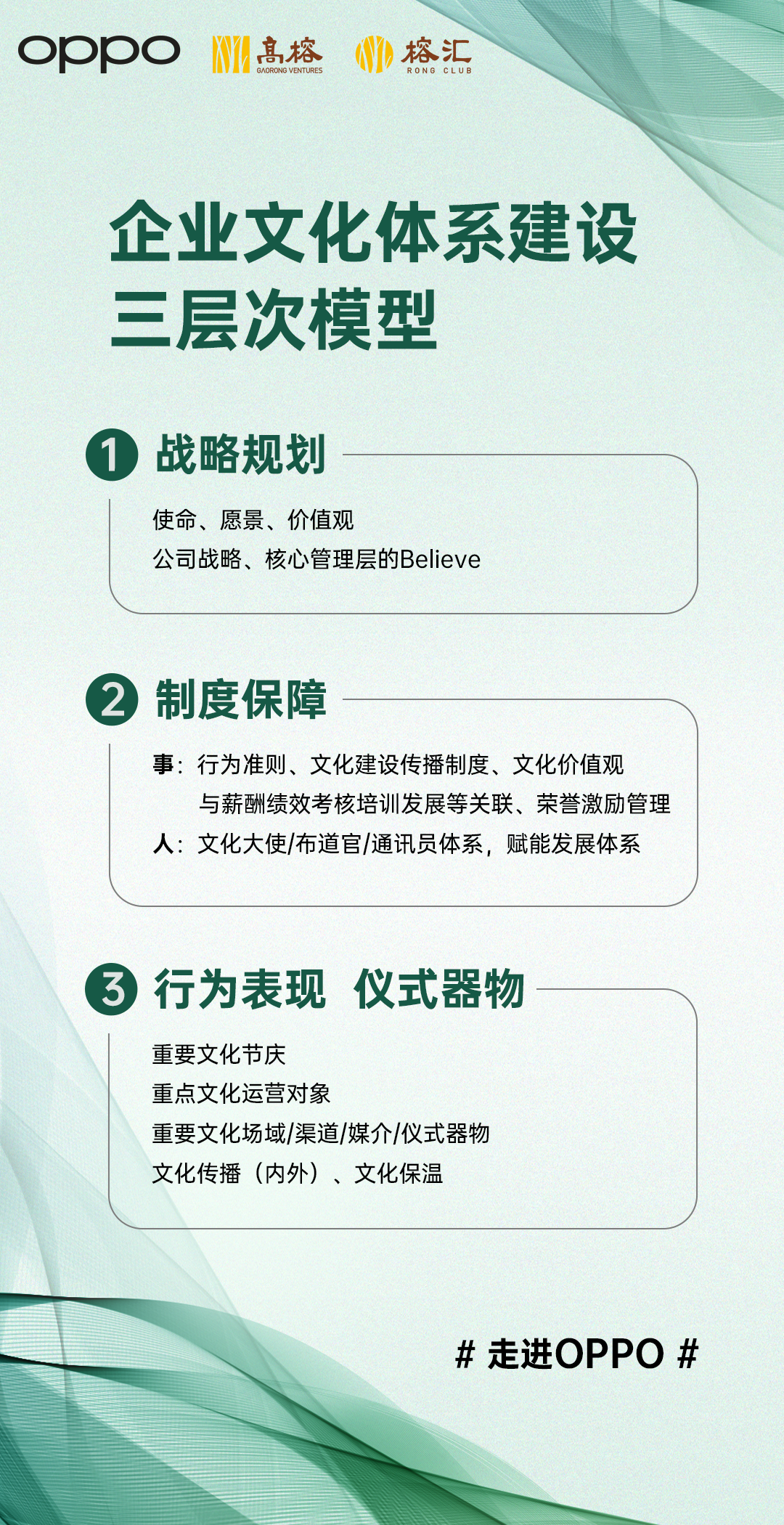
Once a corporate culture exists, how does a company build and implement it in substance, not just in name? Chen then shared a three-level model for corporate culture building with the founders.
First, at the strategic planning level, mission, vision, and values must permeate the company's strategic planning and the convictions of core management. Second, the institutional guarantee level ensures culture lands on both tasks and people. At OPPO, cultural practice is strongly tied to employee compensation and performance evaluation — "performance is the threshold, values are the bottom line." The third level requires visible behaviors, rituals, and artifacts that subtly and continuously influence the organization.
Chen also noted in her sharing that global conflict and turbulence are intensifying. "Perhaps startups can learn from what has sustained OPPO through cycles over the past 20 years — benfen."
Facing new geopolitics and new ecosystems, enterprises need to embrace change with an open mindset, while clearly defining their capability boundaries and establishing a "not-to-do list."
Moreover, we are entering an era where growth logic replaces expansion logic. Companies need to build strong internal capabilities, maintain sufficient minimum growth speed, focus and break through in areas consumers can perceive, and pursue excellence.

In early 2024, OPPO launched the Find X7 equipped with its self-developed large model AndesGPT — the first AI phone certified by national authorities, and the world's first phone with a 7-billion-parameter large language model running on-device, widely seen as establishing an entirely new flagship standard for AI phones. Since then, OPPO has continued pushing generative AI capabilities across its entire product line.
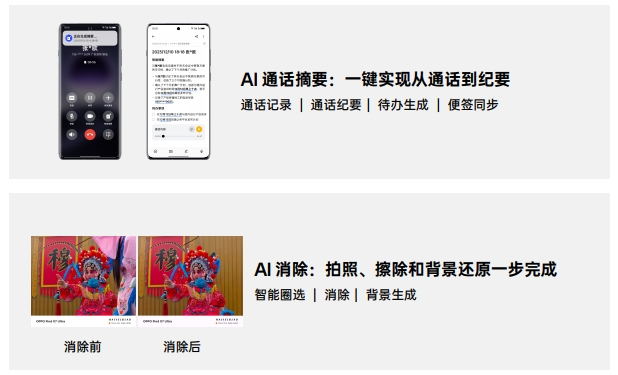
AI phones are already demonstrating value in imaging experiences, information management, device operation, and lifestyle services. Features like AI erasure, closed-eye fix, and AI call summaries have received widespread user acclaim.
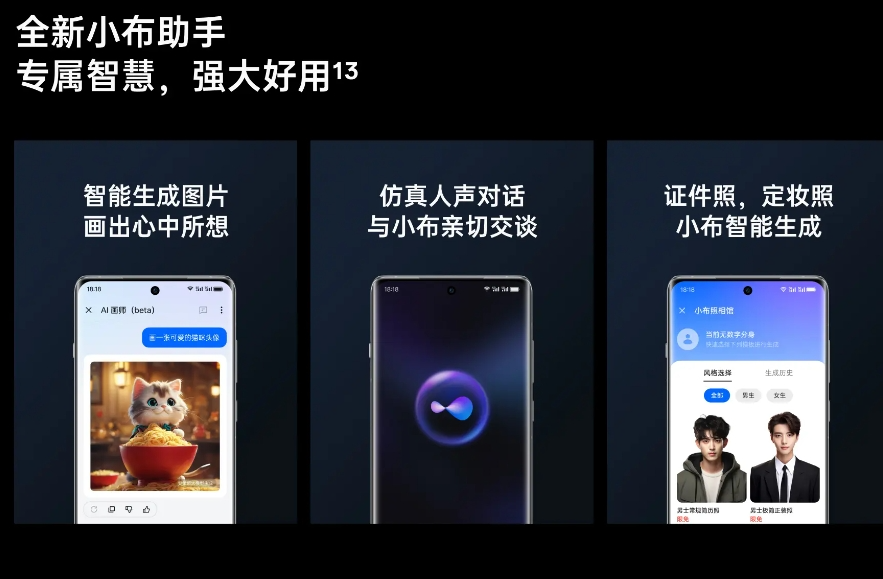
The updated Xiaobu assistant, powered by large model capabilities, provides users with over a hundred AI functions including general Q&A, human-like voice conversations, device operation, and intelligent creation.
Wan Yulong, Head of OPPO's Intelligent Assistant Department and Chief Architect of Xiaobu, shared his thinking on the evolution, practical application, and challenges of interactive AI, drawing from frontline R&D experience.
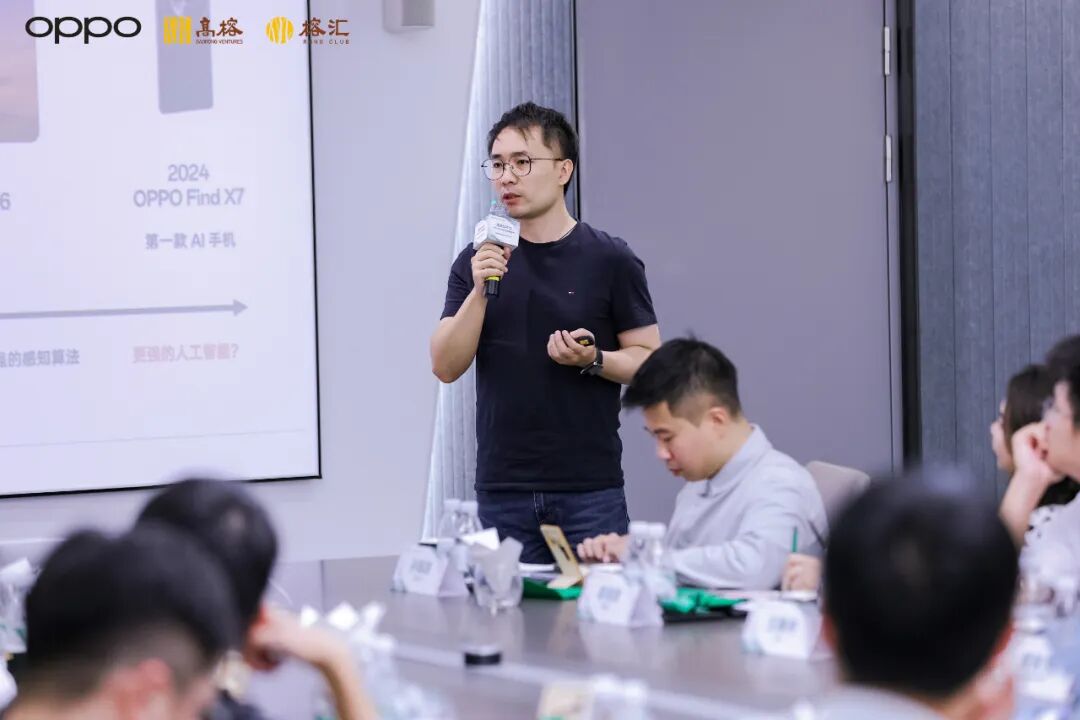
Today, smartphones are considered one of the most important vehicles for AI technology, thanks to several characteristics: they're carried everywhere, always on, and connect both edge and cloud. Phones' nearly "ubiquitous" sensing capabilities, combined with AI's powerful abilities, are dramatically changing how users access services and creating opportunities to disrupt smartphone interaction — where all services can be realized through natural conversation.
In fact, since the Turing test was proposed, humanity has been exploring natural conversation with machines. In recent years, Apple Siri, Amazon Alexa and others have explored voice assistants as a product form. OPPO's Xiaobu assistant launched in 2018 and now has over 140 million monthly active users.
Wan noted that AI technology has evolved from early discriminative AI to today's booming generative AI. The next critical stage is interactive AI. The closed-loop chain of interactive AI comprises four components — perception, cognition, expression, and execution.
For AI phones, perception mainly involves voiceprint understanding and visual determination, including speech recognition, voice wake-up, and human voice detection. Cognition's focus is intent understanding. Expression involves text generation, speech synthesis, and more. Execution includes app distribution, hardware control, and content recommendation.
Today each of these four faces challenges. Perception needs to solve multimodal sensing, multilingual recognition, and noisy environments. At the cognition level, reliability, consistency, and safety ethics must be addressed. In expression, while we're amazed by GPT-4o's natural conversational effects, achieving hyper-realistic natural expression requires optimization of capabilities including low-cost replication, multilingual fusion, and localized expression. For execution, safety, completeness, and service ecosystems need consideration.
From a user perspective, Wan pointed out that "they expect voice assistants to become friends in their digital lives," which involves key challenges like persona consistency and natural human-like expression, while also requiring integration of scene and situation awareness, user preferences, and interaction history to provide more personalized service.
Wan looked ahead to future trends in AI hardware and application ecosystems.
First, AI Native applications will continue emerging, with interactive AI interfaces becoming standard, continuously reinforcing users' conversational interaction habits. Second, a wave of new hardware devices will appear under new technical frameworks, with multimodal interaction as a key focus. Third, application ecosystems will undergo transformation — GPTs enabling non-technical developers to build applications with zero code, with this new ecosystem poised to take off.
However, for AI phone product development, Wan emphasized that the ultimate focus must return to the user perspective, solving the problems of users not knowing about, not knowing how to use, or finding AI functions unsatisfactory, using technology rationally to ultimately exceed user expectations.

Beyond phones, large models are beginning to integrate into more terminal devices, with new AI-native hardware constantly appearing. When AI large models collide with new and existing interactive terminals, what new possibilities will emerge for human-computer interaction and even social engagement?
OPPO's Wan Yulong, Jiajin Zhu (Founder of Digital Eden), Huang Guan (Founder/Chairman of Shifang Ronghai), and Xiaohui Zhang (Founder of Looi), discussed this under the moderation of Qilin Chen, Executive Director at Gaorong Ventures.
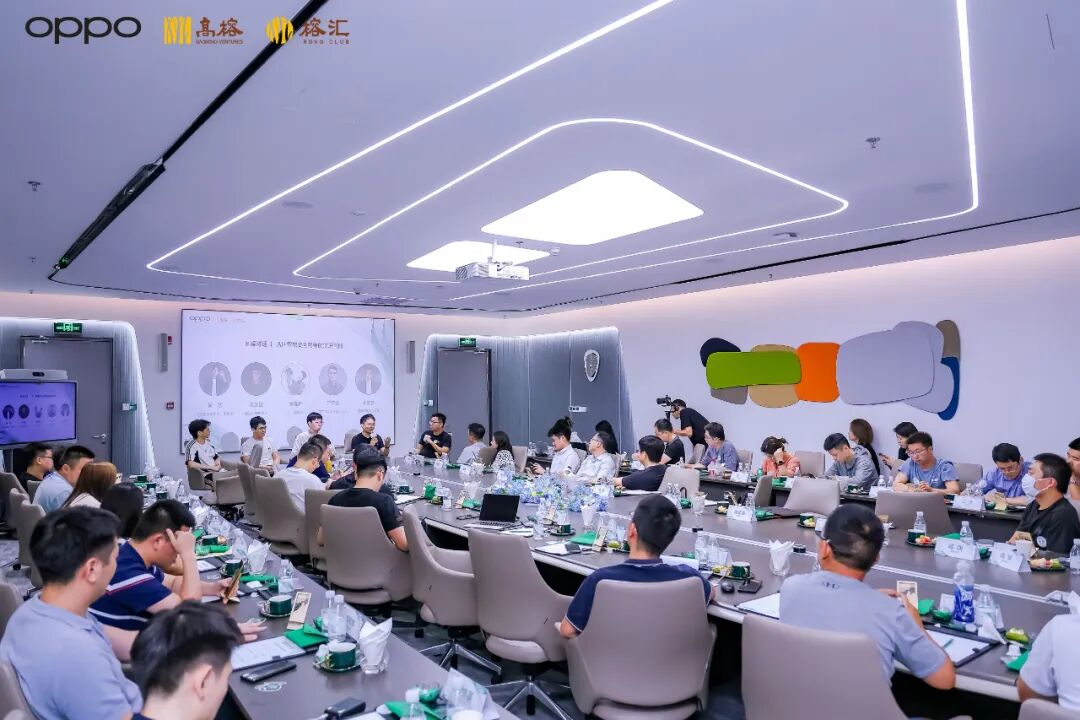
Digital Eden builds multiplayer music-and-dance social games for XR devices like Vision Pro. Founder Jiajin Zhu has years of industry experience and multiple successful products under his belt. He noted that from ancient times to today, humanity has constantly pursued more efficient information transmission. XR devices represented by Vision Pro offer higher efficiency and density of information transmission compared to previous-generation terminals, and move people from flat to 3D,立体, and immersive experiences when accessing information, interacting with machines, and engaging socially — thereby creating opportunities for disruptive entertainment in gaming.
Meanwhile, the fusion of multimodal large models with new-generation hardware further enriches interaction possibilities. For example, Ray-Ban Meta smart glasses can analyze what users see in the real world and respond through large models.
Shifang Ronghai founder Huang Guan shared opportunities for future vertical-scenario AI hardware from an education industry perspective. Huang noted that since OpenAI released ChatGPT, the company has actively embraced large model technology, developing its own large models while also applying AI to internal operational efficiency and user services. Its AI multidimensional interactive teaching system has already served millions of users, providing them with efficient, intelligent, personalized learning experiences.
Huang believes that as lifelong learning takes deeper root, and diverse learning demands emerge in senior education, blue-collar skills upgrading, and advanced technical talent training, intelligent interactive terminals will no longer be limited to phones, PCs, and similar forms, but will be custom-designed for different application scenarios. From simple terminals like AI learning machines and AI intercoms meeting basic learning needs of youth and seniors, to smart devices supporting blue-collar hands-on training, to AR/VR learning platforms for advanced technical talent — all represent important evolutionary directions for AI+education intelligent interactive terminals worth exploring in depth.
Looi is a piece of hardware that pairs with smartphones, aiming to give phones a body and transform them into desktop robot companions for users. Looi employs a biomimetic behavior system capable of sensing users and their surroundings to proactively initiate interactions. It also integrates large models, supporting stronger reasoning and natural language interaction.

Xiaohui Zhang emphasized that Looi essentially aims to create characters or life forms previously only seen in science fiction films — "with its own personality, its own behavior patterns, and on that basis providing users with emotional companionship and interactive entertainment experiences."
As multimodal large models develop, delivering more natural interaction experiences requires giving intelligent assistants or models "eyes" — enabling them to proactively understand scenes and situations, achieving proactive intelligence. Wan pointed out that a notable issue at present is how to make sensors and cameras on phone hardware run 24/7 at lower power consumption, allowing users to enjoy large model technology without impacting battery life.
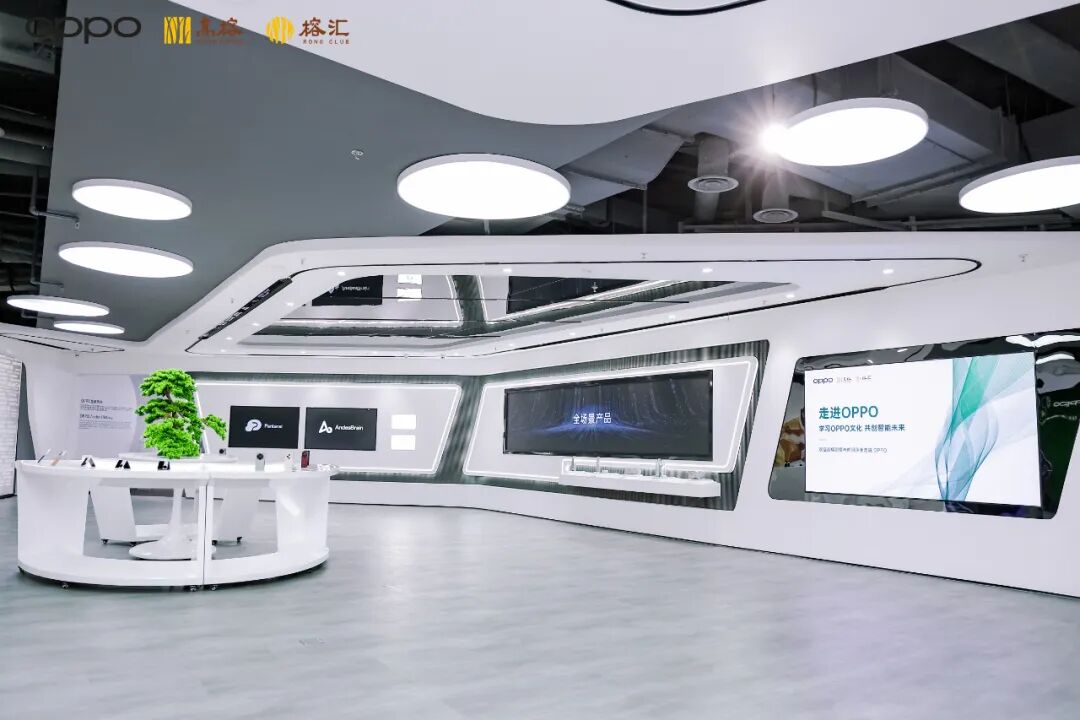
As Ma Xiaoyu, Managing Director at Gaorong Ventures, noted in her opening remarks, OPPO's definition and thinking about AI phones returns to fundamentals. "From an industry perspective, OPPO is guiding AI large model capabilities from novelty to everyday use; from a consumer perspective, leaving complexity to AI and simplicity to consumers." OPPO's practice in building AI phones similarly embodies people-centricity and technology for humanity.
Whatever waves AI may bring, such values and the original aspiration to make user experiences more "elegant" through technology will always hold power.