AI Product Growth: Before Talking PMF, First Achieve AI Market Fit | Ronghui Practical Insights

The defining feature of future AI-native products will be that the product adapts to the person, not the other way around.
From ChatGPT's launch to today — with AI penetrating numerous industries and large models at home and abroad essentially entering the era of roughly 1 yuan per million tokens — in less than twenty months, AI products have unlocked an entirely new growth paradigm. While its patterns and laws possess some distinctive characteristics, they must still largely follow fundamental growth principles.
Recently, Xinhua Liu, Investment Partner at Gaorong Ventures and former Chief Growth Officer at Kuaishou, shared his thoughts on AI product growth at the GCF GenAI Entrepreneurship Bootcamp.
He believes that the fundamental barrier to AI application explosion is cost. Over the next 18 months, as lower costs and more powerful models emerge, the barriers and obstacles to innovation at the AI application layer may be removed. Until then, AMF (AI Market Fit) remains the dominant law governing AI product growth.
Liu also drew on case studies to share specific product strategies and methods for improving retention and preventing churn in consumer-facing and enterprise AI applications.

The following is Xinhua Liu's presentation (edited for clarity):

The Fundamental Barrier to AI Application Explosion Is Cost
There's no question that AI has attracted widespread attention across society and penetrated many industries. Yet AI applications, particularly AI-native ones, have not achieved large-scale explosion — or their explosion has been confined to narrow domains. If we recall the rise of mobile internet around 2011, with the proliferation of iPhones and the emergence of the App Store, the application ecosystem flourished in ways that make today's landscape look comparatively barren. Enterprise AI products have largely been modifications of existing offerings, with relatively limited scenarios achieving disruptive efficiency gains.
Why haven't AI applications met optimistic expectations? We believe the fundamental issue is cost. On one hand, model training and inference remain expensive; on the other, model capabilities need further improvement, including multimodality and end-to-end capabilities.
The good news is that major changes may occur within the next 18 months — multiple converging factors could drive large model inference costs down dramatically, with the rate of decline far outpacing Moore's Law.
First, AI-related hardware costs could drop by 4-5x, including chips, storage, and manufacturing costs themselves.
Second, model architecture optimization could yield another 4-5x cost reduction. Building on the Transformer architecture, techniques like model distillation, model stitching, and mixture-of-experts models can compress parameter counts and computational requirements. Additionally, distributed computing and compute cluster scheduling can lower training costs. Edge-cloud collaboration technologies that reduce reliance on cloud resources will also cut model costs.
Finally, algorithm-level optimization could bring 3-4x cost reductions, such as using agents to automatically execute sequential tasks, or combining with machine learning algorithms tailored to specific scenarios.
These three factors multiplied together could potentially reduce the cost of developing, deploying, and operating AI application products by 100x. If entrepreneurs build on open-source models and add their own proprietary data, costs could fall even further.
In other words, as lower costs and more powerful models emerge, the barriers and obstacles to innovation at the AI application layer will be essentially removed. This will enable more users to freely experiment with and even participate in product creation, allowing products to gain more data feedback that in turn improves large models and AI capabilities, making product experiences better. Only then will AI-native applications have the opportunity for systematic explosion and large-scale growth.

Recently, whether OpenAI's GPT-4o mini or domestic players like ByteDance and DeepSeek, we've essentially entered the era of roughly 1 yuan per million tokens. We believe that as large models become cheaper, AI entrepreneurs will have the opportunity to accelerate innovation at lower cost.

The Early AI-Native Era Follows the AMF Law
In October 2023, we were among the first to propose that AI products at this stage should follow the AMF law (AI Market Fit) — essentially PMF (Product Market Fit) for the early AI-native era. Given that model inference costs have not yet fallen dramatically, AI products face numerous limitations in achieving PMF; therefore, AMF will remain the dominant law governing AI product growth for the foreseeable future.
Broadly speaking, due to cost constraints, AI products currently seeking AMF need to target high-value scenarios or price-insensitive scenarios, such as search, text-to-image, and emotional companionship. As these constraints are removed, we believe unprecedented products will emerge. AI applications with truly massive growth potential in the future will definitely be native applications, whose most important characteristic is that products adapt to people, rather than people adapting to products.
Next, let's examine how consumer-facing and enterprise AI products can achieve AMF separately.
For consumer products, building a positive unit economic model, forming a closed business loop, and reaching AMF require the following characteristics:
High usability is a prerequisite;
Focus on high-value scenarios: intelligent assistants, text-to-image products, search products like Perplexity, and education products like Duolingo all provide users with substantial practical value; emotional companionship products like Character.ai provide users with emotional value.
Consumer AI products tolerate a certain degree of creative latitude — hallucinations and other issues common to large models can in some cases become advantages, as AI-generated images may produce creative ideas that human imagination could not conceive.

For enterprise products, high usability is equally essential, as is targeting high-value scenarios such as marketing, programming, law, industrial design, and finance — professions that are highly dependent on expertise, involve complex processes, and carry high costs. Unlike consumer scenarios, enterprise scenarios have low tolerance for large model hallucinations and require approaches combining labeled data, RAG, and even domain-specific small models to improve output accuracy. Additionally, enterprise products must integrate tightly with workflows and incorporate feedback from professionals.
Overall, reaching AMF takes longer in the enterprise domain because beyond large model costs, there are additional constraints around data and compliance.
AI Product Growth Must Still Obey Fundamental Growth Laws
Over their ten-plus-month journey, AI-native products have experimented with numerous growth methods, with some breaking through via "novel and surprising" approaches. As these products gradually build growth moats, they find that many underlying patterns are converging — AI product growth must still obey fundamental growth laws.
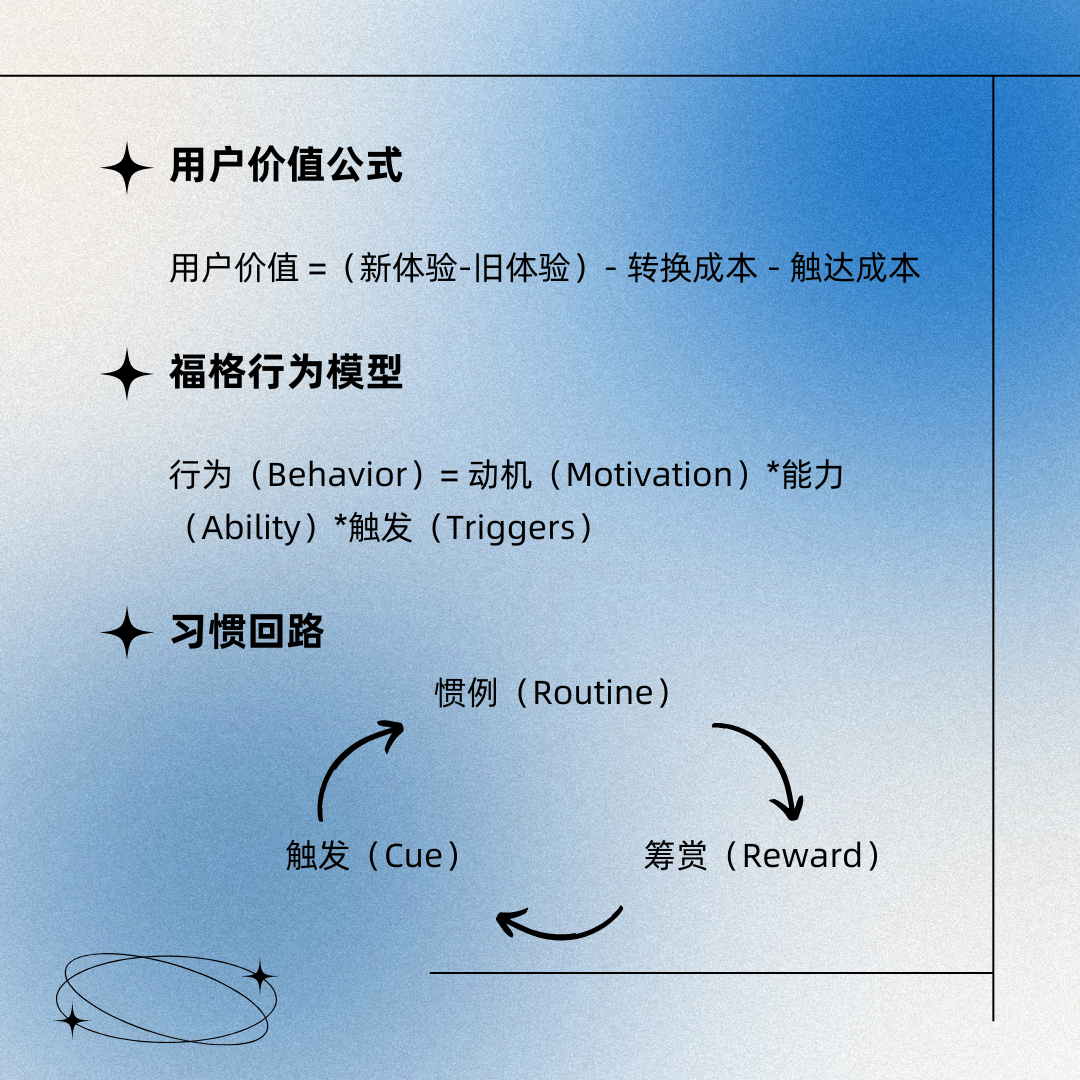
Today, the cost of reaching users is increasingly high; ultimately, we must return to users themselves, making the user value formula critical. The new experience brought by AI products compared to the old experience needs to create a 10X experience gap — only then can it effectively compensate for user switching costs and customer acquisition costs while generating sufficient value pull, thereby driving large-scale user and customer migration in a market with clear demand.
To think about AI product growth, we must also understand how user behavior changes, and Fogg's Behavior Model provides excellent guidance. How strong is user motivation, how low are capability barriers, and how frequent are triggers — these determine whether users will adopt a product from scratch. For example, AI products need to satisfy motivations of "pursuing pleasure, hope, and recognition; escaping pain, fear, and rejection"; remove capability barriers to using the product, such as time, money, and even mental effort barriers; and employ triggers including paid triggers, feedback triggers, and interpersonal triggers.
"Short-term look at activation, medium-term look at habits, long-term look at mindshare" — AI product growth must look beyond short-term acquisition to how to build better growth models and effective growth loops over the long term. Products like ChatGPT, Moonshot AI, Midjourney, and Leonardo.Ai have already established user habit loops in certain scenarios, where people have begun integrating these products into daily work or life and gradually formed stable mental associations.

Establishing habit loops is the most important thing after a product achieves PMF, determining medium-term growth, retention, and stickiness. Building habit loops requires continuous cycling of cue, routine, and reward, thereby breaking old habits and forming new ones. For example, when users discover after using an AI tool that it can dramatically improve their efficiency, that's the reward in the habit loop.
Methods for Improving AI Product Retention
Overall, compared to Web2-era products, today's AI-native products still have gaps in both new user activation and existing user retention. Drawing on frameworks from a16z and Bessemer Venture Partners, let's examine how consumer-facing and enterprise AI applications can improve user retention and prevent churn.
First, seven methods for consumer AI-native products to improve retention.
1) Demonstrate core product value as quickly as possible: Products should showcase their core value in the shortest time possible. Perplexity, for example, is clean and easy to use — users can quickly get started and personally experience the improvement in search efficiency.
2) Guide users to experience the "aha moment" during onboarding: In extensive product growth practice, teams discover a tipping point from quantitative to qualitative change — when a user's key behavior reaches a certain threshold, retention improves dramatically, the moment of converting from passerby to fan. For example, users of social products who add 10 friends within 7 days. AI products need to guide users to reach these thresholds quickly.
3) Design reciprocal mechanisms where users contribute to the product: "You get out what you put in" — the more users invest in a product, such as depositing their own creations and work, the harder it is to leave. For example, the AI video product Viggle requires users to create and publish videos before they can see others' work — this mechanism helps with both cold start and retention.
4) Use push notifications strategically: Design pushes around personalized information such as social feedback, badges, likes, and milestones.
5) Gamified check-in designs that maintain user continuity: The AI education product Duolingo, for example, incorporates numerous fun gamified check-in designs that help users gradually develop learning habits through gameplay.
6) Create summaries for users: Such as periodic or year-end reviews — generative AI can more easily produce personalized summaries.
7) Grant community status to influential creative users: Early product growth needs opinion leaders or KOLs in the community to drive momentum; providing them with incentives and guiding leaderboard participation can activate more users.

Next, six product strategies for enterprise AI applications to prevent customer churn.
1) Embed into existing platforms and workflows through integration and partnerships: The goal is to meet users where they are, reduce access friction, and demonstrate value in the shortest time possible. Methods include providing API interfaces, integrating into products users frequently use (such as Slack, DingTalk, WeCom), or offering Chrome extensions.
2) Deliver tangible work products: Enterprise AI products are best when they have clear deliverables, such as quickly generating reports, presentations, data charts, etc., enabling better quantification of product value.
3) Provide capabilities around the value chain to bring more value to ideal customer profiles (ICPs): In enterprise product growth, defining ideal customer profiles is crucial. AI-embedded products should think about how to provide more added value; AI-native products should provide more services to target customers around the value chain and in adjacent scenarios, rather than blindly expanding to other populations in the short term and failing to generate growth synergy.
4) Build moats using proprietary data or novel data techniques: As mentioned earlier, enterprise AI products can combine labeled data or proprietary fine-tuned small models to build growth moats — for example, EvenUp possesses extensive proprietary databases for different claims scenarios.
5) Achieve multimodality: Enterprise services typically require multimodal support, which in the future can increase product depth and satisfy diverse customer needs.
6) Maximize network effects through platform architecture: Consider how to build single-sided or double-sided network effects — network effects remain the most powerful moat for any product.

One final addition: early-stage AI product growth should also skillfully employ some unique growth methods. For example, community-driven growth can effectively help AI products cross the innovation chasm and form diffusion curves; you can also try using AI methods to capture traffic opportunities, such as AI-generated unique static pages and FAQs that can be indexed by search engines and social media to drive external links, making AI an amplifier of growth.
We look forward to connecting with more AI-native entrepreneurs and accompanying you on your growth journey.