ARR Keeps Climbing: From Deel to Dianxiaomi, Here's a Guide to AI-Powered Global Growth | Ronghui

Closed-Door Session on Global Growth
This summer, Bryan Kim, a partner at a16z, put forward a striking thesis — "momentum is the moat for AI products." As large models become a baseline capability that iterates rapidly, everyone starts from the same line. Whoever can build, iterate, and distribute products fastest — and capture user mindshare — wins. "Early distribution is everything."
One key manifestation of this momentum is ARR (Annual Recurring Revenue). AI products seem to be racing toward faster ARR growth.
- What unconventional yet grounded growth strategies are AI products using today?
- What did benchmark companies that hit $1 billion ARR in six years do right?
- How do you choose the best-fit regional markets for your product globally? And how do you build the corresponding global organization and compliance foundation?
Recently, Gaorong Ventures, together with partners including Deel and Huawei Cloud, organized a closed-door session on global growth in Shenzhen. Here, we bring together perspectives from five experts with different vantage points, all drawing from firsthand lessons in their global growth journeys (covering both B2C and B2B angles), to create this growth playbook.


On October 16, Deel announced a $300 million Series E at a $17.3 billion valuation. Deel provides one-stop HR and IT services for global teams, with wholly-owned entities in over 130 countries across North America, Latin America, Europe, Southeast Asia, Asia-Pacific, the Middle East, and Africa.
At launch, Deel had just one product: payroll services for flexible workers and independent contractors at multinational companies. It then expanded its product matrix based on customer demand, adding Employer of Record (EOR), Global Payroll, HRIS, AI products, and IT services — helping companies hire and pay global talent compliantly, anywhere.
Founded in 2019, Deel itself is a standout example of global growth. It reached $1 billion ARR in just six years, becoming the fastest-growing SaaS company ever, and has been profitable for three consecutive years.
Zihua Liao was Deel's first hire in Greater China. Drawing from his firsthand experience with Deel's growth journey, he offers three pieces of advice for AI products going global today.
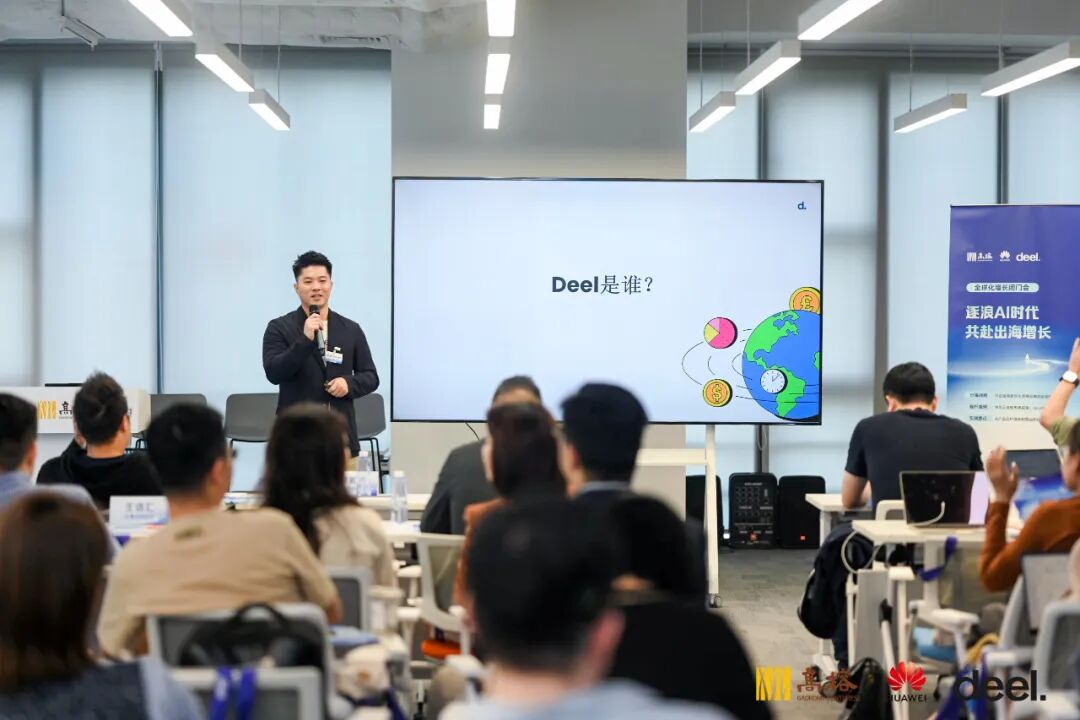
First, on Go-to-Market: when Deel enters a new market, it starts by assembling a lean local team, then defines and continuously refines strategy based on that team's feedback. Zihua emphasizes that after setting the broad strategic direction at the company level, Deel gives local teams considerable autonomy.
Second, compliance must be a priority from Day One in any global expansion. For example, companies can use Deel to handle overseas payroll, taxes, and local regulations — letting teams focus on business growth while avoiding compliance pitfalls.
Third, on talent in global expansion, Deel has always believed that "hiring the right person is the key" — "finding the right person delivers higher ROI than anything else." Deel's advice: "Don't settle for good enough." Aim for the best in the industry. Zihua stresses, "Especially with overseas hires — if you have even the slightest doubt, be cautious. Wait until your 'perfect match' appears, because hiring has real costs."

In the AI era, what has changed and what hasn't in application paradigms and product building? Wei Qi, founder of Rockbase and former head of AI product growth at a large model company, helped grow an AI SaaS application from zero to tens of millions of registered users and nearly ten million in ARR.

Wei points out that shifts in model capabilities at different stages have driven corresponding changes in application paradigms — and explosive growth.
For example, stronger language models (with few-shot learning, RAG, tool use, and longer context) brought the revival of chatbots and a boom in SaaS, exemplified by products like Notion AI and Gamma. Stronger multimodal models removed constraints on input and output types, spawning numerous image/voice/music/video generation, understanding, editing, and transformation products. Stronger reasoning models and complex task handling — such as Moonshot AI's K2 — are catalyzing the explosion of agent products and coding applications.
Wei notes that as models continue to iterate, we may see the emergence of personal dedicated agents, multi-agent systems, and AI with long-term memory or personality. This will test product teams' deep understanding and foresight about model capabilities, as well as their execution strength.
Saylo is an immersive virtual companion app from XVERSE, primarily targeting overseas markets. Users gain emotional value through interactions with AI characters in one-on-one chats, group chats, and story generation. The app reached #1 on the entertainment charts in China, Hong Kong, and Taiwan; and achieved strong rankings on local free and grossing charts in markets including the US, Japan, the UK, Malaysia, and the Philippines.
Yuhui Wang, Saylo's product lead, shared several insights on product building. First, Saylo maintains a leading position in full-modal capabilities, fully integrating XVERSE's AI image generation, AI voice calls, and AI video features to create more lifelike virtual characters and enhance immersive user experiences. For different overseas markets, Saylo pursues localization — adapting large language models, content, and operations to each market.
Lingdi Style3D focuses on empowering the fashion industry with AI and 3D technology. Its core product, the 3D simulation modeling software Style3D Studio, currently serves over 2,000 global clients including Chanel, Nike, ANTA Group, Bosideng, and Shein, with overseas clients contributing roughly 60% of revenue.
On how Style3D builds its product, Xinping Chen, COO of Lingdi Style3D, outlined three methodologies. First, clear positioning: Style3D focuses on the textile and apparel industry, delivering end-to-end empowerment across design, production, and marketing. Second, staying on top of technology trends: its self-developed AIGP (AI Generate Pattern) and fashion industry agent system DeepModa are world-leading technologies, integrated into product features. "As large models and multimodal technologies mature, they are in some sense redefining our product form." Third, disciplined product building with clear boundaries and customer prioritization. Xinping cautions, "Often we may be overly optimistic about overseas markets and the timeline for product-market fit. We need clearer-headed judgment."


A critical question when taking products abroad is: which market to enter first? Wei, drawing from her experience with an AI productivity tool, explains, "Generally you run broad campaigns across multiple markets first to understand customer acquisition costs and ROI for each region."
"If you're a subscription product, prioritize markets with higher ROI — for example in Europe and North America: France, Italy, Germany, the UK, Canada, Australia. If you're a traffic-driven product that needs large DAU, go where traffic is cheap: Southeast Asia, South America, Latin America, etc."
Yuhui adds that when a consumer app is selecting target markets, the first consideration is user-need fit. Saylo initially selected China, Hong Kong, and Taiwan, as well as Japan — a market with naturally higher demand for emotional companion products and better retention. Japan's consumer app market is hard to crack but defensible once you're in; user acquisition costs are high, but the moat is deep.
Second is market maturity and willingness to pay. Yuhui emphasizes that the per-user cost of large model applications (such as inference costs) is much higher than traditional internet apps, so you need to choose regions with real monetization value — markets with high willingness to pay and high ARPU — before investing in localized promotion.
Third is localization complexity: for example, religious and cultural factors, or policy restrictions on virtual characters.

Dianxiaomi focuses on SaaS services for global e-commerce sellers, having cumulatively served over 3.2 million users worldwide. It has deep partnerships with 70+ top e-commerce platforms, 1,700+ logistics providers, and 360+ overseas warehouses, processing over 30 million orders daily. Its product portfolio includes Dianxiaomi ERP and Saihu ERP, and it has established four overseas localized business lines: BigSeller for Southeast Asia, UpSeller for Latin America, 4Seller for Europe, and Duoke, a global AI customer service system.
Chenyong Tang, CMO of Dianxiaomi, notes that in selecting overseas markets, the company focuses on local e-commerce growth rates and penetration. For example, Dianxiaomi chose to enter Southeast Asia in 2020 when e-commerce coverage and growth there were both very rapid.
Xinping adds that Lingdi Style3D returns to two principles in overseas market selection. First, where are the customers? Second, how is competition evolving? "Style3D is B2B with a product form somewhat like Adobe's, serving a very vertical market. So our overseas path is clear: Europe, the US, and China as core direct-sales markets first; Southeast Asia, South America, etc. through distributors."
In practice, Lingdi Style3D acquired a German company to help establish local credibility and benchmarks, and to improve customer penetration. "The pressure created by market fit plus team execution has delivered real results."

Dianxiaomi provides SaaS software for e-commerce sellers, consistently adhering to a PLG-to-SLG growth model — always product-led first.
In its first three years in Southeast Asia, Dianxiaomi offered its ERP product free to local cross-border sellers. "With a great product, exceptional service, and zero price, we captured over 50% market share in Southeast Asia over three years and built our own moat and user base." Since beginning monetization in 2023, it has hit 100% of sales targets every year.
Wei believes there is no universal formula or standard playbook for growth. Teams should gradually build foundational growth capabilities.
First, continuously strengthen understanding of and matching with users and needs. **For example, when launching an AI product, you can find seed users through specific channels to achieve pre-PMF. To illustrate: for a B2B product serving cross-border e-commerce, you might find cold-start users in Facebook group chats.
Second, at the scaling stage, **this tests your deep understanding and operational mastery of channels — including traffic ceilings, funnel optimization, and ROI controllability across SEO/ASO, social media, influencers, paid acquisition, and other channels.
Third, cultivate the ability to capture attention.** "Today's users have very limited attention, so you need brand stories and creativity. That's why so many AI app founders are personally active, sharing user stories and use cases."
Fourth is product self-circulation — whether you have features that are "unique in your track, or superior where others exist." This shows up in retention or paid conversion that outpaces competitors, with a healthy growth flywheel and brand presence. A key trait of today's leading AI products is "usage is distribution" — for example, videos generated by Sora carry the Sora logo. This is "content as marketing."

An efficient, agile organization is the foundation of successful overseas business. Deel has 7,000 employees across 105+ countries. "Interestingly, Deel operates fully remote globally — not a single physical office. So Deel is also the world's largest fully remote organization."

Dialogue moderator: Chloe Xue, Deel APAC Head of VC & Startup Ecosystem Partnerships
The Deel team notes that global teams today can adopt more flexible hiring models, such as mixing full-time employees with contractors. But this requires investment in culture and communication tools. Deel empowers its team through knowledge bases, AI tools, all-hands meetings, and other means.
Especially with the rise of AI product teams today, "these teams are all very lean." Wei explains that in Silicon Valley, one closely watched metric is revenue per employee. "This organizational form differs greatly from large companies of the past, though of course this is enabled by AI productivity improvements." Growth teams can use approaches like Vibe Coding to build growth tools, run experiments faster, and face more diverse talent requirements.
For localization team building at B2B companies, both Dianxiaomi and Style3D have chosen a complementary model between headquarters and local teams. Dianxiaomi shares that country managers are preferably Chinese employees, paired with local ethnic Chinese as the number-two. Style3D has also drawn from leading overseas Chinese companies' experience, using a "stacked" approach to balance expatriates and local talent — creating a more stable structure and better transmission of headquarters' strategic intent.
There is no universal playbook or formula for global growth of AI products, nor is it about single-point breakthroughs. It is resonance across strategy, product, organization, and localization.
Ronghui looks forward to partnering with quality collaborators to accompany more founders in unlocking new possibilities for global growth of AI products.