Ruben Technology Closes Nearly $10 Million Series A, Unveils Flagship Intelligent Teach Pendant RVT

Make industrial robots accessible to everyone.
Recently, Ruben Technology, a company focused on developing robot motion planning and 3D vision products, announced the completion of a nearly $10 million Series A funding round led by Gaorong Ventures. In early 2018, Gaorong Ventures had invested in Ruben Technology's angel round. The new capital will primarily accelerate market expansion, drive product adoption, and strengthen talent development.
Founded in April 2018 by experts in robot control and motion planning, computer vision, and optics, Ruben Technology has focused deeply on motion planning and 3D vision. Positioning itself as a core component supplier, the company is dedicated to providing partners with high-quality hand-eye products and professional, rapid technical services, with the goal of becoming the "intelligent hand-eye expert" for the automation industry. In just two and a half years since its founding, Ruben Technology has launched three products: the powerful robot planning controller MPC (Motion Planning Controller), the high-precision non-contact visual displacement analyzer VDA (Visual Displacement Analyzer), and the high-precision, high-speed 3D camera RVC X. Leveraging these product advantages, the company has established deep partnerships with over a dozen leading systems integrators and equipment manufacturers across automotive, 3C, medical, coating, logistics, and engineering inspection industries.
On the team side, CEO Hui Li brings over ten years of R&D experience in machine vision, having previously held core research positions at internationally renowned R&D teams. CTO Qiang Qiu earned his bachelor's degree in mechanical engineering from Tsinghua University and his Ph.D. from the School of Mechanical Engineering at Shanghai Jiao Tong University, bringing deep understanding and extensive practical experience in robot control, planning, and related algorithms.
Will Robots Be Everywhere in the Future?
In recent years, automation has become a major trend and hallmark of industrial upgrading. Industrial robots are indispensable core components for driving intelligent industrial transformation, improving manufacturing quality, enhancing social productivity, and liberating people from heavy and harmful industrial labor.
However, industrial robots currently have relatively low penetration across the automation industry. According to CRIA statistics and IFR preliminary data, total robot sales in China in 2018 were fewer than 150,000 units — far below the number of manufacturing workers. Moreover, industrial robots are applied in relatively narrow domains, primarily automotive and 3C; most other industries have not adopted them at scale. Data from the Qianzhan Industry Research Institute shows that in 2018, robot sales in the home appliance and food industries were merely 4,930 and 2,640 units respectively. The root cause lies in the vast room for improvement in robot usability. Current industrial robot deployment mainly relies on experienced operators using teach pendants on-site to program robot movements point by point; the actual robot then simply repeats fixed paths. This approach demands highly experienced operators, and complex tasks often require repeated debugging before arriving at a program that meets process and cycle-time requirements. This point-by-point teaching method severely limits robots' potential — long training cycles and high experience requirements for operators; diverse robot types with varying usage methods; tedious task editing and lengthy deployment times. These high barriers to use and deployment costs restrict robots to industries with high standardization, stable production lines, and high product value, preventing their spread to other automation sectors. The industry needs more general-purpose, user-friendly tools for deploying robots.
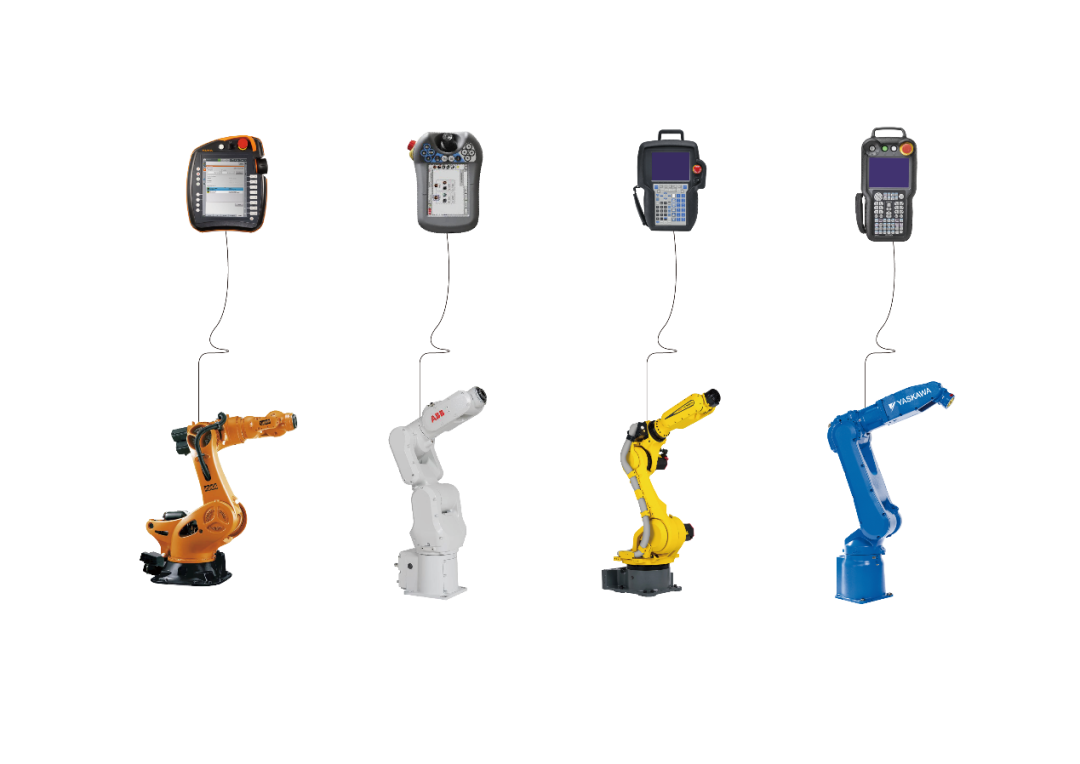
Teach pendants come in many varieties with different usage methods
Making Industrial Robots Accessible to Everyone
Ruben Technology's MPC planning controller, launched last year, aims to unify mainstream robot control interfaces while providing rich motion planning capabilities and development tools, enabling developers to quickly complete robot task editing and debugging through C++/Python, and to accomplish tasks that traditional robot teaching struggles with when combined with 3D vision. MPC significantly expanded robots' application scenarios, but still required users to have some programming ability. To address the difficulty of using robots, Ruben Technology consolidated its technical积累 in robot planning and control to introduce an entirely new product: the RVT Intelligent Teach Pendant (RVBUST Teach Pendant), which revolutionizes robot programming and human-robot interaction, replacing traditional point-by-point teaching and redefining what a teach pendant can be. The RVT Intelligent Teach Pendant makes robot operation more intuitive and simple, allowing beginners to quickly master deployment and debugging of multiple mainstream robots within just a few hours, dramatically lowering the barrier to operating industrial robots.
#Video: RVT Intelligent Teach Pendant

Broadly Applicable
Traditional robot manufacturers each have their own teach pendants and programming languages with different usage methods; yet different projects require different robot brands. To meet business development needs, integrators often need to assign operators for different robot brands according to project requirements, slowing business growth. Mainstream robot controller adaptation technology lets users operate all major industrial robots through a unified interface without worrying about robot model, enabling robot status monitoring, precise trajectory control, IO and external axis control, and error status retrieval and clearing — allowing anyone to become a multi-brand robot integrator.
Simple and Intuitive
Traditional industrial robot teach pendants have numerous buttons and only allow trajectory path point position and speed modification through parameter changes — operation is not intuitive and the interaction experience is poor. RVT can directly display robots and trajectories in a 3D interface. Based on trajectory planning technology, users can quickly update trajectories by dragging 3D path points or workpiece positions, making operation more intuitive and simple.
Easy to Learn and Use
Traditional point-by-point teaching requires robot operators to have extensive experience with both the robot itself and the task at hand; otherwise it's difficult to quickly teach complex trajectories that are collision-free, meet cycle-time requirements, and comply with process specifications. RVT features automatic planning technology — users need only set necessary task information (such as start and end points), and the system automatically generates robot motion trajectories that satisfy constraints, without requiring accumulated experience, lowering the professional demands on engineers for robot task editing.
Fast and Flexible
Unlike offline programming software, while providing fast and user-friendly task editing for different robots, RVT focuses more on the actual deployment and debugging experience. Based on online trajectory planning and robot control technology, RVT offers rich debugging functions to simplify task deployment. Trajectory testing: Using RVT, users can jog forward and backward along trajectories at any speed to test whether trajectories meet actual scene requirements.
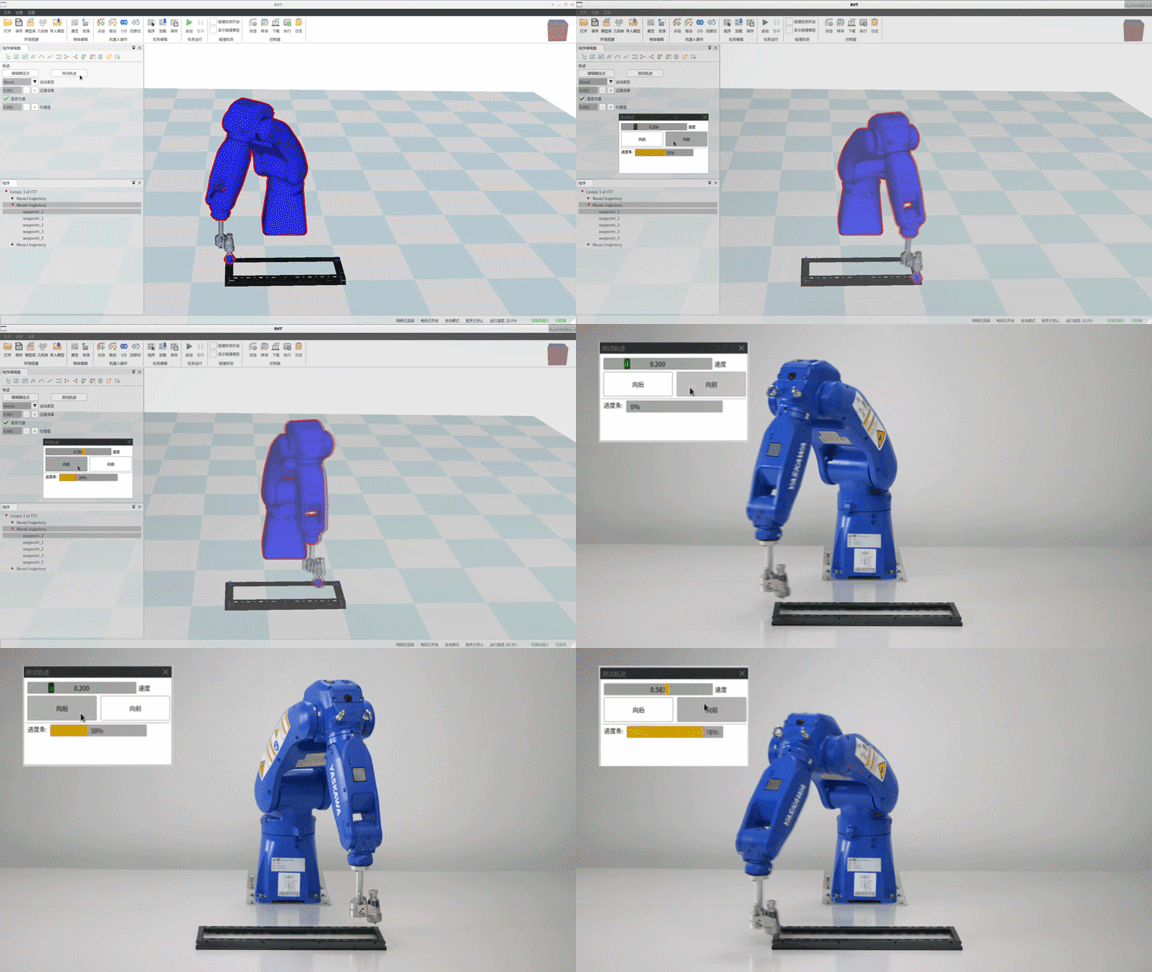
Trajectory testing speed and direction can be flexibly set, with progress bar for intuitive viewing
Soft Stop: RVT gives all robots a "soft stop" function. Unlike traditional emergency stops, "soft stop" can pause tasks at any time during trial operation, stopping the robot on the programmed trajectory without deviation; during this process, the controller maintains robot control, and after trajectory updates or problem resolution, operation can resume at any time without complex restart or reset operations.
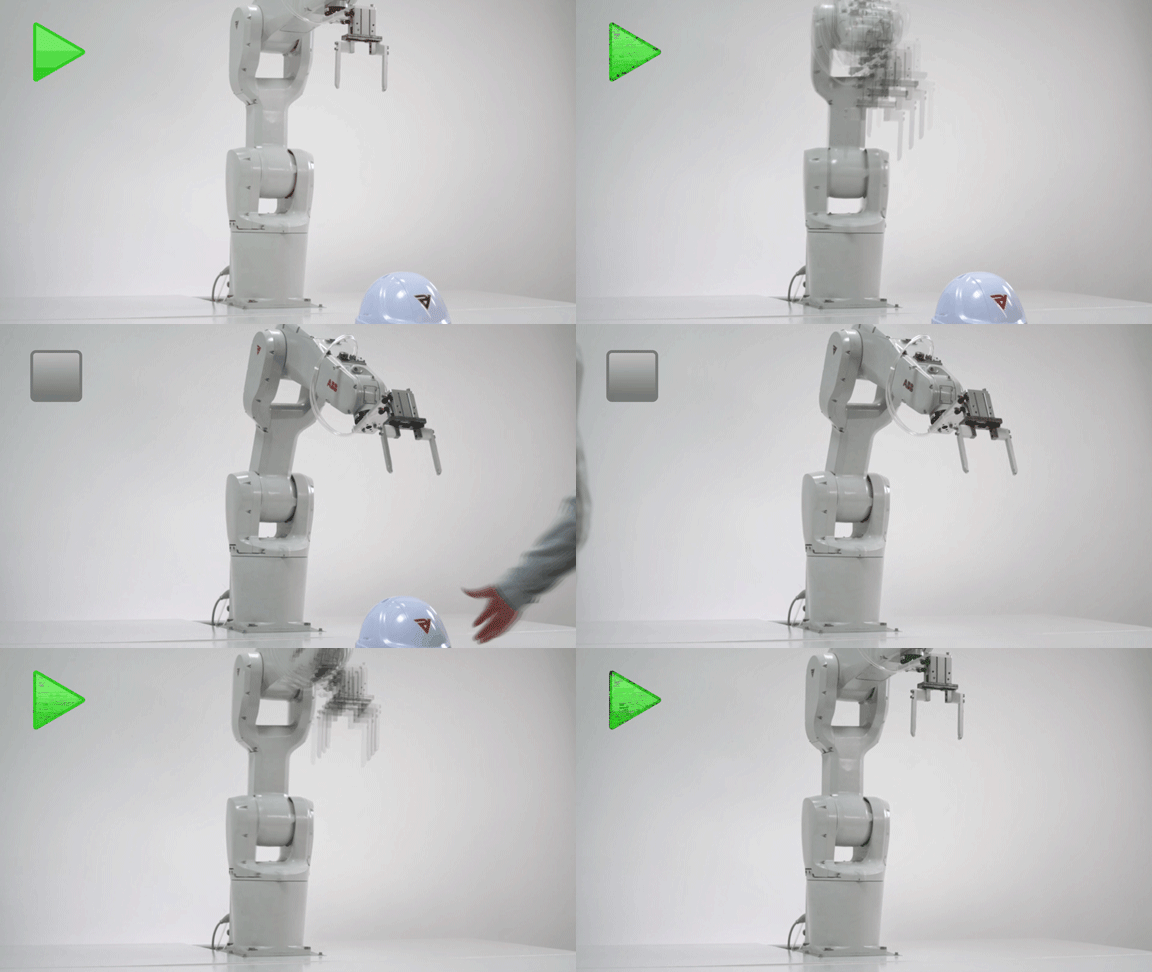
One-click pause on the programmed trajectory, one-click resume production
One-Click Return to Origin: During debugging, robots often need to be reset and programs rerun. RVT uses motion planning technology to plan collision-free return trajectories for robots stopped at arbitrary positions, enabling rapid reset.
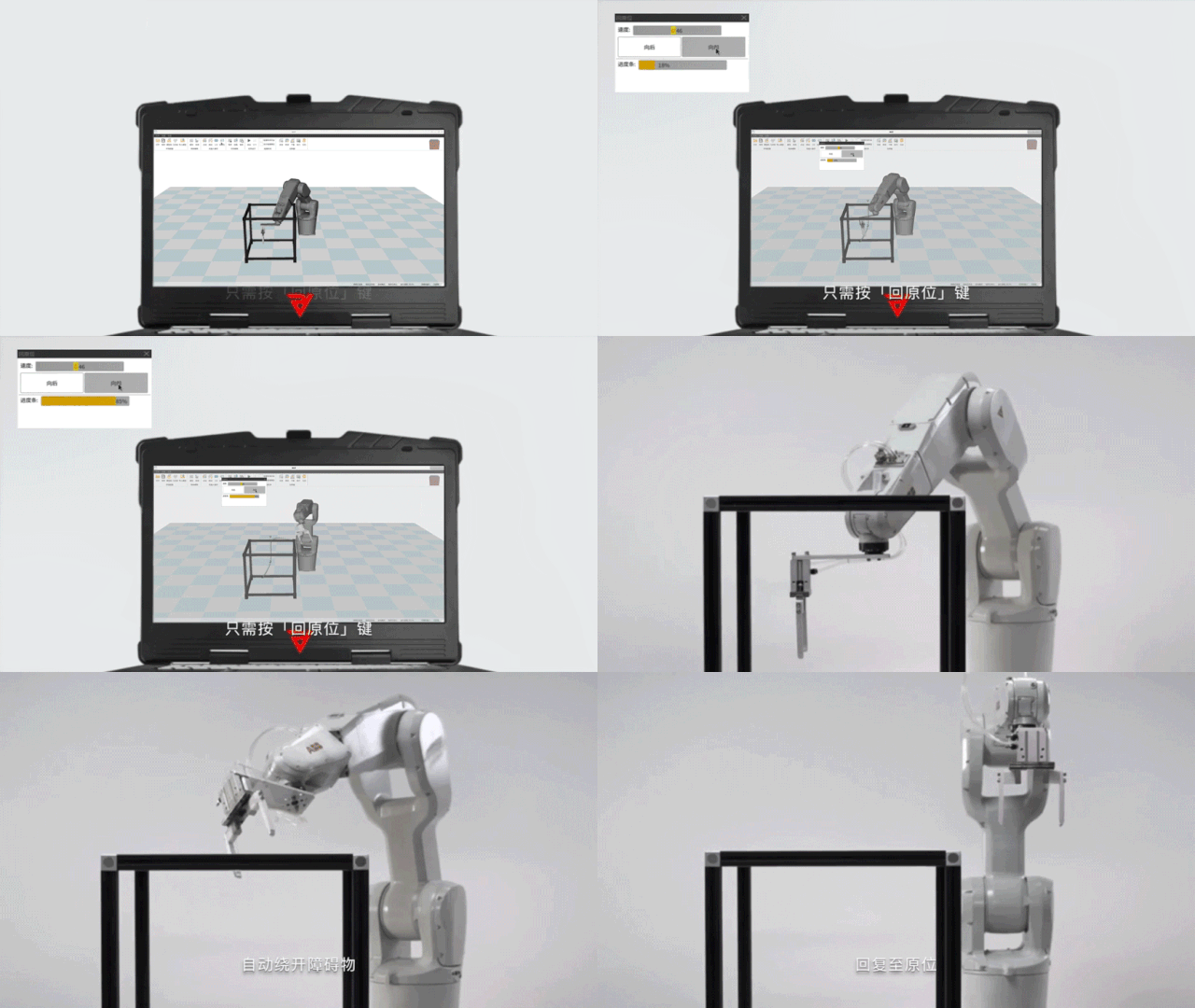
No production halt needed for debugging, one-click automatic return to origin
After users complete robot task editing and debugging, RVT can automatically translate task code into corresponding brand robot programs (such as ABB's RAPID language) and download them to the robot's own controller for independent operation. One RVT unit can deploy multiple workstations, plug-and-play, use and go. Ruben Technology CTO Qiang Qiu explained, "From the MPC planning controller to the RVT Intelligent Teach Pendant; from enabling developers to quickly use robots to enabling anyone to easily use robots, Ruben Technology has been committed to exploring and solving how to make robots more usable and widespread across more domains through combining motion planning and 3D vision technology. RVT integrates extensive R&D成果, using automatic planning and real-time control technology to let anyone easily use robots." Going forward, Ruben Technology will continue enriching RVT's functions, providing process support for more industries, and promoting RVT's standardized application across different sectors. It is reported that the RVT Intelligent Teach Pendant will make its debut at the upcoming September Industry Fair. Gaorong Ventures founding partner Yuebin Yue stated, "Making robots simpler for everyone to use — this is a difficult but correct endeavor. Over the past two-plus years, we have witnessed Ruben Technology's rapid growth. We believe this is a team that can steadfastly walk this path; everything is just beginning." Ruben Technology CEO Hui Li said, "Last October, we launched the fast, high-precision RVC series 3D cameras. Today we are releasing RVT, a product that enables everyone to use industrial robots. Ruben Technology remains committed to developing high-quality hand-eye products, and we look forward to collaborating with more partners to jointly advance the industry."