Before Mastering Taobao, Douyin, and Kuaishou Marketing Tactics, Learn Product and Data Thinking First | Ronghui

In the wave of data-driven marketing, marketing has become product and operations.
"In the wave of data-driven marketing, many marketing activities have essentially become product and operations functions. Take Tmall's marketing department — it used to be an event-planning team, but now it's an IP operations unit."
As people, products, and content have become fully datafied, brand marketing has shifted entirely to data-driven approaches. Meanwhile, the old model of brand advertising powered solely by individual creativity has become a massive waste of money for many companies. At a recent online salon co-hosted by Gaorong Ventures and Canjia Academy, Xia Ji — CEO of Molecular Union, former Alibaba marketing director, and former general manager of Bilibili's brand marketing center — shared how brands can excel at digital marketing and comprehensively improve advertising conversion efficiency.

Xia Ji noted that facing internet platforms with increasingly complex traffic logic and highly segmented user bases, brand marketers today need to do two things simultaneously: first, adopt a product manager's mindset to understand the product and traffic mechanisms behind different platforms; second, drive all decisions with data, using multi-dimensional analytics and "content horse racing" to continuously approach the optimal match between people, content, and touchpoints. Below is an edited transcript of Xia Ji's presentation:
The Marketing Revolution Brought by Datafication and Lower Content Barriers
The transformations in marketing stem from two major changes brought by mobile internet: datafication and the lowering of content creation barriers.
1. Change 1: Datafication
Today, all user behaviors — including browsing, clicking, purchasing, and location data — can be datafied. The complete datafication of people, products, and content has triggered two major shifts in marketing.
First, efficiency has improved dramatically. Marketing has moved from fuzzy to precise, from "human time" to "machine time." In the past, from strategy to content preparation to media selection to going live, a marketing campaign took at least two months. Now, almost the instant a user opens a page, machines can determine what content to show and which products to recommend — this is "machine time." Whether judging content quality or content-person matching, the speed is extraordinarily fast.
The second transformation from datafication is in information matching methods. From the information square represented by portals, to keyword matching represented by search, to today's dominant "thousands of faces for thousands of people" recommendation model. Marketing under this "thousands of faces" paradigm requires entirely new operational approaches.
2. Change 2: Lower Content Barriers
The lowered barriers to content creation in the mobile internet era has also brought massive change to marketing. The most direct impact has been an explosion of content, with creators shifting from PGC to UGC and interest circles continuously multiplying.
Previously, when marketers placed ads, they chose media outlets. Now they must choose different content creators or content touchpoints. And to select the right content touchpoints, product-oriented thinking and data-driven analysis are essential.
Marketing with Product Thinking: Understanding the Product Logic Behind Marketing "Playbooks"
Many brands and marketing professionals are already very familiar with the marketing "playbooks" on platforms like Taobao, Xiaohongshu, Douyin, Kuaishou, and Bilibili. But we need to be clear: these playbooks are determined by product characteristics. This is precisely why we need to approach marketing growth with product thinking.
1. Taobao: Super-Complex Product and Traffic Logic
2008-2016 was Taobao's "explosive hit" era. Back then, you could get massive traffic through "brushing" fake orders and gaming search rankings. But from 2016 onward, many merchants began feeling that Taobao had no traffic left, that ranking manipulation no longer worked, that investing in "Guess You Like" was useless. In reality, Taobao hadn't lost traffic — its product and traffic logic had become super-complex.
In early 2016, search traffic accounted for 80% of Taobao's total traffic. Merchants who did well on keyword SEO and SEM could influence large numbers of users under those keywords, and could push explosive hits up the rankings very quickly.
In the second half of 2016, "thousands of faces for thousands of people" began testing. The same keyword would yield completely different results for different users.
2019's Double 11 marked the full maturity of "thousands of faces." The 2019 Double 11 venue was fully personalized — for example, when different users entered the beauty products venue, the 120 slots recommended completely different products. Today, over 50% of Taobao's traffic is distributed through "thousands of faces" logic, which means brands can no longer get traffic through crude, one-size-fits-all methods.
Currently, the only traffic stream with targeted official support is livestreaming. Starting in the second half of 2019, to attract merchants to open store livestreams, Alibaba gradually increased the coefficient of livestreaming's impact on store weight.
We know that many factors affect store weight, including store/item PCTR, store DSR, store quality score, new product frequency, total fans/members, etc. One of these weights is "primary marketing tool/platform marketing share." This is actually an Alibaba operations tactic — when Alibaba wants to push a particular product or tool, it raises that tool's weight percentage. For example, the higher the percentage of store livestream sales to total store sales, the higher the store weight.
Beyond livestreaming, I recommend that everyone start paying attention to short video content production on Taobao from the second half of this year. Only when short videos take off will Taobao's content strategy truly succeed.
2. Xiaohongshu: Build a KOL Matrix
Brands doing marketing on Xiaohongshu know they need to build a KOL matrix. When a new brand launches, it needs to first find 1-2 top-tier Xiaohongshu influencers, plus a dozen or so mid-tier influencers and hundreds of micro-influencers. After basically 2-3 rounds of placement, brand awareness on Xiaohongshu will be established.
Why use a KOL matrix approach on Xiaohongshu? Let's analyze from the product perspective. First, Xiaohongshu has "favored daughters" — top-tier influencers are Xiaohongshu's "favored daughters" with natural traffic advantages, so you need to invest in top and mid-tier influencers whose influence on the platform is sufficient. Second, search placement is very important in Xiaohongshu's product design, with search traffic accounting for over 50% of total traffic, so you also need to invest in micro-influencers — this is essentially an SEO approach to increase brand exposure under target keywords.
Additionally, many brands know that while planting seeds on Xiaohongshu, you must simultaneously prepare for conversion on Tmall. The reason is Xiaohongshu's product positioning is high-end and quality-focused, with many products being brand-oriented, which involves price comparison — users will definitely run to Tmall to compare prices, creating the "Xiaohongshu plants, Tmall harvests" result.
Compared to Xiaohongshu, Douyin and Kuaishou, which also started as content platforms, found it easier to切入 e-commerce. Because the bulk of Douyin and Kuaishou e-commerce sales are actually non-standard products like snacks and fruits — categories where price comparison is impossible and purchases are more impulse-driven.
3. Douyin: Chase Content Hits
Douyin marketing doesn't require choosing influencers with large follower counts. Instead, you need to prepare large volumes of video content for testing, chasing content hits. Prepare multiple pieces of content for one product in advance, test continuously, and then scale up distribution for videos that perform well.
This marketing approach is fundamentally determined by Douyin's product characteristics and traffic distribution. Douyin's core product is feed + recommendation, with 80% of traffic coming from the recommendation feed and only 20% from following and search. The essence of recommendation algorithms is bucket testing, with the information granularity being individual videos, not people.
For each video, Douyin has a numerical ladder: 300-500-1000-3000-10000-50000-100000-..., up to a maximum of 15 million. That is, a video first gets 300 impressions to observe completion rate, interaction rate, like rate, comment rate, and other metrics; if above a threshold, it gets 500 impressions. Conversely, if it can't sustain the traffic, it stops there.
So on Douyin, influencers with tens of millions of followers have no algorithmic advantage. It's very normal for many influencers' video views to fluctuate in waves. Therefore, I recommend that when brands invest on Douyin, they first prepare at least 15-20 videos, use Douyin+ to buy 5,000-10,000 impressions for each video, and observe the user metrics each video generates — essentially using Douyin+ to do bucket testing. Then take the best-performing video and invest in feed ads.
4. Kuaishou: Core Is Choosing the Right Influencer Family
Kuaishou's core marketing "playbook" is livestreaming, and the core is choosing the right influencer family. Influencers will use连麦 (connected mic) to share users or fans, driving purchases. For example, Dong Mingzhu's Kuaishou livestream used the typical influencer connected mic approach.
Kuaishou's product DNA and user habits have created influencers' powerful private domain capabilities. Kuaishou launched short video with a following mechanism from the start — the product homepage was the following page. The product has changed, but user habits are hard to change. Kuaishou influencers with over 5 million followers have very strong号召力 because their fans are truly their fans — "old铁 is old铁" (老铁, or "old iron," is Kuaishou slang for close friends/fans), users who have long followed and liked the influencer.
So the fastest way to gain followers on Kuaishou is to get big accounts to bring you along — this "甩人" (passing people) method has formed Kuaishou's unique "families." Kuaishou's Simba, Er驴, and Sansha families are still the top three in Kuaishou livestream带货. So the core of promotion on Kuaishou is finding the right influencer. But regardless of family, Kuaishou user attributes are similar — they're all rather mixed.
5. Bilibili: "Traditional" Brand Play
I think promotion on Bilibili is more of a "traditional" brand approach. Due to Bilibili's commercialization characteristics, treating Bilibili as a traffic引流 platform actually works poorly; treating Bilibili as a brand platform to establish brand tone and brand values反而 yields better results.
Bilibili has been very cautious about monetization and commercialization since its founding. Bilibili's commercial atmosphere is more "鬼畜" (kichiku/mad remix) in nature — users will recognize you, and Bilibili users have very strong "deconstructive传播 capabilities," able to turn what brands do on the platform into social topics, thereby enhancing brand influence.
To summarize, when we use today's internet platforms for marketing and branding, we're all familiar with the "playbooks." But more importantly, looking at these platforms and products with a product manager's mindset reveals the reasons behind the playbooks, enabling further optimization. Today, all internet platforms run on data and algorithms. Only by understanding algorithms, traffic mechanisms, and user attributes can we leverage these platforms for better brand building.
How to Achieve Data-Driven Marketing: Based on Alibaba's Data System
Next, let's use Alibaba's data system as an example to see how to do data-driven brand marketing well.
1. Understanding Data
First, let's categorize brand data, which generally falls into first-party, second-party, and third-party data.
First-party data is the brand's own data, including CRM data, proprietary research data, IoT device data, etc.
Second-party data mainly refers to primary platform data. A通俗 understanding: if you can't clearly say whether the data belongs to the brand or the platform, it's second-party data. For example, when a brand opens a Tmall store, whether the consumer data from that Tmall store belongs to the brand or Alibaba is unclear — that's second-party data.
Third-party data includes purchased third-party data, or data obtained through co-marketing partnerships with other brands. There are already many third-party data monitoring platforms helping monitor WeChat, Douyin, Weibo, and other ecosystems.
Currently, very few brands have established complete first-party data centers, and not many brands truly make good use of third-party data. We'll focus on analyzing second-party data application. Opening a Tmall store or even a Taobao store generates substantial data, which is already sufficient for current needs.
2. Alibaba's Four Data Platforms and the AIPL Model
In my view, today in China there is only one platform that offers complete data support from marketing strategy formulation to落地 execution to results feedback — Alibaba.
Alibaba's data tools and platforms are very comprehensive, mainly including four platforms. First is the Strategy Center, focusing on industry and products, including consumer flow between brands and competitors, industry consumer trend changes, etc. Data Bank mainly focuses on brand-consumer relationships. DMP (Damo Pan) + Business Advisor mainly monitors store and traffic data. Promotion Black Box focuses more on tools and target audiences.
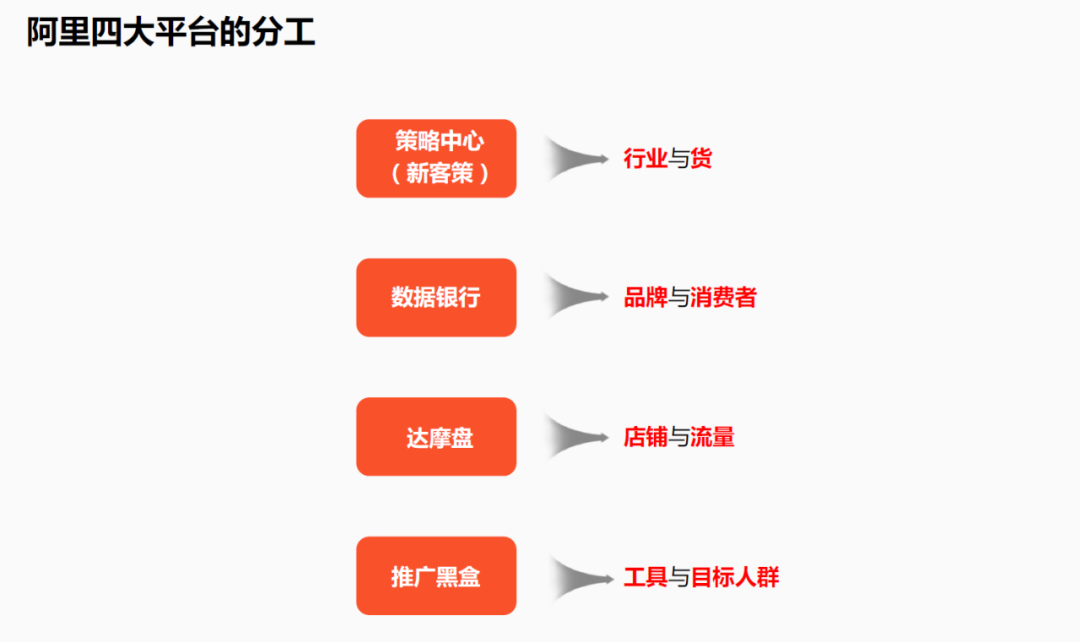
Among these, Alibaba's Data Bank focuses on the relationship and stickiness between brands and consumers. As traffic红利 disappears, everyone is paying more attention to customer lifetime value. Previously, the brand revenue formula was GMV = Traffic × Conversion Rate × Average Order Value. Now the formula is GMV = Customer Acquisition × Conversion Rate × Customer Lifetime Value. Previously, brands had only two relationships with consumers — bought or didn't buy. But Alibaba Data Bank supports还原 the entire journey from Awareness (A) to Interest (I) to Purchase (P) to Loyalty (L), known as the consumer AIPL model.
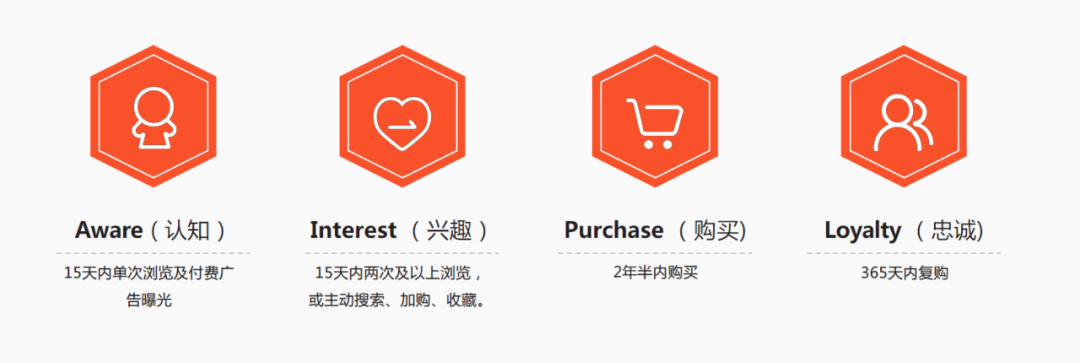
For example, previously when you placed a brand ad that reached 10 million people, you only knew that 200,000 eventually bought. But among those 10 million, there might have been 5 million interested in the brand, with no way to track this or know which channels to use for重复触达. Based on the AIPL model and consumer touchpoints, we can fully track consumer flow and brand-consumer interactions, then use different content to influence consumers at different layers — this is the foundation of精细化运营.
3. Case Analysis: Why Did a Brand's 618 Campaign Underperform?
Next, let's look at how to use data for marketing through a real brand case from 618.
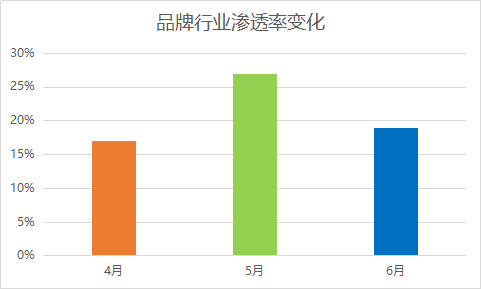
This shows a brand's industry penetration rate from April to June. Despite increased investment during 618, June penetration actually decreased compared to May. Here penetration doesn't mean GMV penetration, but buyer penetration. Because in the vast majority of categories, different brands substitute for each other in consumers' wallets — if a consumer buys Brand A, they basically won't buy Brand B in the short term.
Through analysis of a series of data, we can dissect the reasons for the penetration decline.
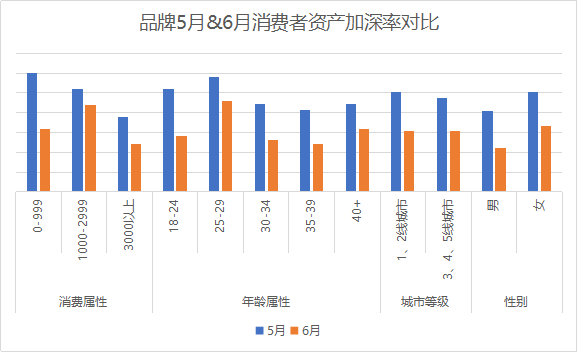
First look at a metric called "deepening rate." The deepening rate refers to the percentage of consumers whose relationship with the brand deepened by one step, including consumers moving from A to I, I to P, and P to L. As seen in the chart below, this brand's overall deepening rate declined in June — consumers were farther from the brand, indicating serious user conversion problems.
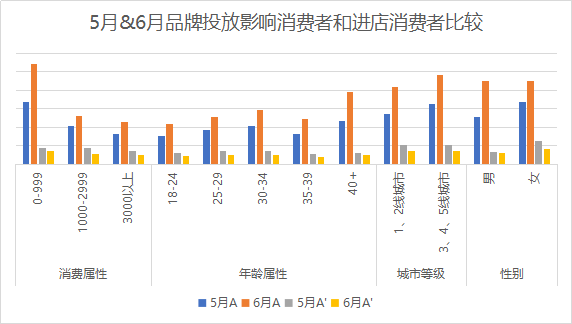
Where did the user conversion problem come from? Looking further at the comparison of consumers influenced by the brand's May and June campaigns (A bars) versus consumers who entered the store (A' bars). We can see that June influenced far more people than May, but store entry numbers were actually lower. More spend, less traffic.
Why? Beyond intensified 618 competition, another important reason — the投放人群 wasn't right. Based on Alibaba's data system, we can profile consumer attributes for groups with different behavioral characteristics. We can see that during 618, this brand's "A人群" differed significantly from its "PL人群": while over 70% of actual brand purchasers were female, only about 52% of influenced users were female. Actual purchasers skewed young, but the campaign reached more older users. By city tier, actual purchasers came more from tier-1 and tier-2 cities, but the campaign targeted more lower-tier users. By spending amount, actual purchasers were higher-spending Taobao users, but the campaign targeted more low-spending users.
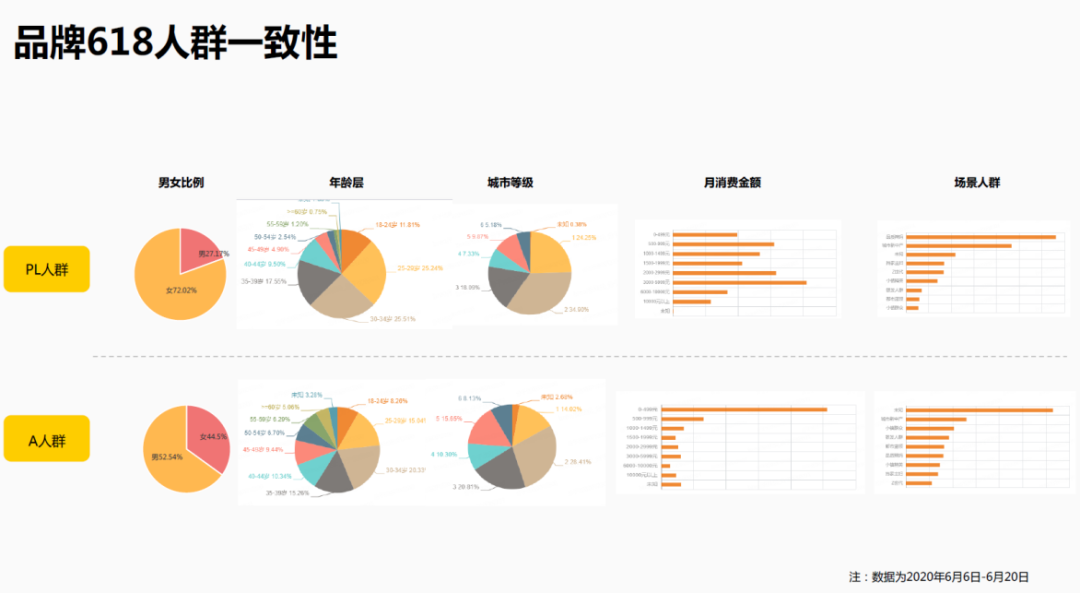
At this point we can conclude that the brand's biggest problem during 618 was in投放 — failing to do targeted audience segmentation.
4. How to Develop Brand投放 Strategy Based on Data
Next, still using Alibaba's data platform, let's discuss how to develop advertising投放 strategy based on data analysis. Generally, this can be summarized in four stages.
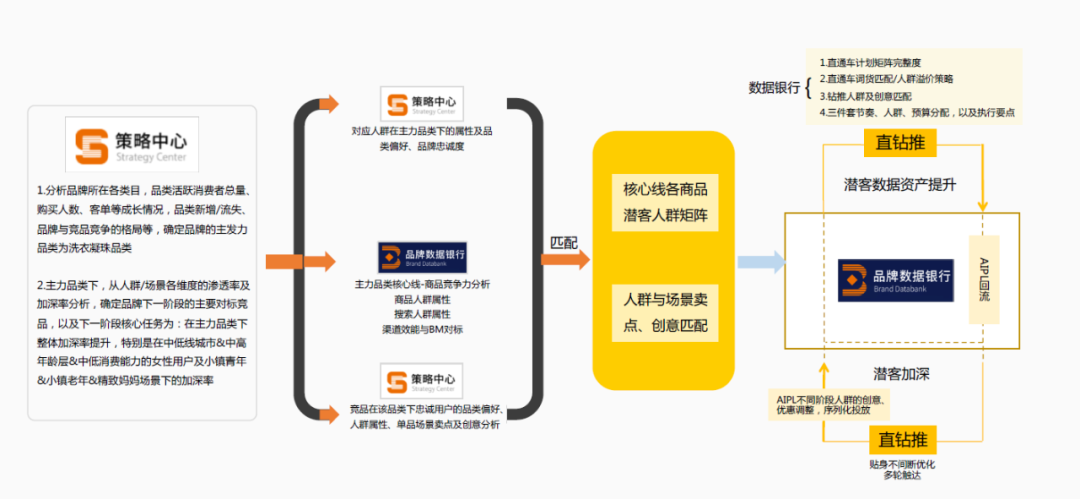
First, by benchmarking overall penetration, new customer ratio, and deepening rate against main competitors, as well as penetration and deepening rates across different user groups (Alibaba defines eight groups including Gen Z,精致 Moms,小镇 Youth, Urban Silver Generation, etc.), identify which competitors are fighting for the same users. The core is confirming who to benchmark against next, the core mission, and the primary audience direction.
Second, confirm the next stage's category direction and set target KPIs. First, through multi-category growth analysis and category brand gains/losses, confirm the brand's main focus categories. For example, if a sub-category is overall a fast-growing blue ocean market, and the brand has price advantages in that category where a price adjustment can capture more users, this indicates the brand has advantages in that category relative to competitors. Additionally, by calculating the GTA gap against the next stage's target competitor, including how many new customers, returning customers, and how much GMV are needed, the team's KPIs and marketing budget can be determined.
Third, confirm the next stage's primary channel focus. Through efficiency analysis and value透视 of different channel touchpoints, benchmarking against competitor channel gaps, and combining with brand operational characteristics, the focus for traffic improvement in the next stage can be determined.
Finally, through single-product and channel AIPL analysis and product competitiveness analysis, confirm next stage's single-product matching, establish audience matrices for different scenarios, determine target audiences, and do people/product/scenario matching to clarify "attack weapons."
In reality, today's marketing投放 is continuously doing combinations and matching of three elements: content (including products, prices, promotional information — all are content), people, and touchpoints. This is why we say marketing today is doing operations work.
Finally, let me share a常规 rhythm strategy for new product data operations. It's generally divided into five stages: data accumulation period, audience optimization period, content horse racing, full-domain penetration, and core harvest period. In reality, new product operation strategy is "tested out," especially the selection of new product content expression which we call "content horse racing." Previously, 4A agencies made endless proposals; now we test large volumes of UGC content for data performance and effectiveness, find the content that truly influences users or generates user interaction, and then do large-scale投放.
To summarize, in today's marketing environment, the core operational philosophy is — from users, to users. And may all entrepreneurs make good use of the data engine to efficiently reach real users.


Hyperparameter's Liu Yongsheng: Exploring Evolutionary AI in Virtual Worlds
When Traffic Is More Expensive Than Gold, How to Do Traffic Growth? | Ronghui
The Advancing Enterprise Service Track: What New Growth Ideas for 2020? | Gaorong Sharing