BioGeometry Closes $100 Million Series A Round to Advance Self-Evolving Microscopic World Model Toward Superintelligence in Life Sciences

Bringing the Recursive Self-Improvement (RSI) Paradigm to Life Sciences
Recently, AI-native biopharmaceutical company BioGeometry announced the completion of its Series A+ round, bringing total Series A funding to over $100 million. The round was led by China Life Private Equity Investment Company Limited, with existing investor Shanghai Biomedical Industry Equity Investment Fund contributing additional capital. Guokai Technology Venture Investment, RuiLi Investment, Guofang Capital, and several leading biopharmaceutical industry players followed on, while existing investor Fortune Venture Capital continued to increase its stake. Gaorong Ventures had exclusively led BioGeometry's angel round in 2022 and has continued to invest in subsequent rounds. The new funding will primarily support continued iteration of GeoFlow (molecular-level) and GeoCell (cellular-level) — its two micro-world models — expansion of high-throughput automated laboratories, and commercialization of its proprietary drug pipeline.

Bridging Molecules and Cells: Building Multi-Scale Micro-World Models
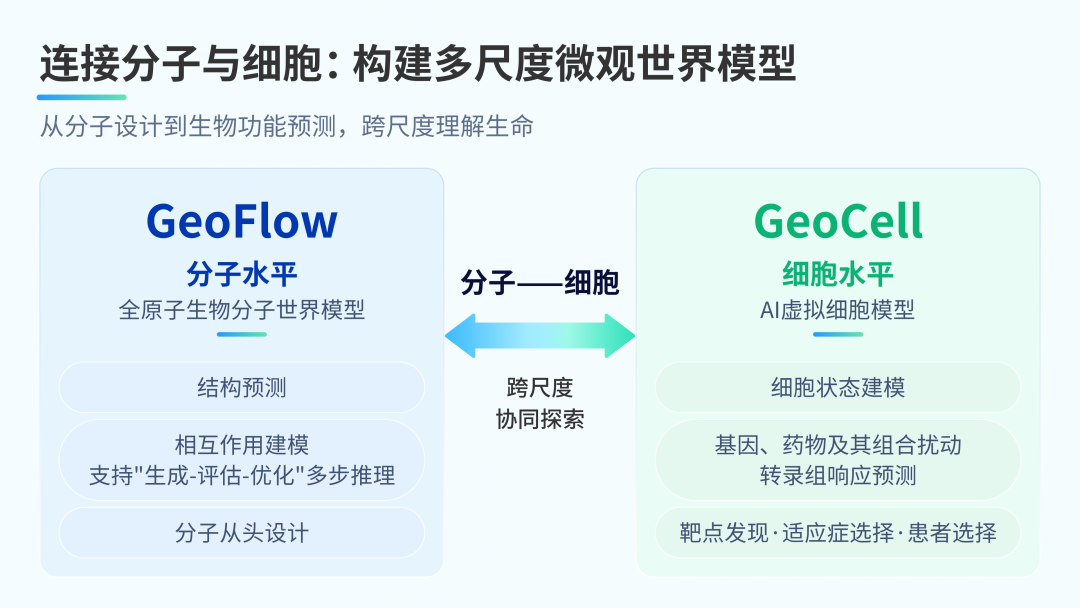
The crux of life science R&D lies in understanding connections across scales: how molecular structure and interactions influence cellular function, and how cellular responses to interventions help explain molecular mechanisms. BioGeometry addresses this challenge by building a micro-world model system that bridges "molecule to cell." GeoFlow is a full-atom biomolecular world model at the molecular level, continuously integrating structure prediction, de novo design, and multi-step reasoning capabilities. GeoCell operates at the cellular level, modeling cell states and their responses under various perturbations. Together, they enable cross-scale exploration from molecular design to biological function prediction.
GeoFlow: From Structure Prediction and Molecular Design to Complex Molecular Systems
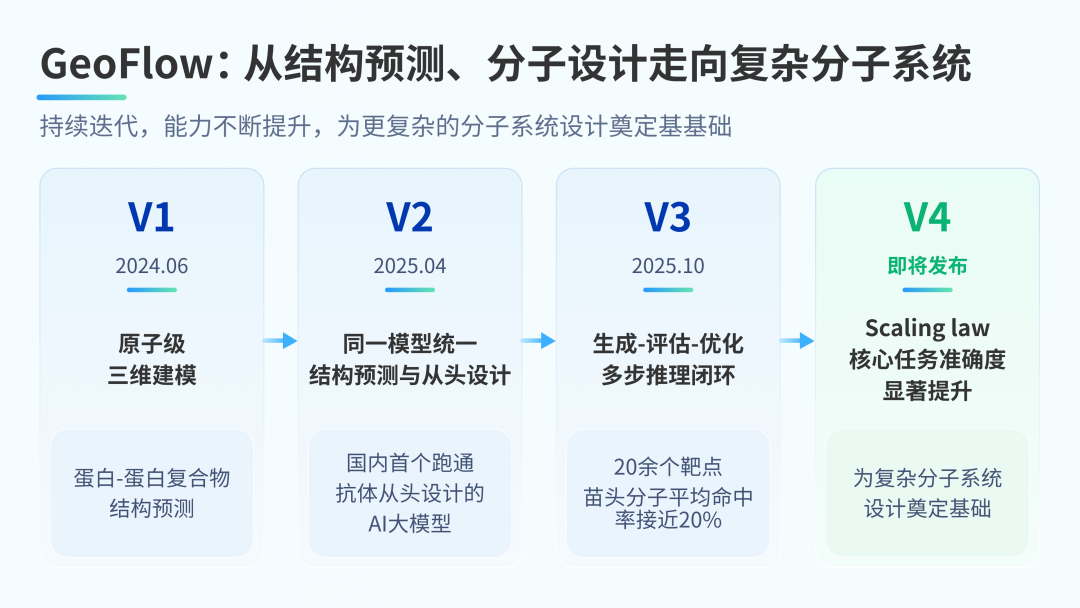
GeoFlow has undergone three generational leaps in two years: V1 (June 2024) directly modeled three-dimensional space at the atomic level, achieving protein-protein complex structure prediction on par with AlphaFold 3; V2 (April 2025) was the first globally to unify structure prediction and de novo design in a single model, becoming China's first AI large model to successfully execute antibody de novo design and breaking the monopoly of overseas closed-source models; V3 (October 2025) introduced for the first time a "generate-evaluate-optimize" multi-step reasoning loop, mimicking the antibody affinity maturation process for autonomous evolution. Across more than 20 targets, hit molecule average hit rates approached 20% — nearly a 100-fold improvement over previous AI methods — with lead discovery timelines compressed to within three weeks.
The upcoming GeoFlow V4 follows scaling laws, expanding simultaneously in model parameters and training data. Core tasks including structure prediction, interaction modeling, and de novo design show significant accuracy improvements over V3, laying groundwork for more complex molecular system design.
GeoCell: From Molecular Design to Disease Biology
Molecular design is only the starting point. Whether a drug succeeds depends on whether the target truly drives disease, and in which patients it works — answers that lie not in the molecules themselves, but in disease biology. BioGeometry's self-developed AI virtual cell model GeoCell uses generative AI to model cellular transcriptomic responses to genetic, drug, and combination perturbations. It can predict cell state changes under unseen perturbation conditions, reconstructing causal chains of disease development and intervention response at the computational level.
Thus, GeoCell permeates the three most experience-dependent stages of R&D: target discovery — identifying targets that genuinely drive disease phenotypes; indication selection — determining which diseases a molecule is most likely to treat; and patient selection — predicting which populations will respond to intervention.
GeoFlow answers "what molecule to design"; GeoCell answers "which target to hit, which disease to treat, and for whom." Together they form BioGeometry's "molecule-cell" micro-world model, with deepening understanding of disease biology as data and validation results accumulate.
RSI Wet-Dry Closed Loop: Recursive Autonomous Evolution of Micro-World Models
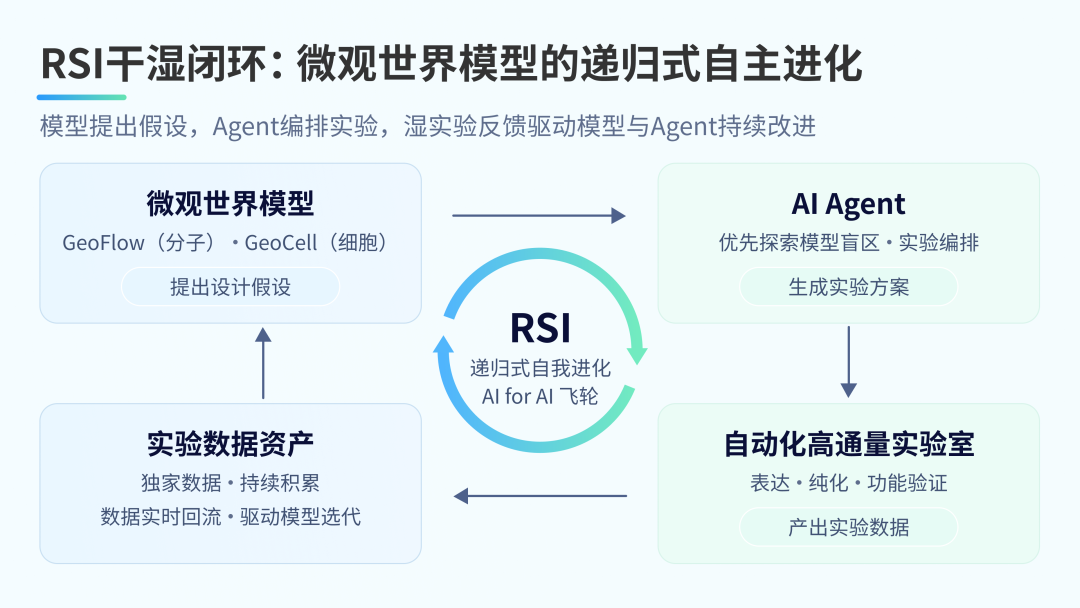
AI is evolving from "humans training AI" to "AI training AI" (AI for AI), with recursive self-improvement (RSI) viewed as the core path toward superintelligence. BioGeometry brings this paradigm into life science, where every "self-improvement" is validated by real wet-lab experiments.
BioGeometry connects models with automated laboratories through AI Agents, forming an RSI wet-dry experimental system: the model proposes design hypotheses, the AI Agent automatically generates experimental protocols and orchestrates workflows, the high-throughput platform completes expression, purification, and functional validation, and data flows back in real time for model iteration — a "design-experiment-learn" cycle that repeats continuously.
The AI Agent prioritizes hypotheses that most expose model blind spots; the model corrects biases and improves design capabilities from real feedback. The model grows "smarter with use," the Agent grows "more capable with practice" — forming an AI-for-AI flywheel in biology, while continuously accumulating proprietary experimental data that others cannot replicate.
This funding round will support building automated high-throughput laboratories, enabling the RSI flywheel to spin faster with greater throughput and shorter feedback cycles.
Biopharmaceutical and Synthetic Biology Dual Engines, Realizing Platform Value
BioGeometry has built a portfolio of dozens of proprietary drug and synthetic biology product pipelines. On the biopharmaceutical side, multiple bispecific antibody programs are expected to enter IND stage by 2027. On the synthetic biology side, more than five product pipelines including α-ketoglutaric acid (AKG) and natural borneol have completed pilot-scale production. Notably, natural borneol has been biosynthesized for the first time globally, with costs reduced by 80% compared to plant extraction — it is approaching scaled production and will generate scaled revenue by 2027.
Models drive pipelines; pipelines feed back into models — as GeoFlow and GeoCell continue to iterate, the RSI loop deepens, and proprietary pipelines accelerate, BioGeometry is approaching an inflection point where technology and commercialization converge. This funding round will accelerate this process, strengthening the system's capabilities to pose questions, validate hypotheses, and autonomously improve, advancing toward superintelligence in life science.