BioGeometry Closes Angel Round, Next-Generation AI to Power Macromolecular Drug R&D

Released TorchProtein, the first open-source machine learning platform for macromolecular drug discovery.
On September 21, 2022, BioGeometry announced the completion of its $10 million angel round, with Gaorong Ventures as the investor. The team also released TorchProtein, the first open-source machine learning platform for large-molecule drug discovery, dedicated to accelerating drug R&D through AI.

Founded by Jian Tang, a leading scientist in graph representation learning Next-generation AI technology to accelerate drug discovery
BioGeometry was founded in 2021 by Dr. Jian Tang, an associate professor and tenured faculty member at Mila, the Quebec Artificial Intelligence Institute at the University of Montreal. The company is dedicated to developing next-generation AI technologies — including geometric deep learning and deep generative models — for large-molecule drug discovery. The company has also gained the recognition and support of Turing Award winner Yoshua Bengio, one of the "godfathers of deep learning" and a professor at the University of Montreal, who will serve as the company's scientific advisor.
The company is building two foundational platforms: an AI-powered large-molecule drug design platform and a high-throughput wet-lab validation platform for large-molecule drugs. Through a closed loop of computational and experimental work, it aims to rapidly complete candidate drug design and improve the success rate of candidates in clinical stages.
The continuous improvement of computing power, combined with the exponential growth of high-throughput biological data production, has ushered in a new era of drug discovery and development for scientists. From molecules and proteins to medical knowledge graphs, AI models and datasets are constantly reshaping the biopharmaceutical landscape through massive amounts of graph-structured data.
BioGeometry founder Dr. Jian Tang graduated from the School of Electronics Engineering and Computer Science at Peking University, served as a researcher at Microsoft Research Asia, and conducted postdoctoral research at Carnegie Mellon University and the University of Michigan. Dr. Tang has done pioneering work in graph representation learning and is among the earliest scholars internationally to apply deep learning to graph-structured data.
Dr. Tang received the Best Paper Award at ICML 2014 (the only one from China) and a Best Paper Nomination at WWW 2016, one of the top conferences in data mining. His representative work in graph representation learning, LINE, published in 2015, has been widely recognized by universities and industry both domestically and internationally, with over 4,500 citations. He has served multiple times as an area chair for top machine learning conferences including ICML and NeurIPS, and has received multiple faculty research awards from companies including Amazon and Tencent.
As early as 2018, Dr. Tang realized in his research on graph representation learning that the most killer application might emerge in the biomedicine field. He pioneered the application of graph representation learning and geometric deep learning technologies to drug discovery, conducting extensive innovative research on molecular property prediction and structural property prediction. Dr. Tang led his team to develop TorchDrug, the first open-source machine learning system specifically designed for drug discovery, aimed at promoting open-source sharing of AI in drug discovery and accelerating the entire drug R&D process, which attracted widespread attention.
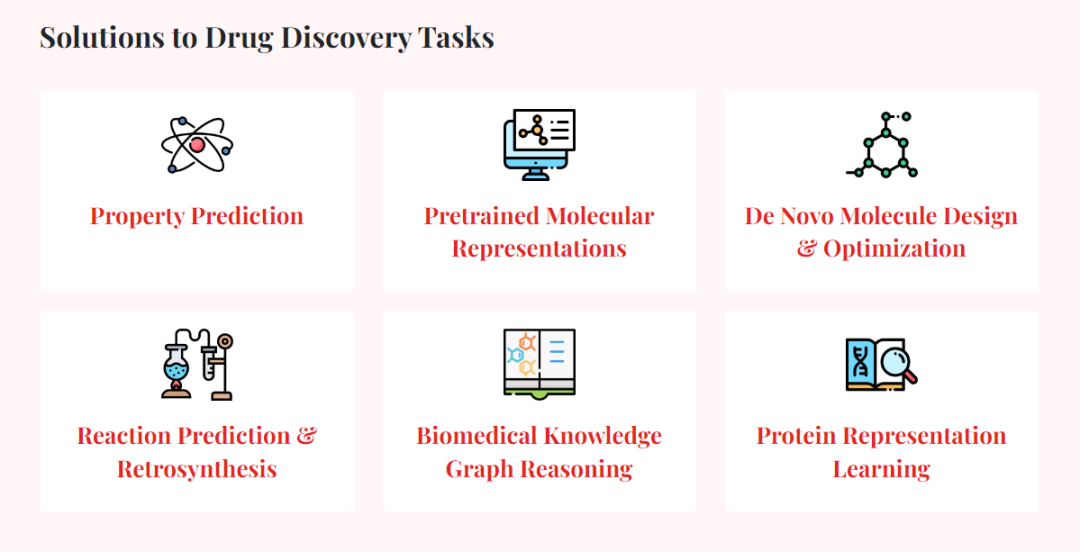
Open-source machine learning system TorchDrug solutions
AI large-molecule drug design platform completed Antibody optimization and structure prediction reach world-leading levels
Currently, BioGeometry has essentially completed the construction of its AI large-molecule drug design platform, achieving world-leading performance in tasks including antibody structure prediction, antibody optimization, antibody sequence design, and enzyme activity prediction.
The company's high-throughput wet-lab validation platform for large-molecule drugs is also being built in collaboration with renowned universities and laboratories in the biomedicine field to advance cutting-edge work. The company hopes to accelerate the drug R&D process through a closed loop of computational and experimental work.
At the same time, the team has collaborated with NVIDIA, Intel, IBM, and other companies to jointly release TorchProtein, the first open-source machine learning platform for large-molecule drug discovery. The platform open-sources a general framework for deep learning-based large-molecule modeling, the first pre-trained large model based on 3D geometric structures of proteins, and a standard benchmark dataset specifically designed to evaluate deep learning performance on protein modeling.
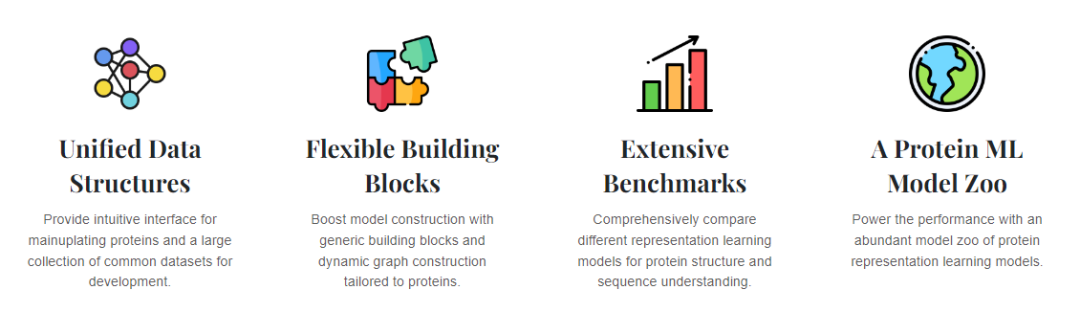
Advantages of open-source machine learning platform TorchProtein (for large-molecule drug discovery)
The team has already established partnerships with multiple prestigious universities and companies both domestically and internationally to jointly advance AI in drug discovery.
Dr. Jian Tang stated, "We are currently at the intersection of the AI and biotechnology revolutions. On one hand, geometric deep learning technologies such as AlphaFold2 have made tremendous breakthroughs in molecular modeling. On the other hand, biotechnology represented by synthetic biology enables rapid reading, writing, and editing of genes, creating massive amounts of data for AI. The deep integration of these two revolutionary technologies brings enormous opportunities for biomacromolecule design."