BOSS Zhipin CEO Richard Zhao on Organizational Design: Rules Should Be Simple, Structure Should Be Flat, Titles Should Be Real | Ronghui Practical Sharing

The growth of an organization is a miraculous journey of life.
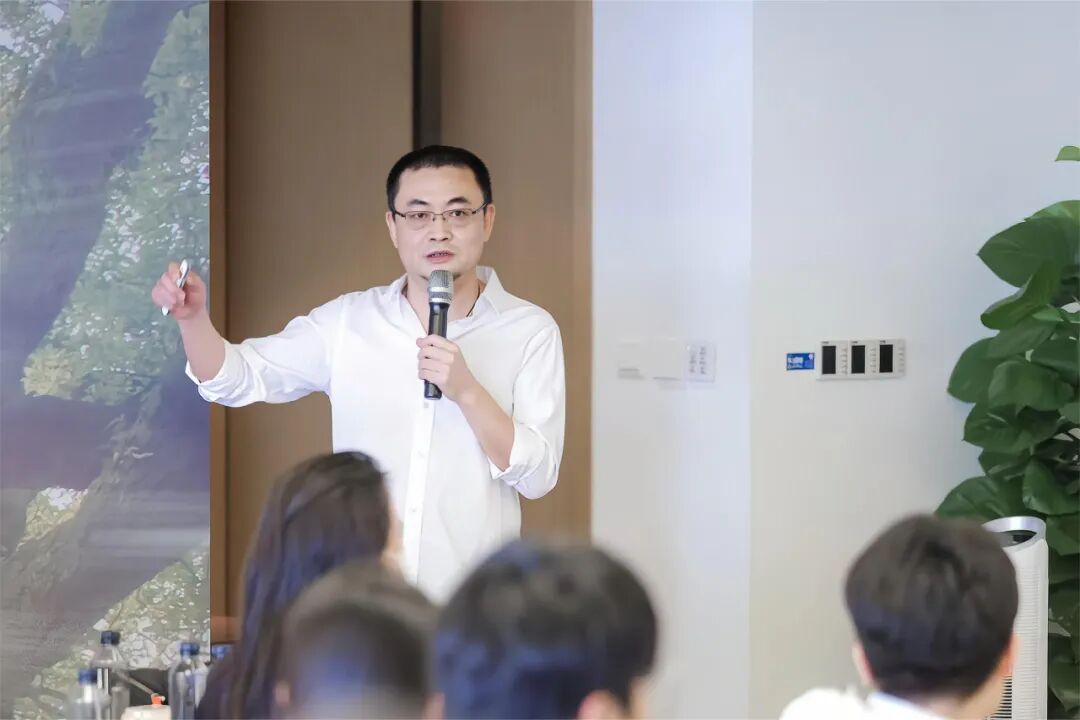
This article is adapted from a talk given by Zhao Peng, Chairman and CEO of BOSS Zhipin, at Gaorong Ventures' "Organizational Upgrade Season" event, shared with founders from Gaorong's portfolio companies.
The image Zhao Peng chose to close his presentation was the same one used at BOSS Zhipin's 2016 funding press conference. "At the time, I picked it because it's the blue ice of Lake Baikal — extraordinarily beautiful. Today, I chose it because the broader environment is a bit cold. But within that cold, there is much beauty — beauty we likely wouldn't notice in the summertime."

On the topic of "organizational structure," Zhao Peng believes that a company operates like an evolving organic lifeform, and the process of organizational growth is a miraculous journey of life. As a founder, participating in this journey brings tremendous joy and reward.
As Zhao Peng put it: "Entrepreneurship is a fascinating journey. In a frozen world, we go searching for that beautiful blue."
In his talk, Zhao Peng offered his distinctive perspectives on the evolution of corporate organizations, entropy increase caused by falsehood and blockage, rule-making based on common denominators of human nature, innovation and "getting it right," and the cultivation of talent and leadership.
The following is an edited transcript of Zhao Peng's remarks:
Gaorong gave me a topic: corporate organization. My knowledge comes from two sources. First, eight years of this entrepreneurial journey — from three or four people to several thousand. I've been both a participant and an observer, remembering certain things and forming certain views. Second, reading and reflection — my understanding of our species, Homo sapiens. Putting these together, let's look at corporate organization. What I'm offering today isn't systematic, but I hope some of it helps.

A Corporate Organization Is an Evolving Organic Lifeform
If I had to sum it up in one sentence: a corporate organization is like an organic lifeform established by individual lives according to rules and operational objectives. The defining characteristic of this organic entity is its capacity for evolution.
From a biological perspective, Homo sapiens as a lifeform — aside from skin color and hair — has undergone essentially negligible physical evolution over tens of thousands of years. Each of us, throughout our complete life journey, strictly speaking experiences no fundamental evolution of our core self.
But a corporate organization's evolution can be dramatic, because enterprises must constantly adapt to their environment. The commercial world undergoes natural selection every single day. This gives entrepreneurs a fascinating experience: the ability to witness, with the naked eye, the evolution and metabolism of an organic lifeform — something an individual cannot experience alone.
When observing a startup's organizational evolution, three time points matter: year one, year three, and year eight. First, you must survive "one to three." 2018 central bank statistics showed that the average lifespan of Chinese enterprises is 2.5 years. Making it to three years already puts you above average. Next is "three to eight." Historically, many companies become interesting around year eight. Steve Jobs returned to Apple, and in his ninth year launched the first iPhone. Tesla launched the Model S in its ninth year. Most fascinating is "eight to N." Looking back at many large companies, you'll find they looked completely different at twenty-something than they did at eight. The most formidable enterprises are always those that evolve most dramatically.
In 1871, physicist James Clerk Maxwell, to illustrate the possibility of violating the second law of thermodynamics, imagined a tiny demon — "Maxwell's demon." Picture a room divided in half by a wall. A demon sits atop it, able to detect and control the motion of individual molecules, sending fast ones to the left and slow ones to the right. Over time, the left side becomes hot and the right side cold — achieving a low-entropy state.
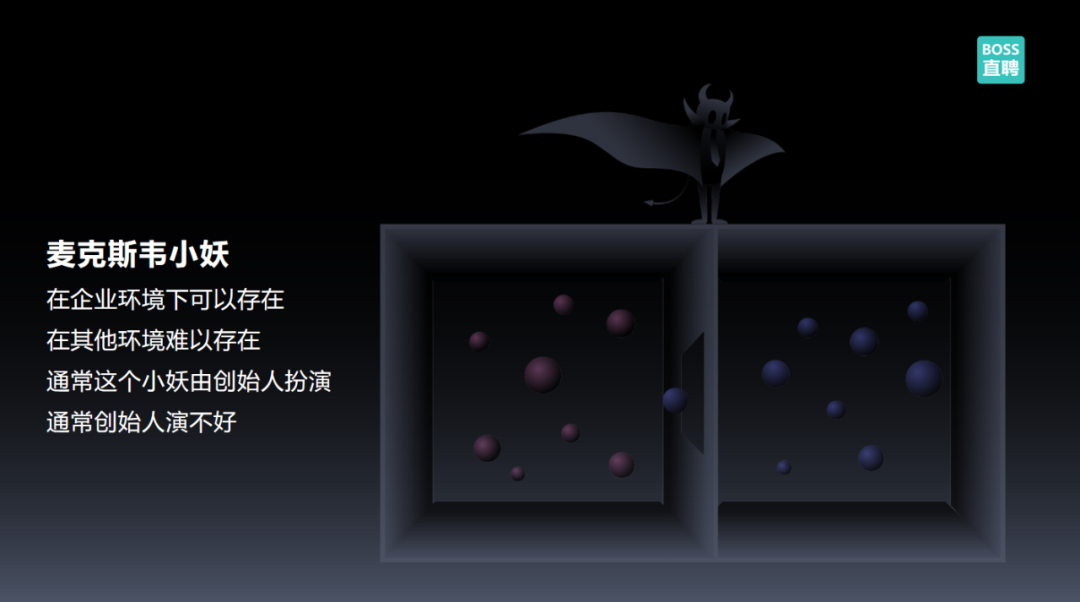
Maxwell's demon is difficult to sustain in other environments, but in a corporate setting, it can exist. Every entrepreneur's daily, constant work is to prevent theoretically irreversible entropy increase in their enterprise — so we are all playing the role of Maxwell's demon. Adjusting and optimizing talent distribution, for example, is a classic selection process.
Yet in reality, while founders should be preventing entropy increase, many end up being the primary source of it — causing talented employees to leave or "lie flat," while less capable ones become managers.
Statistics tell us that most Chinese enterprises are like annual or biennial herbaceous plants. There's a common biennial plant — the scallion. A small number of enterprises grow into perennial trees. So China's enterprise market consists of vast grasslands, some scallions, and a small number of trees. For those that evolve from grass or scallion to tree, their "Maxwell's demon" has done its job — this is a necessary condition.
Rules Should Be Simple, Structures Flat, Titles Genuine, Rewards Clear
No organization can function without two things: rules, and operational objectives.
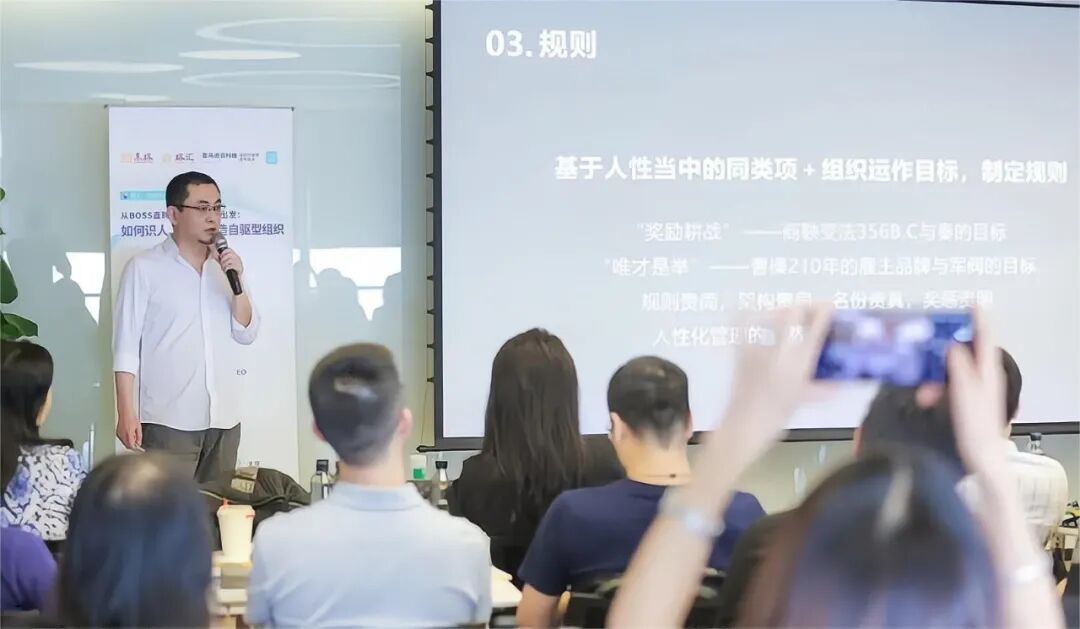
In 356 BC, after entering Qin, Wei Yang proposed a rule — "reward agriculture and warfare" — drastically simplifying the rules for Qin as a western frontier state. Qin's organizational objective was equally clear: to become number one, even to monopolize.
In 210 AD, Cao Cao raised a banner of "promote the capable regardless of background." This was his employer branding, shaped by the environment of the time. The realm of the Three Kingdoms belonged to warlords, and warlords valued warfare. The saying "when the state is in peril, one thinks of good generals" stemmed from the warlords' objective of conquest. Cao Cao set aside values to solve the most pressing problem.
After eight years of entrepreneurship, my experience is this: in enterprises, rules should be simple, structures flat, titles genuine, and rewards and punishments clear.
When Liu Bang entered Xianyang, he established three laws: "death for murderers, appropriate punishment for those who injure or steal." When Wei Yang entered Qin, it was "reward agriculture and warfare; without military merit, no noble title." Both exemplify the principle that rules should be simple.
These years, we often see 10,000-person companies with excessive layers, elongated structures, fake titles, and VPs everywhere you look. Falsehood is entropy increase's intimate companion.
As enterprises develop to a certain stage, they recruit talent from major tech companies, who bring "big company culture." They ask for "humanized management" — no need to come in mornings, no clocking in, emphasizing that hours don't matter. At this point, we must distinguish: is our management "based on human nature" or "based on individual preference"?
All management rules must extract common denominators from human nature — "greed, anger, delusion, arrogance, doubt" and "benevolence, righteousness, propriety, wisdom, faithfulness" are all human nature — then combine these with operational objectives to formulate rules. A viable corporate rule must be founded on respect and understanding of human nature; but demands for personalization beyond the rules are privileges to be wary of.
Distributing money is technical work. Entrepreneurs often fall into a trap: negotiating with employees, asking if they'd take less since it's a startup. At that moment, you're already being insincere. Using lower pay to find more capable people who deliver greater contribution — this violates fundamental principles. Many companies have low offer-to-hire conversion rates, especially when founders invest massive time, energy, and heart — most likely, the money wasn't distributed properly. First and foremost in entrepreneurship: follow the rules. No matter how many rules, values, or technical elements a corporate organization has, it first becomes an organization based on economic purpose, economic interest, and economic bonds.
A company with sound values helps attract talent. If we believe a corporate organization is a lifeform whose members must collaborate, people with sound values can likely cooperate well with others. This is because human values, properly formed, are built upon shared history and social order, inherently pointing toward collaboration. Some people are highly capable but deeply flawed in values — "rather he wrong the entire factory than the factory wrong him." Such people can work solo, be a lone wolf, but rarely generate productivity within an enterprise.
A company with sound values, bringing together people who can collaborate well and are capable, makes itself stronger. Good interaction among people, between the organization and its community, between humanity and Earth, between ethnic groups, between intelligent life forms — this is the product of history, the optimal choice, and the origin of values.
Innovation Springs from Chaos; Success Depends on the Probability of "Getting It Right"
There's a term "trial and error." I want to talk about "getting it right." Trial and error is the denominator; getting it right is the numerator. We want the numerator.
Innovation's success is positively correlated with the probability of getting it right. That probability is positively correlated with the number of trials. The number of trials is positively correlated with resources (how much runway you have, how much money, etc.). And all of this depends on the efficiency of each trial.
This efficiency correlates with only one thing: who is the person responsible for this attempt at getting it right. Whether that person is right is the watershed moment — sometimes one right person makes it right.
So founders must ask themselves: if getting the right person is crucial, how high is this on your priority list? If you work 70 hours a week like Elon Musk, how many hours go into getting people right? Get the people right, and the problem is likely solved.
Innovation always springs from chaos, even disorder. It's the result of free growth, even Brownian motion. I've even seen people establish dedicated departments — "the must-innovate department within the enterprise." This happens constantly: big companies do it, mid-sized companies do it, sometimes even small companies do it — usually to little effect. "Organized innovation" is either chasing trends, copying others, or sometimes mere self-comfort.
Innovation is actually a form of destruction — destruction of old cognition, old paths, old models, even old leadership cadres and old organizational structures. We have an unconventional approach to innovation, called "three survivals." If a young team member says "I want to innovate," ask them these three questions. First: if this fails, will the company survive? Because there are unaffordable efforts, unspendable money, and unmakeable mistakes. Second: if this fails, will this young person's own sharpness survive? Third: will their team's sense of honor survive? If the company survives, their sharpness survives, and the team's honor survives — then why not do it?
The vast majority of innovations ultimately fail; this we must endure. No one can a priori prove something is "the right thing." And human nature tends to avoid error, so sometimes we need to encourage people before they'll dare to innovate boldly.
Every Battle Is for Training Troops; Learn from Eastern Wu, Beware of Becoming Shu Han
Growth is the sign of a living enterprise. An enterprise not growing may be nearing its end. In our entrepreneurial experience, growth and development are two sides of the same coin — growth is the result, development is the cause.
How to develop? Learn from Eastern Wu, beware of becoming Shu Han. At the Battle of Red Cliffs, Eastern Wu's commander was Zhou Yu. When they later seized Jingzhou from Shu Han, the commander was Lü Meng. At the Battle of Xiaoting, Eastern Wu's commander was Lu Xun. Three generations of commanders, all homegrown talent — Eastern Wu's talent development speaks for itself.
Shu Han, by contrast, gained the veteran general Huang Zhong after Red Cliffs. Over a decade later, when Lu Xun burned the seven-hundred-li encampment, Shu Han's vanguard was still Huang Zhong. As the saying goes, "Shu has no generals; Liao Hua leads the vanguard." At a certain point, inferior strength or growth results fundamentally stem from inadequate talent development.
Another common pitfall in entrepreneurship: waiting until leaders are fully mature before appointing them. Leaders are made through use, not through waiting. Put the burden on them. When their core muscles aren't enough, when they can no longer carry it, extend both hands to support them, then help lighten the load. As a founder, sometimes you must watch someone make mistakes, let them experience it, bravely clean up behind them — because growth ultimately depends on one's own internal force.
There are certainly geniuses in organizations. If your organization acquires one, you must have a protective container for that person. Actually, rather than protecting them, it's about protecting everyone else. Genuinely believe that a corporate organization's capacity for geniuses is limited; there cannot be many.
Another counterintuitive insight about talent. Common wisdom says "train troops for a thousand days to use them for one; all training is for battle." As entrepreneurs, in developing leaders, believe this: every battle is for training troops. Because we can calculate when our enterprise begins, but not when it ends. Live one day, create one day, march one day, never stop — only thus might life be longer.
In entrepreneurship, in any market, there is no such thing as "decisive battle." No enterprise can say: after this battle, no war for thirty years. Since there is no decisive battle, every battle is for exercising the troops.
As enterprises gradually develop, they face a predicament: the "three ages problem" — team members' chronological age, company tenure, and psychological age. Some say they prefer young people; we must be clear — youth's essence isn't "cheap," but abundant time cost, sufficient cultivation cycles, higher odds of successful development. And regardless of which age, ultimately it's psychological age. How to discern someone's psychological age? First examine what goes through your own mind daily — are you living intensely, or merely not dead? See clearly, then observe others.
Communication Cost Is an Enterprise's Greatest Cost
Communication cost is an enterprise's greatest cost. Sometimes high communication costs stem from blockages we've built into the organization. These blockages force two people who fundamentally struggle to understand each other's work essence to try to understand each other — exhausting if they're in a upstream-downstream relationship.
Beyond removing blockages, daily communication methods matter. My own experience: in an enterprise, if you can stand, don't sit; if you can say it face-to-face in a few words, don't call; if you can clarify by phone, don't WeChat; if you can clarify by WeChat, don't email; if you can write a short email, never write a long one; and CCing one fewer person on an email is a contribution.
Future Organizations May Be New Species with "Distributed Brains"
On the entrepreneurial journey, we witness an organic lifeform — evolving, laughing, weeping, succeeding, failing, stumbling, being praised, being cursed. The process is truly miraculous; participating in it yields much reward.
Entrepreneurs place themselves within a collective organism, becoming part of a super-lifeform. We know that ants, bees — we can view their entire colony as one organism. There's a book called The Superorganism, studying collective organisms. In the science fiction work Ender's Game, the species humans battle is also a superorganism.
So our ideal, most powerful organization may be a new species. Definitely not a CEO as brain, but possessing a "distributed brain" — a superorganism composed of smart people (preferably smart and kind), operating according to iterable rules and iterable objectives.
If we accept that under modern civilization, in the Earth-humanity relationship, Homo sapiens as a species no longer requires natural evolution — because there's nothing left to adapt to — then our evolution may take one practical form: through "distributed brains" composed of corporate organizations. Some enterprises are indeed doing things that seem two centuries ahead.
So entrepreneurship is a fascinating journey. A corporate organization of 150 people — how much like a tribe of old. In that pastoral era, the tribe was a superorganism composed of individuals.