CDM Leader "CloudXinda" Closes Tens of Millions in Funding, Unlocking the Backup Data Gold Mine in the AI Era | Gaorong Future

The Data Foundation for the AI Era
As DeepSeek drives democratization in compute and algorithms, high-quality data has become the decisive factor in AI industrialization.
Copy Data Management (CDM), as a leading data management technology, goes beyond solving traditional problems of high backup costs and management complexity — it efficiently enables compliant data retention and agile data provisioning. As large AI models move into deeper waters, CDM's latent market value is surfacing: it could allow large models to directly consume backup data, unlocking this data gold mine.
Recently, CloudXinda (云信达), China's leading CDM vendor, announced the completion of a tens of millions of RMB Series C1 funding round. According to IDC reports, CloudXinda has ranked first in China's CDM market for three consecutive years with a 33.4% market share. Gaorong Ventures invested in CloudXinda's Series A+ round in 2020.
CloudXinda founder and CEO Bing Zhang has over 25 years of deep experience in data management. Recently, we spoke with Zhang to unpack the mutual empowerment between CDM technology and large AI models.

The following is Bing Zhang's sharing (edited):

2024 was a very eventful year for the U.S. data management track.
In February 2024, Cohesity, a "new force in CDM," announced its acquisition of veteran data backup company Veritas, with investments from NVIDIA and IBM. Shortly after, Cohesity launched Gaia, an AI assistant based on RAG (Retrieval-Augmented Generation) technology, becoming the first to help enterprises gain instant, high-quality insights from on-premises backup data. Jensen Huang of NVIDIA stated, "Cohesity is backing up and protecting data across the globe, and customers can use GenAI to unlock this commercially valuable gold mine."
In April 2024, data security company Rubrik listed on the NYSE with a market cap exceeding $10 billion; in November, cloud backup platform EON raised new funding, reaching a valuation of over $1.4 billion in less than a year since founding, committed to providing instant access to all backed-up cloud data through a next-generation platform.
These cases all demonstrate that beyond large models, data management has become a battleground, and the CDM + AI combination is unleashing entirely new value.

CDM technology can be traced back to around 2010. At that time, database leader Oracle and cloud computing leader VMware, seeking to make data backup more convenient, introduced "native format copy" technology — what Gartner later defined as "application-consistent soft snapshots" — which became the underlying technical foundation for CDM.
So-called "application-consistent soft snapshots" refers to making one-time, live mirror snapshots at each point in time while business systems are running online. This brought about an epoch-making change in data management.
Previously, data backups from business systems couldn't be used directly in production environments. It was like backing up phone data to a computer — it would form a packaged file that couldn't be opened directly on the computer; it had to be restored to a new phone to be usable.
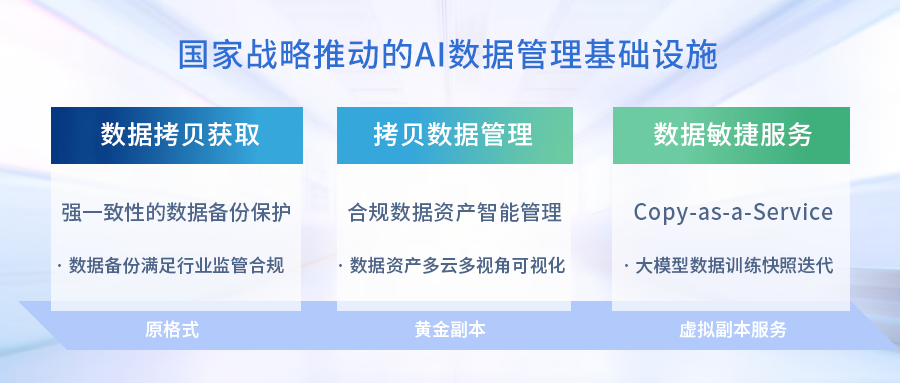
Native format copy, on one hand, enables recording and traceability of business data, which is the prerequisite for all compliance; at the same time, the backed-up data becomes visible and operable. Because soft snapshot data is in raw disk format, it can form "golden copies" on non-production storage, then generate multiple virtual copies directly mounted to servers for immediate use in backup recovery, disaster recovery, development and testing, and other scenarios. No additional physical copying is needed in the process, bringing revolutionary improvements to data management efficiency.
Building upon native format copy, CDM gradually evolved and matured into a full-lifecycle data asset management solution, composed of the CDM trilogy of "copy data acquisition," "copy data management," and "agile data services," ultimately achieving efficient, agile, secure, and controllable collection, management, and use of raw data assets within a unified copy data foundation.

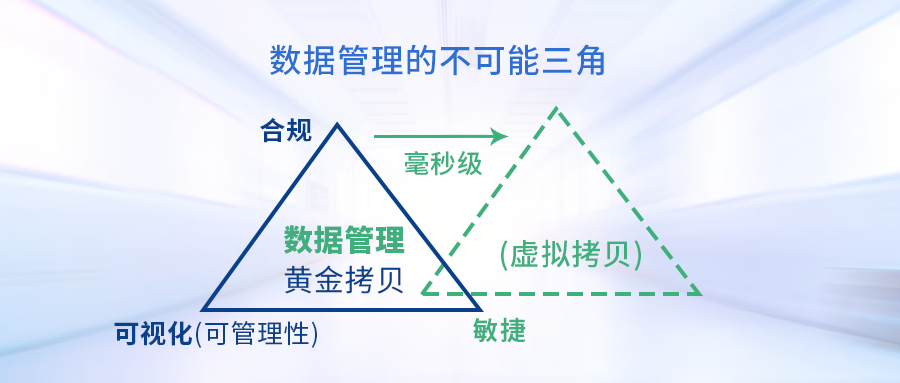
A key value of CDM lies in cracking the "impossible triangle" of data management.
The "impossible triangle" is everywhere in our lives and work. In investing, for example, returns, liquidity, and safety form an "impossible triangle"; in distributed systems, the famous CAP theorem — Consistency, Availability, and Partition tolerance — is also an "impossible triangle."
CDM technology cleverly combines golden copies and virtual copies — golden copies achieve compliance and manageability, while pointer-based snapshots clone unlimited virtual copies at millisecond speeds, achieving agility and low cost — thereby breaking the "impossible triangle" of data compliance, manageability, and agility.

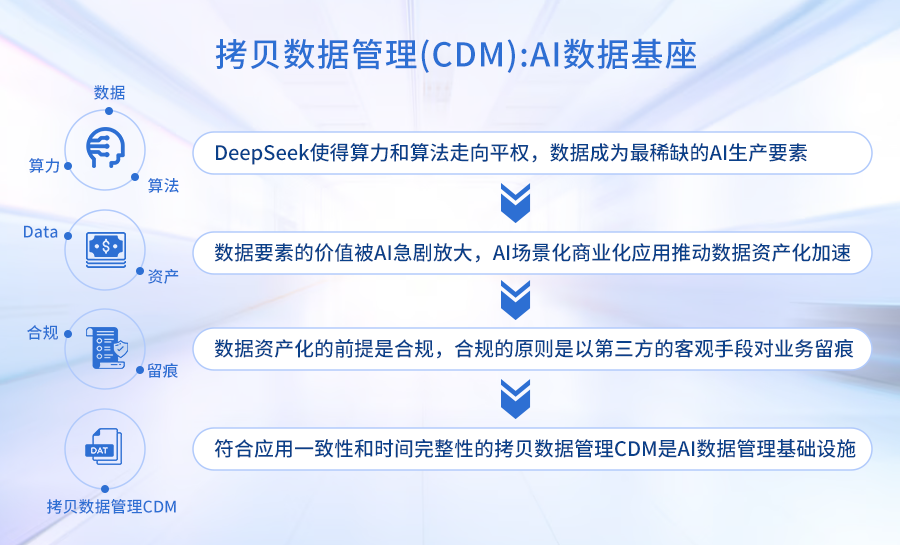
With DeepSeek's emergence, the AI field is seeing democratization of compute and algorithms. As AI enters vertical business scenarios, data becomes the scarcest production factor, accelerating data assetization.
The industry is calling for future-oriented data management infrastructure — one that end-to-end satisfies data compliance and agility across the entire chain of data collection, management, and circulation.
CDM, from its very inception, is about traceability of business data, conforming to application consistency and temporal integrity, fully matching compliance requirements; simultaneously, compared to traditional backup, it is directly usable, providing agility; moreover, data is decoupled from original applications. Thus it is positioned to become a core infrastructure-level technology supporting AI.
Looking further ahead, as AI moves into deeper waters, it will need real, valid, uncleaned raw data, which it then identifies, retrieves, and cleans itself, ultimately generating results or achieving reasoning. Backup data happens to be exactly the high-quality data AI needs. I believe that as more enterprises connect backup data directly to large models, unlimited potential will be unleashed.

Over the past few years, based on independently controllable innovative CDM technology, CloudXinda was first to meet the domestic substitution needs for Xinchuang (信创) data backup, building the ecBackup product. Of course, CloudXinda is not merely about domestic substitution — we also help customers achieve replacement of data backup from old engines to new engines. In this process, we have served numerous top-tier domestic operators, banks, insurance companies, stock exchanges, and securities firms.
Take the operator industry as an example: backup centralized procurement in this industry is considered the "crown jewel." CloudXinda spent three years on China Telecom's centralized procurement construction, covering 70% of provinces and autonomous regions nationwide, serving production data protection for China Telecom Group and provincial intelligent cloud network business operations and dispatch centers.
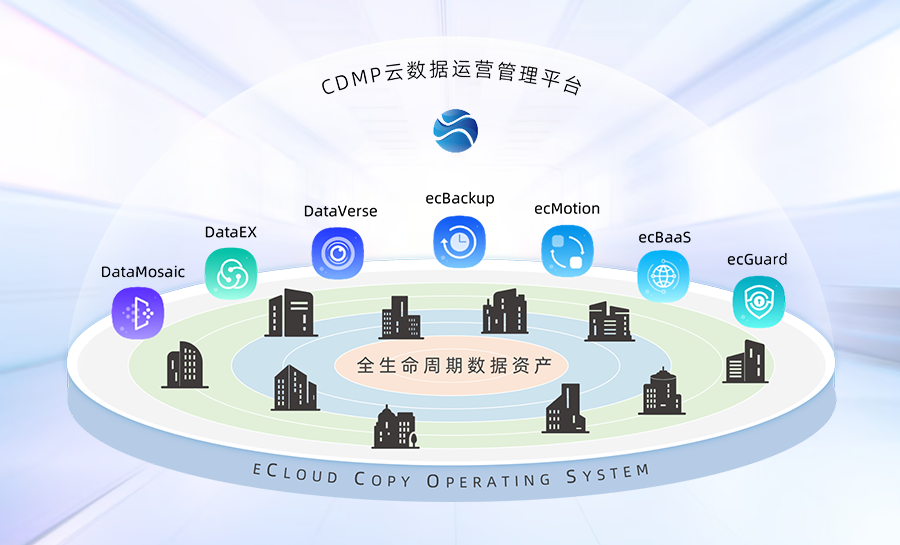
Second, CloudXinda leverages CDM virtual copies to activate compliant data from backup centralized procurement, meeting agile data usage, simulation testing, and other needs across various digital intelligence application scenarios, and has built the subscription-based product DataEX. Currently, this market is also showing visible growth.
Third, CloudXinda is building DataVerse, an AI data management infrastructure-level product. With the deepening of national strategies like "East Data West Computing" and AI compute construction, there is growing demand for cross-cloud, cross-domain storage-compute separation and data service capabilities. CDM can simultaneously satisfy multi-cloud, multi-site data backup and distributed data scheduling needs — it can be called the natural choice.
Today, CloudXinda is also working with top-tier customers in banking and insurance to explore mutual empowerment between CDM technology and large AI models — generative AI empowering purification of backup data; CDM empowering large AI models with instantly retrievable, high-quality data.
In the long term, we hope to help enterprises shift from "data backup" to mining the value of "backup data." Data backup has traditionally been seen as a technical service method for IT departments; backup data, however, belongs to the domain of asset management. CDM copy data management helps enterprises master their most core, most authentic, and most complete data assets — assets with the potential to become among the most valuable riches of the enterprise.
If in the digital era, lacking compliant data management methods meant the entire edifice of digitalization was a "castle in the air"; then in the AI era, data management technologies like CDM are like fuel, keeping the rocket accelerating to reach the stars.