How Can an Engineering-Minded CEO Drive Sales Results? Sales Is a Science, Not "Magic" | Ronghui To B Growth Camp

To B sales requires the courage and resolve to "dig in deep and fight the hard battles."
For B2B founders, sales is the lifeblood of growth. CEOs without deep sales management experience often pin their hopes on hiring star sales executives. But a company's sales success doesn't hinge on recruiting celebrity sellers — it depends on designing replicable success. By creating repeatable value and outcomes for customers, you generate repeatable, long-term revenue.
Recently, at the 2021 Ronghui B2B Growth Camp, Cai Yong — founder of Silicon Valley Sales Institute and China partner at Winning By Design, a global strategic sales acceleration firm — drew on over 25 years of enterprise sales and marketing experience to share with founders how to approach sales with scientific, systematic thinking, understand its essence, and master the core methodology for scalable growth.

In his talk, Cai Yong covered:
How engineering-minded CEOs can manage sales effectively; Why sales is a science, not an art; Why B2B founders need the courage and resolve to "dig in and fight methodically," obsessing over performance levers; Why sales methodology should center on customer experience and journey; Respecting the law of compounding and the power of granular management...
Below is an edited transcript of Cai Yong's remarks:
Among Chinese B2B founders, most come from technical or product backgrounds — and sales often feels like a headache. But we believe sales can be a science rather than an art.
As Winning By Design puts it: there's no special "magic" to sales. What you need is the right process, the right tools, clear skills, and a strong organizational structure.
We believe sales can be analyzed and solved through a very analytical, product-manager mindset. If you don't treat sales as a science, you can't truly achieve scalable growth.
I hope today's sharing helps elevate your overall understanding of sales and grasp its fundamental nature.
The Engineering Mindset Applied to Sales
Break Big Problems into Small Ones, Solve Them One by One
Silicon Valley Blueprint has a foundational model for scalable growth comprising eight models, one of which is the full-funnel sales model — the "bowtie funnel."
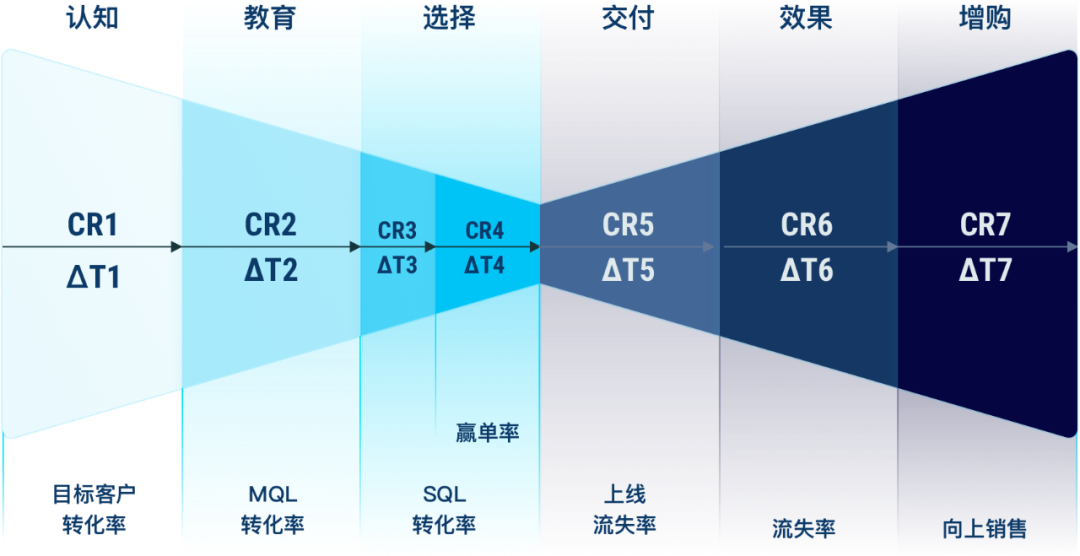
For engineering-background CEOs accustomed to systematic thinking and data-driven problem-solving, this is often exactly how they want to manage sales. The commercial process is broken down into key stages: Awareness, Education, Selection, Onboarding, Outcomes, and Expansion — each with its own conversion rate and cycle time.
So what are the benefits of such a model for engineering-minded founders?
First, it helps break big problems into small ones and tackle them individually. For example, a founder needs to solve the big problem of company revenue and wants to double performance this year. If you simply hand this big problem to your sales leader, they'll likely say they need to double headcount. But even with twice the people, revenue won't double — because sales results suffer from diminishing marginal returns as organizational scale expands. Internal resources are limited; your first sales hires consume more resources than new ones, and newcomers can't match their output.
But with the bowtie funnel, doubling revenue becomes decomposable. Is it a marketing problem? A customer acquisition problem? Are lead volumes or quality off? Are conversion rates in the sales funnel lagging? Is renewal performance weak? With these smaller problems identified, you can target each one.
Second, solving small problems requires scientific definitions, processes, and goals. Each stage has a conversion rate — numerator and denominator. That conversion rate becomes a baseline for measuring efficiency at that stage, rather than demanding immediate results. Results are composed of processes; watch the process first. And processes need definition — you must clearly know where your problems lie to solve them effectively.
Third, the new customer funnel and existing customer funnel are equally important. In the bowtie funnel, the new customer funnel and existing customer funnel are symmetrical; their value should be treated as equal. Many companies obsess over new customer acquisition, but we've found that every company that truly builds something substantial in B2B places enormous emphasis on existing customers.
Fourth, once the sales process is digitized and conversion rates across different cycles can be analyzed together, you enable much more granular management.
Following this logic, the ultimate goal is continuously improving per-capita productivity — or ensuring that even as you rapidly scale up sales hiring, productivity doesn't drop significantly.
If the entire company uses systematic thinking to define its current stage, clarifying who is upstream and downstream and how to hand off between them, and calmly tackles each small problem one by one — only then can you truly solve your big problems.
Understanding the Nature of Sales
How to Improve Win Rates? Reduce Touchpoints + Boost Stage-by-Stage Conversion
Now, what is the essence of sales? If the entire commercial process is the big "bowtie," the "sales funnel" in the middle is a smaller bowtie. To outsiders, the "sales funnel" often looks like "a cloud." The time between opportunity and closed-won deal leaves many CEOs feeling that sales can't be tracked or managed. At the start of a quarter, salespeople seem relaxed, almost leisurely. Then near quarter-end, they somehow transform into "pirates," charging out fiercely, and somehow the deals close — no one quite knows why.
So some CEOs say: since I don't understand sales, I'll hire someone who does. But if you hire the wrong person, the cost is enormous — you've wasted precious time.
So what is the essence of the "sales funnel," and how is its efficiency measured? The core metric is win rate.
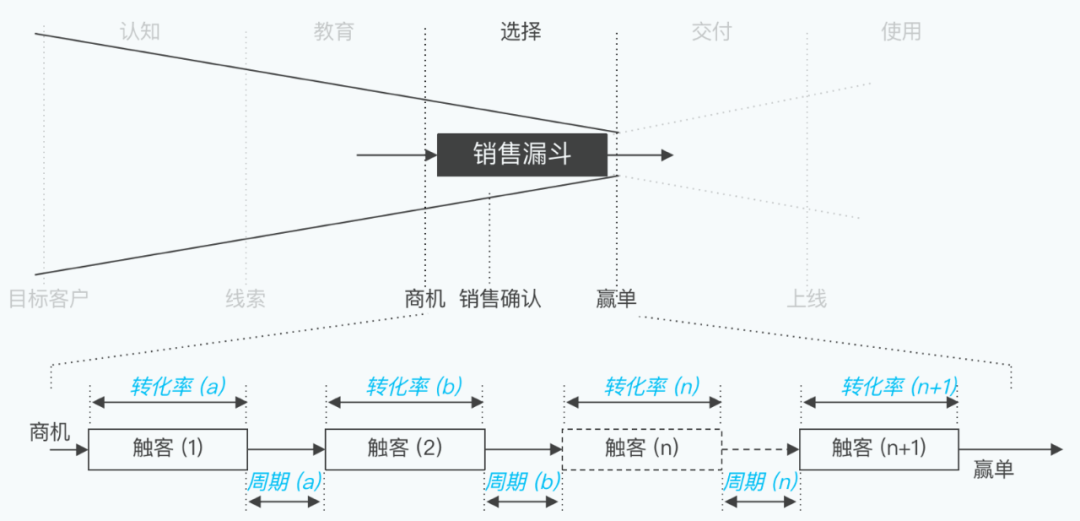
Win rate has a simple formula: Win Rate = Won Deals / Opportunities.
How is win rate calculated and improved? From opportunity to closed-won, there are multiple customer touchpoint meetings, each with its own stage conversion rate. The interval between meetings is the sales cycle. Win rate equals the product of all stage conversion rates; total sales cycle equals the sum of days between all touchpoint meetings.
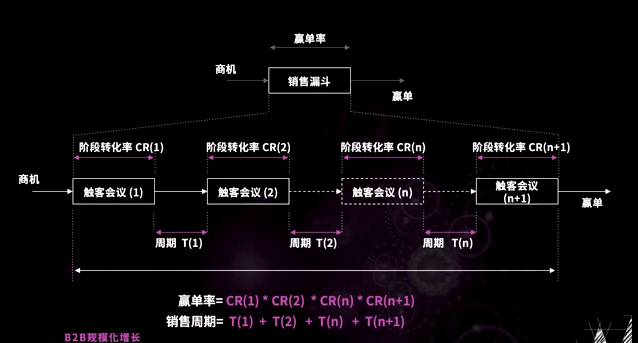
Consider a complex sale with high deal value requiring 12 touchpoint meetings per customer. Even with ~90% stage conversion at each meeting, overall conversion is 0.9 to the 12th power — 28.5%. If average stage conversion is only 80%, final win rate drops below 10%.
So how to improve win rate?
Based on the math, two approaches: first, reduce touchpoint count; second, improve stage-by-stage conversion.
Reducing Touchpoints
On one hand, we study which of multiple touchpoint meetings can shift to remote. Chinese customers are pragmatic — post-pandemic, many face-to-face sales have moved remote, and customers accept this. Critically, remote sales save time between meetings. Face-to-face sales always require scheduling around availability; two weeks easily slip by. Don't underestimate two weeks — several of those add up to a very long sales cycle.
Beyond remote, there's asynchronous selling. Traditional touchpoint meetings include discovery/demos, solution presentations, kickoffs, and other key stages. Asynchronous means skipping some steps, using content to advance the sales process. For the solution stage, you might share the solution online for customer feedback, co-creating it together — giving the customer more incentive to share and drive internally. Throughout, customers perceive the seller's professionalism, building trust and sharing more information that helps prepare for the next touchpoint.
Remote and asynchronous selling represent the most disruptive methods for accelerating buying processes over the next two years. If you reduce touchpoints from 12 to 10 through remote and async, 0.9 to the 10th power means a 34.8% win rate — above average for high-deal-value sales.
Improving Stage-by-Stage Conversion
First, it's essential to recognize that different deal values require different sales methodologies; each tier needs the right approach. This sounds simple, but many companies deviate in practice. High deal values require consultative or even challenger selling; lower deal values can use solution-selling plus consultative approaches. Challenger selling means telling customers what opportunities they're missing; consultative selling helps customers identify and solve pain points; solution selling focuses more on price and features.
We also strongly recommend that B2B sales have full-funnel playbooks or blueprints for execution. Before each touchpoint, sales must clearly know the objective and what preparation is needed. Through playbooks or blueprints, sales understands the deal path and customer decision process — how typical deals in the main business close, what decision-makers might appear after initial contact. These playbooks even include what questions to ask different key decision-makers, how to converse.
We believe sales management granularity needs to reach this level of detail. Only then can managers be confident that even peripheral team members, executing these playbooks with basic scripts and frameworks, maintain certain quality standards. When training brings salespeople's understanding and actions up to standard, stage-by-stage conversion won't be low — or will be more efficient than competitors. That means burning less cash, producing more, with shorter sales cycles, making it more likely to become category leader.
If through such granular management, average stage conversion improves from 90% to 92%, 0.92 to the 10th power yields a 43.4% win rate. So by reducing touchpoints, making small optimizations on each small problem, and improving stage-by-stage conversion, the multiplicative effect creates massive change. This is the law of compounding.
Going further: if you and a competitor start from the same line, shortening sales cycles and improving touchpoint effectiveness creates a meaningful efficiency gap — and that gap, over time, becomes your market share.
Here I'll borrow a phrase from Zeng Guofan: "dig in and fight methodically." We believe B2B company leaders or sales heads need this courage. Many lack this courage and strategic resolve, perpetually chasing new models. In reality, once a business model works, it's about replication, replication, and more replication — the business snowballs. It doesn't require much imagination; just do your own work solidly.
Obsessing Over Performance Levers
Throughout the commercial process, different critical moments correspond to performance levers. Let me share three cases. When we examine granular sales data and stage-by-stage conversion, we find certain key performance levers. If you can obsess over these and improve conversion by a few points, you amplify total performance and accelerate revenue across the full funnel.
Company A does private-domain marketing automation. Their performance lever: "getting to decision-makers on first visit after initial contact." How to improve? We helped A's sales design their initial prospect call to discuss private-domain tactics and how benchmark clients in the industry operate — demonstrating professionalism, knowledge depth and breadth. This way, the initial contact might pull in higher-level decision-makers for the first visit. Otherwise, the first visit likely meets only the sponsor, probably another wasted trip.
Company B's problem: very low conversion from first visit to second visit. Sales tended to prioritize higher-probability deals, neglecting follow-up on first-visit opportunities. When they focused on the "follow-up after first visit" lever, overall conversion improved significantly.
Company C had achieved some scale with small customers, with an overall 7% win rate, and debated allocating resources to large customers. Our advice: if they could improve small-customer sales win rate by 3 points to 10%, they'd hit 80-90% of overall revenue targets; remaining share could go to large-customer BD, where just one or two deals would achieve the overall goal.
Methodology for Scalable Growth
Understanding Foundational Models
With sales essence understood, we turn to scalable growth. Scalable growth isn't built in a day, but there are scientific paths and methods to achieve it.
One point to emphasize: in B2B, whether SaaS or traditional B2B hardware/software services, "repeatable revenue comes from repeatable outcomes and value." Because B2B isn't a one-time transaction — it's ongoing business. If you deliver sustained value to customers, you get repeatable revenue and continuous growth.
We have a "scientific sales methodology." Traditional sales methodologies focus on helping sales win deals, with little attention after; we believe sales methodology should center on customer experience and journey. Only this helps B2B companies achieve truly sustained, stable revenue — the proper path to scalable growth.
We've seen many companies where sales processes become "vendor-centric" — shaped by internal resource allocation rather than customer needs. But sales results and revenue fundamentally revolve around what customers want.
I've always said selling is "climbing up the pole" — internal sales processes should align with customer value realization, with customer procurement and decision processes, with how key decision-makers in the chain achieve their expectations, including what resources are needed to build internal consensus.
Silicon Valley Blueprint has eight foundational models for scalable growth: commercial model, growth stage model, full-funnel sales model, compounding effects model, pricing strategy model, cost model, unified communication model, and design model. Today I'll briefly introduce several core concepts.
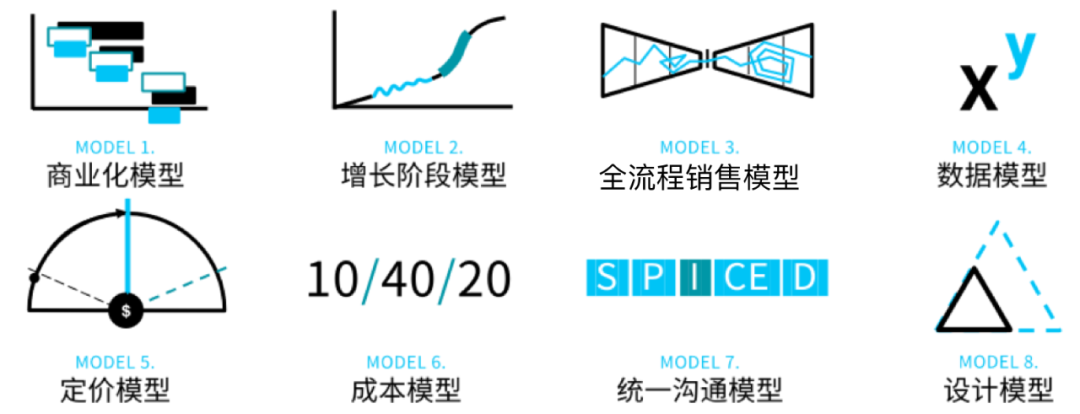
Commercial Model
The commercial model's essence: different customer types (SMB, mid-market, enterprise) receive completely different resource allocations — including customer acquisition, sales closing, customer success, etc. For example, fast, high-frequency small deals from DingTalk traffic for small/professional users versus deals over 20 million RMB require completely different resources and playbooks.
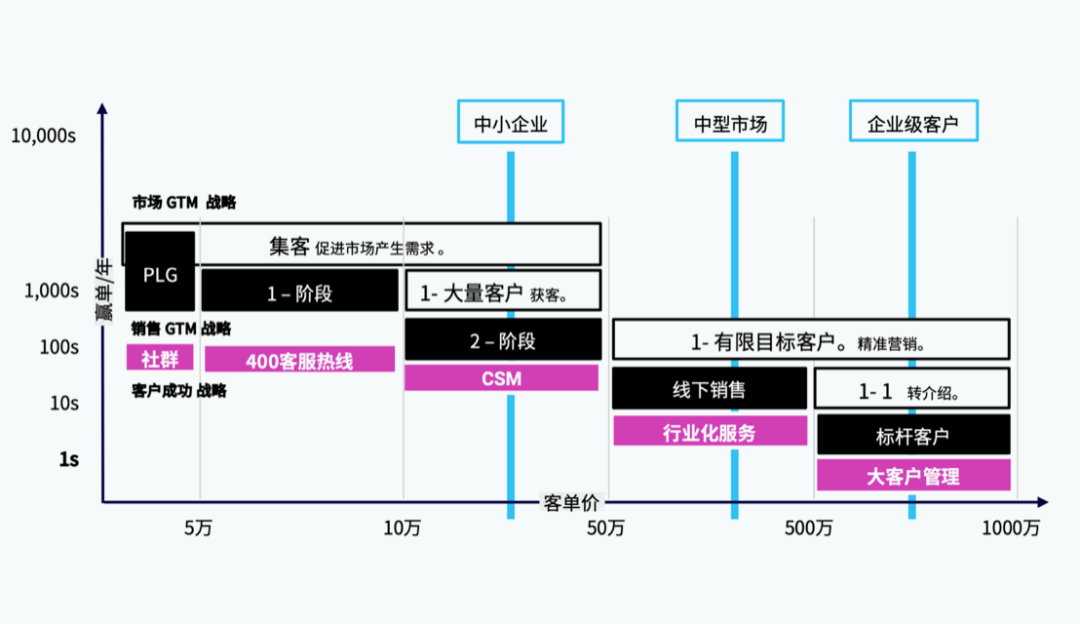
So when B2B companies want to move between deal-value tiers, it's not automatic — you can't simply apply one proven playbook to a different tier.
Growth Stage Model
Breaking down B2B company growth stages: Minimum Viable Product (MVP), Product-Market Fit (PMF), Go-To-Market Fit, Scale Up, and Defend Position.
Many B2B CEOs, after accumulating 10 or 20 customers and feeling they've validated PMF, start scaling and hire many salespeople. Around 2015, numerous SaaS companies hired aggressively, only to find revenue and cost models completely mismatched.
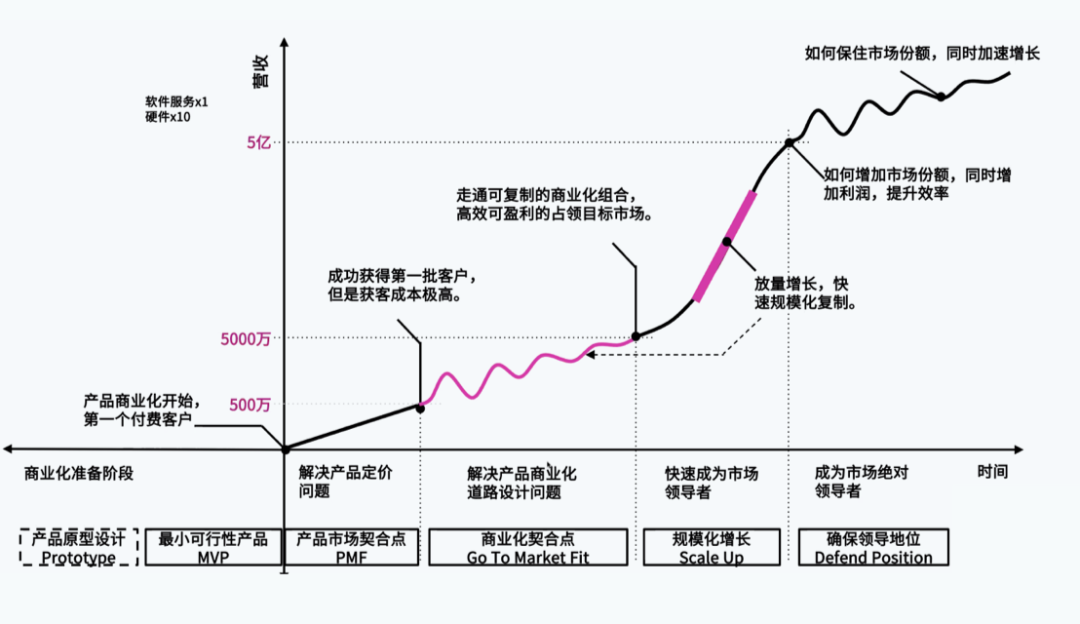
Why? They skipped Go-To-Market Fit between PMF and scaling — failing to establish a replicable commercial combination to efficiently and profitably capture target markets. This stage takes time. Not that you wait until 100% ready to scale, but you reduce risk to a predictable range before going all in.
We see Chinese B2B startups becoming more pragmatic today — not burning cash immediately after fundraising, but validating models before confidently pursuing growth. This is excellent evolution.
Full-Funnel Sales Model
The full-funnel sales model, the "bowtie funnel" discussed earlier. Beyond new and existing customer funnel symmetry, there's another symmetry: promises made at closing should align with first value delivered post-onboarding, or customers churn. This is also critical.
Compounding Effects Model
In the full commercial process, new customer conversion creates exponential effects — a growth system where tiny improvements yield massive results. Existing customers create compounding effects — a closed-loop system that repeatedly generates exponential results.
For example, well-managed existing customers with annual renewals and even seemingly small 10% expansions create powerful compounding. Continuous expansion for seven years doubles value. Thus customer success for existing customers is also a crucial growth engine.
Pricing Strategy Model
On pricing: there are many options. By ownership, there's a spectrum. Far left is full ownership; far right is no ownership. This yields hardware one-time purchase, hardware with annual maintenance contracts, multi-year/annual/quarterly/monthly software agreements, usage-based or even outcome-based consumption.
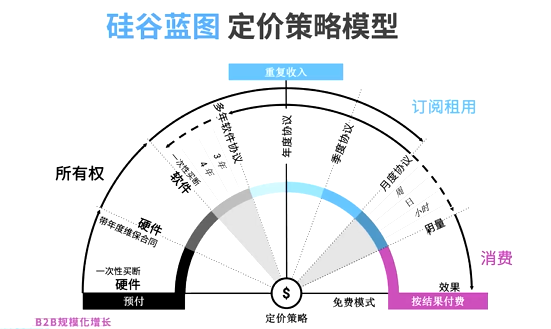
So companies with both hardware sales and usage-based models find the two incompatible — they're fundamentally different business models.
Unified Communication Model
We also recommend B2B companies develop a strategic communication model. Used for external customer communication and internally for handoffs, this alignment dramatically reduces communication costs.
Sales Organization Building
Not Hiring Star Salespeople, But Designing Replicable Success
Of course, scalable growth requires building a professional, modern sales organization.
For sales organization design, start from minimum sales units and pods, because these are replicable. An industry-focused sales pod is a natural sales organization — from lead generation to sales follow-up, closing, and customer success, all within the pod. The relationships within the pod are different; it's a complete business unit. Once a POD is established in Industry A, it can largely be replicated to Industry B.
Additionally, multi-tier commercial operations need unified design — different tiers with different resource investments, with thinking through how to connect them.
When managing sales organizations, we recommend an operations manual for each small problem, breaking it down to details, thinking through how to enable sales, thereby forming best practices. These manuals include full-funnel business operations, full-funnel sales playbooks/blueprints, marketing acquisition operations, customer success operations, and for high deal values, account-based marketing (ABM) strategy.
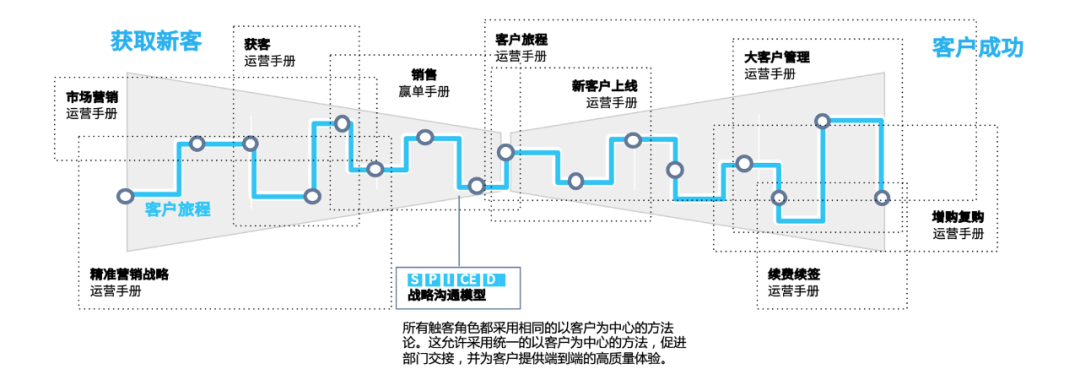
As Harvard Business School's Frank V. Cespedes and Silicon Valley Blueprint founder Jacco van der Kooij have said: the best way to achieve growth is not hiring star salespeople, but designing replicable success. Through proactive design, making best practices replicable, scalable growth is achievable and sales can be accelerated.
Everyone says B2B requires long-termism. Our understanding of B2B long-termism: find performance levers, build internal capabilities, optimize continuously; believe in the power of compounding, believe that year-after-year effort and small conversion improvements at different stages, multiplied together, produce remarkable numbers and substantial growth.



12 Global B2B Trends and 12 New Growth Models | Ronghui B2B Growth Camp
Gan Jiawei: B2B Sales Must Return to Fundamentals, Don't Rely on "Mysterious Forces" | Ronghui