A Conversation with Cornerstone Robotics' Ouyang Guowei: From Zero to Clinical in Three Years, Forging a Premium Surgical Robot's Hardcore Product Power | Gaorong Ventures

Safety and reliability are what really matter.
In the 1860s, the renowned British surgeon Joseph Lister pioneered antiseptic surgery, transforming the operating room from a "gamble with death" into a field of medical science. Over the century that followed, modern medicine advanced through generations of dedicated practitioners, each building upon the work of their predecessors to conquer disease.
By the late 20th century, the convergence of hard tech — robotics, AI — with medicine brought together engineers who could "turn stone to gold" and clinicians with "dexterous hands and discerning minds," giving birth to surgical robots. On the operating table, robots extended the surgeon's hands and eyes, accelerating surgery's entry into an era of intelligence and minimally invasive procedures.
In recent years, laparoscopic surgical robots, exemplified by Intuitive Surgical's da Vinci system, have matured and gained widespread clinical adoption. According to Frost & Sullivan, the global laparoscopic surgical robot market exceeded $5.25 billion in 2020 and is projected to reach $15.59 billion by 2025. In China, where penetration remains low, growth potential is substantial — the market is expected to expand from roughly $320 million in 2020 to $1.9 billion by 2025, a compound annual growth rate of 42.8%.
Against this backdrop of Chinese medical device innovation, domestic surgical robot companies have emerged. Among them, Cornerstone Robotics, founded in 2019, stands as a formidable new entrant. Its founder, Professor Dennis Lo, a world-leading expert who once led the development of multiple generations of the da Vinci surgical robot, aims to develop safe, efficient surgical robot platforms that benefit more doctors and patients while injecting Chinese surgical robot capabilities into the global market.
Within three years of its founding, the company's first-generation laparoscopic surgical robot system has entered human clinical trials and will seek medical device certification globally. This June, Cornerstone Robotics was featured as an outstanding Greater Bay Area innovator in celebrations marking the 25th anniversary of Hong Kong's return to China, earning coverage on CCTV News.
Gaorong Ventures co-led Cornerstone Robotics' angel round in 2019 and has continued to participate in subsequent funding rounds. To date, Cornerstone Robotics has raised nearly one billion RMB in total financing. Recently, we spoke with Professor Lo. Just as the medical luminaries remembered by history combined rational rigor with humanitarian commitment, developing surgical robots demands simultaneous attention to engineering challenges and clinical needs.
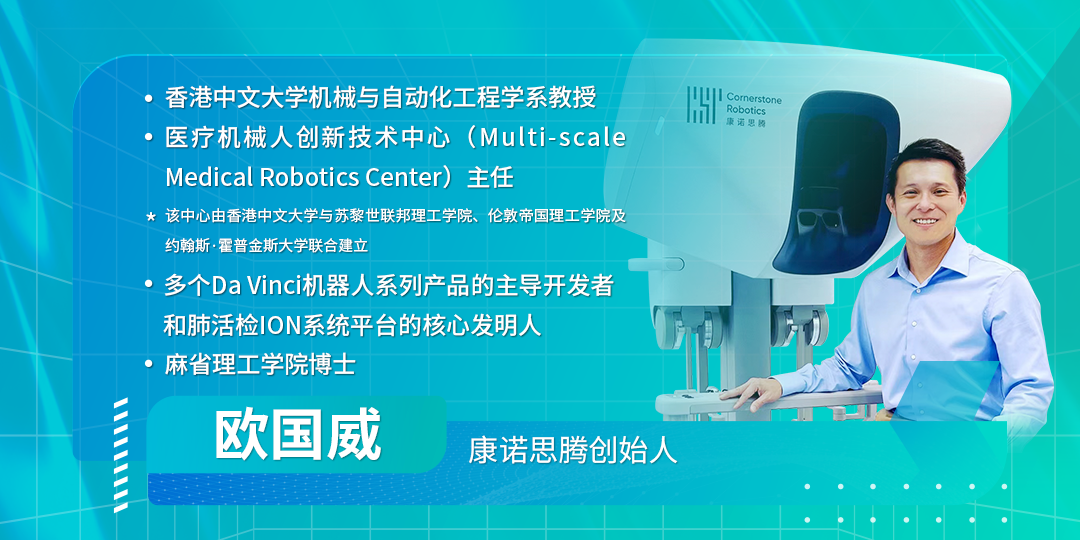

"For the past 20 years, I've been working on medical robotics research," Lo recalls. During his doctoral studies at MIT, he began developing robotic ankle prostheses that would allow below-knee amputees to walk with natural gait. After completing his PhD, he joined Intuitive Surgical, where he led the development of the da Vinci Single-Site (Si, Xi) single-port surgical robot platform and the ION lung biopsy robot platform. "These products all received FDA approval and have been widely used in clinical practice."
In 2016, after eight years at Intuitive Surgical, Lo returned to his alma mater, The Chinese University of Hong Kong, to teach and serve as director of the Centre for Innovative Medical Technology.
"In recent years, we've seen the government roll out supportive policies for medical robotics and innovative medical devices, and we've been fortunate to witness growing industry talent converging in the Greater Bay Area." In 2019, with favorable timing, geography, and people in alignment, Lo founded Cornerstone Robotics. "I wanted to draw on my years of industry experience to develop domestic surgical robots that address the limitations of traditional clinical surgery and contribute to the medical industry."
Based on his understanding of technology and market dynamics, Lo is highly optimistic about surgical robots' future potential, as they deliver tangible benefits to both doctors and patients. On one hand, surgical robots enhance the dimensionality and intensity of a surgeon's work. "By dimensionality, I mean surgical robots can extend the angles of human hands — robotic arms can maneuver smoothly and flexibly in very small spaces, even more nimbly than human hands themselves, enabling doctors to perform more complex, demanding procedures within the abdominal cavity. For intensity, surgical robots help overcome hand tremors caused by age or fatigue, and provide clearer, wide-angle vision that allows doctors to fully leverage their experience and better treat patients." Additionally, advanced surgical robots feature more streamlined preoperative setup, helping nurses and assistants accelerate surgical workflow.
On the other hand, for patients, more precise surgical manipulation means reduced tissue damage and lower infection risk. Lo notes that numerous reports have shown robot-assisted surgeries result in less intraoperative bleeding, shorter recovery times, and fewer postoperative complications.
Yet as the "culmination" of medical engineering technology, surgical robots impose extraordinarily high demands on a development team's technical caliber and comprehensive capabilities. Lo identifies several major sources of R&D difficulty: "First, algorithmic complexity — achieving fully self-developed, safe systems is no easy feat. Second, surgical instruments must be sufficiently small, flexible, and reliable, requiring extensive experience in their design and production. Third is motor control — without refined motor design and control, you cannot create robotic hands that meet surgical usability requirements. Software architecture design is equally critical, needing to support system integration and human-machine interaction. Then there are control challenges, such as how robotic arms decelerate and stop, and how to coordinate multiple complex robotic hands simultaneously."
Beyond these core technical hurdles, Lo emphasizes that "the hardest part of developing surgical robots is translating clinical medical needs into engineering requirements. Many people in surgical robot R&D come from engineering backgrounds and don't fully understand medical or surgical needs, so what they build may end up little different from industrial robots, potentially increasing surgical risk. This requires teams to constantly focus on clinical needs and their translation."

"Safety" was the keyword Lo returned to most frequently in our conversation. "As we often say, 'human lives hang in the balance.' Surgical robots are indeed bottleneck technology, but this bottleneck differs from chips or materials — surgical robots are life-critical products, and safety and reliability must come first."
Over three-plus years of development, Lo has identified several key priorities for ensuring sufficient product reliability. From the start, Cornerstone Robotics insisted on in-house development of core components. The team has fully mastered and achieved independent R&D of mechanical architecture, power modules, electrical architecture, software architecture, complex algorithms, and visual imaging control — thoroughly conquering core technologies in critical domains and achieving complete self-developed systems.
Second, "you need tremendous patience, continuously testing in clinical settings, gathering data, and iteratively improving the product." After prototyping, surgical robots require extensive clinical testing. Lo recalls the team's experience developing the robot's master controller: initially, control was imperfect. The team continuously sought different surgeons for testing while iterating mechanical designs roughly every two weeks, ultimately developing a master controller that surgeons found most fluid and intuitive to operate — "this process took nearly a year in total."
As Lo puts it, "If a technology can be fully resolved through mathematical modeling, it's relatively straightforward — we have many excellent algorithmic talents on our team. But when we face clinical problems, along with ergonomic and user experience challenges, we must answer them through experimentation, and that takes considerable time."
Third, because surgical robots involve such complex technology and R&D processes, teams must conduct very clear workflow analysis to identify where real problems originate — this depends on rich experience to pinpoint core issues within complex systems. "Is it unclear clinical requirements? Incorrect component design? Or flawed algorithms?"
Finally, during development Cornerstone Robotics has built its own underlying technology platform, enabling not just a first-generation product but future pipeline products combining core components to cover more major surgical specialties.

In 2022, Cornerstone Robotics' first-generation multi-port laparoscopic surgical robot entered human clinical trials. Lo explains that while multi-port laparoscopic surgical robots have the highest requirements and greatest development difficulty, they address the broadest range of surgical scenarios and can deliver the greatest benefits to patients — hence the decision to start there.

Multi-port laparoscopic surgical robots can be applied in urology, gynecology, general surgery, thoracic surgery, and other departments for procedures involving the prostate, kidneys, uterus, gastrointestinal tract, liver and gallbladder, lungs, ears/nose/throat, and even heart surgery. These operations are often complex and precise, requiring highly experienced surgeons.
To date, Cornerstone Robotics' surgical robot has completed over 30 clinical human trial surgeries, including radical prostatectomy, colectomy, hiatal hernia repair with fundoplication, and others — "all proceeded smoothly, with colectomy completed within one hour." Based on feedback from clinical physicians, Cornerstone Robotics' surgical robot offers fluid operation, clear vision, precise control, and convenient setup — performance fully comparable to foreign surgical robots.
In September 2022, a team led by Professor Simon Ng, professor of surgery at The Chinese University of Hong Kong and director of the Ho Shiu Wai Urology Centre, successfully performed a complex radical prostatectomy using Cornerstone Robotics' system. Professor Ng assessed: "I believe Cornerstone Robotics' robot is comparable to imported robots in operation, fluidity, and safety, with improvements at key safety technical nodes that provide greater patient safety assurance."
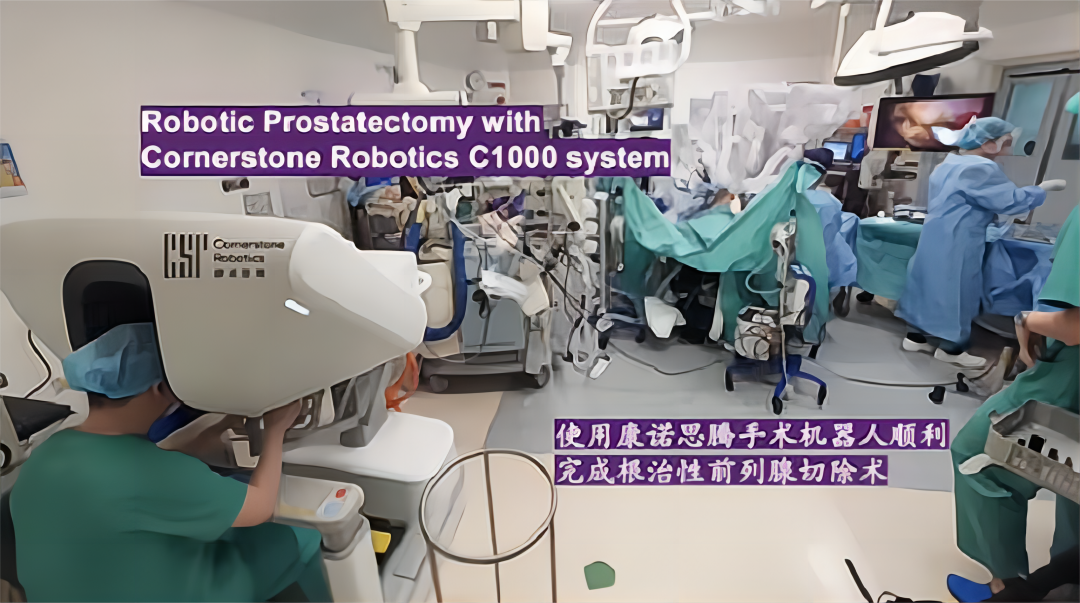
Lo adds, "To date, our surgical robot has not experienced a single incident or mistake. During clinical testing, our engineers don't participate in surgery — it's entirely controlled by doctors and nurses. That Cornerstone Robotics' surgical robot can handle different types of surgeries, including complex, high-difficulty procedures, shows that our first-generation product has passed its exam well."
Furthermore, Cornerstone Robotics' robot offers advantages including ease of use and a short learning curve, effectively addressing clinical pain points in traditional surgery such as excessive reliance on surgeon experience and inability to achieve standardized, reproducible operations. Cornerstone Robotics is also committed to helping more doctors learn to use robots. From December 18–22, 2022, Cornerstone Robotics co-hosted its first surgical robot professional skills training program with The University of Hong Kong-Shenzhen Hospital, targeting healthcare professionals across the Greater Bay Area and training over 30 medical staff from general surgery, gynecology, urology, pediatric surgery, thoracic surgery, and other departments on multi-port laparoscopic surgical robot operation.
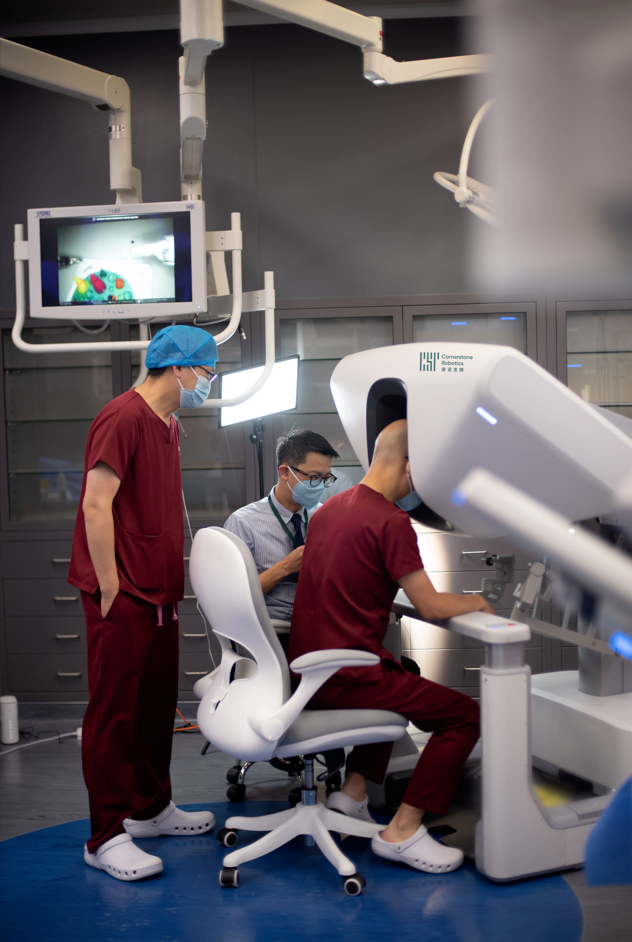

Compared to other surgical robot companies, Cornerstone Robotics' achievement of independently developing robot products from scratch and advancing to human clinical trials within three years of founding, while establishing multiple R&D centers and production lines, represents globally leading speed. What experiences and insights underlie this?
Lo first points out, "Finding the right people in different domains and building a strong team is the most critical factor." Cornerstone Robotics' talent spans mechanical engineering, electrical engineering, software, control, algorithms, imaging, and other disciplines, with core team members possessing extensive experience in medical robotics scientific research, technology development, clinical translation, and industrialization.
Among them, founders and leaders must serve as bridges, facilitating better communication between engineering and clinical teams. "In my role, I help the engineering team understand what surgery entails and how each step operates; during clinical testing, I analyze clinical needs for the engineering team. Moreover, each surgical robot has tens of thousands of components, so you must approach problems with systems thinking. We break down complex systems into smaller subsystems, clearly articulating the clinical requirements and risks for each, enabling the engineering team to more purposefully develop corresponding engineering solutions."
Furthermore, Cornerstone Robotics' vision is to become a global innovative surgical robot company, accelerating surgical robot普及 so that more patients in China and abroad can access advanced medical devices. "From the start, we established a global organizational footprint — we have already completed global strategic deployment across Hong Kong, Shenzhen, Beijing, and the United States. This allows us to gather top talent in different regions, and these R&D centers will help us promote products in different markets going forward."
Finally, laparoscopic surgical robots impose extremely high precision manufacturing requirements for production lines, so Cornerstone Robotics prioritized supply chain development from its early days. "The Greater Bay Area offers mature supporting industry chains and policy support, with abundant excellent supply chain and testing talent. Therefore in our second year, we began building a mass production factory in Shenzhen, establishing our own production line from scratch. Today, all Cornerstone Robotics instruments are produced from our own lines." Leveraging Greater Bay Area supply chain advantages, Lo explains, will not only control production costs and gain competitive advantages, but also ensure mass production quality and speed.

Regarding future surgical robot development potential, Lo expresses strong optimism: "I hope that in ten years, every surgical department in hospitals will have at least one surgical robot. Future surgical robots will be cost-effective, more compact, and easily deployed across different operating rooms. More importantly, they will be more intelligent with greater automation capabilities, simplifying surgery and enabling doctors to complete even more complex procedures."
This vision depends on multiple factors.
First, as AI, 5G, AR, VR, and other technologies advance, they can all be integrated with surgical robots.
Second, AI's critical foundation is data. As more surgeries are performed with robotic assistance, rich data combined with secure algorithms can be analyzed and quantified to make surgical robots more automated and precise, helping doctors make better judgments. Moreover, the wider-angle, high-definition vision that surgical robots provide may reveal things currently invisible to the naked eye.
Of course, all this presupposes first achieving safe, effective, cost-reasonable robots and continuously improving penetration rates. Lo believes an ideal scenario would be every hospital having surgical robots, with each machine performing four to five surgeries daily.
Regarding upcoming strategic priorities, Lo summarizes: the foremost remains continuously improving surgical robot product capability — "what matters most is that doctors genuinely want to use it and feel confident using it. My greatest fear is building a product that doctors find uncomfortable or difficult to use, and that ends up sitting unused."
Additionally, in terms of application scenarios, different surgical domains have different requirements. "We need to focus on surgical robot system and design, maximizing product adaptation to surgical application scenarios — you can't have robots that only work for one procedure and can't be used for others." In 2023, Cornerstone Robotics will accelerate development of new product pipelines to cover more major surgical specialties, increase clinical promotion efforts, boost factory production capacity, and seek medical device certification globally to serve healthcare professionals worldwide and benefit more patients.
As Lister said in his address to medical graduates: "Our profession is one of proud distinction, tasked with caring for the earthly tabernacle that houses the immortal spirit. Our path must be upright, guided by the truth that sets free and sincere love." The road of surgical robot R&D is filled with challenges, but with breakthrough technologies ahead and shared vision as guide, the long journey can be faced without fear.