Interview with RayzeBio: Two Funding Rounds in Six Months, How the Surging "Radiopharma" Sector Is Transforming Cancer Treatment | Gaorong Ventures

Accelerating on the "fast track" of TRT therapy.
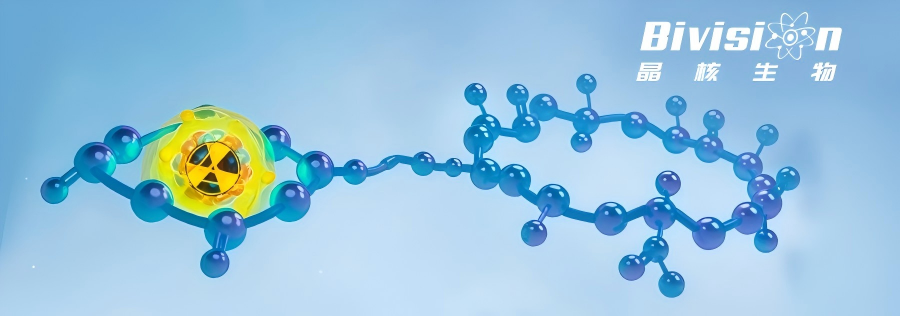
In 2024, radiopharmaceuticals were undoubtedly the "star" of new drug R&D — overseas pharma companies poured in capital, clinical development and investment activity stayed hot, and clinicians looked to nuclear medicine to bring new hope to cancer treatment.
"Radiopharmaceuticals span a very broad category, but add the word 'targeted' and the implications change entirely," said Dr. Haihua Yu, founder and CEO of CoreHT (晶核生物). Targeted radiopharmaceuticals use targeting molecules to carry high-energy radioisotopes, selectively killing and treating tumors, with the potential to become a blockbuster therapy for mid-to-late-stage cancers.
In 2021, Dr. Yu and three other seasoned drug development scientists founded CoreHT, focusing on the R&D of targeted radionuclide therapy (TRT) with integrated diagnosis and treatment.
Today, CoreHT announced the completion of its Series A+ funding round — the company's second financing in six months, following its Series A in July 2024. This round was jointly led by SANY Innovation and CICC Capital's CICC Nuosige Fund, with existing investor Gaorong Ventures continuing to add to its stake. Gaorong Ventures led CoreHT's angel round in 2022 and has consistently increased its investment in subsequent rounds.
Dr. Yu brings over 15 years of new drug R&D experience, having served as a senior scientist at GSK and head of Huayi Radiopharmaceuticals' platform, where he led and contributed to multiple diagnostic and therapeutic radiopharmaceutical programs. CTO Dr. Yu Wang has more than 20 years of US-based drug development experience, previously serving as head of radiopharmaceutical R&D at Endocyte, where he led the advancement of the Pluvicto program that sparked global TRT enthusiasm and was later acquired by Novartis for $2.1 billion.
Recently, Dr. Yu shared with us the innovative mechanisms behind TRT drugs and CoreHT's R&D journey.
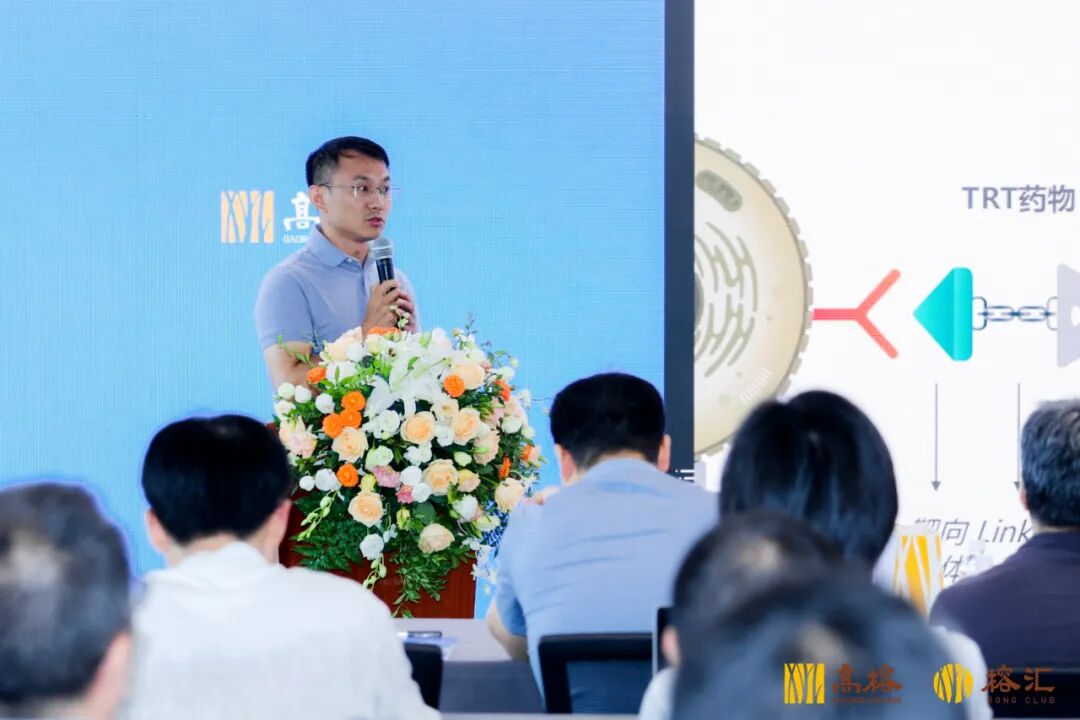
The following is Dr. Haihua Yu's account (edited):

TRT: The New Battleground?
"Seeing is believing" — targeted radiopharmaceuticals embody this principle.
Targeted radionuclide therapy (TRT) couples targeting ligands (such as peptides or small molecules) with radioisotopes, precisely delivering them to lesions where the emitted radiation energy rapidly kills diseased cells. This addresses the urgent clinical need for treating late-stage metastatic lesions in cancer patients.
Moreover, TRT enables "theranostics" — a feature of major clinical significance. Before treatment, nuclear imaging techniques can localize and assess tumors; during treatment, drug distribution and efficacy can be effectively monitored, achieving true integration of diagnosis and therapy.

Such transformative treatment has drawn major multinational pharma companies into this race. From Novartis and BMS to Eli Lilly and Company, AstraZeneca, and Johnson & Johnson, all are doubling down on innovative radiopharmaceutical R&D through acquisitions, mergers, or strategic partnerships.
The successful launch and strong performance of Novartis's two TRT drugs have electrified the industry. Pluvicto, for prostate cancer treatment, reached $1.041 billion in global sales in the first three quarters of 2024, already achieving blockbuster status.
This has accelerated the explosion of the global targeted therapeutic radiopharmaceutical market. According to MEDraysintell data, the global nuclear medicine market was approximately $7 billion in 2022, with diagnostic drugs dominating; as more therapeutic drugs reach the market, the global nuclear medicine market could reach $30 billion by 2030.

"Ultimately, It Comes Down to Clinical Value"
The massive attention on targeted radiopharmaceuticals ultimately hinges on one question: what real value can this novel therapy bring to clinical practice?
In developing nuclear medicines, two core considerations dominate — diagnosis plus treatment. When CoreHT develops TRT drugs for a given target or indication, our strategy is "one ligand, two applications."
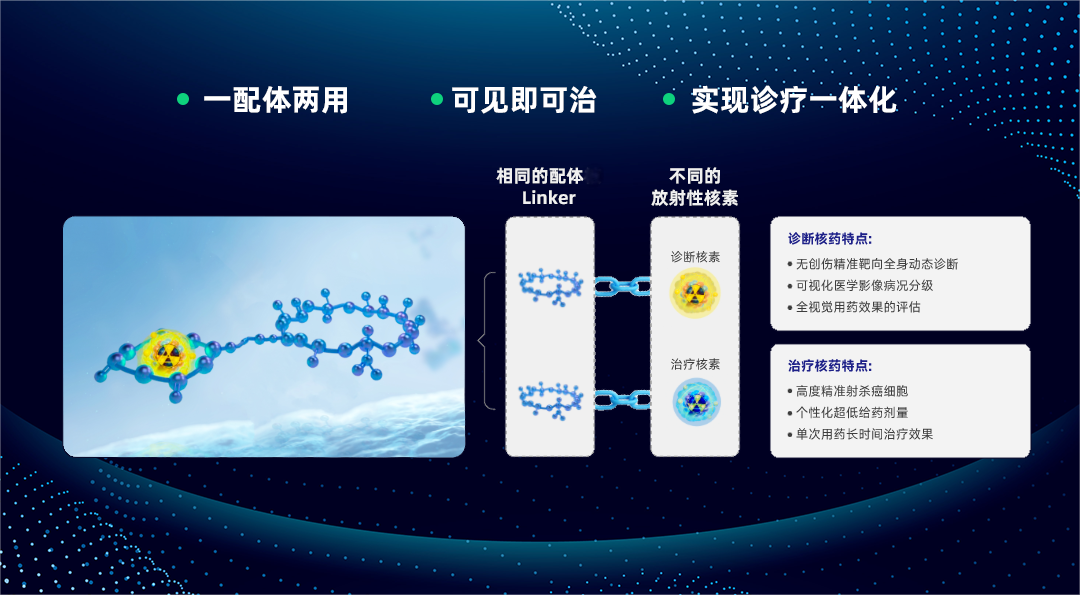
Before treatment, the ligand coupled with a diagnostic radionuclide via a linker reaches the lesion. Signals are then detected using PET-CT or SPECT and other medical devices, enabling precise diagnosis of the patient's condition — tumor stage, lesion size, metastatic spread, and more. The entire process from injection to isotope decay can be fully visualized, revealing whether the drug interacts with the tumor after entering the body, enabling fully visualized assessment of drug efficacy.
This means that when enrolling patients in TRT clinical trials, researchers can precisely determine a given patient's response to the drug — essentially achieving a one-to-one match between drug and patient. The precision of TRT drug enrollment is revolutionary.
Meanwhile, using the same ligand and linker with different radioisotopes allows switching from diagnostic to therapeutic radionuclides, which upon reaching cancer cells deliver highly precise lethal radiation, achieving targeted treatment.
Thus, TRT drugs achieve one ligand, dual purposes; see it, treat it — ultimately realizing theranostics.
Compared to existing targeted therapies, next-generation TRT offers broader target selection, clearer mechanisms of action, and other advantages. Additionally, TRT demonstrates a "crossfire" effect (destroying surrounding untargeted cancer cells), differentiated cell killing mechanisms, and low resistance potential.
Drug scientists are also exploring further possibilities for TRT. For example, some "cold" tumors unresponsive to PD-1/PD-L1 may be converted to "hot" tumors through radiopharmaceutical energy exposure, enabling immune response. Looking ahead, there is still much work to be done.

Accelerating R&D: Team and Innovative Technology Platform
Since its founding, CoreHT has rapidly built a complete radiopharmaceutical R&D chain, achieving pipeline progress from zero to IND within 18 months with multiple programs advancing quickly — thanks to the founding team's deep, complementary industry experience.
CoreHT CTO Dr. Yu Wang entered the radiopharmaceutical field in 2013, leading the Pluvicto program; Senior VP of Medicinal Chemistry Dr. Yanjun Wang was responsible for targeted radiopharmaceutical development at Progenics and Siemens Molecular Imaging; Senior VP of Biology Dr. Jinqiu He worked at Roche, GSK, and others, leading and contributing to over 30 new drug programs, bringing ADC development concepts to the radiopharmaceutical field.
Rich experience in both diagnostic and therapeutic radiopharmaceuticals, international perspective and mindset, and the vision to achieve Chinese innovation in this emerging blockbuster赛道 brought us together.
Since founding, CoreHT has also continuously selected and cultivated radiopharmaceutical talent, gradually building a tiered team from preclinical to clinical stages.
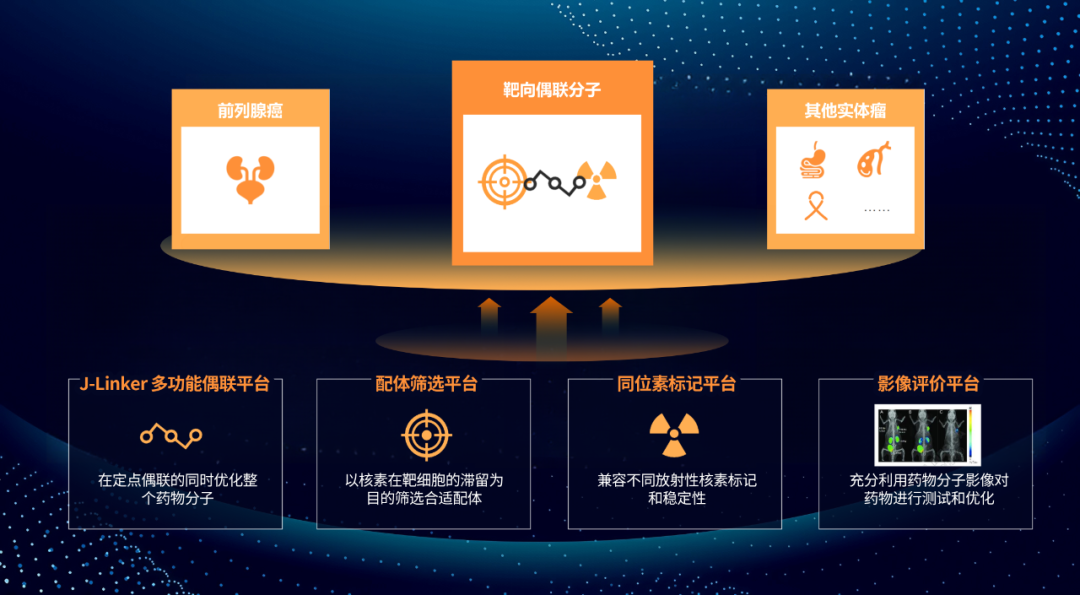
CoreHT has now established proprietary technology platforms for targeted radiopharmaceutical development, including the J-Linker multifunctional conjugation platform, ligand screening platform, isotope labeling platform, and imaging evaluation platform. Among these, the J-Linker multifunctional conjugation platform can effectively increase drug exposure at disease sites while reducing exposure in other organs, bringing better therapeutic effects and a wider safety window to CoreHT's pipeline.

Differentiated Pipeline, Rapid Entry into Clinical Trials
Leveraging these innovative platforms, CoreHT has built multiple differentiated targeted radionuclide therapy pipelines, including best-in-class and first-in-class programs. Our extensive experience has also enabled us to rapidly advance products into clinical trials, demonstrating industry-leading R&D efficiency.
CoreHT's first solid tumor pipeline, JH02, has shown in preclinical studies significant advantages over comparable foreign products, including higher safety, better therapeutic efficacy, and simpler manufacturing processes, with notable advantages in low-to-moderate expression models.
JH02 received implicit approval from the US Food and Drug Administration (FDA) in June 2023 and from the Center for Drug Evaluation (CDE) of China's National Medical Products Administration in July 2023 to conduct clinical trials for PSMA-positive prostate cancer treatment. This made CoreHT the first Chinese company to receive dual US-China approval for a TRT pipeline. Phase I registration clinical enrollment for JH02 has now been completed.
Additionally, CoreHT's multi-tumor indication theranostic molecule JH04 has completed diagnostic IIT (Investigator Initiated Trial) clinical enrollment, with therapeutic IIT ongoing and IND filing advancing rapidly.
Going forward, we will continue advancing JH02 clinical work, JH04 IND filing and clinical development, as well as preclinical and IIT studies for multiple subsequent globally innovative pipelines. The company will also continue its global expansion, including overseas clinical development and partnership opportunities for overseas rights.
Overall, radiopharmaceutical pipelines remain in early-stage development globally. We hope to continue accelerating on the "fast lane" of TRT innovation, ultimately showcasing Chinese innovative radiopharmaceuticals on the international stage.